What the 15 W wireless and 20 W USB-C figures actually mean
The BoostCharge Pro 10K packs a 10,000 mAh internal battery, described by Belkin as two 5,000 mAh cells, roughly 37 Wh of nominal energy at a typical lithium-ion cell voltage. The two headline figures, 15 W of magnetic Qi2 charging and 20 W over USB-C, are real and verifiable on the manufacturer's own spec sheet, but one condition applies throughout: they only hold for a single connected device.
Recharging the pack itself follows the same two-speed logic: up to 20 W over USB-C PD in pass-through mode (plugged into the wall while powering a device), and up to 18 W when it recharges alone with nothing else drawing power. Neither figure has been confirmed by an independent full-charge time test, a gap the spec sheet itself leaves open rather than stating a number of minutes.
Three devices at once: the promise and its real cost in watts
The case is marketed on its ability to charge up to three devices at the same time: one phone magnetically, plus two more over USB-C. Belkin publishes, with a level of detail unusual for this category, exactly what that promise costs in available power.
| Charging mode | One device only | Three devices together |
|---|---|---|
| Wireless Qi2 | 15 W | 7.5 W |
| USB-C, combined across both ports | 20 W (one port in use) | 10 W shared |
The mechanism is a common one (a charging circuit sized for a single peak load, not three simultaneous flows at once), but the drop here is particularly steep: wireless power is cut in half, and the combined USB-C total across both ports falls to half of what a single port delivers on its own. The split isn't always as gradual as this table suggests: rather than a simple power share, a second device plugged in over USB-C can, in some cases, cut off the first device's charge entirely, a more on/off behavior than the spec sheet implies, and one that seems to depend on the cable or device involved rather than happening every time.
How many Wh the pack actually delivers
Belkin advertises roughly 35 extra hours of video playback and enough to charge an iPhone 15 fully once plus about half of a second charge, but publishes no figure for actual Wh delivered. Magnetic Qi2 power banks of comparable capacity (10,000 mAh) typically show a wireless discharge efficiency of around 70 to 76% of nominal energy, since magnetic conversion consumes a share of energy that a direct wired output doesn't lose.
Applying that efficiency to the 37 Wh nominal figure puts usable energy at around 27 Wh. That number remains a calculated estimate, not a wattmeter reading of this specific unit, but it lines up with the manufacturer's own claim: 27 Wh out, once the phone's own charging-circuit losses are factored in too, works out fairly closely to one full iPhone 15 charge plus roughly half of a second charge, the same order of magnitude Belkin puts forward itself.
Frequent warmth on extended wireless charging
Extended wireless charging makes the case noticeably warm, a point that comes up across several markets and ranks among the most frequently mentioned about this product, alongside the magnetic hold and battery life. The most pronounced case involves pass-through mode: the pack plugged into the wall while wirelessly charging a phone resting on it, with both energy flows (recharging the pack and wirelessly charging the phone) adding up inside the same case.
In some cases, this warmth triggers a charging cutoff before the phone reaches 100%, the thermal protection cutting power rather than letting the temperature keep climbing. That's the expected behavior of a protection system doing its job, not a failure in itself, but the practical result is still an incomplete charge and a case that takes a while to cool down. The simplest practical rule is to unplug the pack from the wall once charging is done rather than leaving it in pass-through mode continuously.
The built-in kickstand: sturdy, but not exclusive
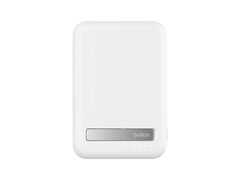
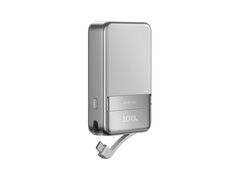
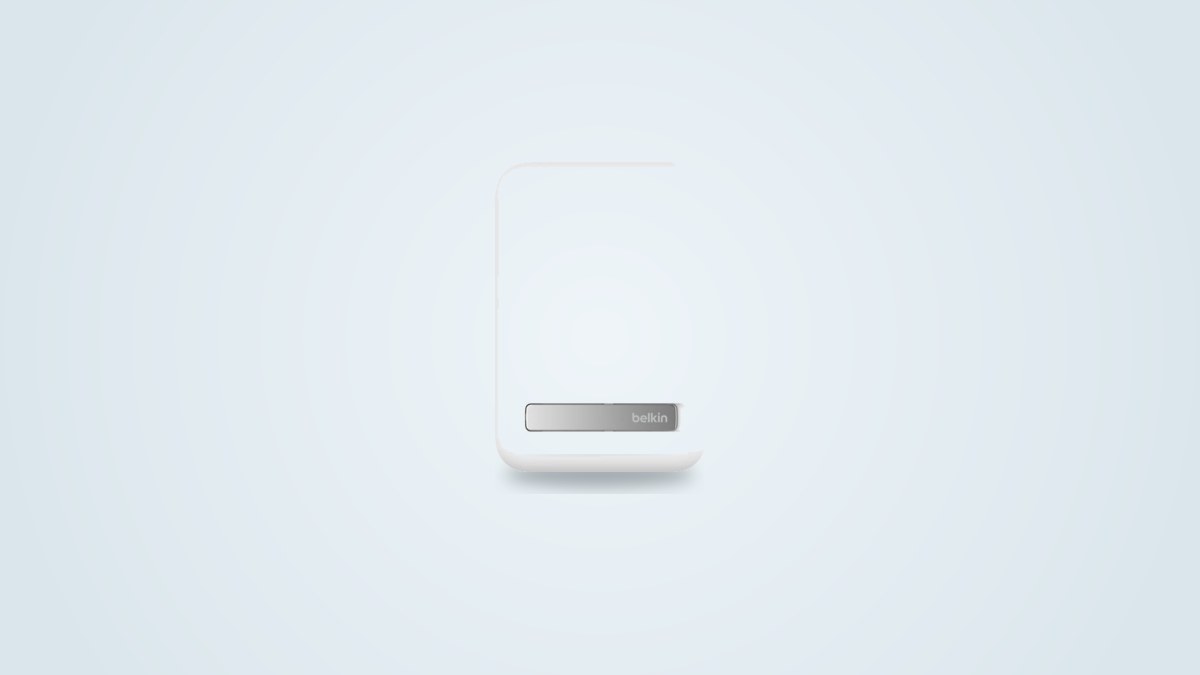
The small foldable metal leg that props the phone up horizontally or vertically while it charges ranks among the best-regarded traits of the product: its mechanical hold is particularly sturdy, with no wobble or apparent fragility after repeated folding. The case doesn't cover the iPhone's camera module, even on Pro models with the largest lens bumps.
This site's own product page for this item describes the kickstand as unique in its category. That isn't accurate: a direct 10,000 mAh magnetic rival, compared further below in this review, also has a built-in kickstand. The BoostCharge Pro 10K's real edge isn't the exclusivity of the idea, but the perceived quality of its mechanical execution.
Against the direct competition: MagFlow, MagGo and Zolo Magnetic
On the specific segment of 10,000 mAh magnetic Qi2 power banks, three direct rivals help place the BoostCharge Pro 10K.
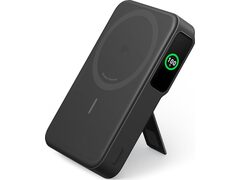
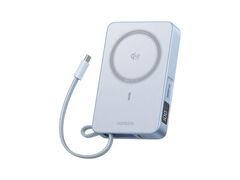
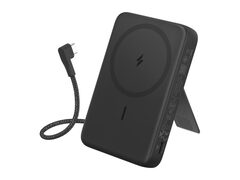
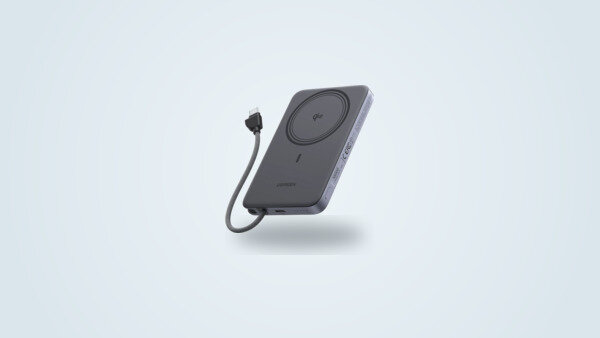
| Criterion | Belkin BoostCharge Pro 10K | Anker MagGo (10K) | Ugreen MagFlow 10000mAh | Anker Zolo Magnetic 10,000 |
|---|---|---|---|---|
| Wireless Qi2 | 15 W | 15 W | 25 W | 7.5 W |
| USB-C, one device | 20 W | 27 W | 30 W (built-in cable) | 30 W (built-in cable) |
| Screen | No (4 LEDs) | Yes, LCD | Yes, digital | No |
| Built-in kickstand | Yes | Yes | No | Yes, adjustable |
| Weight | 7.7 oz (218 g) | 8.8 oz (250 g) | not disclosed | 8.5 oz (240 g) |
The BoostCharge Pro 10K sits between two opposing approaches. The Ugreen MagFlow pushes wireless speed to the maximum (25 W) at the cost of lower total energy delivered than its rivals; the Anker Zolo Magnetic flips that trade-off, with very slow wireless charging (7.5 W) but one of the best real-world phone-charge counts in its category. The Belkin doesn't try to lead on either axis: it aims for a middle-ground speed, and stands out mainly on weight, the lightest of the four at equal capacity. The Anker MagGo remains the most fully equipped in absolute terms, with a screen and 27 W over USB-C, but at the cost of a heavier case.
Build quality, warranty, and a recall that doesn't apply here
Belkin backs the BoostCharge Pro 10K with a 2-year limited warranty, plus coverage for connected devices in the event of electrical damage during charging, a level of coverage uncommon at this price point. The case is made from at least 72% post-consumer recycled plastic, in plastic-free packaging.
One point is worth clarifying explicitly: in late 2024, Belkin issued a CPSC recall for a magnetic smartwatch charging puck, after a fire risk tied to overheating affected roughly 4,000 units sold between May 2023 and June 2024. That recall covers a different reference (BPD005, a watch charger), not this 10,000 mAh phone power bank (BPD008). The two products share a brand and part of a lineup, but not the specific model covered by the recall.
Compatibility that reaches beyond the iPhone
Unlike a proprietary MagSafe charger, the BoostCharge Pro 10K is built on the open Qi2 standard, which widens its magnetic compatibility beyond the Apple ecosystem alone. Every MagSafe-compatible iPhone (12 and later) gets automatic alignment and the full 15 W, but Belkin also lists compatibility with the Google Pixel 10 (Pro, Pro XL and Pro Fold variants) and the Samsung Galaxy Z Flip8 and Fold8, the first Android phones to natively include a Qi2 magnetic ring. AirPods with a wireless charging case can also charge on the magnetic face.
For an Android phone without a native magnetic ring or a compatible case, the USB-C port remains the only reliable charging path; the magnetic attachment itself may work with a generic magnetic case, but without any guarantee of optimal coil alignment.
A successor already on sale: is it worth waiting for the UltraCharge Pro?
A successor line, the UltraCharge Pro, is already sold by Belkin alongside the BoostCharge Pro, with a 10,000 mAh magnetic variant with a kickstand aimed at the same use case. Its observed price runs noticeably higher than the BoostCharge Pro 10K's, which suggests the latter could eventually be phased out rather than simply supplemented.
For now, the two lines coexist on the market, and nothing points to an imminent discontinuation of the BoostCharge Pro 10K, nor to a flaw that would make it a poor choice against its potential replacement. The price gap remains today's most concrete deciding factor between the two generations, more than their advertised specs.
Who it suits, and who it doesn't
It suits anyone charging a single iPhone (or a Qi2-compatible Android) at a time who wants the lightest build in its class, with a sturdy kickstand for watching a video or joining a call while it charges. The 2-year warranty and connected-device coverage are reassuring over the long run, and no safety issue applies to this specific model.
It suits less anyone planning to regularly charge three devices at once, since power then drops sharply on every output, anyone wanting a precise charge-level readout rather than four rough LEDs, or anyone running long wireless sessions in pass-through mode, since heat is the product's most sensitive point.