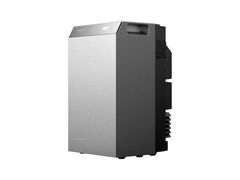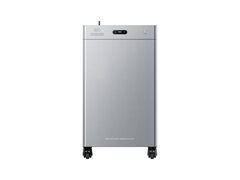
A built-in inverter that genuinely changes the equation
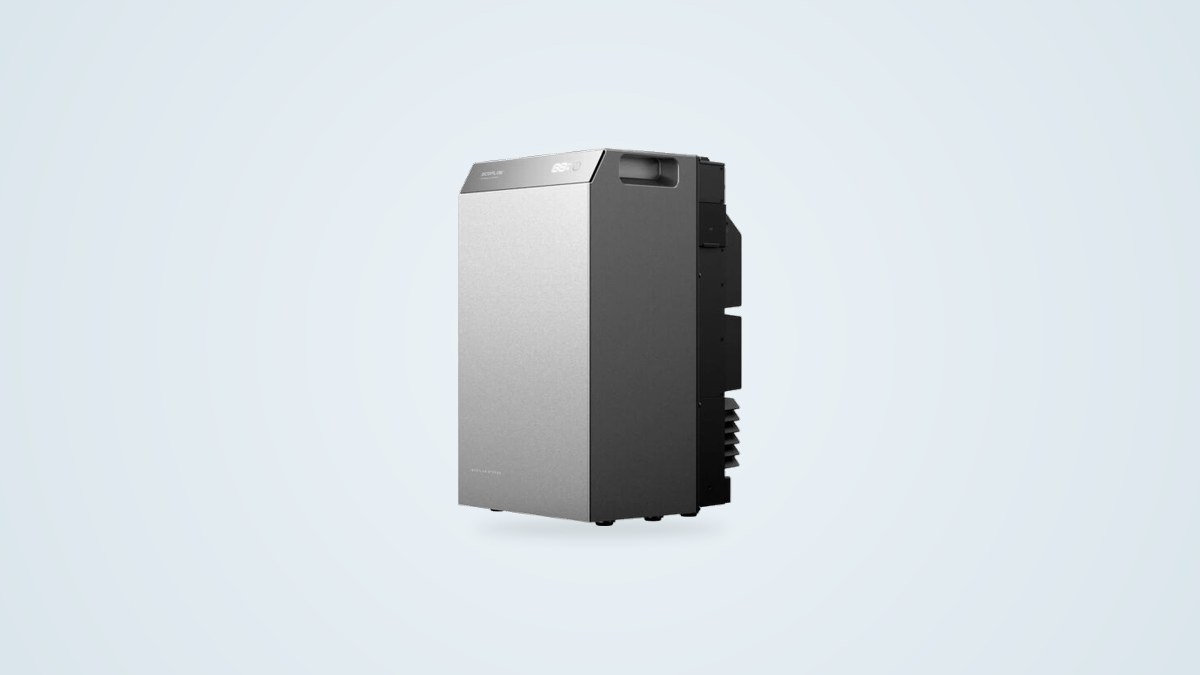
The Stream 5000 sets itself apart from most home batteries through an architecture choice that is simple to state but rare at this price point: a 3,000 W bidirectional inverter built straight into the battery. In practice, the unit needs no existing solar inverter to work at all: it handles converting solar current into usable power, storing it in its LFP cells, and feeding it back to the house or the grid, all by itself.
Its own sibling, the Stream AC 5000, shares the exact same 5,024 Wh capacity but merely stores energy already produced by an existing solar inverter; without that existing kit, it does nothing. For a household with no solar installation at all, that difference changes the whole starting point of the project, since there is no separate inverter to fit before storage can even be considered. It also explains the price gap between the two units at equal capacity in the UK, where both are actually sold: the built-in-inverter model is priced higher of the two at launch.
5,024 Wh claimed: a precise capacity, an efficiency still unverified
The Stream 5000's base capacity is set at 5,024 Wh of LFP (LiFePO4) cells, a precise, unrounded figure that is more likely to reflect the cells' actual capacity than a rounded marketing number. EcoFlow rates it for 10,000 charge cycles and backs it with a 10-year warranty, two figures in line with the best current LFP standards. LFP chemistry is generally recognized for better thermal stability than older NMC chemistries, a relevant safety point for a battery meant to stay permanently wired in a garage or next to a meter. On size, the unit weighs 100.1 lb (45.4 kg) for dimensions of roughly 11.6 x 19.3 x 11.7 in (295 x 489 x 298 mm); EcoFlow claims a footprint around 40% smaller than a comparable wall-mounted 5 kWh unit, a marketing figure that has not been independently verified but is plausible given the unit's compact shape.
What remains open is the real efficiency: how much of that claimed 5,024 Wh actually ends up available at the outlet once the inverter's own conversion losses are accounted for. The Stream 5000 has only just launched, and no independent lab has yet published a measured delivered-capacity figure or an efficiency curve at different load levels for this specific model. Recent LFP battery-and-inverter combinations typically post a round-trip efficiency around 90%, but that is a category average, not a measurement of this unit: there is no way yet to say whether the Stream 5000 sits above or below it.
"Plug-in" branding versus what grid rules actually require
The "Stream" name covers two very different things: small solar kits that plug straight into a wall outlet, capped at 800 W, and, since August 2026, far more powerful home batteries like this Stream 5000. That shared naming invites confusion on a point that actually matters: unlike the small plug-in kits, the Stream 5000 remains a 3,000 W system that needs to be wired in by a licensed electrician, with a formal interconnection application filed with the utility.
In the UK, the first market where the unit can genuinely be bought, that installation falls under the G98 notification route for the base unit, and the longer G99 route, which involves a prior assessment by the network operator, once several units are networked beyond the first route's threshold. Reported UK installation costs typically run £250 to £450, on top of the unit's own price. A comparable system installed in the US would similarly need a licensed electrician and a utility interconnection agreement for any grid-tied use beyond a simple standalone outlet, though the exact process and cost vary by state and utility, and EcoFlow has not announced a US launch for the Stream 5000 to test that process against. This is not a design flaw: it is a direct consequence of the power involved, one no manufacturer can sidestep through marketing alone.
Grid export: 800 W by default, 3,000 W once registered
A second ceiling, separate from the unit's own power rating, is worth knowing: grid export. In the UK market, by default, without formal sign-off of the installation by the network operator, real export stays capped at 800 W, exactly the familiar ceiling for plug-in solar kits. Reaching the full 3,000 W quoted on the spec sheet requires the installation to first be registered under the notification route mentioned above.
That default 800 W ceiling is not a technical limit of the Stream 5000's own inverter, which is genuinely built to deliver 3,000 W: it is a regulatory limit, the same kind that applies to any system exporting power without prior utility sign-off, in the UK, in the US, or anywhere else. A buyer comparing spec sheets alone could reasonably expect far more instantly usable power than what is actually available until the installation has been formally upgraded.
From 5 to 90 kWh: the expansion path, and its Gateway box
The Stream 5000's expansion path is one of its strongest points on paper. A single tower accepts up to two extra expansion batteries to reach 15 kWh, a straightforward stack with no extra hardware. Beyond that, scaling up changes in nature: networking several towers together requires adding a STREAM Gateway, a separate networking box that coordinates up to three main units for a total of 45 kWh; two Gateways then need linking together through the app to reach the advertised ceiling of 90 kWh across six main units.
That detail is not made prominent in the launch messaging, which leads with the single headline figure of 90 kWh. The Gateway is a separate accessory with its own cost, one a buyer planning to install a single tower will never need, but one that becomes necessary the moment a second main unit joins the system. It is a useful nuance to know before budgeting around the headline ceiling alone, wherever this product eventually becomes available.
| Tier | Capacity | Hardware required |
|---|---|---|
| Single unit | 5,024 Wh | None |
| One full tower | 15 kWh | 2 expansion batteries |
| Three networked towers | 45 kWh | 1 STREAM Gateway |
| Six networked towers | 90 kWh | 2 STREAM Gateways linked via the app |
Backup (UPS) mode: the near-instant switchover, and its real reach
Backup (UPS) mode is billed as one of the Stream 5000's headline features: during a power outage, the switchover is claimed to be near-instant (0 ms claimed by the manufacturer), avoiding a restart of sensitive devices such as a home router. No independent instrument has measured that switchover delay to date, so it is best treated as a manufacturer's claim rather than an established fact.
One architectural point is worth spelling out: by default, backup power runs through the single AC outlet on the unit itself. For the switchover to genuinely protect several rooms or circuits in the house rather than just whatever is plugged straight into the unit, it needs to be wired upstream into the electrical panel, which brings back the professional installation discussed above. A buyer picturing simply placing the Stream 5000 in a corner and having the whole house covered from the very first outage risks being disappointed: without that wiring, only the unit's own outlet stays live.
Charging: generous power on paper, a timing still uncertain
On paper, the Stream 5000's charging power looks generous: up to 3,000 W from the mains and up to 5,000 W from solar. According to the published specifications, combined charging power (mains and solar together) is nonetheless capped at 4,000 W at the battery itself, rather than the raw sum of both inputs. On pure arithmetic, filling the base 5,024 Wh would therefore theoretically take about 1 hour 40 minutes from the mains alone at full power, or about 1 hour 15 minutes combining mains and solar up to that 4,000 W ceiling; that math ignores the inverter's real conversion losses, never independently measured on this unit to date.
That caution is reinforced by the catalogue's track record with this same very-high-capacity family: on the Delta Pro Ultra, a unit in the same sub-category from the same manufacturer, a charge time advertised at 60 minutes turned out closer to 1 hour 45 minutes to 2 hours in real full-power use. Nothing suggests the Stream 5000 will repeat that gap, but nothing rules it out either, as long as no independent measurement exists.
Ports and control: a single AC outlet on the unit itself
On control, the Stream 5000 ticks the expected boxes for a unit of this generation: a mobile app over WiFi and Bluetooth, an onboard LCD screen, and, notably, a local mode that keeps managing the system even without an internet connection, a meaningful point for a device meant to provide backup power exactly when the grid, and often the home network, is down.
Physical output connectivity is more limited than the "very high capacity" class might suggest: a single AC outlet sits on the unit itself. Powering several circuits or several mains devices at once, beyond plugging in a simple power strip, again means routing through a professional connection to the electrical panel. On the solar side, the 4 independent MPPT inputs are a genuine strength, generous enough to wire several differently oriented panel strings without the efficiency loss of a single series string.
Against the Stream AC 5000 and the direct competition
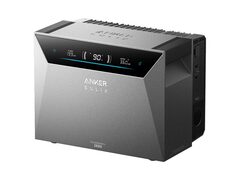
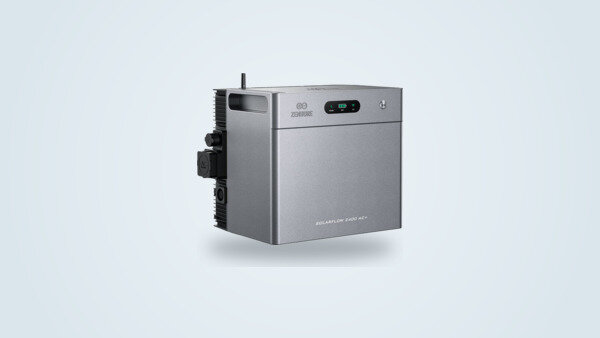
At a comparable price, the Stream 5000 faces three kinds of alternatives: its own sibling without a built-in inverter, the Stream AC 5000; the Anker Solix Solarbank 4 E5000 Pro, which shares the exact same base capacity; and the larger, pricier Zendure SolarFlow 4000 Mix AC+.
| Criterion | EcoFlow Stream 5000 | EcoFlow Stream AC 5000 | Anker Solix Solarbank 4 E5000 Pro | Zendure SolarFlow 4000 Mix AC+ |
|---|---|---|---|---|
| Base capacity | 5,024 Wh | 5,024 Wh | 5,024 Wh | 8,000 Wh |
| Built-in inverter | Yes, 3,000 W | No | Yes | Yes, 4,000 W |
| Off-grid output | 3,000 W | None standalone | 2,500 W | 3,680 W |
| Expandable up to | 90 kWh | 90 kWh | 30 kWh | 50 kWh |
Against the Anker Solix Solarbank 4 E5000 Pro, the contest is mostly about expandability: the Stream 5000's 90 kWh ceiling triples its direct rival's, a strong argument for a household planning to grow its system over several years. Against the Stream AC 5000, the whole difference comes down to the built-in inverter, which removes the need for an existing solar setup, at the cost of a higher price and a more involved installation. The Zendure SolarFlow 4000 Mix AC+ offers more raw capacity and output power, but at a noticeably higher price, which reserves it for more ambitious projects from the outset. None of these four units is currently sold through a US retailer.
Who the Stream 5000 suits, and who should wait
Once it does reach a given market, the Stream 5000 is aimed first at a homeowner already sold on the principle of home energy storage, who plans to bring in a professional for installation, whether for the electrical wiring or the utility interconnection paperwork. This is a multi-year equipment project, not a top-up purchase to plug in on a Sunday afternoon.
It particularly suits two profiles: someone with no existing solar setup who wants a standalone starting point rather than an add-on to a system already in place, and someone who wants to grow their installation in stages without a low ceiling, thanks to an architecture that scales up to 90 kWh. The built-in backup mode also makes it a serious candidate for protecting sensitive home equipment against outages, provided the buyer accepts the professional wiring needed for that protection to cover more than the unit's own outlet.
For a US reader specifically, none of this is actionable yet: the Stream 5000 is not sold in the US, and EcoFlow has not announced a US launch date. It also does not suit anyone looking for a genuinely self-installed solution with no outside help, wherever it eventually ships: despite the range's name, this is not a "plug-in" device in the literal sense beyond a single socket. Nor does it suit anyone who needs a definitive verdict on real-world performance today: the product has only just launched in the UK, and much of what will define its reputation, real efficiency, noise under load, long-term backup reliability, still needs independent verification in the months ahead.
Launched abroad, with no US date on the calendar
The Stream 5000 launched in the UK in late August 2026, which remains, as this review is written, the only market where the unit can genuinely be ordered. Prices there have stepped down over the following weeks, early-bird pricing followed by full price, a pattern common at EcoFlow but one that makes any single price snapshot an unreliable basis for comparison. Rollout to France, Germany, Italy and Spain has been announced for September 2026, with pricing already published by EcoFlow market by market.
No US retailer or EcoFlow's own US store currently lists the Stream 5000 for order, and no US launch date has been announced. For a US household curious about this category, that means the Stream AC 5000 architecture and the built-in-inverter approach described in this review are worth understanding now, even though acting on them, wiring, permitting, and a firm order, is not yet possible domestically. This review will be updated once a genuine US order option opens.