2100 W continuous, 2400 W peak: power stated without inflation
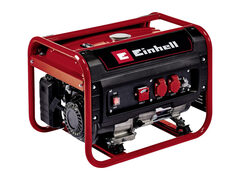
The TC-PG 25/1/E5 is a conventional gas generator (synchronous alternator, no inverter stage) built on a fixed tubular frame. Its official spec sheet rates it at 2100 W continuous and 2400 W maximum, at a rated current of 9.1 A at 230 V. The gap between the two figures is only 14%, tight compared with many entry-level generators that quote a peak figure well beyond what they can actually sustain.
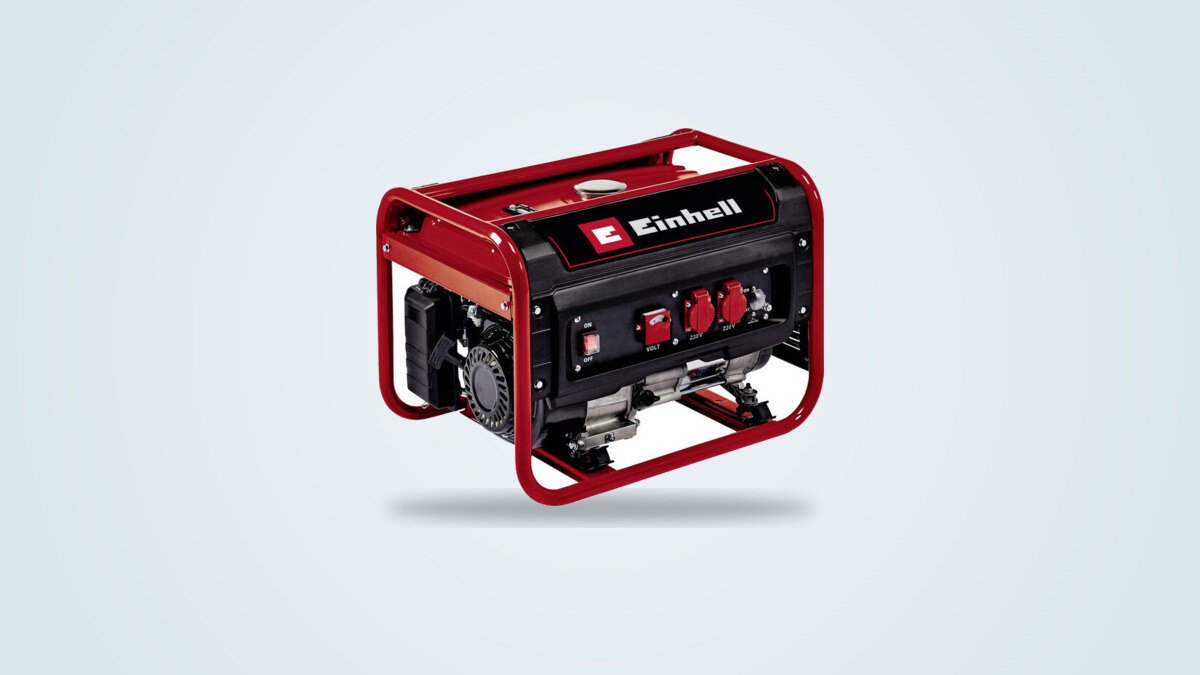
Two 230 V outlets sit on the front panel, alongside an analog voltmeter that shows the delivered voltage at all times, a handy reference the moment another appliance is plugged in. A continuous output of 2100 W covers most household backup or light job-site needs (lighting, a refrigerator, a pump, power tools), but it will not stack several heavy loads at once.
15 liters, the best runtime of the three: 12.5 hours at two-thirds load
The real selling point of the TC-PG 25/1/E5 is its tank. At 15 liters, it matches exactly the capacity of its bigger sibling, the TC-PG 35, a size normally reserved for far more powerful generators. Set against a consumption of around 1.2 liters per hour at two-thirds load, that capacity yields an official runtime of 12.5 hours, the best of the three conventional gas generators compared here.
The TC-PG 35, despite being more powerful and fitted with the same 15-liter tank, tops out at 10.7 hours under the same reduced-load conditions: its higher consumption (around 1.4 L/h) eats into part of the advantage the large tank provides. The SDMO Perform 3000, with only 4.1 liters, runs for 3.2 hours at 75% load, a refueling rhythm in a different league.
96 dB(A) guaranteed: as loud as the TC-PG 35, despite 500 W less
The guaranteed sound power of the TC-PG 25/1/E5 reaches 96 dB(A), the manufacturer's declared figure for this class of outdoor power equipment. At the operator position, the stated level is 73.1 dB(A).
That figure is surprising at first glance: it is exactly the same level as the TC-PG 35, despite that model producing 500 W more continuous power, and the same as the SDMO Perform 3000. Contrary to intuition, a less powerful generator is not automatically quieter: the noise of an open-frame unit depends mainly on the engine architecture and the absence of an acoustic enclosure, not solely on the electrical output. Choosing the TC-PG 25/1/E5 over the TC-PG 35 buys lighter weight and more runtime, not more quiet.
| Criterion | Einhell TC-PG 25/1/E5 | Einhell TC-PG 35 | SDMO Perform 3000 | Honda EU10i |
|---|---|---|---|---|
| Guaranteed sound power (LWA) | 96 dB(A) | 96 dB(A) | 96 dB(A) | 87 dB(A) |
| Architecture | Conventional, open frame | Conventional, open frame | Conventional, open frame | Inverter, enclosed |
| Continuous power | 2100 W | 2600 W | 2400 W | 900 W |
The Honda EU10i, the only inverter generator already reviewed on this site, shows what an enclosed architecture buys: a guaranteed sound power of 87 dB(A), 9 dB(A) less, a difference very clearly audible, at the cost of a quarter of the continuous power (900 W) and a noticeably higher price. In practice, the TC-PG 25/1/E5's level rules out camping use or running it near homes in the evening; it remains suitable for daytime job-site work or the occasional backup run, kept well away from occupied rooms.
AVR regulation steadies the voltage, not the waveform
AVR (automatic voltage regulation) keeps the output close to 230 V regardless of the load, within the 2400 W available. That is a genuine benefit for power tools or lighting, which cope badly with voltage dips as a motor starts up. AVR acts on the amplitude of the current, though, not on the shape of its wave: a conventional generator like this one produces current straight from the synchronous alternator, without the electronic reconstruction of a smoothed sine wave that an inverter generator provides.
Starting is exclusively by recoil cord, with no electric starter and no battery to maintain. An overload breaker protects both 230 V outlets, and a low-oil safety shutoff automatically stops the engine before it can be damaged.
4.1 kW at the engine, 2100 W at the outlet: what the spec sheet does not say
One figure in the official documentation is easy to miss: the 208 cc four-stroke engine develops a maximum mechanical output of 4.1 kW (5.6 hp), almost double the 2100 W of continuous electrical output quoted on the front panel. The gap is neither an error nor marketing excess: part of the engine's mechanical power goes into driving the alternator with a working margin, rather than being fully converted into continuously usable current. That margin keeps the engine from running flat out all the time, a factor in longevity rather than a weakness.
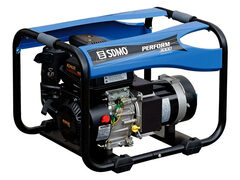
A technical curiosity: the SDMO Perform 3000, fitted with a Kohler CH270 engine of professional standing, shares the exact same 208 cc displacement, yet delivers 300 W more continuous electrical power (2400 against 2100 W). The gap shows how much an engine's tuning and design, beyond displacement alone, determine the electrical power that finally reaches the outlets.
81.1 lb (36.8 kg) dry, close to 106.9 lb (48.5 kg) full: the lightest of the three, but no wheels
The TC-PG 25/1/E5 weighs 81.1 lb (36.8 kg) dry. Of the three conventional gas generators compared here, it is the lightest: 11.5 lb (5.2 kg) less than the TC-PG 35 at 92.6 lb (42 kg) and 18.1 lb (8.2 kg) less than the SDMO Perform 3000 at 99.2 lb (45 kg). That figure is still a dry weight, though: full of gasoline (15 liters, around 24.7 lb / 11.2 kg at a gasoline density of roughly 0.745 kg per liter) and engine oil (around 0.6 liters), the unit approaches 106.9 lb (48.5 kg) ready to run, a figure rarely highlighted on sales sheets.
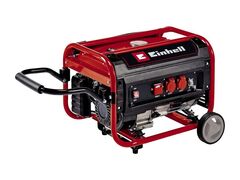
The tubular frame protects the engine and doubles as a carry handle, but it has neither wheels nor a telescoping handle. Unlike the TC-PG 35, which rolls on two large wheels despite weighing 92.6 lb (42 kg), the TC-PG 25/1/E5 is a two-person lift or a trunk job. The SDMO Perform 3000 shares this same lack of wheels, at a higher weight still. Being the lightest of the three helps when lifting it, but it is no substitute for wheels once the unit needs moving around a job site.
Build and the Classic range: the same base as the TC-PG 35
Einhell is a German consumer tool maker based in Landau an der Isar, Bavaria, in this market since the 1960s. The TC-PG 25/1/E5 belongs, like the TC-PG 35, to the brand's "Classic" range, positioned for occasional use rather than continuous, intensive professional work. The standard manufacturer warranty is two years.
No recall or recurring structural fault shows up for this model, on sale for several years and widely distributed internationally. The real friction points sit with the noise already covered and the lack of wheels, not with early mechanical failure.
Against the TC-PG 35 and the SDMO Perform 3000
At around $411, the TC-PG 25/1/E5 sits as the brand's entry-level gas generator, just below the TC-PG 35. The table places the three closest conventional generators in the catalog by range and power.
| Criterion | Einhell TC-PG 25/1/E5 | Einhell TC-PG 35 | SDMO Perform 3000 |
|---|---|---|---|
| Continuous power | 2100 W | 2600 W | 2400 W |
| Peak power | 2400 W | 3100 W | 2800 W |
| Fuel tank | 15 L | 15 L | 4.1 L |
| Official runtime | 12.5 h (2/3 load) | 10.7 h (2/3 load) | 3.2 h (75% load) |
| Guaranteed sound power | 96 dB(A) | 96 dB(A) | 96 dB(A) |
| Dry weight | 81.1 lb (36.8 kg) | 92.6 lb (42 kg) | 99.2 lb (45 kg) |
| Wheels included | No | Yes | No |
| Warranty | 2 years | 2 years | 3 years |
| Observed price | ≈ $411 | ≈ $397 | ≈ $758 |
Against the TC-PG 35, the gap comes down to three specific points: power (2100 against 2600 W), wheels (absent here, present on the TC-PG 35) and runtime, where the TC-PG 25/1/E5 has the edge despite an identical tank. Noise does not separate the two models at all: 96 dB(A) either way. Against the SDMO Perform 3000, the gap is wider on continuous run time (12.5 against 3.2 hours on a full tank) and on weight, both favoring the TC-PG 25/1/E5, while the SDMO keeps the edge with its Kohler engine of professional standing and a longer warranty (3 years against 2). The choice comes down to this: tank and light weight for the TC-PG 25/1/E5, power and wheels for the TC-PG 35, engine and warranty for the SDMO Perform 3000.
Who the TC-PG 25/1/E5 suits, and who it does not
It suits anyone after a long tank runtime at a contained price for the occasional household backup or a small job-site task, and who can live with the noise of an open-frame generator and the lack of wheels.
It does not suit anyone who needs more than 2100 W continuous (the TC-PG 35 or the SDMO Perform 3000 fit better), who needs quiet for camping or for running near homes in the evening, who needs an inverter generator for very sensitive electronics, or who needs a wheeled frame to roll the unit around a job site rather than carry it.