What the claimed 15000mAh actually deliver
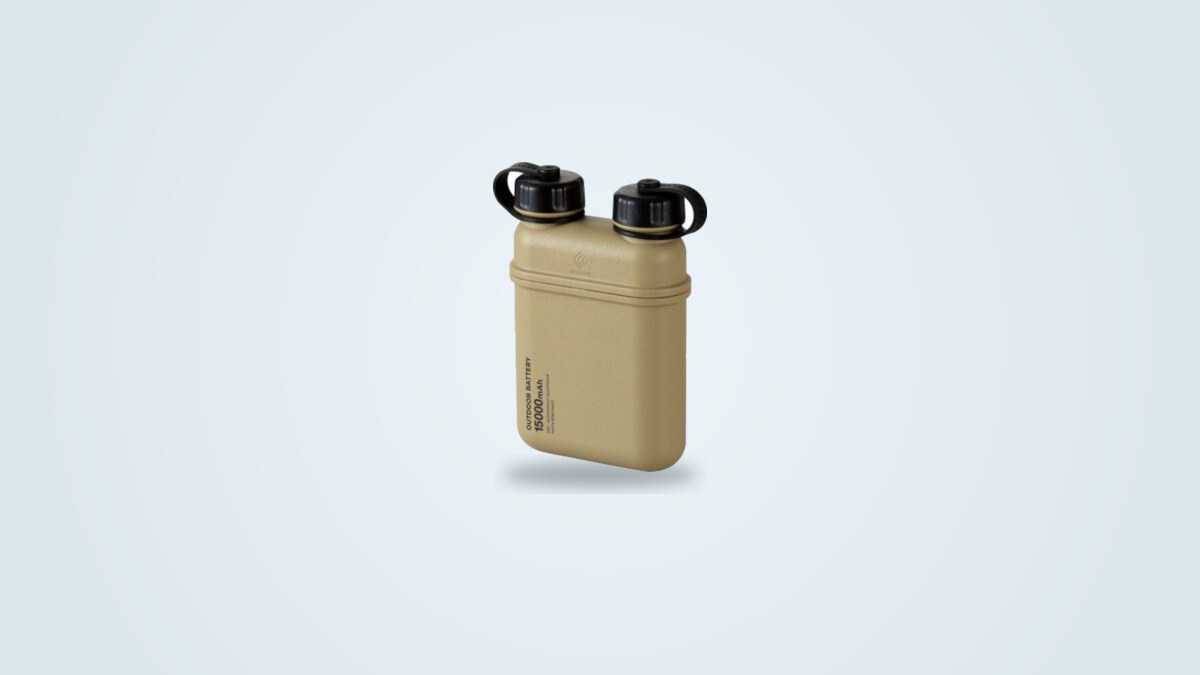
The Elecom Nestout 15000mAh packs a Li-ion cell rated at 3.6V, which works out to roughly 54 Wh of nominal energy, a figure the manufacturer's spec sheet confirms without ambiguity. That's the number on the box, and it underpins the marketing pitch: several full smartphone charges, extended use across several days on the trail.
The electrical reality is less generous. An identical measurement protocol applied across several comparable hiking-focused power banks puts the gap between claimed and actually available output energy at roughly a third. In practice, usable capacity settles closer to 36 Wh, still enough for three to four full charges of a modern smartphone, but well short of the best efficiency figures on the market, which typically run between 75% and 85% of nominal capacity for the most efficient units.
Weighed against the housing's mass, this real-world capacity places the Nestout among the least favorable in a comparison of hiking-focused power banks: under this specific protocol, it delivers the lowest usable energy per ounce of the compared group. What that means for the product's weight gets its own chapter further down in this review.
A recharge notably slower than advertised
Elecom claims a full recharge of the Nestout 15000mAh in roughly 3 hours 35 minutes, a figure obtained under optimal conditions with a USB Power Delivery source able to supply the maximum power the unit accepts, around 20W. That's the number on the product page and across retail listings.
With a standard off-the-shelf charger, the time actually needed climbs to just over 5 hours, an increase of nearly 40% over the claim. The protocol applied here stays consistent from one product to the next in the comparison this figure comes from, which makes the gap meaningful rather than incidental. The unit does eventually fill up completely, with no interruption or charging failure: the promise isn't broken, it just demands more patience than advertised.
For hiking or backcountry camping, where recharging typically happens overnight or through a low-power solar panel, this gap matters little. It becomes more of an issue for anyone counting on a quick top-up at the end of the day before an early departure.
Toughness, the Nestout's real reason for being
The Nestout's IP67 rating breaks down into two indices: IP6X for total dust-tightness, and IPX7 for accidental immersion up to 3.3 ft (1 m) deep for 30 minutes. The rigid shell is wrapped in a silicone cushion that absorbs shocks and vibration, and meets the US military MIL-STD-810G standard, method 516.7 (drop test).
These claims hold up outside the lab. An 8 ft (2.4 m) drop leaves no scratches or visible cosmetic damage. Extended exposure of several minutes under a running tap causes no malfunction, confirming the waterproofing holds in real use, not just on the certification paperwork. Six internal protection circuits (temperature, short-circuit, overcharge, over-discharge, overvoltage and overcurrent) round out this approach, a list the manufacturer states outright.
This is where the Nestout separates itself most clearly from most general-purpose power banks, which typically offer no protection against water or dust, and rarely comply with any formal shock standard. It's also the product's whole reason for being: a deliberate trade-off in favor of physical reliability, at the cost of other criteria covered further down in this review.
The pleasant surprise: cold-weather performance
Lithium-ion batteries typically lose a significant share of their available capacity in cold weather, a well-known effect that leads many winter hikers to sleep with their power bank inside their sleeping bag. On this specific point, the Nestout surprises in a good way: in cold-weather simulation, its efficiency loss doesn't exceed 1%, a result notably better than what its modest room-temperature efficiency might suggest.
This result doesn't offset the efficiency gap covered in the first chapter of this review, but it's a genuine differentiator for winter or high-altitude use, where most general-purpose power banks suffer a far steeper performance drop. The silicone cushion wrapped around the housing, originally meant for shock absorption, likely also plays a partial role as thermal insulation, though this specific mechanism isn't confirmed by the manufacturer.
Weight, the real price of toughness
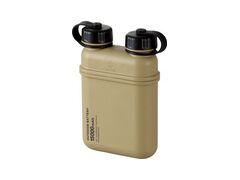
The Nestout 15000mAh's actual measured weight settles between 12.8 and 12.9 oz (364 to 365 g), matching the manufacturer's claim to the ounce. Its dimensions run around 5.1 x 3.3 x 1.4 in (130 x 85 x 36 mm), for an unusual silhouette inspired by a vintage fuel canister, wider and bulkier than a classic rectangular power bank of similar capacity.
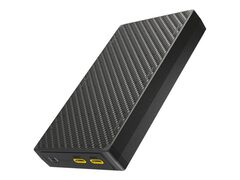
This weight isn't a manufacturing flaw: it's the direct consequence of the rigid shell and silicone cushion needed for shock resistance and waterproofing. But it comes at a real cost against the competition. In our own catalog, the Nitecore NB20000 delivers a claimed 20000 mAh, a third more capacity, for just 10.3 oz (291 g), 2.6 oz (73 g) less than the Nestout, but with no waterproofing and no shock-standard compliance at all. Weighed per ounce, the Nestout therefore posts the least favorable usable-energy-per-ounce ratio in an independent comparison of hiking-focused power banks, as the first chapter of this review already noted.
For use where every ounce counts (ultralight trekking, thru-hiking), this weight can tip the scale toward lighter but less protected alternatives. For use closer to van life, jobsites or a car, where the unit sits rather than gets carried continuously, the argument loses much of its weight.
The modular accessory ecosystem, a promise worth qualifying
The Nestout is built to work with modular accessories sold separately: the LAMP-1 lantern, with omnidirectional light, and the FLASH-1 LED panel, directional and steplessly adjustable from roughly 30 to 1000 lumens via a twist dial. A standard 1/4-20-inch tripod mount is built into the underside, with no extra accessory needed for that particular use.
In practice, pairing the battery with these accessories brings up several real friction points. The connection requires an adapter that has to be screwed on first, is directional, and is prone to cross-threading if not aligned carefully. The carry pouch for the matching solar panel uses elastic retention straps that tend to stretch out with repeated use. The USB-A-to-USB-C cable bundled with the battery runs no longer than about 4 in (10 cm), a length that forces the two devices almost flush against each other for any external charging.
None of these friction points is a dealbreaker on its own, but taken together they meaningfully qualify the promise of an ecosystem designed for quick handling in the field. The idea holds up; the execution leaves real room for improvement.
Real-world output power and connectivity
The Nestout offers three ports usable at the same time: one USB-C Power Delivery port up to 27W, and two USB-A ports up to 12W each, for a combined output of 32W. Smart power allocation automatically splits available current based on what each connected device needs, and simultaneous charging of three devices is confirmed in real-world use.
This setup suits its target audience well: smartphones, earbuds, cameras, small rechargeable headlamps. It shows its limits, though, against a modern laptop, whose fast charging typically demands 60 to 100W or more on a single port; the Nestout can at best slow down a laptop's battery drain during use, not charge it at a comfortable rate.
On the interface side, a built-in LED indicator shows remaining charge level, with no detailed digital display. No wireless charging is offered, a choice consistent with the product's outdoor positioning: an induction coil would have complicated the housing's waterproofing for little real benefit to the intended use.
Against the direct competition
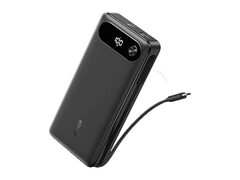
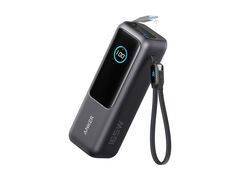
Around $67, the Nestout 15000mAh crosses paths with several very different power bank profiles. Here's how it stacks up against three alternatives from our own catalog: the Nitecore NB20000, ultralight but with no waterproofing; Anker's Power Bank 20000 (87W), general-purpose and notably more powerful; and Anker's A1695 (165W), more complete but also pricier and heavier.
| Criterion | Nestout 15000mAh | Nitecore NB20000 | Anker Power Bank 20000 (87W) | Anker A1695 (165W) |
|---|---|---|---|---|
| Claimed capacity | 15000 mAh | 20000 mAh | 20000 mAh | 25000 mAh |
| Weight | 12.8 oz (364 g) | 10.3 oz (291 g) | 15.2 oz (431 g) | 21.0 oz (595 g) |
| Waterproofing | IP67 | None | None | None |
| Shock resistance | MIL-STD 810G | None | None | None |
| Output power | 32 W | 22.5 W | 87 W | 165 W |
| Price observed | $66.99 | $99.95 | $49.99 | $119.99 |
This comparison sums up the Nestout's central trade-off: it's the only one of the four to combine IP67 waterproofing with compliance to a military shock standard, a segment none of the other three address at all. In exchange, it's the heaviest for its capacity outside the A1695, and the least powerful in output outside the Nitecore. The choice comes down almost entirely to intended use: demanding outdoor conditions for the Nestout, versatility and power for the two Ankers, pure lightness for the Nitecore.
Reliability and signals worth watching
Elecom claims roughly 1000 full charge cycles for the Nestout's cell, a figure in the upper-average range for consumer power banks. Six internal protection circuits cover temperature, short-circuit, overcharge, over-discharge, overvoltage and overcurrent, a standard but complete list for this type of product.
One isolated case of charging capping at 80% of total capacity was resolved through a manufacturer-handled replacement, with the exact nature of the initial fault never made public. A single individual report like this doesn't point to a widespread reliability problem, but it deserves a mention alongside the rest of this product's limitations.
The screw cap protecting the two ports can, on occasion, catch on the O-ring during reassembly instead of threading smoothly, a minor flaw that doesn't affect waterproofing once properly closed but that demands a bit of care with every use.
Who the Nestout 15000mAh is for
The Nestout 15000mAh makes its case first for a specific use: demanding hikes, camping, outdoor jobsites, or any situation where a drop, a downpour or a dusty environment is part of the unit's everyday life. On that ground, its combination of IP67 and MIL-STD-810G has few direct equivalents among general-purpose power banks.
It suits less well anyone chasing the lightest possible weight down to the ounce, anyone who needs to charge a laptop at full speed, or anyone who prioritizes the best real-capacity-for-price ratio above all else. For those uses, other power banks on the market, including some in our own catalog, offer a better compromise on that specific criterion, at the cost of reduced toughness.
In the end, the Nestout remains a deliberate niche product: it doesn't aim to be the best general-purpose power bank, but the most physically dependable in conditions where others fail.