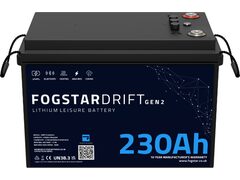
The 230Ah against Fogstar's other capacities: confirming the right generation
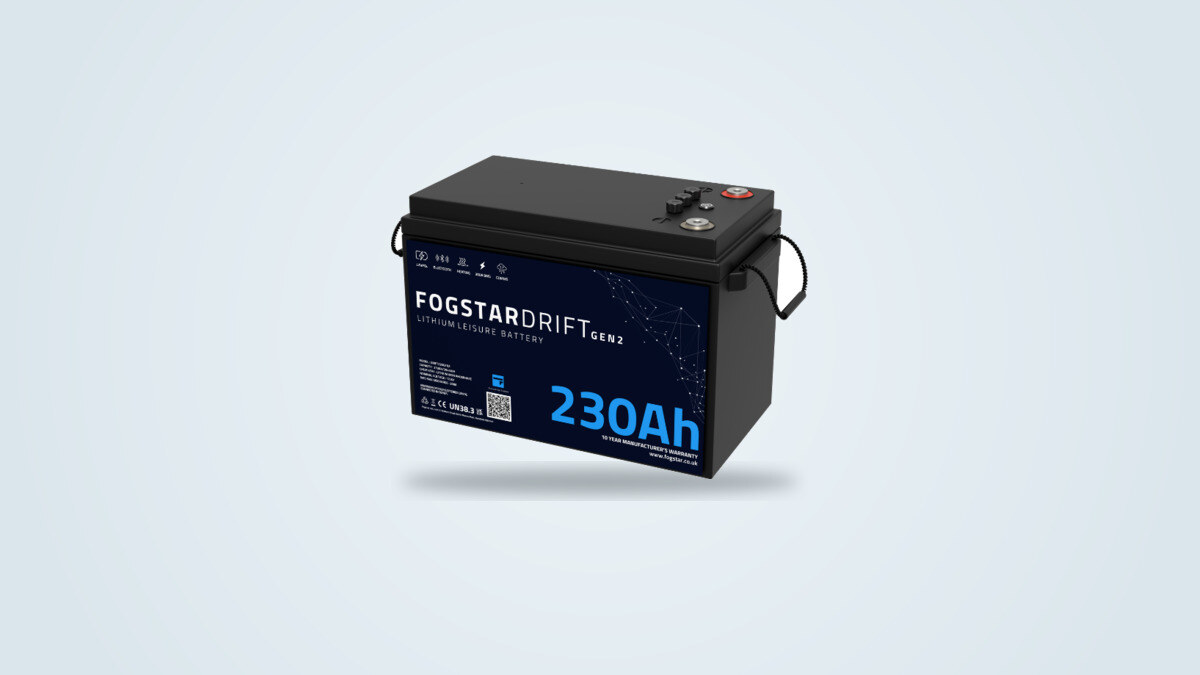
Fogstar sells its Drift LiFePO4 line in several capacities (105, 230, 460 and 668Ah at least), and the brand has already updated this exact 230Ah size three times over the years: a first version with a 200A BMS, a second with 250A, then this Gen2 with 300A. The product covered here is specifically the Gen2, identifiable by its manufacturer reference Fog/Dri/Gen2/12V/230 and its 300A BMS.
What sets this Gen2 apart from earlier generations of the same capacity: a built-in active balancer, a feature Fogstar's own documentation ties specifically to this Gen2, a shunt current accuracy rated at 0.2A, and native Victron compatibility over CAN bus. The ABS case stays at 15.1 x 7.6 x 9.8 in (383 x 193 x 250mm) for a rated weight of 50.7 lb (23 kg) in the dedicated datasheet, even though a separate figure of 48.5 lb (22 kg) appears in the same manufacturer's shipping data, a minor discrepancy with no real-world impact. A video widely linked to this line by search engines dates from 2023 and covers the brand's very first 105 and 560Ah models, a different generation and different capacities from this Gen2 230Ah.
The 300A BMS, and a datasheet that contradicts itself on charging
The BMS on this Gen2 is rated at 300A, on both charge and discharge, a real step up from the 250A of the previous version of the same capacity and the 200A of Fogstar's very first 230Ah model. That 300A figure appears in three separate places across the datasheet and the user manual: the BMS specification table, the charging section, and the trigger threshold for the overcurrent-charge protection.
A second discrepancy exists on the deep-discharge cutoff threshold: the dedicated datasheet lists it at 10V, while the range's general user manual places over-discharge protection at 11.6V. That gap changes nothing about the battery's real safety, since the BMS cuts off well before a dangerous level either way, but it does point to documentation consistency that could be tighter from a manufacturer that is otherwise very thorough across the rest of its datasheets.
Cycle life: 4000 cycles, but at 80% depth of discharge, not 100%
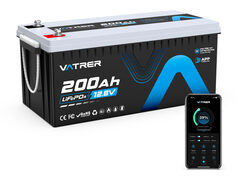
Fogstar rates this Gen2 at 4000 charge/discharge cycles, a figure explicitly tied to an 80% depth of discharge (DoD) in its datasheet. That is a level of detail few direct rivals provide as clearly: both the Dyness 24V 100Ah and the LiTime 12V 50Ah rate their cycle life at 4000 cycles at 100% DoD, and the Vatrer Power 200Ah claims more than 5000 cycles, also at 100% DoD.
| Product | Rated cycles | Depth of discharge |
|---|---|---|
| Fogstar Drift 230Ah (this product) | 4000 | 80% |
| Vatrer Power 200Ah | 5000+ | 100% |
| Dyness 24V 100Ah | 4000+ | 100% |
| LiTime 12V 50Ah | 4000 | 100% |
A shallower depth of discharge mechanically extends the number of cycles a given cell can reach, so a figure pegged to 80% DoD is not directly comparable to one pegged to 100%, and would likely translate into a lower total if the same protocol were pushed to a full discharge. On this specific point, Fogstar's transparency about its own basis for the figure paradoxically works against it in a head-to-head comparison with rivals that quote a 100% figure without qualifying it.
The range's general manual does note that this Gen2 tolerates a near-complete discharge in practice: the deep-discharge cutoff sits at 10 or 11.6V depending on the document (see above), very close to the empty-cell voltage of a LiFePO4 cell, which suggests the rated 2944Wh remains almost entirely usable on every cycle, even though the manufacturer does not separately quote a cycle-life figure at 100% DoD.
Integrated heating: the exact mechanism, and how far it really goes
The integrated heating function clearly sets this Fogstar Drift apart from its direct rivals: neither the Vatrer Power 200Ah, the Dyness 24V 100Ah nor the LiTime 12V 50Ah offer active heating on the versions already reviewed on this site, only a passive charge cut-off below 32 °F (0 °C). Fogstar instead builds in two 36W heating pads controlled by the BMS.
The exact mechanism, as described in the range manual: as soon as internal cell temperature reaches 32 °F (0 °C) during charging, the incoming current is cut and redirected to the heating pads instead of the cells themselves. Normal charging only resumes automatically once the cells have warmed back up to around 41 °F (5 °C). The heating runs solely on current supplied by the connected charger, never on the battery's own stored energy, and needs a minimum charge current of 0.5A to activate. Fogstar states the system has been tested down to -4 °F (-20 °C) and is rated for outdoor ambient conditions as low as -40 °F (-40 °C), a far wider range than the -4 °F (-20 °C) discharge tolerance most LiFePO4 batteries of this size share.
The mechanism comes with one simple condition: the charger has to stay connected and keep supplying current for the heating to work, the battery cannot warm itself up from its own reserve. An undersized charging setup that cannot deliver at least 0.5A in cold conditions will not trigger the heating.
Bluetooth, app and native Victron integration
The Fogstar Drift Gen2 is controlled from the free Fogstar Drift app (iOS and Android), with pairing via a simple scan of the QR code printed on top of the battery and optional protection with a 6-digit PIN to block unauthorised connections. The app shows state of charge, voltage, current, temperature and protection status in real time, with no internet connection required.
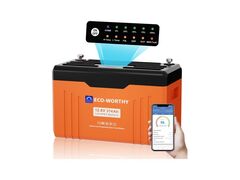
Its real difference from the Vatrer Power 200Ah, the Dyness 24V 100Ah, the LiTime 12V 50Ah and the Eco-Worthy EnergyTrek 314Ah, all of which are limited to a proprietary Bluetooth-only app, lies in its native Victron compatibility: the Gen2 talks directly over CAN bus to a Victron Cerbo GX or any GX-enabled inverter, sharing voltage, state of charge, internal and external temperatures, per-cell voltages and up to 10 BMS alarm states. The communication cable ships with every battery. This integration is active by default on a parallel setup; for Victron communication on a series setup, Fogstar asks buyers to contact its technical support directly.
Another nuance worth knowing: when the physical discharge button is engaged, control of the discharge function from the Bluetooth app gets locked out, and terminal voltage drops to a level incompatible with most standard appliances (some low-power devices such as LED lighting may still work). For complete isolation during long-term storage, a physical switch or disconnect remains more reliable than app control alone.
Expandable up to 47.1kWh in parallel: what the figure really means
Fogstar rates this Gen2 for expansion up to 16 units in parallel or 4 units in series. In parallel, capacity and current both add up while voltage stays at 12.8V nominal: two units form a 460Ah system (600A combined peak), and the full 16-unit bank reaches 47.1kWh. In series, it's voltage that adds up (up to 51.2V nominal with 4 units) while capacity and current stay unchanged.
This 16-unit parallel ceiling matches the LiTime 12V 50Ah (also 16 units, but only 10.24kWh combined for lack of as large a unit capacity) and beats the Vatrer Power 200Ah's 10-unit parallel ceiling. The Eco-Worthy EnergyTrek 314Ah, with its larger individual capacity (4019Wh), tops out at 8 units total (4P2S or 2P4S configuration) for 32.15kWh, still below the 47.1kWh that 16 units of this Fogstar can reach in pure parallel.
Successfully pairing an older Fogstar 230Ah (200A or 250A BMS) with a recent Gen2 (300A BMS) remains possible provided the wiring runs through busbars with identical cable lengths from each battery to the common connection point, even though Fogstar recommends identical units (same model, same capacity, same age) as a rule for any series or parallel bank.
10-year warranty: the registration step to remember, and the real cost of buying from the US
Fogstar rates the whole Drift and Drift Gen2 line at a 10-year warranty, matching the best in the segment at Eco-Worthy and double the usual 5 years at Vatrer, Dyness and LiTime. That duration is not automatic, though: the range manual explicitly asks buyers to register the battery on the manufacturer's website on receipt to activate the warranty, a step missing from the detailed warranty document itself, which only states that proof of purchase will be requested.
The warranty does not transfer to a future second-hand buyer and stays tied to the original owner. It excludes damage from prolonged deep discharge, storage at too low a state of charge, or a charge or discharge current beyond the published values, which indirectly loops back to the gap mentioned above on the maximum charge current (230 or 300A depending on where you look in the datasheet): sticking to the more cautious figure is the safer bet to avoid a dispute in the event of a claim.
If the battery drops to 7V, Bluetooth stops working and a factory return becomes necessary for a revival service, billed separately. The remaining exclusions are standard for this kind of product: opening the case, changing BMS parameters, installation by an unqualified person, or exposure to moisture beyond the stated IP67 rating.
Head to head with the closest rivals
Among the 200-320Ah lithium batteries already reviewed on this site, the Fogstar Drift 230Ah lines up directly against the Vatrer Power 200Ah (2560Wh, rated 4.3) and the Eco-Worthy EnergyTrek 314Ah (4019Wh, rated 4.2), the two closest references by capacity and price positioning.
| Criterion | Fogstar Drift 230Ah | Vatrer Power 200Ah | Eco-Worthy EnergyTrek 314Ah |
|---|---|---|---|
| Energy | 2944Wh | 2560Wh | 4019Wh |
| BMS (charge/discharge) | 300A | 200A | 200A |
| Rated cycles | 4000 (80% DoD) | 5000+ (100% DoD) | 6000 to 15000 (DoD unstated) |
| Integrated heating | Yes | No | No |
| Victron integration | Native (CAN bus) | Not stated | Not stated |
| Warranty | 10 years | 5 years | 10 years |
| best-batteries.com rating | 4.4 | 4.3 | 4.2 |
Against the Vatrer Power 200Ah, the closest anchor by capacity, the Fogstar wins on the BMS (300A versus 200A), the integrated heating (absent on the Vatrer) and native Victron integration, but falls behind on rated cycle life at equal depth of discharge (Vatrer claims 5000 cycles at 100% DoD against 4000 at 80% here) and on price, which is notably higher. Against the Eco-Worthy EnergyTrek 314Ah, the Fogstar offers a smaller individual capacity (2944 against 4019Wh) and a lower combined-energy expansion ceiling at an equal unit count, but it stands out with more consistent documentation on cycle life (a stated depth of discharge, against an unexplained 6000-to-15000-cycle gap at Eco-Worthy) and with the integrated heating, also absent there. These two trade-offs, one in its favour and one against it, justify a rating slightly above its two closest anchors, without pulling far ahead of either.
From the first generation to Gen2: three BMS generations in one line
The 230Ah capacity has existed at Fogstar for several years, and its BMS has progressed through three clearly identified steps: 200A on the very first model, 250A on the version that succeeded it, then 300A on this current Gen2. The manufacturer presents this latest step as a full overhaul rather than a simple tweak: shunt accuracy rated at 0.2A, an active balancer built into the BMS, redesigned terminals and lid, and the addition of a physical front-panel switch.
On mixing generations in parallel, pairing an older unit (200A or 250A BMS) with a 300A Gen2 remains workable as long as the wiring goes through busbars with identical cable lengths to the common connection point: the total current drawn can never exceed what the least capable battery in the group can supply anyway. Fogstar still recommends, as most manufacturers in this space do, identical units (same model, same capacity, same age) for any series bank.
Who it's for, and who should look elsewhere
This Fogstar Drift 230Ah Gen2 is best suited to anyone fitting out a van, a boat or an off-grid solar setup in a cold or very cold climate, who wants active integrated heating rather than a simple passive cut-off, and who already has, or is planning, a Victron ecosystem to connect natively over CAN bus. The 300A BMS also suits a powerful inverter or high current draws without having to check a separate limit, unlike some batteries in this segment whose recommended inverter power sits below what the BMS discharge current alone would suggest.
It suits less well anyone chasing the lowest price in the segment (the Dyness 24V 100Ah or the LiTime 12V 50Ah remain notably cheaper for a more modest need), anyone with no real use for Victron integration or the dedicated app, or anyone uneasy about ordering from a UK-based brand with no confirmed US retail or service presence at the time of writing. Confirming the warranty registration on receipt and checking with the seller which maximum charge current actually applies (230 or 300A depending on where you look in the datasheet) remain two simple precautions before the first use.