A 100% USB-C mini station, neither a full power station nor a simple power bank
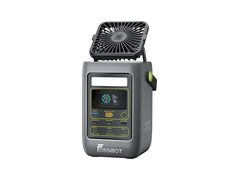
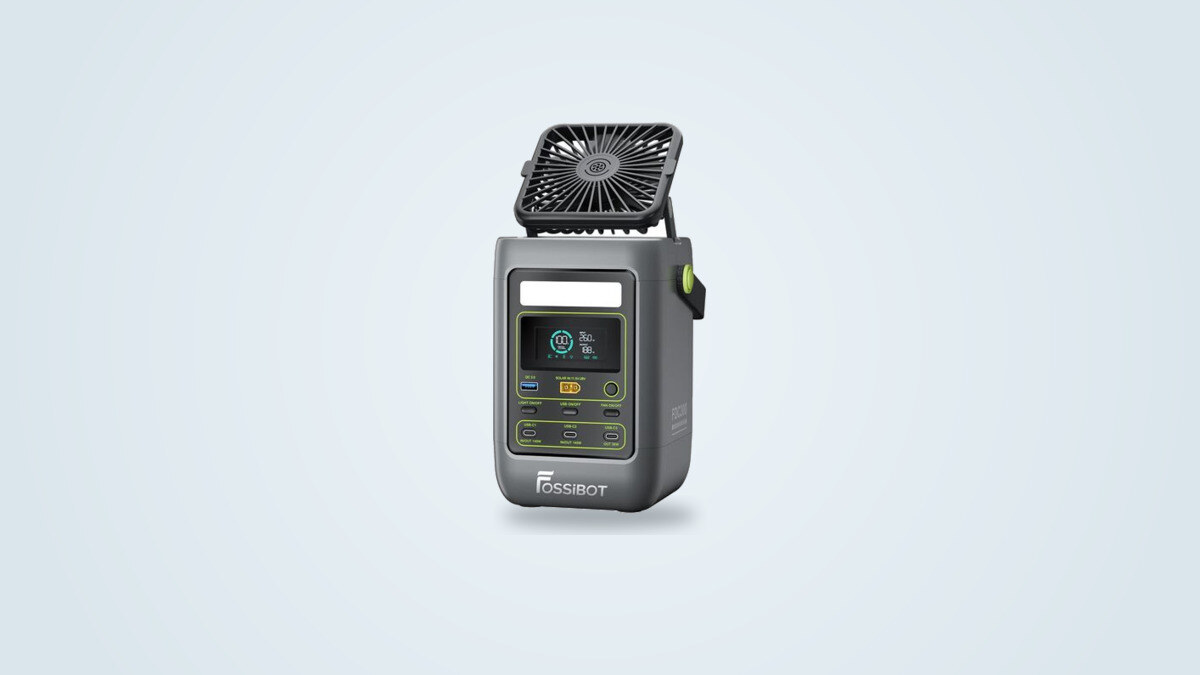
The Fossibot FDC300 was unveiled at IFA 2026 (Berlin, 4 to 8 September, hall 2.2), in a niche this site has already covered twice: 100% USB-C mini power stations with no AC outlet at all. Its 288Wh LiFePO4 battery sits at exactly the same capacity as the Anker Solix C300X DC and the EcoFlow Trail 300 DC, two direct rivals already covered here. The housing measures 5.3 x 5.3 x 8.1 in (135 x 135 x 205 mm) for 6 lb (2.7 kg), fan included.
This compact format targets a specific use case: recharging mobile electronics (phones, tablets, USB-C laptops, drones, cameras) rather than replacing a home electrical setup. Unlike a regular power bank, it includes a screen that constantly shows charge status, an XT60 input for solar or 12V car charging, and above all an accessory no direct rival of the same capacity currently offers: a folding personal fan. As of this review, no US retailer has confirmed carrying the FDC300 yet: it was unveiled on the European show floor at IFA 2026, and the manufacturer's own documentation does not list a confirmed US listing at this time.
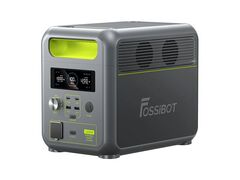
The FDC300 isn't trying to compete with the larger stations from the same brand, such as the Fossibot F1200 and its 1200W AC outlet: it occupies a narrow niche between a premium power bank and a mini backup station, a niche this site has already covered twice with mixed results on ports and efficiency.
No AC outlet, no 12V output: a choice worth understanding before buying
Dropping the AC outlet isn't a marketing simplification: the manufacturer's own official documentation states it in black and white for this exact reference, no AC outlet equips the FDC300. All its power comes out through the USB-C and USB-A ports. This choice puts it in the same camp as its two direct rivals of the same capacity, the Anker Solix C300X DC and the EcoFlow Trail 300 DC, which make the same architectural choice: without a DC-to-AC conversion stage, the stored energy doesn't need to run through an inverter to power a USB or DC device, which mechanically limits conversion losses on this type of output.
One point sets the FDC300 apart from those same two rivals, and not in its favor: no 12V output equips the unit at all, while both direct rivals each offer one (a cigarette-lighter style socket or a dedicated output). In practice, that rules out classic 12V van and camping accessories, coolers, water pumps, standard 12V lighting, which normally plug into that kind of socket rather than a USB-C port. For anyone who already owns this kind of gear, that's not a minor detail: it means either a separate USB-C to 12V adapter, or giving up on using that gear with this particular station.
In exchange, the FDC300 keeps the core benefit of this architecture: charging a laptop, phone, tablet or drone remains possible without going through an inverter, as long as the device accepts USB-C or USB-A. The XT60 input, for its part, accepts up to 120W from solar panels or a 12V car socket, an input path that isn't available in this form on every rival in the segment and that sets the FDC300 apart from a simple oversized power bank.
The folding personal fan, the FDC300's real signature feature
This is what truly sets the FDC300 apart from its two direct rivals: neither the Anker Solix C300X DC nor the EcoFlow Trail 300 DC includes a fan. The FDC300, on the other hand, hides a folding personal fan on top of the housing, with three speeds and a "natural wind" mode that varies airflow intensity. Folded away, it sits flat on top of the unit and reveals a hidden phone stand underneath; deployed, it angles to cool the user directly rather than the inside of the unit.
The manufacturer rates it for up to 100 hours of runtime using this function alone on a full battery, potentially several nights in a row without a recharge. No independent data currently confirms this figure for a model that has only just been unveiled, but the order of magnitude is plausible: a small personal fan typically draws only a few watts, well below most USB-C uses of the same battery.
A built-in three-mode light and a screen that constantly shows charge status round out the equipment, in a housing that's otherwise fairly standard for the category (grey finish, green accents, a side handle for carrying). It's a bundle of secondary functions rather than a single standout feature, but it's a bundle that neither of the two direct rivals already covered on this site currently offers, and it accounts for a good share of the product's appeal for tailgating, a summer patio or festival use on its own.
200W total, 140W per port: what that means in practice
The FDC300 offers three USB-C ports and one USB-A port: two bidirectional USB-C ports rated at 140W each (Power Delivery 3.0 compatible, usable for both charging and output), a third USB-C port capped at 30W, and one Quick Charge 3.0 USB-A port at 18W. Added together, these four ports represent 328W of individual rated power. The product's own spec sheet, however, states a total power cap of 200W for the whole unit, across all ports combined.
The practical consequence is simple to state, even without having verified it independently: the two main USB-C ports cannot each deliver 140W at the same time, since their sum (280W) already exceeds the stated 200W cap on its own. A powerful laptop on one port and a second demanding device on the other will therefore share a total power lower than the sum of their individual ratings, a common behaviour on this type of device but one rarely highlighted in marketing copy.
For everyday use, phone plus tablet, or a single laptop on its main port, this limit is never noticeable: it only becomes concrete if you try to recharge two demanding devices at the same time, each at the maximum of its own rating. A single laptop on one of the two 140W ports stays comfortably within the stated cap, whatever else is plugged into the 30W USB-C port or the USB-A port.
Recharging: three modes, one shared electronic ceiling
Three charging paths are stated by the manufacturer: the two main USB-C ports combined, a single USB-C port, or the XT60 connector on solar or a 12V car socket (120W maximum).
These three figures remain, for now, documentation numbers, with no independent verification available for a model that has only just been unveiled. A simple calculation from these same figures does offer a useful consistency check, though: 288Wh charged in 1h36 (96 minutes) works out to an average power of roughly 180W across the whole charge, below the 200 to 260W the manufacturer cites for this mode depending on which page you check. That gap between peak power and average power is nothing unusual: any lithium battery charge slows down in its final stage, at near-constant voltage, which mechanically pulls down the average over the full cycle. The same calculation applied to the other two modes (roughly 126W average over 2h17 on a single port, roughly 108W average over 2h40 via the XT60) stays consistent each time with the stated cap for that mode.
One last point is worth flagging rather than glossing over: the manufacturer's own official documentation isn't fully consistent on the exact cap for combined USB-C input, sometimes 200W, sometimes 260W depending on the page. The discrepancy doesn't change the stated charge time, already baked into the 1h36 figure, but it shows that even the official numbers for this very new product haven't yet been fully reconciled from one page to the next.
Against its two direct rivals already reviewed on this site
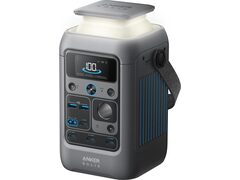
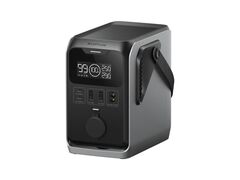
The segment of 100% USB-C mini stations with no AC outlet isn't new to this site: the Anker Solix C300X DC (rated 4.3) and the EcoFlow Trail 300 DC (rated 4.4) share exactly the same 288Wh capacity as the FDC300, with a comparable architecture.
| Criterion | Fossibot FDC300 | Anker Solix C300X DC | EcoFlow Trail 300 DC |
|---|---|---|---|
| Capacity | 288Wh | 288Wh | 288Wh |
| AC outlet | No | No | No |
| 12V output | No | Yes | Yes |
| Built-in fan | Yes, 3 speeds | No | No |
| Fastest port | USB-C 140W (x2) | USB-C 140W (x2) | USB-C 140W (x2) |
| Stated total power | 200W | Not stated | 300W |
| Weight | 6 lb (2.7 kg) | 6.2 lb (2.8 kg) | 5.7 lb (2.58 kg) |
Against these two references, the FDC300 stands out with its built-in personal fan, a feature neither of the other two offers, and a slightly lighter build than the C300X DC. It loses out, though, on two very real points documented on both direct rivals: the complete absence of a 12V output, present on both others, and a more modest stated total power against the Trail 300 DC (200W versus 300W).
On efficiency and how well power is actually held, the comparison clearly favors its two rivals, not necessarily because the FDC300 would perform worse, but because no comparable figure exists yet to show it either way: the C300X DC delivers roughly 95% of its rated capacity, and the Trail 300 DC between 81% and 94% depending on which port is used. The FDC300, unveiled only days before this review was written, hasn't been the subject of any equivalent figure yet: the resemblance to its two rivals of the same architecture makes a similar result plausible, without allowing anyone to state it as fact.
Watch out for generic product listings: several wrongly claim an AC outlet
A useful warning before comparing offers online: several generic product listings already in circulation attribute specs to the FDC300 that don't match this exact model, notably an AC outlet or a 12V output, both absent from the manufacturer's own official documentation for this reference. Others state a 299Wh capacity or a 600W peak output, two figures that likewise don't appear in that same official documentation, which lists 288Wh and a 200W cap for the whole unit.
This kind of mismatch isn't unique to the FDC300: the mini power station and power bank segment is regularly crossed by generic listings that recycle description templates shared across several products from the same brand, without always adapting them to the exact reference in question. It's a particularly common failing on listings machine-translated from one language to another, where a whole paragraph describing a neighboring model in the same range ends up copied over without the power, capacity or ports having been checked against the reference actually being sold.
Before comparing a price or a spec found online, checking that it really matches the FDC300 rather than another model in the same range avoids an unpleasant surprise on delivery, particularly around the missing AC outlet, the point most likely to disappoint a buyer who hadn't anticipated it. The most reliable anchor remains the exact reference shown on the unit's own screen and rating plate, cross-checked against the manufacturer's official documentation rather than a generic listing found at random online.
Build, warranty, and a product with no track record yet
The FDC300's LiFePO4 battery is rated for over 3000 charge-discharge cycles, a figure below the 4000-plus rated for the Anker Solix C300X DC, its closest direct rival by capacity and architecture. That's not a dealbreaker, LiFePO4 chemistry remaining recognized for its thermal stability and safety regardless of brand, but it's a real gap worth knowing before buying rather than assumed to be equivalent from one reference to the next.
The stated manufacturer warranty is 3 years, a reasonable duration for the category even though some rivals offer more on other references in their own range. The stated discharge temperature range runs from 14 °F to 104 °F (-10 °C to 40 °C), a fairly typical span for this type of battery and consistent with the rest of the LiFePO4 mini station market.
Two points no warranty can offset: the FDC300 has only just been unveiled at IFA 2026, mere days before this review was written, and no US retailer has confirmed carrying it yet at the time of writing. No usage history over several months or years exists yet, whether on how the fan holds up over time, a possible early-life defect, or how responsive after-sales support turns out to be if something goes wrong, and it isn't yet clear how a US warranty claim would be handled once the unit does reach American buyers. That's not a negative signal in itself, a brand-new, not-yet-launched product has no track record by definition, but it's a genuine trust reserve to weigh against the more established history of its two direct rivals, both already covered and rated on this site.
Who it suits, who it suits less
The FDC300 suits anyone looking for a compact, versatile energy reserve for mobile electronics: phone, tablet, USB-C laptop, drone or camera, with the bonus of a personal fan useful for camping, tailgating or a festival, and a built-in phone stand handy for watching a video while charging your device. For that same use case, its signature bundle (fan, light, phone stand) makes it more versatile than a plain power bank of comparable capacity, without the weight or price of a proper AC-outlet station, once it actually becomes available to buy.
It suits less anyone who wants to buy today: as of this review, no US retailer has confirmed carrying the FDC300, so an immediate purchase likely means importing the unit rather than buying from a listed US seller. It's also not a fit for anyone who already owns classic 12V accessories (cooler, water pump, standard camping lighting) that neither an AC outlet nor a 12V output here can power, unlike its two direct rivals of the same capacity, nor for anyone looking for a reference whose reliability and real-world performance are already established: no independent data yet confirms how well it holds its rated power, its real efficiency, or how loud its fan runs in use. For a first purchase in this segment without a strong preference for the built-in fan, the longer track record, confirmed US availability, and figures already available on its two direct rivals remain a legitimate reason to choose them instead.