3200 W continuous, 3500 W peak: power backed up by its own stated current
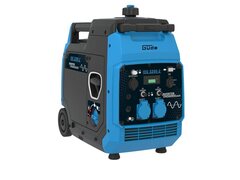
The Güde ISG 3200-2 is the most powerful model in the German maker's inverter generator range, above the ISG 1200-1 and ISG 2000-2. Its 224 cc four-stroke OHV engine, rated at 4.5 kW (6.1 hp), delivers 3500 W peak and 3200 W continuous at 230V, the European standard voltage this unit is built for, for a stated current of 13.9 A. The math checks out: 13.9 A times 230V comes to 3197 W, within three watts of the claimed 3200 W, a sign of a spec sheet built with care rather than copied from one comparison site to another.
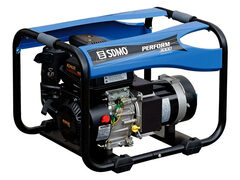
The gap between peak and continuous output is only 9%, a tight margin that points to a continuous rating you can actually hold rather than an inflated peak figure for the box: for comparison, the SDMO Perform 3000 shows a 14% gap, and the Einhell TC-PG 35 only holds its 3100 W peak for two minutes. At this power level, the ISG 3200-2 comfortably runs a cement mixer, a job-site circular saw, or, as home backup, a fridge, a freezer, lighting and a pump at the same time. Inverter technology stays at the core of the product: the DC current produced by the alternator is electronically rebuilt into a stable AC waveform before being delivered, which is what allows a laptop or a device with a control board to be plugged in, unlike on a conventional open-frame unit such as the Einhell TC-PG 35 or the SDMO Perform 3000.
7.8 liters, 7.5 hours at half load: the most fuel-efficient tank in the range
The 7.8-liter tank is the largest of any inverter unit already reviewed on this site, well ahead of the 4.1 liters on the Güde ISG 2000-2 and the Scheppach SG2500i, or the 4.0 liters on the maXpeedingrods MXR3800. Güde publishes two official runtime figures, a transparency rarely seen in this segment: 7.5 hours at 50% load (1600 W) and about 4 hours at full continuous power (3200 W).
These two figures allow a calculation most spec sheets in this segment don't support: real fuel efficiency. At full load, consumption works out to about 1.95 liters per hour for 3200 W produced, or roughly 0.61 liters per kWh. At 50% load, that drops to about 1.04 liters per hour for 1600 W, or roughly 0.65 liters per kWh. The two figures sit close together, which points to an engine holding steady efficiency across a wide load range rather than an ECO mode masking high consumption at reduced load.
| Product | Load | Specific consumption |
|---|---|---|
| Güde ISG 3200-2 | Full power (3200 W) | ≈ 0.61 L/kWh |
| Güde ISG 2000-2 | 50% load, ECO mode (850 W) | ≈ 0.82 L/kWh |
| Einhell TC-PG 35 | Two-thirds load (1730 W) | ≈ 0.81 L/kWh |
Despite a tank half the size of the Einhell TC-PG 35's 15 liters, the ISG 3200-2 posts roughly 25% better efficiency at full power than the Einhell at reduced load, and roughly 20% better than its own little brother, the ISG 2000-2, at a comparable load. This figure is worked out from each maker's own published numbers, not an independent bench measurement: treat it as a consistent order of magnitude rather than a field-verified value.
92 dB LWA: the lowest noise level of any unit above 1600 W in the catalog
The stated 92 dB LWA is a standardized sound-power level (under EU noise-emission directives), a figure meant to compare devices with each other, not what you'd hear standing a few feet from a neighboring campsite. With that caveat in mind, the comparison across the catalog still speaks for itself.
At 92 dB LWA, the ISG 3200-2 posts the lowest figure of any generator above 1600 W already reviewed on this site. It stays almost level with its own little brother, the ISG 2000-2 (93 dB LWA), despite offering more than double the continuous power, and with the Scheppach SG2500i (91.6 dB LWA, 1600 W real output). Against conventional open-frame units of similar or lower power, the gap widens: the Einhell TC-PG 35 (2600 W, 23% less power than the Güde) and the SDMO Perform 3000 (2400 W, 33% less) both sit at 96 dB LWA, four decibels above the ISG 3200-2 despite lower output. Only the Honda EU10i does better in absolute terms, at 87 dB LWA, but for just 900 W, more than three times less than the Güde.
Against its little brother, the ISG 2000-2: what the price and weight gap actually buys
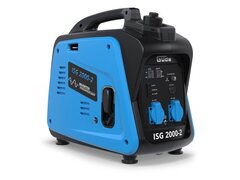
The catalog already carries a review of the Güde ISG 2000-2, the mid-range model in the same inverter line: 3.9 out of 5. Since the two share the same brand, the same technology and the same design philosophy, this is the most direct comparison available to place the ISG 3200-2.
| Criterion | Güde ISG 3200-2 | Güde ISG 2000-2 |
|---|---|---|
| Continuous power | 3200 W | 1700 W |
| Peak power | 3500 W | 2000 W |
| Displacement | 224 cc | 99.2 cc |
| Tank | 7.8 L | 4.1 L |
| Noise (LWA) | 92 dB | 93 dB |
| USB | 2 (1 A and 2.1 A) | None |
| Wheels | Yes, telescoping handle | No, a single handle |
| Weight | 70.5 lb (32 kg) | 40.8 lb (18.5 kg) |
| Observed price | ≈ $716 | ≈ $363 |
The ISG 3200-2 delivers 1.9 times the continuous power of its little brother for 2.3 times the displacement and 1.9 times the tank size, at the cost of 1.7 times the weight and a listed price about twice as high. Noise, by contrast, barely moves (92 against 93 dB LWA) despite this near-doubling of power, and the 3200-2 adds USB ports the 2000-2 doesn't have. Against this main anchor, the ISG 3200-2 is clearly ahead on power, runtime and fuel efficiency, while staying practically level on noise despite a much heavier workload, which supports a rating slightly above the ISG 2000-2's 3.9. It falls behind on pure portability: you pull the 3200-2, you carry the 2000-2 in one hand.
Against the maXpeedingrods MXR3800: the same claimed power, a very different price
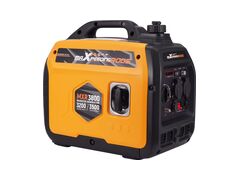
The maXpeedingrods MXR3800, already reviewed on this site (rated 3.9 out of 5), claims exactly the same power figures as the Güde: 3200 W continuous and 3500 W peak. This is the most direct comparison on raw power, and it lays bare the gap in philosophy between the two brands.
| Criterion | Güde ISG 3200-2 | maXpeedingrods MXR3800 |
|---|---|---|
| Continuous power | 3200 W | 3200 W |
| Peak power | 3500 W | 3500 W |
| Displacement | 224 cc | 145 cc |
| Tank | 7.8 L | 4.0 L |
| Certification | TÜV/GS (EU) | Not stated |
| Weight | 70.5 lb (32 kg) | 46.3 lb (21 kg) |
| Observed price | ≈ $716 | ≈ $491 |
At strictly identical claimed power, the MXR3800 weighs 34% less and costs roughly a third less. What the Güde adds for that gap comes down to four points documented in this review: a tank nearly twice the size, an explicit European TÜV/GS certification, a 3-year manufacturer warranty across its whole engine range, and the absence of the caution flag raised on the MXR3800 itself, where the same 58 dB noise figure turns up recycled on a far less powerful model from the same brand, under a different measurement condition. On the other hand, the MXR3800 still ships with a parallel-operation cable included, while it isn't confirmed whether the Güde's parallel terminal comes with its cable in the box, and the MXR3800's own US availability was not verified as part of this review either.
USB, 12V, an LCD display and a Re-Start button: full connectivity
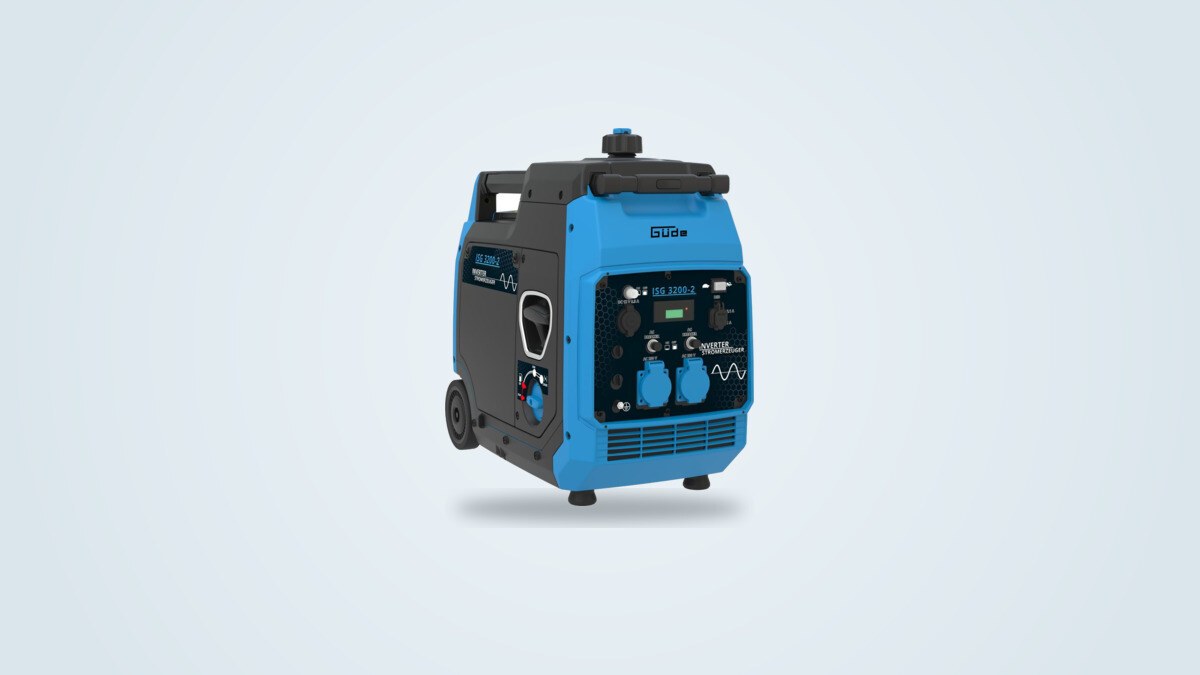
The panel brings together two 230V sockets (13.9 A combined), a 12V output rated at 8.5 A, or about 102 W available for topping up a car or RV battery, and two USB ports rated 1 A and 2.1 A for smaller devices.
The LCD display continuously shows load level, an overload warning, low oil and fuel level, so you're never left guessing how many hours are left before it runs dry. Two features stand out from the rest of the range. The Re-Start button, highlighted by the maker, lets you restart the unit after an overload trip without pulling the recoil cord by hand again, a genuine convenience on a 224 cc engine where every pull takes real effort. The ECO function, already familiar from the ISG 2000-2, cuts engine speed, and with it noise and fuel use, as soon as electrical demand drops. A parallel-operation terminal is also built in, in theory allowing two units to be paired for extra power; no source consulted confirms whether the connecting cable ships in the box or is sold separately, a point worth checking before buying with that use in mind.
A genuine inverter, EU-certified, with a 3-year manufacturer warranty
Inverter technology remains the core promise of the product: the DC current produced by the alternator is electronically rebuilt into a stable AC waveform before being delivered, independent of engine speed. No total harmonic distortion figure is published for this specific model, a gap shared by nearly every generator in this price segment, the Honda EU10i included.
The ISG 3200-2 is TÜV/GS certified, a recognized German safety mark under European standards; it carries no UL or ETL listing for the US market, which is consistent with a product not officially distributed here. Güde's engine range, badged Power-Engine, which this model belongs to, is covered by a 3-year manufacturer warranty in Europe, the same length already noted on the ISG 2000-2 and longer than the Honda EU10i's standard 2 years, though whether that warranty would be honored on a unit imported into the US independently was not confirmed for this review. Güde has made DIY and garden equipment since 1979 and distributes spare parts through a network of specialist retailers in Germany and several other European countries. No product recall or recurring manufacturing defect turned up for this specific model in the course of this research, but the available track record is thinner than for a Honda, some of whose equivalent engines are documented past several thousand hours of use.
70.5 lb on wheels: heavier than its inverter cousins, better equipped than conventional units
The ISG 3200-2 weighs 70.5 lb (32 kg) net, 79.4 lb (36 kg) boxed, with a footprint of 23.8 x 12.6 x 22.0 in (605 x 320 x 560 mm). That makes it the heaviest of any inverter unit compared in this review, well above the 28.7 to 46.3 lb (13 to 21 kg) of the Honda EU10i, the Güde ISG 2000-2, the Scheppach SG2500i or the maXpeedingrods MXR3800.
Güde offsets that weight with two wheels and a suitcase-style telescoping handle, a more complete solution than conventional units of similar size: the SDMO Perform 3000 (99.2 lb / 45 kg) has no wheels at all and needs two people to move, while the Einhell TC-PG 35 (92.6 lb / 42 kg) sticks to a basic wheeled frame with no telescoping handle. On flat ground, the ISG 3200-2 can be pulled solo like rolling luggage; loading it into a trunk or carrying it over rough ground still takes two people, as with any generator this heavy.
$716 shown here, but US availability is unconfirmed
The price shown on this page is $716. Research for this review places the ISG 3200-2, at continental European retailers billing in euros, in a range generally running from 599 to 899 €, or roughly $616 to $924 once converted at current rates, depending on the retailer and ongoing promotions. The $716 shown here sits comfortably inside that converted range.
What this review could not confirm is a genuine US buying path: no US retailer listing, importer, or stocking distributor turned up during this research, and this site's own product page currently shows no active US retail link. Güde is primarily a European brand, and this unit is built for 230V current, not the 120V standard in US households. Anyone considering this specific model from the US should confirm both an actual purchase path and the voltage question before treating the $716 figure as a real checkout price.
No carbon-monoxide detection confirmed: who the ISG 3200-2 suits
As with almost every generator in this segment, no automatic carbon-monoxide shutoff is confirmed on the ISG 3200-2. The unit must run outdoors only, in a well-ventilated space, never in a garage, tent or any other enclosed space even partially. The housing is also rated IP23M, a level of protection against solid objects and water spray consistent with reasonable outdoor use, though it won't tolerate direct, prolonged exposure to rain.
It suits a buyer who can source a European-voltage (230V) unit and needs genuine job-site or home-backup power (a cement mixer, a circular saw, several large appliances at once) without giving up the clean current of an inverter, and who values an established European brand and 3-year warranty terms over the lowest possible price.
It doesn't suit anyone shopping for a straightforward US checkout experience: with no confirmed US retailer and a 230V-only design, this specific model is a poor fit for a typical US household outlet. The maXpeedingrods MXR3800, at exactly the same claimed power, is both easier to source domestically and roughly a third cheaper and a third lighter.