59 dB(A) at reduced load claimed, a figure that matches no source found
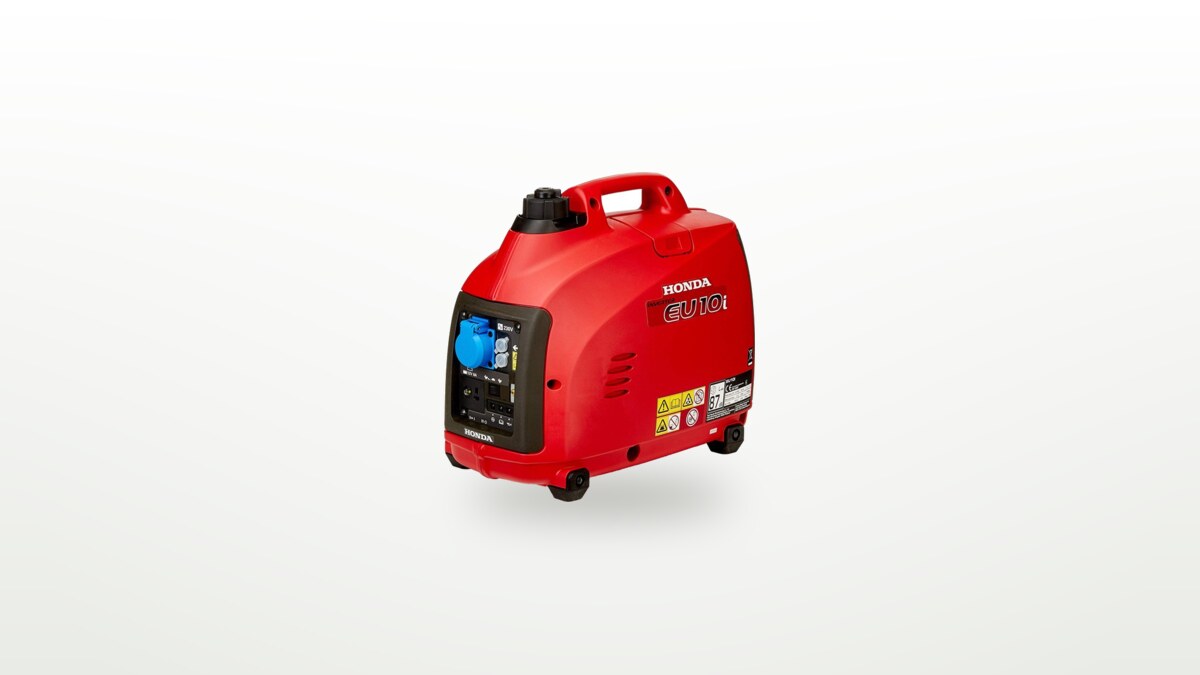
Three official Honda figures, published under distinct protocols, leave no room for confusion: a sound power measured at 84 dB(A), a sound power guaranteed at 87 dB(A) (European directives 2000/14/EC and 2005/88/EC), and an operator-position sound pressure level of 67 to 70 dB(A), measured in the official manual at 1.60 m height and 1.0 m distance. All three figures agree with each other and with the listing already in place.
The 59 dB(A) at reduced load figure this site's listing highlights is of a different nature: reduced load (Eco-Throttle mode, around a quarter of nominal load) sits closer to 52 dB(A) at 7 m, and near-nominal load around 58 dB(A). The 59 dB(A) figure, meanwhile, matches almost exactly the result of a theoretical free-field calculation from the 87 dB(A) of guaranteed sound power at 7 m distance, rather than a measurement specific to reduced load. It therefore more likely describes a near-nominal load than a reduced one.
A consistent stated runtime, but consumption at 900 W never independently measured
The 2.1 L tank gives an official runtime of around 3 hours 54 minutes at nominal load (900 W continuous), and up to 8 h in Eco-Throttle mode at low load. Both figures are consistent with the listing already in place.
However, no consumption measurement in L/h at continuous power, with a described protocol (weighed fuel, timing on a load bench), was found. The only figure available, around 0.54 L/h, is a calculation obtained by dividing the tank size by the stated official runtime, not a field measurement: treat it as a plausible order of magnitude, not as an independently verified figure.
The EU10i does not exist in the Japanese catalog, where the same engine sells under another name
The name “EU10i” appears nowhere in Honda's official range sold in Japan: on that market, the same GXH50 engine, the same chassis (13 kg, an identical 451 x 379 x 242 mm) and the same inverter technology are sold under the name EU9i (and its entry-level variant, the EU9i entry, without the parallel-operation feature). The shift from “9” to “10” between the Japanese market and export markets is not unique to Honda: Yamaha applies exactly the same renaming between its Japanese EF900iS and its export EF1000iS, a practice that is visibly widespread across the industry.
It is not just a naming translation. On the same 2.1 L tank, the Japanese EU9i entry spec sheet states a nominal runtime of 3.2 h against 3.9 h for the export version, meaning a calculated consumption around 22 % higher on the Japanese side, with no source able to explain this gap between two otherwise near-identical spec sheets (engine tuning, a different runtime calculation method?). Worth noting too: the informal name “Handy”, sometimes encountered, applies to the Japanese EU9i range, not to the export EU10i, despite the possible confusion between the two.
No automatic carbon monoxide detection confirmed for this market
The official French user manual for the EU10i contains only generic warnings about exhaust gases and the need for sufficient ventilation, with no mention of an automatic shutoff system for high carbon monoxide concentration.
A strong reputation for longevity, tempered by two real failures
Units still working after 15 years of use exist, as well as identical engines (EU1000i) that have exceeded 6000 hours of operation with maintenance limited to regular oil changes and a spark plug replacement. The most common wear beyond ten years is an oil leak linked to hardened seals, and engine stoppages in use are most often caused by the low oil level safety sensor rather than a genuine failure.
Occasional failures are nonetheless known: an ignition-circuit fault (coil, possibly the stator) causing voltage to collapse under load at idle, and an engine/carburettor gasket air leak causing rough running off choke, generally resolved by cleaning the carburettor and replacing the gaskets. Two isolated cases, not to be generalised, but real. The manufacturer's warranty runs two years, parts and labour.
Pairing two EU10i units: dedicated cable, 1800 W combined
Parallel operation requires a dedicated Honda cable (part number 32360-ZC3-000), seen priced between 37 and 56 € depending on the dealer in Germany. The combined output of two paired units reaches 1800 W (2 x 900 W nominal), with neither loss nor bonus noted. It is an option worth keeping in mind rather than a direct investment in a more powerful model, for anyone who already owns an EU10i and occasionally wants more power available.
Still sold new in 2026, a wide price range depending on the channel
The Honda EU10i remains actively sold new in France in 2026, including directly through Honda France's official online store (in stock, shipped within 24 h), as well as at around fifteen specialist dealers in outdoor power equipment, marine gear and motorhome supplies. No trace of a successor model was found: production of this model continues with no identified generation break.
The price shown on this site's listing (1039 €) falls within this range, representing neither the extreme high nor the extreme low. On the second-hand market, prices seen range from 450 to 800 €, a notably better hold on value than the main direct rival, whose second-hand units trade more in the 250 to 500 € range in comparable condition.
Motorhome and boat use, two common applications with real limits
For motorhome use, it is best to plug the unit into the vehicle's 230 V mains input rather than charging via a direct 12 V connection, letting the vehicle's smart charger manage battery charging. Recharging a heavily discharged battery (around 11.3 V) then takes around three hours or more of running time.
For boat use, the main application is recharging batteries at anchor and powering shore chargers. A real friction point: the unit's breaker can trip when a powerful shore charger (rated above 35 A) and another load, such as a water heater, draw on the unit at the same time. This is a sizing mismatch between the installation and a 1 kVA-class generator, not a flaw in the unit itself. Paired with a Victron-type smart charger, the overload protection can also trip at a high battery charge level (around 80 to 97 % charge), a technical limit worth anticipating for this kind of pairing.
Against the Yamaha EF1000iS, a choice driven more by reliability reputation than by raw performance
The Yamaha EF1000iS remains the main direct rival to the Honda EU10i.
| Criterion | Honda EU10i | Yamaha EF1000iS |
|---|---|---|
| Weight | 13 kg | 12.7 kg |
| Noise at 7 m, reduced load | 52 dB(A) | 48.5 dB(A) |
| Noise at 7 m, nominal load | 58 to 60 dB(A) | 60.5 dB(A) |
| Stated eco-mode runtime | up to 8 h | up to 12 h claimed |
| Second-hand price seen | 450 to 800 € | 250 to 500 € |
At reduced load, the noise gap clearly favors the Yamaha. But the two units get much closer at nominal load, a nuance that a single figure taken in isolation fails to capture. The case for the Honda rests mainly on its reputation for reliability and the availability of its after-sales network, more than on raw performance, a point consistent with the resale-value gap noted above.
Inverter current claimed clean, but no distortion rate published
No numerical total harmonic distortion (THD) value was found for the Honda EU10i: only generic marketing language describes a “clean” current, or one “equivalent to mains power”. For comparison, Yamaha claims a THD at or below 2.5 % across its inverter range, and Genergy claims a THD below 3 % on its Silent Inverter range: two manufacturer communication figures, not independent measurements, to be treated with the same reservation.
In practice, use with sensitive electronics (laptops, camera equipment, radio-control model batteries) shows no known incidents, which remains a favorable qualitative signal in the absence of a verifiable figure.
Building sites, markets, home backup: plausible but thinly evidenced uses
This product's listing highlights light building-site work, markets or food trucks, and home backup power during an outage. These uses remain plausible given the unit's power and portability, but no concrete, verifiable evidence was found for these specific situations, unlike motorhome and boat use, two well-established applications for this type of unit. This difference is more likely tied to the nature of these occasional uses than to any real unsuitability of the unit.
Who it suits, and who it does not
It suits anyone who values long-term reliability and a wide after-sales network, for regular nomadic use (motorhome, boat) with sensitive electronic devices to power, and who accepts paying a premium over cheaper alternatives in exchange for this reputation and strong resale value.
It does not suit anyone looking for the quietest possible model at reduced load at any cost (the Yamaha EF1000iS does better on this specific point), nor anyone needing more than 900 W continuous without pairing two units, nor anyone using the unit in a partially enclosed space without first ensuring genuinely sufficient ventilation, given the lack of confirmed automatic carbon monoxide detection for this market.