A German job-site generator, with no frills and no surprises
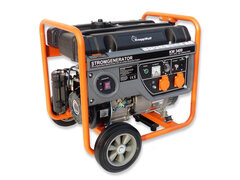
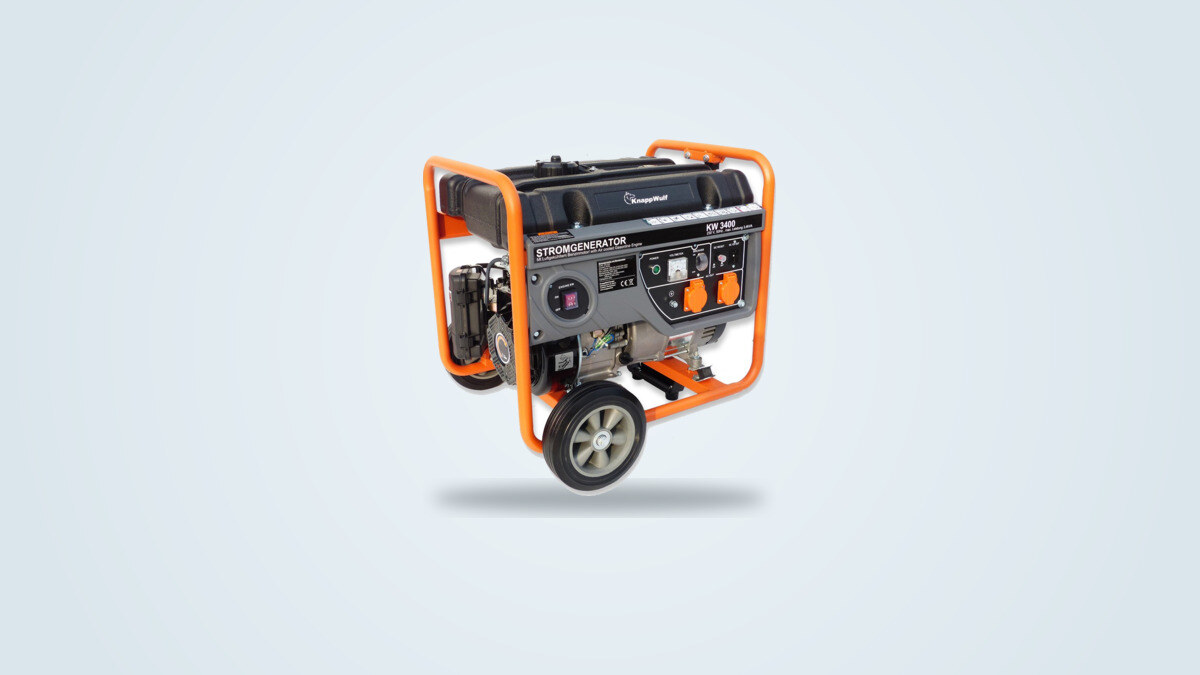
The KnappWulf KW3400 is a conventional gas generator (brushed alternator, no inverter stage), sold direct by this maker based in Frankfurt am Main, with distribution that also runs through general marketplaces. The orange tubular frame, the exposed engine and the control panel reduced to an analog voltmeter and two outlets set the tone: this is a tool for job-site work or household backup, not a leisure generator trying to impress on the spec sheet.
The engine is an air-cooled single-cylinder four-stroke of 208 cc, running on regular or premium unleaded, driving a brushed single-phase synchronous alternator with electronic AVR regulation. Power is stated the German way, in kilovolt-amperes then kilowatts: 3.4 kVA, or 3 kW, at peak, and 3.1 kVA, or 2.6 kW, in steady operation at 230 V and 50 Hz. A KW3400E variant, with electric start and a battery, exists in the maker's range for the same frame and the same output: the dedicated section further down covers what genuinely differs between the two.
2600 W continuous, 3000 W peak: power on a par with the best of the segment
The KW3400's spec sheet states 3.1 kVA or 2.6 kW continuous and 3.4 kVA or 3 kW at peak, across two 230 V outlets. The gap between the two figures is only 15%, a tight ratio that is not an inflated headline number, a common enough practice on generators of this class but not one every maker applies with the same rigor.
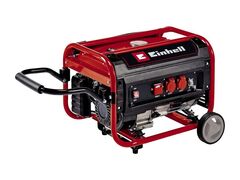
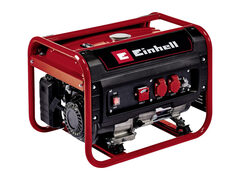
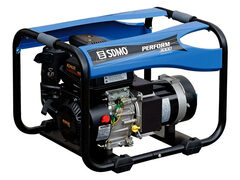
At 2600 W, the KW3400 matches the continuous output of the Einhell TC-PG 35, the most powerful of the three conventional generators already compared on this site, and beats the SDMO Perform 3000 (2400 W) and the Einhell TC-PG 25/1/E5 (2100 W). In practice that runs a cement mixer, a circular saw, a job-site lighting rig, or as household backup a refrigerator with lighting and a few appliances, without being able to stack several heavy loads at once.
15 liters, eleven to twelve hours quoted: a runtime to take with a grain of salt
The 15-liter plastic tank is stated by the maker to be good for eleven to twelve hours of running on one fill. That is a good capacity in absolute terms, identical to the Einhell TC-PG 35 and the Einhell TC-PG 25/1/E5, and nearly four times the SDMO Perform 3000's 4.1 liters.
In real use, that covers a working day on site or a night-time power outage without a refill, provided the full 2600 W is not drawn continuously. For genuinely continuous use at full load, keeping a spare fuel can on hand is a safer bet than trusting the quoted range at face value.
96 dB(A): a level exactly matching the three other generators already compared
The KW3400's guaranteed sound power reaches 96 dB(A), the figure declared under European regulations on noise emissions for outdoor equipment. The maker backs that standardized figure with a secondary measurement of 76 dB(A) taken at 13.1 ft (4 m) from the unit.
| Criterion | KnappWulf KW3400 | Einhell TC-PG 35 | Einhell TC-PG 25/1/E5 | SDMO Perform 3000 |
|---|---|---|---|---|
| Guaranteed sound power (LWA) | 96 dB(A) | 96 dB(A) | 96 dB(A) | 96 dB(A) |
| Maker's secondary measurement | 76 dB(A) at 13.1 ft (4 m) | 74.1 dB(A) at operator position | 73.1 dB(A) at operator position | 67 dB(A) at 23 ft (7 m) |
| Continuous power | 2600 W | 2600 W | 2100 W | 2400 W |
All four generators carry exactly the same guaranteed sound power of 96 dB(A), the standardized figure that allows a fair comparison between them regardless of where each one was measured, independently of the electrical output delivered. The secondary measurements are not comparable term for term, though: each maker takes them at its own distance (13.1 ft here, 23 ft for the SDMO, at the operator position for both Einhell units), which rules out naming a winner on that single figure. The useful takeaway is elsewhere: choosing the KW3400 over one of the three other conventional generators already compared on this site buys no extra quiet, and costs none either. That level rules out camping use or running it near homes in the evening; it stays within the norm of comparable equipment for daytime job-site work or the occasional backup run, kept well away from occupied rooms.
AVR regulation and recoil starting: what the stated reliability covers
A figure from the spec sheet is easy to miss: the engine develops a mechanical output of 7 hp, around 5.1 kW, at 3600 rpm, almost double the 2.6 kW of continuous electrical output stated on the panel. As with the Einhell TC-PG 25/1/E5, which draws 5.6 hp from an identical 208 cc displacement for a lower electrical output (2100 W), the gap comes down to engine tuning and the working margin kept to protect the alternator, not to marketing excess.
AVR (automatic voltage regulation) keeps the voltage close to 230 V regardless of the load, within the 2600 W available. It acts on the amplitude of the current, not on the shape of its wave: the KW3400 is a conventional generator, not an inverter model, and its brushed synchronous alternator produces current straight from the engine's rotation, with no electronic reconstruction of a smoothed wave. No harmonic distortion figure is published for this model, a gap common to conventional generators across this price bracket.
Starting is exclusively by recoil pull, helped by an automatic decompressor that eases the pulling effort. The first start typically takes two to three pulls before the engine catches, an ordinary trait of a single-cylinder engine of this displacement rather than a sign of weakness. A 13 A engine circuit breaker protects the 230 V outlets, and a safety shutoff stops the supply on low oil before the engine can be damaged. No track record spanning several seasons could be confidently tied to this exact model: that is a note of caution, not a proven fault.
103.6 lb (47 kg) on solid wheels with ball bearings: real strengths, a real limit
The KW3400 weighs 103.6 lb (47 kg) on a tubular frame measuring 23.6 x 17.5 x 20.9 in (600 x 445 x 530 mm), making it the heaviest of the four conventional generators compared here, ahead of the SDMO Perform 3000 (99.2 lb / 45 kg) and the Einhell TC-PG 35 (92.6 lb / 42 kg). In exchange, it is the only one of the four fitted as standard with genuine solid wheels on ball bearings, rather than plain plastic wheels on a bare axle: a detail that matters when moving the unit around a site, where the Konner & Sohnen KS 3000 charges extra for the same comfort as an optional kit.
That quality of rolling gear has its limits, though. Wheel diameter stays modest, and the unit struggles to roll over soft ground such as gravel or bare earth, where a larger wheel would clear the obstacle with no trouble. The recoil cord can also catch on the frame during the pull, and the short carry handle offers a limited grip the moment the ground turns uneven: three concrete points of mechanical friction, to weigh against the genuine quality of the wheels themselves.
Against the Einhell TC-PG 25/1/E5, the lightest of the group at 81.1 lb (36.8 kg) but with no wheels at all, the trade-off is simple: the KW3400 is heavier to lift, but far easier to move once it is on the ground.
KnappWulf, Frankfurt: German-made, with distribution still limited
KnappWulf GmbH is based in Frankfurt am Main and sells generators, compressors and garden equipment direct, with distribution that also runs through general marketplaces outside Germany. The brand remains primarily established on its home market, which can complicate getting hold of a spare part or a repair elsewhere in Europe, an ocean away from the US.
The terms and conditions reviewed do not advertise any extended manufacturer warranty comparable to the SDMO Perform 3000's three years or the two years advertised by Einhell on its two models. That is not necessarily a sign of a less durable product, but it is a guarantee on which this maker's documentation stays quieter than these two rivals.
No recall signal or recurring structural fault could be confidently tied to this exact model. The single-cylinder 208 cc engine is a generic block, without the professional standing of an engine maker such as Kohler on the SDMO Perform 3000, but without any particular negative signal either.
KW3400 or KW3400E: the real choice comes down to starting
KnappWulf offers the KW3400 in two versions sharing the same frame, the same 208 cc engine, the same output and the same 15-liter tank: the recoil-start version reviewed here, and a KW3400E fitted with an electric starter and its battery. The difference sits on a single point, but one that genuinely changes day-to-day use.
| Criterion | KW3400 | KW3400E |
|---|---|---|
| Starting | Recoil pull, automatic decompressor | Electric starter with battery, plus a backup recoil pull |
| Power and tank | Identical | Identical |
| Upkeep | No battery to watch over | A battery to charge and eventually replace |
| Price step-up | Base, $335 | A moderate premium, around $428 on the German market |
The electric starter mainly helps on a cold start or for anyone short on arm strength, at the cost of an extra battery to maintain and a higher price. The recoil-start KW3400 stays the simplest and lightest choice over time: nothing electrical to keep an eye on between two uses spaced months apart, which matters for a backup unit that can sit idle for a long stretch.
Against the three other gas generators already compared on this site
The KW3400 sits in the segment of conventional gas generators around 2.5 to 3 kW, alongside two Einhell units and one SDMO already reviewed. The table below sums up the real gaps between the four.
| Criterion | KnappWulf KW3400 | Einhell TC-PG 35 | Einhell TC-PG 25/1/E5 | SDMO Perform 3000 |
|---|---|---|---|---|
| Continuous power | 2600 W | 2600 W | 2100 W | 2400 W |
| Peak power | 3000 W | 3100 W | 2400 W | 2800 W |
| Fuel tank | 15 L | 15 L | 15 L | 4.1 L |
| Guaranteed sound power | 96 dB(A) | 96 dB(A) | 96 dB(A) | 96 dB(A) |
| Weight | 103.6 lb (47 kg) | 92.6 lb (42 kg) | 81.1 lb (36.8 kg) | 99.2 lb (45 kg) |
| Wheels as standard | Yes, solid on bearings | Yes | No | No |
| Extended manufacturer warranty | None advertised | 2 years | 2 years | 3 years |
| Observed price | ≈ $335 | ≈ $397 | ≈ $411 | ≈ $758 |
On paper, the KW3400 is the cheapest of the four by a clear margin, while combining the highest continuous power of the group and the only wheel-and-bearing kit fitted at no extra charge. What it does not bring in return shows up elsewhere: no extended manufacturer warranty clearly advertised where the three other brands offer one, a narrower after-sales network than Einhell's, and a generic engine without the professional standing of the Kohler unit fitted to the SDMO Perform 3000. The choice comes down to this: the best price-to-kit ratio of the group for anyone happy with a less established brand, the two Einhell units for wider distribution, the SDMO for an engine of professional standing and a longer warranty.
Who the KW3400 suits, and who it does not
It suits anyone after high continuous power, a large tank and genuine wheels as standard at the lowest price in the segment, for job-site work or a power outage at home, and who can live with the noise of an open-frame generator and a brand less widely distributed outside Germany.
It does not suit anyone who needs quiet for camping or running near homes in the evening, an inverter generator for sensitive electronics, a clearly advertised long manufacturer warranty, or an after-sales network already well established in their own country.