2000 W peak, 1800 W continuous: a spec sheet that adds up
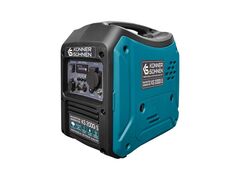
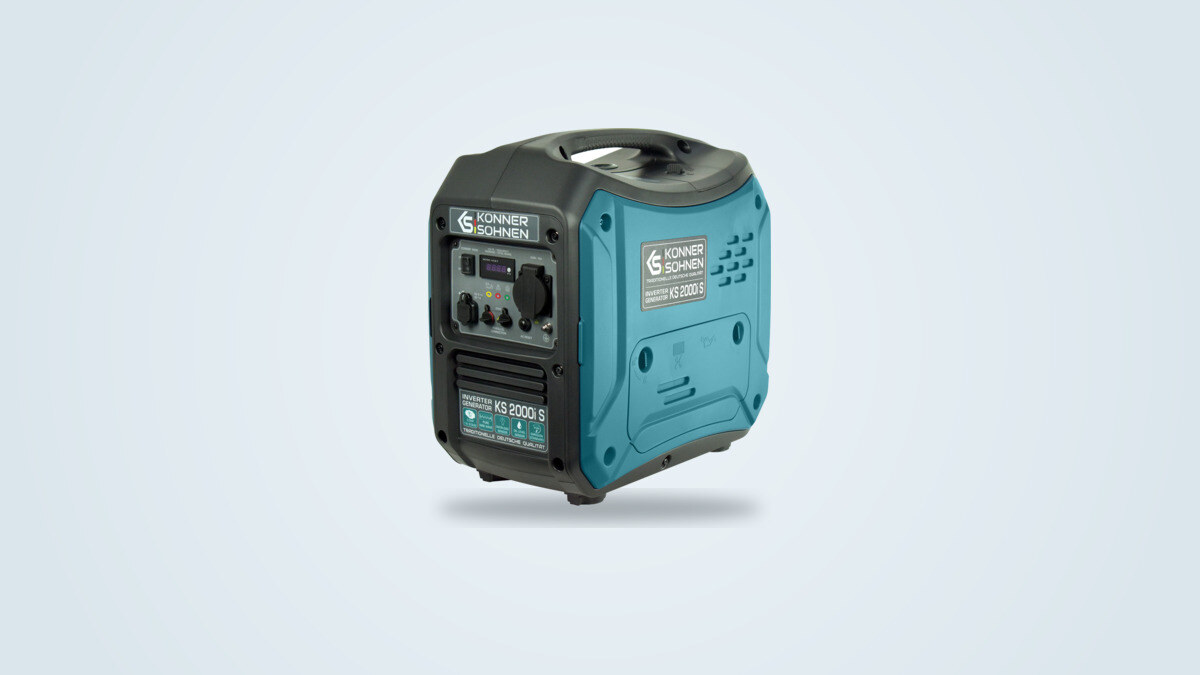
The Konner & Sohnen KS2000i S, sold in the US as the KS 2000iS CO, claims 2000 W peak and 1800 W continuous. On this kind of product, the gap between the two figures matters as much as their raw value: the smaller it is, the more the peak output stays available over time rather than for a few seconds only. Here the gap is 10%, a tight ratio that matches the maximum current the manufacturer claims: 17 A at 120 V on the US spec sheet (about 2040 W) and 8.7 A at 230 V on the European spec sheet for the same engine (about 2000 W). The two regional spec sheets, produced independently of each other, land on the same order of magnitude: a sign of consistency that a good part of the entry-level generator market lacks.
57 to 64 dB at 7 ft (23 ft): what the soundproofed casing is really worth
Quiet running is the central claim behind the KS2000i S's closed casing, but it is also the least stable figure from one official channel to another. The US spec sheet claims 57 dB(A) at 23 ft, or roughly 7 m, the manufacturer's European spec sheet for the same engine claims 62 dB(A) at 7 m (with a sound power level of 90 dB(A)), and the product artwork used on the French market shows 64 dB. Three official sources, three different figures, for a single casing design. A reading at 23 ft is inherently sensitive to ground surface, nearby obstacles and the angle chosen: commercial figures typically represent a best case rather than an average in use. None of this undermines the principle: a closed, soundproofed casing structurally cuts noise compared with a conventional open-frame generator. But none of these figures amounts to an independent, repeatable measurement, which rules out treating it as a claim of superiority over a rival that states, say, 58 dB(A) under different conditions.
1.3 gallons, about 5.5 hours at half load: a compact runtime
The official spec sheet for the KS2000i S claims about 5.5 hours of runtime at half load from its 1.3-gallon (5 L) tank. That is a compact figure, consistent with the rest of the unit: neither the longest-running in its category nor particularly short. The manufacturer does not publish any consumption figure at full continuous power (1800 W), which rules out a reliable cost-per-kWh calculation; rather than estimate that figure from unverified assumptions, it is better to stick to the one published data point. Starting remains manual, recoil pull-cord only: a firm pull, but nothing difficult on an engine of this size, 79.7 cc for 3.3 hp.
A pure sine wave under 3% distortion, a copper-wound alternator not certified for California
The KS2000i S's inverter technology produces a pure sine wave output. The manufacturer claims total harmonic distortion (THD) below 3%, a level of power cleanliness compatible with the most sensitive electronics: laptops, electronic controllers, lithium battery chargers. The alternator is 100% copper-wound: both the US and the European manufacturer spec sheets confirm this feature, which weighs on the alternator's working life. A solid copper winding handles heat better than an aluminium winding or a copper-clad aluminium winding, more common on entry-level models. On emissions, this unit is not CARB-certified: the manufacturer's own US store excludes shipping to California outright, a real restriction to check before ordering if that is where the generator would be used. The casing is rated IP23M, a level of protection against solid objects and water splashes consistent with reasonable outdoor use, without tolerating direct, prolonged rain exposure.
LED display, a household duplex outlet, Eco mode and parallel connection: full equipment
The control panel brings together an LED display (voltage, frequency, hour meter), an economy mode switch that trims engine speed under light load, a reset button ("AC Reset") that avoids having to strip the unit down after an overload cutout, and two differentiated USB ports: a 5V/2.1A port for faster charging and a 5V/1A port for a less demanding accessory. Mains power comes through a household duplex outlet, delivering two 120V/20A sockets rather than a single outlet, so two mains appliances can run at once without a power strip, within the 1800 W continuous limit. Two small parallel-connection ports are also present on the panel, to link two KS2000i S units and add their output for occasional extra power; the linking cable, however, is not included and is sold separately.
Against the Gude ISG 2000-2: same peak power, a price that does not compete
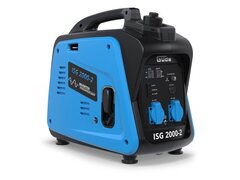
The catalogue already carries a page dedicated to the Gude ISG 2000-2, a portable inverter generator claiming the same 2000 W peak power, credited 3.9 out of 5. This is the most direct comparison on raw power, at a similar size.
| Criterion | KS2000i S | Gude ISG 2000-2 |
|---|---|---|
| Continuous power | 1800 W | 1700 W |
| Peak power | 2000 W | 2000 W |
| Tank | 1.3 gal (5 L) | 1.1 gal (4.1 L) |
| Claimed noise | 57 to 64 dB(A) at 7 m | 93 dB LWA |
| Outlets | Duplex, 2 x 120V/20A | None stated |
| Weight | 41.8 lb (19 kg) | 40.8 lb (18.5 kg) |
| Observed price | $459.00 | $392.46 |
The Gude's noise figure is expressed as sound power (LWA), not sound pressure at a set distance: the two metrics do not compare directly, and no independent measurement under the same protocol can say which of the two units is genuinely quieter. What does compare directly is price: at strictly identical peak power, the Gude costs $66.54 less.
41.8 lb, a built-in handle: portability for a backup unit
Both regional manufacturer spec sheets list a net weight of 41.8 lb, or 19 kg (the European sheet rounds to the same figure): the KS2000i S sits at the light end of its power category, level with the Gude ISG 2000-2 (40.8 lb / 18.5 kg). This site's product page rounds it to 44.1 lb (20 kg). It is neither featherweight nor a burden. The built-in handle, moulded into the top cover, allows one-handed carrying over short distances; the unit does not, however, have wheels, unlike more powerful models in the same product family. Dimensions stay compact at 21.8 x 13.2 x 21.2 in (500 x 285 x 460 mm), consistent with portable use: a car trunk, camping, a patio.
$459.00, a 3-year warranty: what sets the US version apart
The $459.00 price listed on this site's product page matches a promotional price observed directly on the manufacturer's own US store at the time of writing (marked down from a $549.00 list price), with no stock issue. That is a notable point in a segment where gaps between the listed price and the real market are common.
The warranty is where the US version genuinely pulls ahead: the manufacturer backs it with a 3-year residential warranty (parts and labor in year one, parts only in years two and three), against just one year or 1000 hours of use in Europe for what remains mechanically the same KS 100i engine. No recall or known safety defect has been identified for this model.
Carbon monoxide safety, and who the KS2000i S suits
The US version of this unit, sold as the KS 2000iS CO, builds in an automatic carbon monoxide shutoff sensor as standard, a feature the manufacturer does not mention on the European version of the same engine. That sensor is a backup, not a green light: the unit must still always run outdoors, in a well-ventilated space, never in a garage, a tent, or any other enclosed space even partially.
It suits anyone looking for a compact, well-finished backup generator for sensitive electronics (a laptop, chargers, a small fridge), for camping or for occasional backup power at home, who does not need more than 1800 W continuous, values the extra margin of a carbon monoxide sensor and a 3-year warranty, and does not live in California.
It does not suit anyone chasing the best power for the money, where this catalogue's Gude ISG 2000-2 does better on that specific point, nor anyone in California given the shipping restriction, nor anyone who needs more than 1800 W continuous.