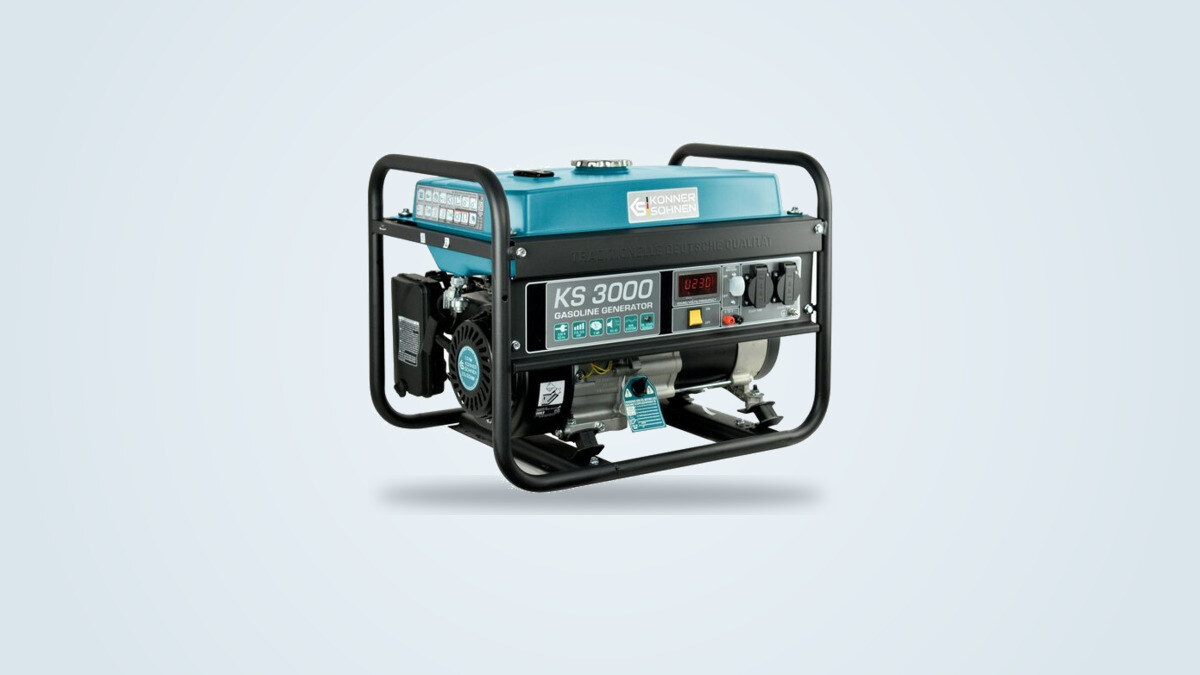
A German job-site generator, sold in several variants
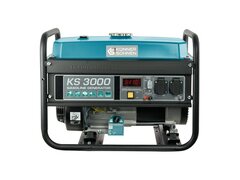
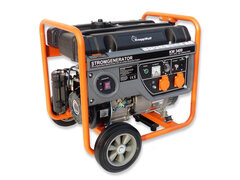
The Könner & Söhnen KS 3000 is a conventional open-frame gas generator from the German maker already in our catalog with the KS2000i S, its inverter cousin. The petrol-blue and black tubular frame, the exposed engine and a control panel reduced to an LED display and two Schuko sockets all point to a tool rather than a leisure device: backup power during an outage, light site work with no power hookup, a garage or an isolated workshop.
The engine is an in-house KS 210, a single-cylinder air-cooled four-stroke gas unit of 208 cc rated at 7 hp. It drives a synchronous alternator wound in 100% copper, paired with AVR voltage regulation. The same frame is also sold as the KS 3000E with electric start, for anyone who would rather skip the recoil pull. Separately, the maker also sells a KS 3000G, a dual-fuel gasoline/propane version with a very similar name but a different weight and price: the distinction is covered further down, since the two are easy to mix up when buying.
2600 W continuous, 3000 W peak: matching the strongest in its class
The KS 3000 is rated at 2600 W continuous and 3000 W peak, a 15% gap between the two figures that reads as an honest spec sheet rather than a purely commercial peak number. The maximum current the maker quotes, 13.04 A at 230 V at full output, lines up exactly with those watts.
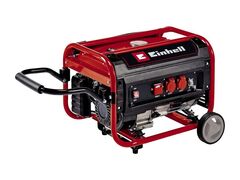
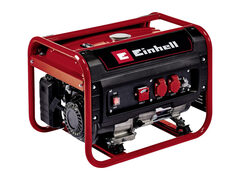
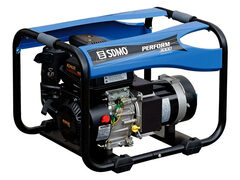
At 2600 W, the KS 3000 matches the Einhell TC-PG 35 and the KnappWulf KW3400, the two strongest generators already reviewed on this site, and beats the SDMO Perform 3000 (2400 W) and the Einhell TC-PG 25/1/E5 (2100 W). In practice, that covers a cement mixer, a circular saw, a site light, or, for home backup, a fridge plus lighting and a handful of appliances, without room to stack several heavy loads at once.
15 liters, 15 hours at half load: a clearly stated benchmark
The maker rates the 15-liter tank for fifteen hours of running at 50% load, roughly 1300 W drawn. That load level is explicitly stated, which is not a given among direct rivals: the resulting deduced fuel burn, roughly one liter per hour at that setting, therefore rests on a clearly stated baseline rather than a guess.
93 dB: the only one of five compared generators under 96 dB
The KS 3000's declared sound power reaches 93 dB, the standardized figure that allows several generators to be compared regardless of where each one was measured. The maker backs this up with a secondary reading of 68 dB(A) taken at 23.0 ft (7 m) from the unit.
| Criterion | Könner & Söhnen KS 3000 | Einhell TC-PG 35 | Einhell TC-PG 25/1/E5 | SDMO Perform 3000 | KnappWulf KW3400 |
|---|---|---|---|---|---|
| Declared sound power (LWA) | 93 dB | 96 dB | 96 dB | 96 dB | 96 dB |
| Maker's secondary reading | 68 dB(A) at 23.0 ft (7 m) | 74.1 dB(A) at operator position | 73.1 dB(A) at operator position | 67 dB(A) at 23.0 ft (7 m) | 76 dB(A) at 13.1 ft (4 m) |
| Continuous power | 2600 W | 2600 W | 2100 W | 2400 W | 2600 W |
Of the five conventional gas generators already reviewed on this site, four post exactly the same declared sound power of 96 dB, regardless of their electrical output: the KS 3000 is the only one down at 93 dB, a 3 dB gap that corresponds to half the actual radiated sound power. Its secondary reading of 68 dB(A) at 23.0 ft (7 m) also matches the best in the comparison, the SDMO Perform 3000 at 67 dB(A) at the same distance, and sits well below the readings taken at 13.1 ft (4 m) or at the operator position for the other three. That level still belongs to an open-frame set, not a sound-insulated one like the same maker's KS2000i S: it rules out camping or evening use near homes, but sits at the top of the pack for daytime site work or occasional backup.
AVR regulation, copper alternator: what the stated reliability covers
AVR (automatic voltage regulation) keeps the voltage close to 230 V regardless of the load applied, up to the 2600 W available. It acts on the current's amplitude, not on the shape of its waveform: the KS 3000 is a conventional generator, not an inverter set, and its synchronous alternator produces current straight from the engine's rotation, with no electronic reshaping into a smoothed wave. No harmonic distortion figure is published for this model, a gap shared by every conventional generator in this price range.
The alternator is wound in 100% copper rather than copper-clad aluminum, a detail that matters in this segment: copper runs cooler and ages better, a trait shared with the KS2000i S from the same maker, where that same winding already counted favorably toward build quality. Starting is by manual recoil pull on the base version, with an electric-start KS 3000E available for anyone who would rather skip it. A low-oil cut-out stops the engine before damage occurs, and an LED display continuously shows voltage, frequency and the hour counter. No recall or known safety defect has been identified for this specific model.
91.5 lb (41.5 kg) with no wheels: light to lift, less easy to move on the ground
The KS 3000 weighs 91.5 lb (41.5 kg) on a tubular frame measuring 22.8 x 16.9 x 17.3 in (580 x 430 x 440 mm), making it the second-lightest of the five conventional gas generators compared here, behind the Einhell TC-PG 25/1/E5 (81.1 lb / 36.8 kg) and ahead of the Einhell TC-PG 35 (92.6 lb / 42 kg), the SDMO Perform 3000 (99.2 lb / 45 kg) and the KnappWulf KW3400 (103.6 lb / 47 kg).
The trade-off lies elsewhere: no wheels are fitted as standard, with the KS 3 KIT transport kit sold separately, as on the Einhell TC-PG 25/1/E5 and the SDMO Perform 3000. The Einhell TC-PG 35 and the KnappWulf KW3400, by contrast, ship with wheels from the factory, the latter with solid ball-bearing wheels. The KS 3000's lighter weight makes it easier to lift into a car trunk with two people, but it does not make up for the lack of wheels once the unit is on the ground at a job site.
Könner & Söhnen: a brand already known in our catalog, up to a 3-year US warranty
Könner & Söhnen is a German brand already reviewed on this site with the KS2000i S, where the 100% copper-wound alternator and the absence of any known recall counted favorably toward build quality. In the United States, Könner & Söhnen backs the KS 3000 with a residential warranty of up to 3 years when the product is registered within 30 days of purchase (parts and labor the first year, parts only the second and third); without registration, coverage drops to 1 year. Commercial, industrial or unusually heavy use is covered for 6 months or 1000 hours, whichever comes first.
The single-cylinder 208 cc engine is an in-house KS 210 unit, without the reputation of a well-known third-party engine maker, but with no particular negative signal either. The LED display, the built-in fuel gauge and the low-oil cut-out round out a build that is consistent with the product's price, without claiming to match the finish of a generator costing twice as much.
KS 3000 or KS 3000G: don't mix up gasoline-only and dual-fuel
Könner & Söhnen also sells, under a very similar name, a KS 3000G that is a different product from the one reviewed here. Both share the same rated electrical output, 2600 W continuous and 3000 W peak, but they are two distinct products: the KS 3000 runs on gasoline only, while the KS 3000G is a dual-fuel version able to run on propane (LPG) as well as gasoline, supplied with the pressure regulator and hose needed for that use.
| Criterion | KS 3000 (gasoline) | KS 3000G (dual-fuel) |
|---|---|---|
| Fuel | Gasoline only | Gasoline or propane |
| Power | Identical | Identical |
| Net weight | 91.5 lb (41.5 kg) | 100.1 lb (45.4 kg) |
| Extra equipment | None | Propane pressure regulator and hose |
| Maker's list price | Base | Roughly $69 more |
This gasoline-and-dual-fuel family only carries a single rating grid on this site, but any genuine dual-fuel advantage on runtime and fuel cost applies to the KS 3000G, not to the model reviewed here: the maker does not publish separate fuel-burn figures for gasoline and propane on that variant, which rules out putting a precise number on that advantage. For anyone who does not need the flexibility of propane, the KS 3000 remains the simpler and lighter choice of the two.
Against the four other gas generators already reviewed on this site
The KS 3000 sits in the conventional gas segment around 2.5 to 3 kW, alongside two Einhell units, an SDMO and a KnappWulf already reviewed. The table below sums up the real differences between the five; the three European rivals are not confirmed to be sold in the US, so their prices and warranty terms are shown as observed on their home European market, for technical comparison only.
| Criterion | Könner & Söhnen KS 3000 | Einhell TC-PG 35 | Einhell TC-PG 25/1/E5 | SDMO Perform 3000 | KnappWulf KW3400 |
|---|---|---|---|---|---|
| Continuous power | 2600 W | 2600 W | 2100 W | 2400 W | 2600 W |
| Peak power | 3000 W | 3100 W | 2400 W | 2800 W | 3000 W |
| Tank | 15 L | 15 L | 15 L | 4.1 L | 15 L |
| Declared sound power | 93 dB | 96 dB | 96 dB | 96 dB | 96 dB |
| Weight | 91.5 lb (41.5 kg) | 92.6 lb (42 kg) | 81.1 lb (36.8 kg) | 99.2 lb (45 kg) | 103.6 lb (47 kg) |
| Wheels as standard | No (kit optional) | Yes | No | No | Yes, ball-bearing |
| Home-market warranty | Up to 3 yrs in the US (registered) | 2 years (EU) | 2 years (EU) | 3 years (EU) | Not identified |
| Observed price | ≈ $574 | ≈ $688 | ≈ $449 | ≈ $742 | ≈ $333 |
The KS 3000 is the only one of the five to drop below 96 dB of declared sound power, and it matches the highest continuous power in the group while remaining the second-lightest. On its home US warranty terms it also compares well, reaching up to 3 years with registration. What it does not bring, in exchange, shows up elsewhere: no wheels as standard unlike the Einhell TC-PG 35 and the KnappWulf KW3400, and a European list price that stays above the Einhell TC-PG 25/1/E5 and the KnappWulf KW3400 once converted. The choice comes down to this: the KS 3000 for anyone who values quietness and strong power together, backed by a solid US warranty when registered.
Who the KS 3000 suits, and who it does not
It suits anyone after a powerful, relatively quiet-for-its-class gas generator for a job site or a power outage at home, particularly when nearby neighbors or an occupied room are part of the decision, who registers the product promptly to secure the full warranty, and who can live without wheels as standard.
It does not suit anyone who needs wheels included at no extra cost, an inverter set for sensitive electronics (the same maker's KS2000i S fits that need better), or the flexibility of a gasoline/propane dual-fuel set, better covered by the KS 3000G.