What the promised 3533 Wh are really worth
The Mango Power E uses CATL lithium iron phosphate (LFP) cells for a nominal capacity of 3533 Wh. As with any inverter based station, how much of that is actually usable depends on the power being drawn: the conversion electronics consume a roughly fixed amount of power, which weighs proportionally more on a small, prolonged load than on a large, short one.
Under a 500 W load, the unit delivers 3080 Wh, or 87.2% of its nominal capacity. That figure climbs to 92.3% (3260 Wh) at 1400 W, then to 92.6% (3270 Wh) at 2000 W. The gap between the low and high end of that range is not a contradiction: it is the classic signature of an inverter whose own power draw stays roughly constant regardless of the current being delivered. These figures come from testing on the shared battery and inverter platform; no independent lab has measured the North American 120V unit separately.
On the charging side, filling the battery back up takes around 4025 Wh from the wall meter, about 14% more energy than the nominal capacity. Combining charge and discharge losses, round trip efficiency sits around 77%, a figure worth keeping in mind for anyone charging the unit from solar panels billed by the kWh produced rather than the kWh actually stored.
In practice, this load dependent efficiency gap separates two very different uses. For backing up a fridge and a router continuously, at a combined 100 to 200 W or so, the unit sits near the lower end of the measured range: a meaningful share of the stored energy goes into running the inverter itself rather than the connected devices. For running an electric oven, a kettle or a power tool at high wattage for a short burst, it sits closer to the upper end, with efficiency near 93%. The Mango Power E therefore suits occasional, high power draws better than round the clock standby on very small loads.
The 3000 W rating, and how it compares to the European unit
The North American Mango Power E, sold on a 120V circuit, is rated for 3000 W continuous. That figure is confirmed across the unit's own listing and independent hands on coverage, and stands apart from the 230V version sold in Europe, which carries a higher 3500 W continuous rating on the same 3533 Wh battery.
No independent lab measurement of the exact overload cutoff point was found specifically for the 120V unit. On the European 230V version, testing found the unit running without cutting out up to 3550 W, with overload protection only kicking in at 3700 W, a thin margin of about 200 W above its own continuous rating. Whether the North American unit's protection threshold sits at a similarly thin margin above its 3000 W rating has not been independently confirmed.
One limit that does appear to carry over regardless of region: outside a dedicated backup mode, the unit cannot charge and discharge at the same time. Plugging a device into the station while it is itself charging from the wall does not work the way it does on some rivals fitted with genuine, always on pass through.
Charging against the measurements, and the outlet that matters
Reaching the unit's full 3000 W charging rate, and the roughly 1 hour to 80% that comes with it, requires a 30A outlet, the kind more commonly found on an RV pad than inside a typical home, along with the matching cable. On a standard 15A household outlet, charging is capped well below that rate and takes roughly 3 hours to reach 80%. That distinction matters more in North America than in Europe, where a standard wall socket already supports the European unit's full charging power.
On solar, the input accepts up to 2000 W at 60 to 150V DC, through a single MPPT tracker and MC4 connectors compatible with the manufacturer's own panels. That is a generous solar input for this capacity class, but a single tracker means it is not possible to wire two differently oriented panel strings without losing efficiency on one of them.
| Mode | Max power | 0 to 80% | Full charge |
|---|---|---|---|
| 30A outlet (RV style) | 3000 W | ~1 h | ~1 h 50 |
| Standard 15A outlet | ~1800 W | ~3 h | longer, not independently measured |
| Solar | 2000 W | depends on sunlight | depends on sunlight |
The manufacturer sets the charging temperature range at 14 °F (-10 °C) to 113 °F (45 °C), narrower than the discharge range of -22 °F (-30 °C) to 140 °F (60 °C): an LFP battery charges poorly at very low temperatures regardless of the model, and the Mango Power E is no exception. No independent measurement of real world solar charging speed was found for this product, which makes it hard to confirm charging time under anything other than the full sun conditions the manufacturer describes.
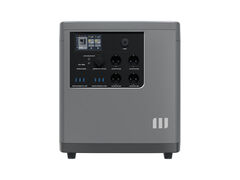
A piece of furniture with a touchscreen, not a case
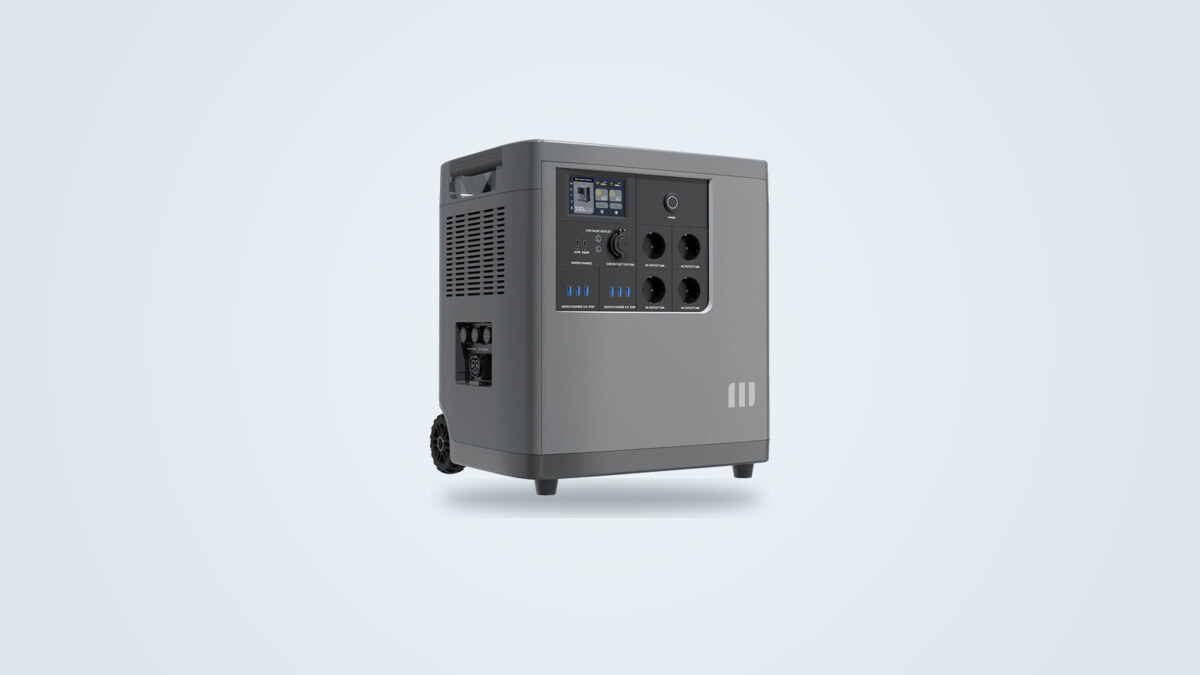
The Mango Power E breaks with the job site case shape used by most stations of this capacity. Mounted on two wheels with a telescopic handle, standing 19.4 in (494 mm) tall on a 17.8 x 13.6 in (452 x 345 mm) base, it looks more like a small cabinet or a mini fridge than a piece of camping gear. Its 100.1 lb (45.4 kg) remain substantial: the wheels help on flat ground, but do nothing for a flight of stairs.
Its most visible signature is the 4.3 inch color touchscreen built into the front panel, which lets you set charge and discharge thresholds without an app. Against the most cited direct rivals at this capacity, that exclusivity is real: neither a simple LED readout nor a small monochrome LCD offers the same level of local control.
The IP21 rating means protection against vertically falling drops, not against driving rain or fine dust. Despite marketing that sometimes gestures at outdoor use, the unit remains first and foremost an indoor, or covered shelter, appliance.
Ports and control, judged against its class
The port selection includes 4 standard household outlets, 2 USB-C ports (up to 100 W), 6 USB-A ports (up to 24 W) and a 120 W 12V output on a DC5521 connector. For a station of this capacity, the number of AC outlets is in line with its class, but the lack of a dedicated 12V cigarette lighter socket (only the DC5521 connector is offered) means an adapter is needed for a standard car accessory.
Control runs over Wi-Fi and Bluetooth through a mobile app, alongside the local touchscreen. At launch, the app was considered limited in its settings and only worked over Wi-Fi, without a full Bluetooth fallback mode. No recent independent assessment was found to confirm whether these limits have since been addressed.
For automatic whole panel backup during an outage, the separate mPanel accessory remains necessary and is sold on its own: alone, the station only powers whatever is plugged directly into it, up to 3000 W.
Build quality, warranty and field reliability
Overall finish, the wheels and the telescopic handle are solid, with a little play noted in the handle once extended. The CATL cells carry a 10 year warranty, and the complete unit a 5 year warranty, both longer than the market average for this product family.
The manufacturer rates the battery for 6000 cycles before it drops to 70% of its original capacity. No independent test has been able to confirm that figure over a full real world life cycle, as is the case for nearly every station on the market: it is a manufacturer projection, not a measurement.
The solar input circuit and its firmware have suffered failures on certain units, with guidance to keep input under 75V in practice while a fix is pending. Warranty turnaround varies widely from case to case: some replacements are handled in under a week, others have taken more than six months before a replacement was confirmed. A side panel door that does not stay shut properly has also been noted on one unit.
The manufacturer states the unit meets US and international safety and EMI standards, but no specific UL, FCC or ETL certification number was found in its documentation, a step behind several direct rivals that publish these references clearly.
Mango Power remains a young company, competing in a segment dominated by far more established, generalist players. The Mango Power E, launched in August 2023, remains to date the only version of this model: no second generation has been identified, which at least simplifies picking the right product compared with rival ranges that multiply variants. The cells themselves come from CATL, a supplier also used by several carmakers for electric vehicle batteries, a mark of industrial scale rather than a guarantee of the finished product's overall reliability.
Noise under load, what the measurements show
At about 1 foot (30 cm), the European unit measured around 40 dB under a light charging load (about 490 W), climbing to 43 to 47 dB between 1200 and 1400 W of charging or discharging, then reaching 61 dB once mains charging hit its 3000 W maximum. That last level is clearly audible, comparable to a normal conversation in the same room. No separate independent noise measurement was found for the North American 120V unit specifically, though it shares the same inverter and cooling hardware family.
The upside: that noise peak only applies to full power mains charging, a time limited phase. In everyday use, at moderate discharge loads, the unit stays quiet.
Expansion and pairing, at what real cost
Base capacity climbs to 7060 Wh with an expansion battery, then up to 14,000 Wh by pairing two units through the mPanel accessory, with home split phase power raised to 6000 W. That is real, and rare, expandability at this price point for a fixed furniture format rather than a modular, cabinet style system.
That level of expansion comes at a real cost, though a current, verified US dollar premium for the expansion battery alone was not found at the time of writing. On the European market, comparing the official price of the unit alone with that of the bundle including an expansion battery puts the extra cost of that single battery at around 2800 euros, nearly as much as the base unit itself minus its inverter and screen; there is little reason to expect the added cost of a second battery to be structured very differently in dollars.
The wider accessory ecosystem still has to be assembled piece by piece: the mPanel accessory handles backup switching for an existing breaker panel, a separate accessory adds a 240V output for larger appliances, and the manufacturer's own foldable solar panels are sold separately too. Each of these adds a distinct cost on top of the starting budget, a modular product line logic worth keeping in mind before comparing the listed price of the bare unit with a rival sold already fully equipped.
Real availability and pricing in North America
Mango Power remains a young brand in the North American power station market, less established than the generalist players in the segment. Pricing on this product has swung considerably since its August 2023 launch: the official listing price has at various points run well above $4,000, while promotions and bundle deals through other retail channels have at times pushed the street price down to a small fraction of that figure.
That spread is worth factoring into any buying decision: comparing today's price against recent historical pricing, rather than assuming a currently listed figure is the going rate, is particularly important on this product. Checking stock and current pricing across more than one retail channel before buying is a reasonable precaution given how much both have moved historically.
Warranty and support experience has also varied by case, with turnaround times ranging from about a week to more than six months for a confirmed replacement. Checking the return and warranty policy of whichever retailer or channel is used, before buying, adds a useful layer of protection given that spread.
Who the Mango Power E suits, against its direct rivals
The most coherent profile is a household after a fixed, presentable backup reserve for the living room or garage, not regular nomadic use: its 100.1 lb (45.4 kg) and furniture format are built to stay put rather than to follow an RV or a backpack from one site to another.
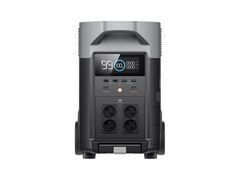
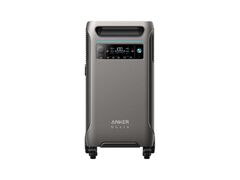
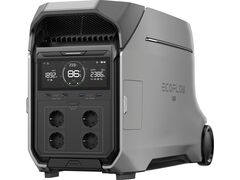
| Criterion | Mango Power E | EcoFlow Delta Pro | Anker Solix F3800 |
|---|---|---|---|
| Capacity | 3533 Wh (7060 Wh expandable) | 3600 Wh (25 kWh expandable) | 3840 Wh (53.8 kWh expandable) |
| Continuous power | 3000 W | 3600 W | 6000 W |
| Built in screen | 4.3 in color touchscreen | No (LED) | No (LCD) |
| Form factor | Rolling furniture | Rolling case | Rolling case |
Against the EcoFlow Delta Pro and the Anker Solix F3800, two direct rivals of similar size, the Mango Power E does not compete on raw maximum power or expansion ceiling, and its 3000 W North American rating sits below both. Its edge lies in its furniture format and local touchscreen, a combination neither of the other two offers. Working against it, on the other hand, are the recurring solar circuit failures and the brand's uneven retail availability.
A third alternative exists in modular form: a main unit paired with a separate battery, in the vein of a Bluetti AC300 combined with a B300, for a capacity near 3072 Wh split across two separate cases rather than one cabinet. That approach gains transport flexibility, since the two parts can be carried separately, but loses the Mango Power E's central appeal, a single block ready to roll with no cabling to assemble.
For an RV, a van, or a site that changes regularly, a lighter station remains the more sensible choice: the Mango Power E was not designed for that use case, wheels notwithstanding. On a tighter budget, notably cheaper rivals exist at a similar capacity; the price premium for the Mango Power E is only worth paying if the built in touchscreen and furniture format genuinely matter to the decision.