A component cell, not a drawer battery: identifying the P42A correctly
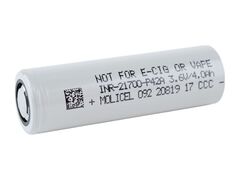
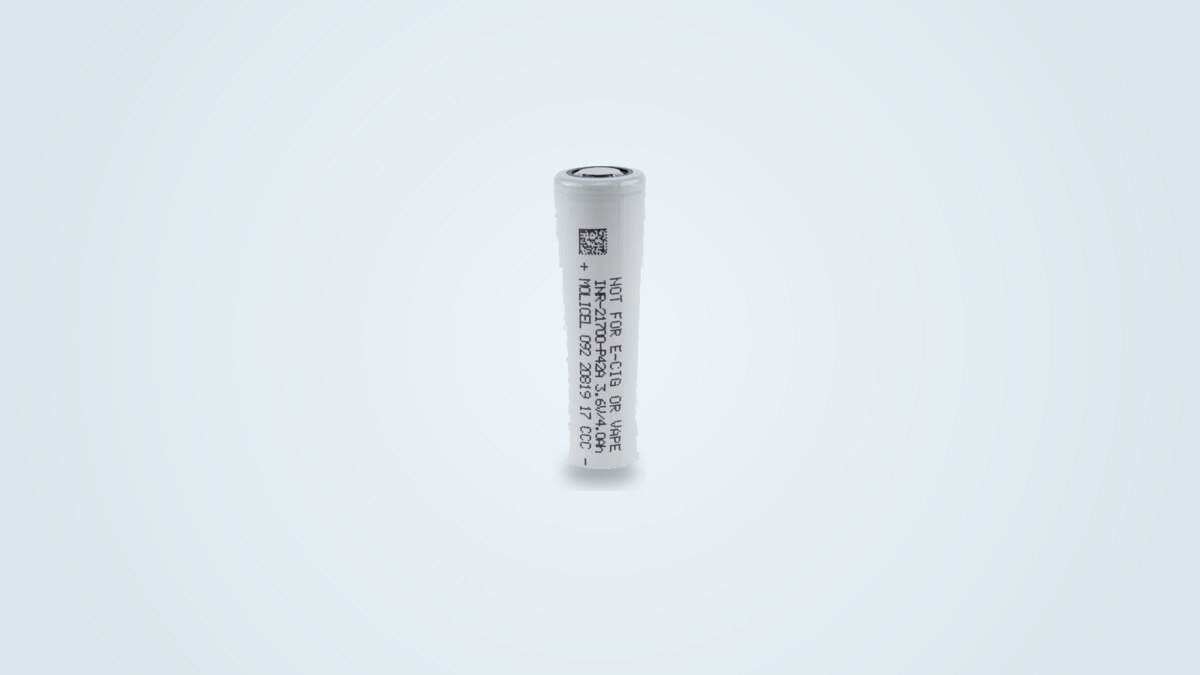
The Molicel P42A is not an everyday consumer battery: it is a bare cylindrical lithium-ion cell, in the 21700 format (0.85 in / 21.7mm in diameter, 2.76 in / 70.2mm long, about 2.4 oz / 68g), sold with no protection circuit or casing around it. It serves as the building block for very powerful flashlights and headlamps, DIY packs (e-bikes and e-scooters, rebuilt cordless tools), and high-power rebuildable vape mods. Its 3.6V nominal voltage (4.2V max charge, 2.5V discharge cutoff) has nothing to do with the 1.2 to 1.5V of an AA or AAA battery, and fitting it in place of a regular consumer battery would damage both the device and the cell.
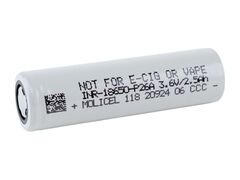
Molicel's high-drain lineup includes several closely named references that should not be confused. The P26A, already in our selection, is the 18650 version (smaller, 2600mAh, 35A): same philosophy, different format. The newer P45B keeps the same 21700 format and the same 45A continuous discharge rating, but with higher capacity (4500mAh) and even lower internal resistance. This review covers the original P42A, in the 21700 format, with a 4200mAh typical capacity and a rated 45A continuous discharge: the fact sheet's specifications (format, capacity, current) match this exact reference, not its 18650 cousin or its more capacious replacement.
This review uses the same rating grid as the rest of the site's Batteries section, already applied to the Panasonic NCR18650B and NCR18650GA cylindrical cells. The format differs (21700 versus 18650), and the P42A leans even further toward current than the NCR18650GA itself: each axis here is read in light of that high-drain purpose, rather than as a direct comparison of specifications that do not measure the same way across formats.
Capacity that lives up to the claim, even under heavy load
Molicel rates the P42A at a typical 4200mAh, with a guaranteed minimum of 4000mAh, for roughly 15.1Wh of energy at nominal voltage. Measured cells deliver 4085 and 4133mAh depending on the sample, comfortably above the guaranteed minimum and close to the rated typical value: a level of fidelity to the maker's claim that is not so common on a cell this focused on current.
The most notable point is not the figure itself but how stable it is: available capacity barely changes between a slow discharge rate and one close to 30A, already a very high continuous current for this format. Many generalist high-capacity cells lose noticeable apparent capacity as they approach their maximum current; the P42A, designed from the outset for high amperage, does not show that drop-off. In practice, this means the 4200mAh figure holds up just as well at moderate current as at high amperage, a trait rarer than it sounds in this segment.
45A claimed, 30A genuinely comfortable: what the headline figure hides
This is the defining trait of the P42A, and what justifies its slightly higher price than a pure-capacity 21700 cell: a continuous discharge current Molicel rates at 45A, among the highest in the format. But that figure needs to be read with its real operating condition. Pushed to 30A, a load well below the rated ceiling, cell temperature already approaches 176 °F (80 °C), the maximum safety limit Molicel sets for this model. The genuinely comfortable continuous ceiling therefore sits closer to 30A, with an intermediate zone up to 40A that stays usable under thermal monitoring, and a 45A rating that reads more like a short burst under good airflow than a sustained load.
This is not a flaw specific to the P42A: it is a trait shared across this whole class of cells. Samsung's own official spec sheet lists two separate tiers for its 40T, another widely used and directly comparable high-drain 21700 cell: 35A plain continuous, and 45A only with a 176 °F (80 °C) thermal cutoff, exactly the same mechanism. A continuous discharge figure on a high-drain cell's spec sheet should therefore always be read as a ceiling reached at the safety thermal limit, not as a comfortable margin available at all times.
In a DIY pack or a very high-current flashlight, sizing the electronics and airflow for a sustained 25 to 30A per cell, rather than the spec sheet's 45A, remains the safest way to use this cell without cutting its lifespan short or edging toward the maker's safety threshold.
500 cycles at 80%, measured at an already demanding rate
Molicel rates the P42A at 80% capacity retention after 500 full charge and discharge cycles, a figure that at first glance looks close to the one already cited for the Panasonic NCR18650B and NCR18650GA cells in our selection (also around 500 cycles, but for a steeper drop, around 68% of initial capacity). A raw comparison would be misleading, though: the P42A's test protocol applies a 10A discharge, a noticeably more demanding rate than the one used for those two capacity-focused cells, which makes the P42A's result harder to earn, not just better on paper.
The maker itself notes that this endurance drops off at discharge rates closest to the 45A ceiling: the 500-cycle, 80% figure applies to 10A use, not to routine near-maximum loads. For a DIY pack or a flashlight used only occasionally at very high current, real-world endurance will track closer to this official figure if most of the use stays under that 10A threshold, with shorter peaks beyond it.
As with any lithium-ion cell, a partial discharge rather than a full cycle every time extends this lifespan considerably. Self-discharge in storage stays in line with high-drain lithium-ion cells generally, without matching the specific strength of NiMH cells built purely for that one trait.
Tactical flashlights, DIY packs, rebuildable vaping: real but expert-level versatility
The unprotected Flat Top format (0.85 x 2.76 in / 21.7 x 70.2mm) stays compatible with the vast majority of holders, flashlights and home-built packs designed for the 21700, a format that has grown steadily over the years against the older 18650 without fully replacing it in older holders and flashlights. Within that format constraint, the P42A covers a wide range of uses for a cell this focused on current: tactical flashlights rated at several thousand lumens, rebuildable sub-ohm mods at moderate resistance, DIY packs for e-bikes and light e-scooters, and cordless tool packs rebuilt from cylindrical cells.
This versatility stays reserved for an experienced audience. On one side, the cell is no substitute whatsoever for an everyday AA or AAA battery, neither in voltage nor in format. On the other, for a mechanical mod or a very low resistance that calls for even more current headroom than the P42A's comfortable ceiling, an even more extreme cell exists in the same lineup (the P45B, or the P26A in the 18650 format for a more compact build), at the cost of a different capacity. The P42A occupies the broadest middle ground: enough current for the vast majority of experienced high-drain uses, without giving up as much capacity as a cell built for the extreme.
Build and safety: counterfeiting, acknowledged by Molicel itself
Molicel has published an official warning against counterfeits sold under its name, stating that any product not bought from the brand or its authorized distributors should be considered a copy that has never gone through its own quality checks. This is not a generic precaution: P42A units sold at very low prices on informal marketplaces have turned out to be copies with nothing in common with the genuine cell beyond the label. The risk is all the more real because the P42A, in high demand among flashlight, vaping and DIY communities, ranks among the brand's most imitated references.
Beyond the counterfeiting issue, a fire broke out in July 2025 in a testing area at a Molicel-group factory in Kaohsiung, Taiwan, causing minor injuries among staff during evacuation; the maker issued official statements about the incident. This was an upstream industrial event, at a production and testing site, not a failure of a cell already in use: it has not been linked to any defect affecting P42A cells already sold, but it is part of the company's safety record and is worth knowing about.
Molicel also carries industrial credibility that goes beyond the hobbyist market: the brand has supplied cells to Milwaukee's professional power tools since 2004, and was one of the first qualified suppliers for an electric vehicle program (the BMW MINI E) back in 2008. On handling, the precautions stay the same as for any bare, unprotected lithium-ion cell: a dedicated 3.6V charger, never a NiMH one, and avoiding any short-circuit, overcharge, or loose storage without an insulating case. One notable detail spotted on recent batches: the label now carries a "Not for e-cig or vape" print, a precaution tied to tightening US rules on marketing bare cells for that use, which changes nothing about the cell's electrical characteristics and does not stop its well-established use, elsewhere, in rebuildable vaping by experienced users.
Against the Samsung 40T and the rest of the Molicel lineup
Within the same class of high-drain 21700 cells around 4000 to 4200mAh, the Samsung 40T is the most direct point of comparison. Both cells share the same two-tier discharge construction (a plain continuous rate, and a second, higher rate reached only with a 176 °F/80 °C thermal cutoff) and an almost identical footprint. The P42A keeps a slight capacity edge and holds voltage better late in discharge; the 40T, for its part, shows a somewhat smaller initial voltage sag right at the start of discharge. The gap between the two stays small: the choice mostly comes down to availability and price at the time rather than any decisive performance difference.
| Criterion | Molicel P42A | Samsung 40T |
|---|---|---|
| Typical capacity | 4200mAh | 4000mAh |
| Guaranteed minimum capacity | 4000mAh | 3900mAh |
| Rated continuous discharge | 45A | 35A plain / 45A with 176 °F (80 °C) cutoff |
| Weight | ~2.4 oz (68g) | ~2.5 oz (70g) |
| Format | 21700 unprotected Flat Top | 21700 unprotected Flat Top |
Within Molicel's own lineup, the P42A is no longer the most capacious cell: the P45B (4500mAh, same 45A tier, lower internal resistance) and the P50B (5000mAh) have since overtaken it on that single measure. It still holds its place in the catalog as the most proven and most widely available cell in the brand's high-drain 21700 lineage, with a track record its newer replacements do not yet have. Against the P26A, already in our selection in the 18650 format, a direct number-for-number comparison does not make sense: format and volume, and therefore capacity and current, differ too much to read side by side. What really sets the two cells apart is the intended use: the P26A suits a device built around the 18650, while the P42A suits a device or pack built around the 21700, with higher absolute capacity and current thanks to its larger format.
Who the P42A suits, and who it does not
The Molicel P42A suits a specific audience: anyone building or servicing a DIY pack, a very powerful flashlight, or rebuilt cordless tools, who needs high continuous current without giving up all capacity. It also fits rebuildable vaping at moderate resistance, as long as use stays within the cell's genuinely comfortable current range rather than chasing the spec sheet's ceiling. In every case, it assumes knowing how to pick a suitable lithium-ion charger, respecting voltage and current ranges, and buying new from a reputable source rather than an anonymous marketplace.
It is not the right fit, however, for anyone looking for a drop-in replacement battery for a consumer device: its 3.6V voltage and lack of a protection circuit rule that out. For a need centered on pure capacity rather than current, with no format constraint, a capacity-focused 21700 or 18650 cell remains more suitable and usually cheaper. For current needs beyond the P42A's comfortable ceiling, the P45B or the 18650-format P26A serve better, each with its own capacity trade-offs.