The power bank function: 18W on paper, less in practice
The Olantern Classic 2 Pro is not just a lantern: its 40.32 Wh battery also feeds two outputs, USB-C and USB-A, rated to deliver up to 18W to recharge a phone or a small accessory during a power outage or a camping trip far from an outlet. The principle genuinely works, but the 18W ceiling is not guaranteed regardless of what gets plugged in.
Both ports offer an adaptive voltage across three steps, 5V, 9V and 12V, each paired with a different maximum current. The full 18W is only reached at the 12V step. Most recent USB-C smartphones, however, negotiate their charge at 5, 9, 15 or 20V under the USB Power Delivery standard, rarely at a fixed 12V. In practice, plugging an ordinary smartphone into the Olantern most often settles around 5V and 1.5A, about 7.5W, well short of the ceiling printed on the spec sheet.
| Voltage | Maximum current | Power |
|---|---|---|
| 5V | up to 2.4A | 12W |
| 9V | up to 2A | 18W |
| 12V | up to 1.5A | 18W |
This is not a hidden flaw so much as the same logic behind most fixed-step fast-charging ports, which need the receiving device to know how to ask for the right voltage. A small USB fan, a headlamp or a 12V accessory will make full use of it. A smartphone will most often settle for a noticeably slower charge than the spec sheet suggests.
The result is still useful: a phone at under 50% regains a full charge in about ninety minutes from the Olantern's port. Enough to get through to the next morning without packing a dedicated power bank, though it won't replace a fast, dedicated power bank for heavy daily use.
300 lumens claimed, 20 minutes held
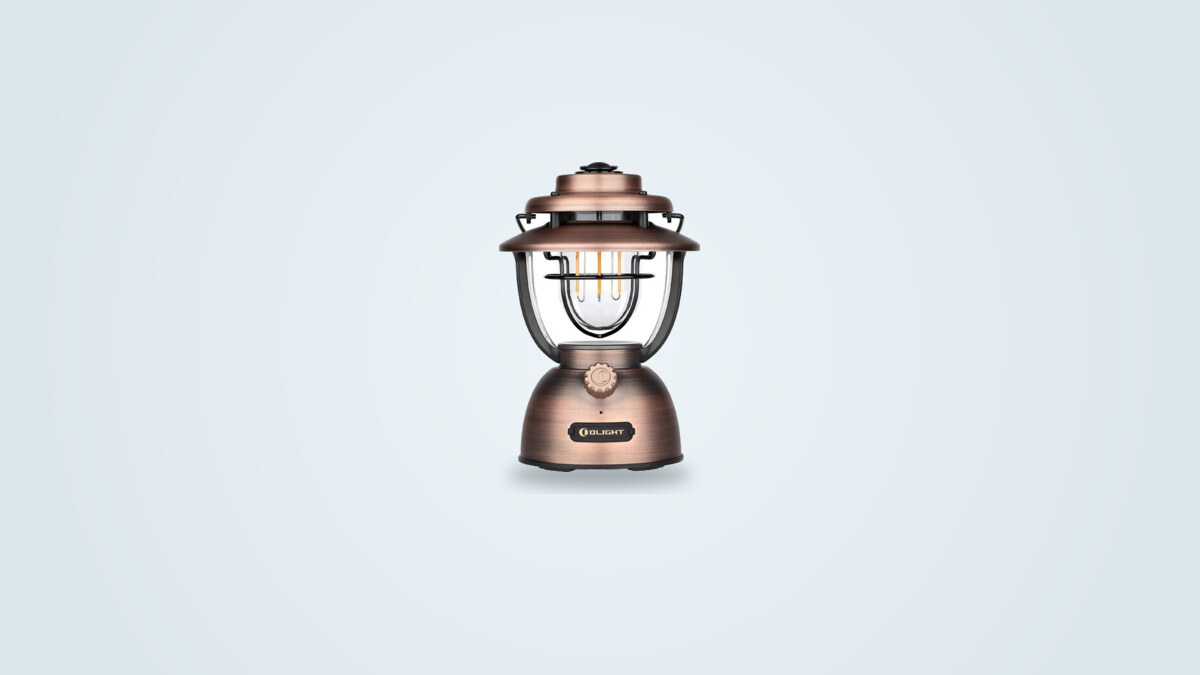
The Olantern Classic 2 Pro's rotary knob covers the entire brightness range in a single continuous motion, with no detents or fixed steps. Starting from the minimum, the orange light climbs from 10 to 130 lumens, then the lantern switches to its warm white diodes to climb further, up to 300 lumens. Nothing physically marks the switch between the two tints, which can be surprising the first time you pick it up.
The stated levels are met, and even slightly exceeded in the first seconds after switching on: 134 lumens on an orange step rated at 130, 142 lumens on the warm white low step rated at the same value, and 318 lumens on the warm white maximum rated at 300. The two tints are clearly distinct: about 1850 K with a color rendering index around 90 for orange, about 3000 K with an index around 82 for warm white.
The 300-lumen maximum, however, is not a setting held over time. It only lasts 20 minutes before the lantern automatically steps down to 200 lumens for 8 hours, then to 150 lumens for 16 hours 40 minutes. This is a deliberate thermal and energy trade-off, but the spec sheet presents these three steps as a single "high" mode without spelling that out.
Throw distance is not this lantern's selling point, built as it is to light a 360° area rather than reach far: about 34 ft (10.5 m) at maximum on the orange setting and nearly 46 ft (14 m) on warm white at maximum, figures in line with a campsite lantern rather than a long-range signal light.
Runtime: short of the claims up top, far past them at the bottom
The gap between the claim and reality does not run the same way depending on the setting used, and that is the single most useful fact in this review. On the two brighter settings, runtime down to 10% of initial output, the flashlight industry's standard yardstick, falls well short of the maker's claim. On the most economical setting, it's the opposite: runtime goes well beyond it.
| Setting | Claimed runtime | Actual runtime | Gap |
|---|---|---|---|
| Orange, 130 lm | 23h | 14h 01m | 61% of claim |
| Warm white, 300 lm (steps combined) | 25h | 17h 56m | 72% of claim |
| Orange, 10 lm | 180h | 276h | 153% of claim |
The mechanism makes sense. The 10% cutoff applies to a high starting brightness: on warm white, that works out to 30 lumens, a level the lantern crosses fairly quickly once the battery is partway through its discharge. On the most economical setting, by contrast, 10% of 10 lumens is a barely perceptible glow, so the lantern keeps being useful well past that theoretical cutoff, and the maker's claim, conservative on this point, ends up beaten by a wide margin.
For ordinary camping use, this flips the usual advice on its head: relying on the most economical setting for several nights pays off even more than the spec sheet suggests, while counting on a full 23 hours at the comfortable 130-lumen setting is optimistic.
Charging: 4 hours by cable, more than double that on the magnetic dock
A full charge over USB-C cable takes about 4 hours with an adapter capable of delivering the needed 18W. That's a solid rate for 40.32 Wh, consistent with the stated input power, and a figure that comes up consistently across every spec sheet.
A magnetic charging dock ships alongside it, a handy alternative when the USB-C port is already in use or hard to reach once the lantern is set down. The convenience comes at a cost in speed, though: a full charge over the magnetic dock takes about 10 hours, more than twice as long as by cable. Olight states this itself in its documentation, without ever leading with it in its marketing.
An LED indicator built into the base shows charge status at a glance: red while charging, green from 95% onward. One cabling detail is worth knowing before buying: a USB-A-to-C cable will not reach the same charging speed as a genuine USB-C-to-C cable, the difference coming down to the power negotiation that only the latter can carry out properly.
The manual also states a storage limit worth respecting: a temperature above 140 °F (60 °C), for instance inside a car in summer, is not recommended for the built-in battery. A simple precaution, but a useful one for a lantern meant to travel in a car trunk or a camping bag.
Don't confuse it with the Smart version
Three lanterns now carry a very similar name at Olight, and mixing them up means buying the wrong one. This review covers the original Olantern Classic 2 Pro (UPC 6972378126177), controlled solely by its rotary knob, with no Bluetooth or app. Two other versions exist and don't share the same features.
| Version | Classic 2 Pro (this review) | Classic 2 Lite | Classic 2 Pro Smart |
|---|---|---|---|
| Power source | Built-in 11,200 mAh battery | 4 AA batteries | Built-in battery |
| Power bank function | Yes, 18W | No | Yes |
| Controls | Knob only | Knob only | Knob and Olight app |
| Stated minimum runtime | 180h | 105h | 180h |
The Smart version, released after the one reviewed here, adds Bluetooth control from the Olight app: real-time battery level, timer, a sleep mode that switches the lantern off after 3 hours of inactivity when enabled, and remote tint switching. It sells at a price very close to the original, making it a logical alternative for anyone who values that remote control.
One market signal points the same way: at least one specialist retailer already lists the original gray colorway as discontinued, suggesting a gradual shift toward the Smart line. Before buying, check that the full product name, on the box as on the retailer's listing, does not mention "Smart" if the knob-only version is what you're after, or check for its presence if app control matters to you.
Build quality: metal everywhere, a battery you'll never replace
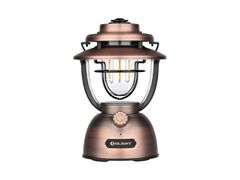
Build quality is the one point every source agrees on: a steel frame, a 2mm polycarbonate globe, Torx screws rather than plastic clips, and a copper-finished housing that never creaks or flexes at the seams. Under the globe, the orange section combines three vertical tubes and four pot-light LEDs, while the warm white section lines up 16 LEDs, two genuinely separate optical assemblies rather than a single filtered LED array.
The built-in battery pairs four 18650 cells wired in parallel to total 11,200 mAh at 3.6V. That cell format happens to be one of the most standardized on the market, used as a swappable part in plenty of flashlights, Olight's own included. Here, it's soldered and glued in place: no replacement is possible, and the lantern's entire service life follows that of its battery, with no recourse once its charge cycles run out.
No safety recall affects the Olantern Classic 2 Pro to date; the only recall tied to the brand covers two entirely different flashlights, the Warrior Mini and the M2R Pro, pulled in 2022 over a risk of accidental activation in a pocket, an unrelated product with no bearing on the lantern reviewed here.
Weight and size: the price of a genuine metal housing
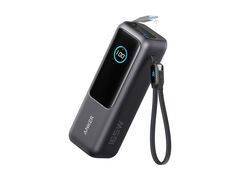
On the scale, the Olantern Classic 2 Pro lands between 1.65 and 1.67 lb (748 to 757 g) depending on the unit, for a base diameter of 4.9 in (124 mm) and a height of 7.3 in (186 mm). Set against the battery's 40.32 Wh, that works out to an energy density of about 53 Wh per kilogram, a mediocre figure for a standalone power bank: a dedicated power bank of comparable size, like the Anker A1695, tops 150 Wh per kilogram.
The comparison is misleading if taken at face value, though. Nearly all of that weight serves the device's primary job: a complete metal frame, a globe protected by a steel cage, a top handle and a hanging ring built to hook the lantern onto a tent awning or a branch. This isn't a power bank that happened to gain a light, it's the other way round.
For anyone after a light, easily packed energy reserve above all, that weight remains a genuine drawback. For anyone after a sturdy lantern that also happens to offer that service, it's entirely justified.
Against other multi-function devices in the same aisle
Against a plain AA-powered lantern, such as the Classic 2 Lite in the same line, the Olantern Classic 2 Pro costs noticeably more up front but removes the battery budget and adds the power bank function. Against a dedicated power bank of comparable capacity, though, it loses on nearly every criterion that makes a good power bank: fewer watt-hours per dollar, no status screen, and a much higher weight for the energy actually available at the output.
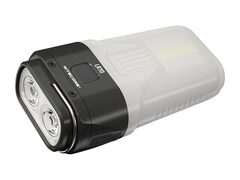
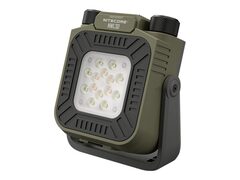
| Device | Olantern Classic 2 Pro | Nitecore LR70 | Nitecore NWL30 |
|---|---|---|---|
| Functions combined | Lantern + power bank | Flashlight + lantern + power bank | Work light + power bank + mosquito repeller |
| Battery capacity | 11,200 mAh | 10,000 mAh | 18,000 mAh |
| Priority | Retro style, metal finish | Versatility, high light output | Versatility, job-site use |
Both Nitecore units bet on raw versatility and a far higher light output, in a more utilitarian housing. The Olantern flips that priority: fewer peak lumens, but a warm, adjustable light built for ambience, in a housing that belongs on a table rather than in a toolbag.
Against more utilitarian lantern-flashlights with a plainer finish, the Olantern's lumens-per-dollar ratio comes up short: several competing models, without the retro styling, deliver more lumens per dollar spent and take user-replaceable batteries or cells. That gap is real, but it compares two different buying logics: one chases the cheapest possible light, the other wants a finished object, set on a table, that lights a space as well as it decorates it.
The Olantern Classic 2 Pro's real position, then, is neither the cheapest survival lantern nor the most capable power bank: it's a sturdy ambience piece that can bail out a phone, and that's the combination it should be judged on.
Who it suits, and who it doesn't
The Olantern Classic 2 Pro suits, first, anyone who wants a genuine ambience lantern, capable of lasting several nights of camping on its economical setting, and who appreciates being able to bail out a phone without packing an extra accessory. It also suits home backup use, tucked in a drawer for power outages, or a bedside night light thanks to how gradual its low end is.
It also suits anyone who prefers a knob to an app: no pairing, no updates, no account to create, just a physical motion to set the light. That's a deliberate choice, one not to regret later on discovering the Smart version exists.
It suits less well anyone chiefly after a strong power bank to recharge a phone daily: the watt-hour return per dollar and per gram is weaker than a dedicated power bank's, and the 18W ceiling only holds under specific conditions. It also suits less well anyone who needs remote app control, better served by the Smart version; anyone chasing the most lumens per dollar, better served by a more utilitarian lantern-flashlight with replaceable batteries; and anyone who would rather be able to swap the battery themselves in a few years' time, something the Olantern's glued, soldered assembly will never allow.