What the claimed 2048Wh are really worth
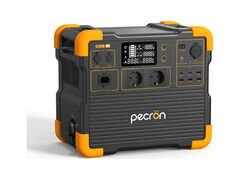
Pecron rates the E2400LFP at 2048Wh, a LiFePO4 battery at 51.2V that places this station in the crowded segment of backup units close to 2kWh, alongside the expandability up to 8192Wh covered further down. As with any inverter-based device, the energy actually available at the output never equals the battery's chemical capacity: some of it feeds the conversion electronics, and that share weighs proportionally more when the load drawn is high and sustained over time, since the fans and inverter then run flat out to hold the requested power.
Under a load close to the claimed continuous ceiling (around 2275W, or 95% of the 2400W spec), the station delivers around 1536Wh out of the 2048Wh rated, a 75% efficiency figure. That number trails what other Pecron stations reach under comparable conditions: the E1000LFP, E1500LFP and E3600LFP typically sit between 80 and 90% delivered under heavy load, without the behavior described in the next section. A 75% efficiency figure under such a heavy load is not dramatic on its own, but it stands out against the rest of the same manufacturer's lineup.
That 75% figure was only reached on a second attempt. A first full-power charge cut short even earlier, around 36 minutes instead of the 54 minutes expected at full efficiency, output shutting down with roughly 15% battery still remaining. A full charge followed by a few hours of rest, allowing the internal sensors to recalibrate as the manufacturer suggested, improved the result slightly to 40.5 minutes, the 75% figure used above, without making the hot shutdown behavior covered in the next section disappear.
2400W continuous: overheating under sustained heavy load
The spec sheet highlights 2400W of continuous power. Under a load close to that ceiling (2275W, held continuously), output shuts down before the battery is normally exhausted: the fans ramp up to maximum, output voltage gradually sags, then the inverter shuts down to prevent internal overheating, with 15 to 20% battery still available. This behavior reappeared identically after a full sensor recalibration following the manufacturer's own troubleshooting steps, whose support team first suggested a non-representative unit without offering a replacement at that point in the exchange.
This behavior does not affect, under the same conditions, the other Pecron stations in the lineup: the E1000LFP, E1500LFP and E3600LFP hold a load close to their own ceiling without a protective shutdown or comparable overheating. The E2400LFP therefore stands out, as things stand, as the only model in the family to show this behavior under a sustained load close to its claimed ceiling. This is an isolated data point, obtained on a single unit, worth knowing without generalizing it to the whole production run. Everyday use, running a fridge or a set of electronics at a noticeably lighter and non-continuous load, does not carry the same risk to the same extent.
Peak power itself is not stated consistently across the manufacturer's own channels: the structured spec sheet for this unit lists 4000W for 10 milliseconds, while several sales pages and a blog post from the same manufacturer state 4800W with no duration given. Neither figure is confirmed beyond its own commercial source at this point: it is safer to plan around the lower figure when sizing a heavy current draw, such as starting a compressor or a motor-driven tool.
Another point worth knowing: in backup mode (UPS), available power caps at 1800W instead of the 2400W on the spec sheet, per that same structured spec sheet. For most home backup uses (fridge, router, lighting), that limit remains plenty, but it is worth knowing before sizing a larger backup setup around it.
90-minute mains charging holds up, solar input is more fiddly
Pecron rates the E2400LFP for a full mains charge in 90 minutes. On this unit (AC input capped at 1800W, 100 to 120V), a full charge from empty measures at around 81 minutes, beating the manufacturer's own claim. The European version accepts higher input power (up to 2000W at 220 to 240V) for the same claimed 90-minute charge time, a figure that rests on the manufacturer's own claim for that market, without independent confirmation at the time of writing.
The solar input is more involved than it first appears. The claimed 800W actually splits across two separate, non-interchangeable connectors: a proprietary GX16 port takes up to 700W (32 to 95V, 15A max), while a second DC5521 port only takes an extra 100W (12 to 18V, 7A max). Reaching the combined 800W therefore needs two different cable runs rather than a single unified input, a complication that most direct rivals avoid with one XT60 or MC4 port at full power.
Ports: three outlets here, two in the European version
This unit, sold at 100 to 120V, carries three mains outlets for a shared 2400W. The European version instead has two 230V sockets, confirmed by both the official product photos and a direct look at the front panel. That is not a spec-sheet error but an electrical choice that fits each grid: a single 230V socket can carry more power than a single 120V outlet, which is why this unit needs more of them to split the same total 2400W. The manufacturer's own marketing copy, including on its dedicated European store, still lists a figure of three sockets in places that does not match the unit actually shipped on that market, a mismatch worth knowing about rather than the outlet count itself.
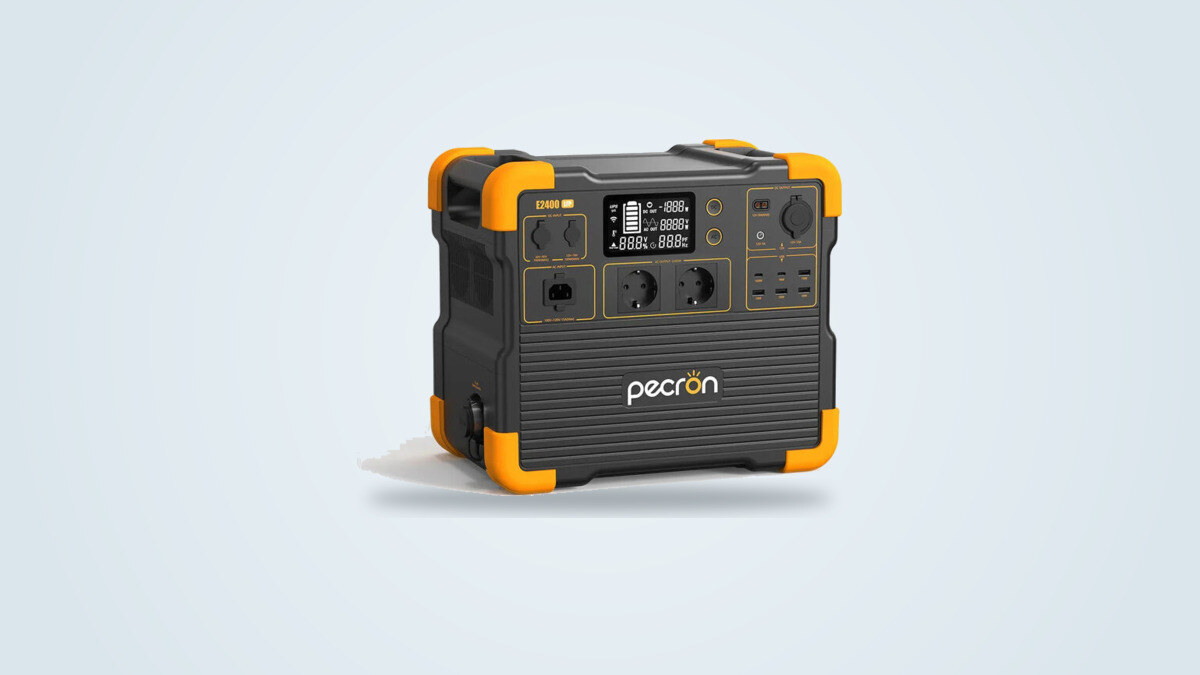
The rest of the port selection is identical across regions: four USB-A ports at 18W each, two USB-C ports of which only one delivers up to 100W (the second tops out at 18W), a 12V cigarette lighter output (120W), and an XT60 12V/30A output (360W) aimed at demanding uses such as a vehicle fridge or a high-draw accessory. An LCD screen shows charge level and input/output power in real time, and a Wi-Fi-controlled app allows remote monitoring without relying on Bluetooth, which this model does not have.
Two design choices, common to every version, stand out in daily use: there is no physical power button, the inverter only switches on from the app, and there is no built-in light, a feature that would help during a night-time outage and that several direct rivals do include.
Expandable to 8192Wh: the real strength of the lineup
The E2400LFP's real selling point is not its starting capacity, which sits squarely in the middle of its price segment, but its ability to grow. One or two additional EP3000-48V batteries (3072Wh each) connect to the main unit without changing the inverter or its control electronics, taking the total reserve to 5120 then 8192Wh. The manufacturer also offers a 2304Wh EP2000S-48V battery, compatible with the same family of stations (E1500LFP, E2400LFP, E3600LFP), a useful in-between option for matching the expansion to the available budget rather than always having to invest in the largest module.
This expandability changes the nature of the purchase: a single unit covers occasional backup or van life use, one or two added batteries turn it into a home reserve able to last several days without ever swapping the main unit. That is a coherent path for a household planning to grow its setup over time rather than buying everything at once, a logic already seen on other Pecron stations in the same lineup.
Build quality, cycle life and warranty
The E2400LFP's LiFePO4 battery system is TÜV-certified and rated for over 3500 cycles before dropping to 80% of its original capacity, a level in line with current standards for this chemistry. The stated warranty is 3 years, split into 2 years of full cover followed by a year of support, a formula identical to other Pecron stations in the catalog and less generous than a full cover of the same length.
The station discharges between -4 °F and 113 °F (-20 °C to 45 °C) and charges between 32 °F and 113 °F (0 °C to 45 °C), a wide range that covers most outdoor uses, including a harsh winter as long as the unit is not asked to charge in severe cold. No safety recall or thermal-runaway incident is tied to this model at this point.
A point covered above is worth repeating here: the overheating under a load close to the continuous ceiling, limited to a single unit at this point, did not lead to a replacement when the question was raised with support, the exchange stopping at a suggestion of a non-representative unit. That is not necessarily a widespread design flaw, but a point of caution about how responsive support is to this kind of issue.
Standby draw and after-sales support
With the inverter switched on and nothing plugged in, the E2400LFP draws around 13.6W continuously, or about 327Wh lost over 24 hours starting from a 98% charge. That is a reasonable draw next to higher-capacity stations (an Anker Solix F3800 sits around 70W on standby), and slightly lower than the same manufacturer's smaller E1000LFP, rated at around 18W on standby. This figure genuinely matters for extended off-grid backup use: over several days, the inverter's standby draw alone can eat into a meaningful share of the total energy available.
On support, a dedicated US phone line now exists, an improvement over the email-only support offered on other models in the lineup. The answers given remain technically uneven, though: one phone agent's estimate of a fridge's power draw came in an order of magnitude too high compared with the figures usually used for this type of appliance. The commercial policy otherwise stays generous, with free shipping and a return window extended beyond a year for followers of the manufacturer's social media accounts.
Against the direct competition
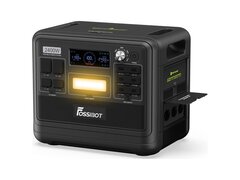
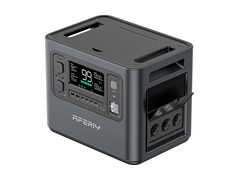
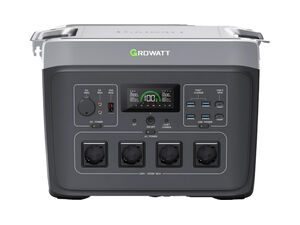
In the crowded segment of backup stations close to 2kWh, the E2400LFP shares the stage with the Fossibot F2400, the Aferiy P210 and the Growatt Infinity 2000 Pro, all close to 2048Wh and 2400W. Against these three rivals, the E2400LFP is the lightest at 45.2 lb (20.5 kg) and, along with the Growatt, the only one offering capacity expansion, with the Growatt Infinity 2000 Pro capping at 6144Wh where the E2400LFP reaches 8192Wh. Its starting price also stays among the lowest of the comparison.
| Criterion | Pecron E2400LFP | Fossibot F2400 | Aferiy P210 | Growatt Infinity 2000 Pro |
|---|---|---|---|---|
| Capacity | 2048Wh | 2048Wh | 2048Wh | 2048Wh |
| Continuous power | 2400W | 2400W | 2400W | 2400W |
| Expandable | Yes, up to 8192Wh | No | No | Yes, up to 6144Wh |
| Weight | 45.2 lb (20.5 kg) | 48.5 lb (22 kg) | 48.5 lb (22 kg) | 50.7 lb (23 kg) |
| Warranty | 3 years | 2 years | 7 years | 5 years |
This table does not capture everything: it is precisely the efficiency under heavy load and the ability to hold continuous power, covered above, that set the E2400LFP apart from these three rivals over time, an axis no spec sheet alone can settle. The Aferiy P210 remains unbeatable on warranty, the Growatt Infinity 2000 Pro also offers expansion but more limited and on a heavier unit, and the Fossibot F2400 does not stand out on any criterion in this table against the Pecron.
Who it suits, and who it does not
With its base 2048Wh, contained price and expandability up to 8192Wh, the E2400LFP suits a step-by-step approach to home backup well: start with the unit alone to cover the essentials of an outage (fridge, router, lighting, electronics), then add an EP3000-48V battery if outages drag on or repeat. It also suits use in an RV or van for running a fridge, a portable induction hob or onboard electronics, loads that never continuously approach the 2400W ceiling, as well as light job-site use with typical power tools.
It suits less well anyone planning to run one or more appliances totaling close to 2400W continuously for tens of minutes at a time (a powerful space heater, an electric oven, a tool with a heavy, sustained current draw): that is exactly the load range where the protective shutdown described above kicks in. For that kind of sustained, full-power use, a station further up the same lineup like the E3600LFP, larger but without this behavior under the same conditions, or a direct rival without this known limitation, remains the safer choice.