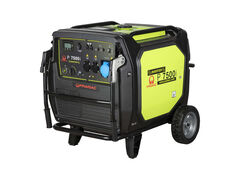
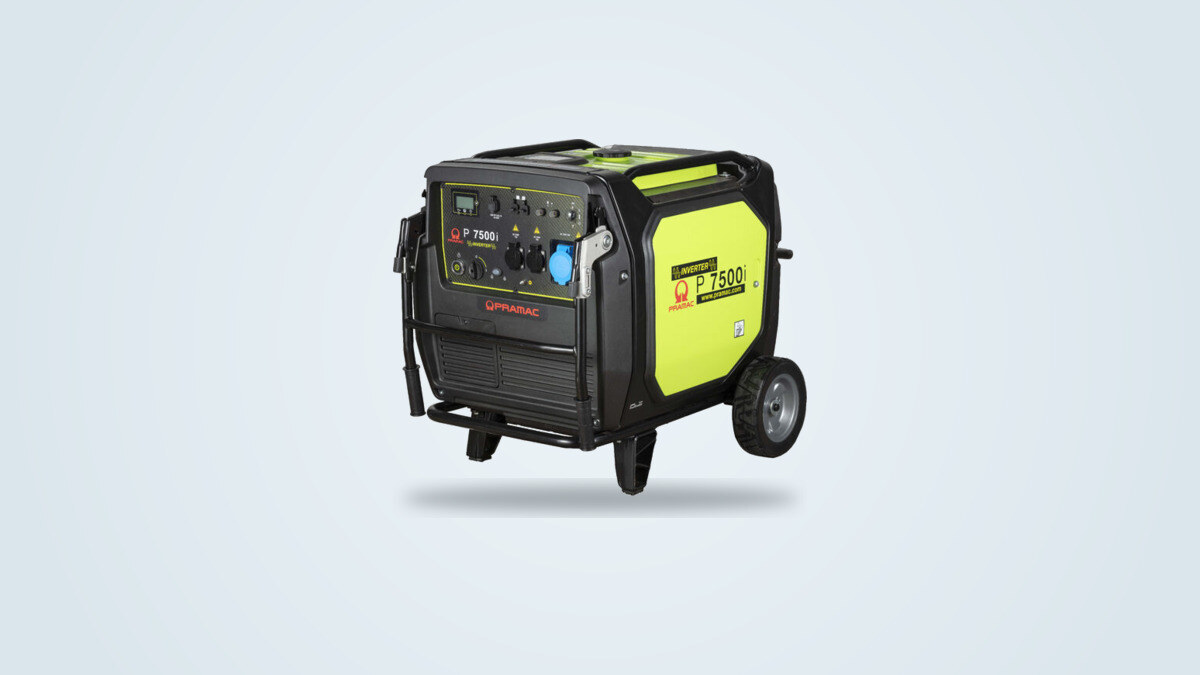
6500W continuous, 7000W peak: an unprecedented output for a portable inverter
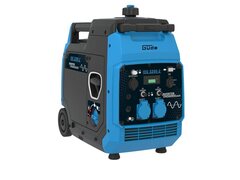
The Pramac P7500i stands apart in this site's portable inverter sub-category: 6500W continuous and 7000W peak, more than double the 3200W continuous of the Güde ISG 3200-2, previously the most powerful of the family. The maker states an output current of 30.5 A, consistent with the 7000W peak at 230V (30.5 x 230 = 7015W, within 15W); at continuous output, 6500W at 230V works out to roughly 28.3 A.
The 420cc four-stroke gas engine, compliant with the European Stage V emissions standard, drives the variable-speed alternator at the heart of the inverter technology. A PowerRush function, specific to this Pramac range, temporarily boosts available current beyond the rated output to help start an electric motor such as a pump or compressor, a task that typically demands several times the rated power for a few seconds. At this output, the P7500i comfortably covers a full home during an extended power outage (fridge, freezer, space heater, lighting and a sump pump all at once) or a demanding job site full of power tools, where the more compact inverters in the catalog can only cover one or two devices at a time.
25 liters, 11 hours at 75% load: the largest tank in the inverter family
The P7500i's 25-liter tank is the largest of any portable inverter generator in the catalog, well ahead of the 7.8 liters on the Güde ISG 3200-2 or the 4 to 5 liters on more compact models. Pramac states consumption of 2.25 liters per hour at 75% load, or roughly 4875W, for an 11-hour runtime on a full tank.
This consumption-and-load pair allows a calculated fuel efficiency of about 0.46 liters per kWh produced. That figure holds up well against generators far larger than the average portable inverter: the Hyundai DHY6000SE, a 5000W-continuous diesel unit already reviewed on this site, works out to about 0.48 L/kWh at 50% load, and the Scheppach SG5200D, also diesel, to about 0.51 L/kWh at two-thirds load.
| Product | Reference load | Specific consumption |
|---|---|---|
| Pramac P7500i | 75% (4875W) | ≈ 0.46 L/kWh |
| Hyundai DHY6000SE | 50% (2500W) | ≈ 0.48 L/kWh |
| Scheppach SG5200D | Two-thirds (2800W) | ≈ 0.51 L/kWh |
The P7500i therefore comes out slightly more efficient in use than these two diesel references, a result that owes mostly to the relative load being compared (75% against 50% and 66%) rather than any general mechanical edge of gas over diesel. The flip side of this partial transparency: Pramac publishes only one consumption point, at 75% load, against two official points for the Güde ISG 3200-2. There's no way to tell whether efficiency holds up, improves or drops off at lighter or heavier loads.
92 dB(A): level with the best inverter in the catalog despite double the power
Pramac states a guaranteed sound power of 92 dB(A) for the P7500i and a level of 64 dB(A) at 23 ft (7 m). Sound power (LWA) is a figure standardized under European noise regulations for outdoor equipment: it's meant to compare devices with each other, not to predict what you'd actually hear from a neighboring campsite.
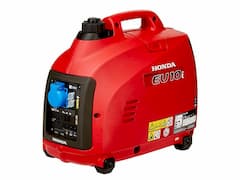
At 92 dB(A), the P7500i exactly matches the Güde ISG 3200-2, previously the quietest inverter generator in the catalog for its output, while producing double the continuous power. It stays quieter than the Zipper ZI-STE2800iV (95 dB(A), 2800W) and the Knappwulf KW3400, a conventional AVR unit rated at barely 2600W, less than half the Pramac's output, which nonetheless posts 96 dB(A). Only markedly less powerful inverters like the Honda EU10i (87 dB(A), 900W) or the Scheppach SG2500i (91.6 dB(A), 1600W real output) come in under this level. Across the whole family, this is the best ratio between power and guaranteed noise level seen in this catalog to date.
The P7500i's economy mode automatically adjusts engine speed to actual load, cutting noise and fuel use as soon as electrical demand drops, a feature shared with most inverters in the catalog. Pramac doesn't, however, publish a separate figure for this mode, unlike some competitors that detail both a no-load and a full-load reading.
Digital display, remote start, parallel kit: connectivity built for professional use
The P7500i's panel pairs two 230V 16A Schuko sockets, a 32A 230V industrial socket for high-draw equipment, a 5V USB port and a digital display showing voltage, frequency and running hours. Two separate breakers, one thermal and one magnetothermal, protect the standard sockets and the industrial socket respectively.
A wired remote-start function, on two dedicated terminals, lets the P7500i be wired into an automatic transfer switch: the engine starts as soon as the contact closes, with five automatic start attempts, and stops as soon as it opens. This capability is absent from every other portable inverter generator already reviewed on this site, all of which start by hand only. A parallel-kit connector is also built in, allowing, with a second P7500i and the matching accessory, the available power to be combined. None of this changes the underlying voltage question covered below: the sockets themselves are 230V Schuko and CEE types, not the NEMA outlets standard on US equipment.
A genuine inverter, an Italian brand that's been part of the Generac group since 2016
Inverter technology remains the product's core promise: the current produced by the alternator is rectified and then electronically rebuilt into a stable AC waveform, independent of engine speed, which allows sensitive electronics such as a computer, a compressor fridge or a variable-speed pump to be plugged in without risk of surge damage. As with almost every generator in this segment, the Honda EU10i included, no numerical harmonic distortion figure is published to independently confirm how clean the claimed waveform really is.
Pramac has been making power-generation equipment since 1966, first under the name L'Europea and then under its current brand. Since 2016, the Italian company has been part of the Generac group, one of the largest generator and light-tower manufacturers in the world, and itself a well-known American company: that ownership gives Pramac more substantial industrial backing than most of the DIY-oriented brands making up the rest of this family, though it does not by itself confirm any US retail path for this specific European-spec model. The P7500i includes an automatic shutoff for low oil level and carries a standard 2-year manufacturer warranty. No product recall or recurring manufacturing defect turned up for this specific model, but the number of accessible customer reviews remains too small to draw a firm conclusion on field reliability, lacking the extensive track record available for the Honda EU10i, some of whose equivalent engines are documented past several thousand hours of use.
286.6 lb net: the heaviest portable inverter in the catalog, built to be wheeled rather than carried
The P7500i weighs 286.6 lb (130 kg) net, 321.9 lb (146 kg) boxed, on a two-wheel cart with a telescopic handle. That makes it by a very wide margin the heaviest portable inverter generator in the catalog: the Zipper ZI-STE2800iV, previously the heaviest of the sub-category at 72.8 lb (33 kg), weighs less than a quarter as much.
Fitting the cart is mandatory before first use: the maker's manual explicitly forbids running the unit without it, on pain of letting dust and debris into the cooling circuit. On flat ground, the telescopic handle lets it be pulled solo like rolling luggage; loading it into a truck bed or a van still takes two people, as with any generator this heavy. Against the two closest diesel units in the catalog by output, the Scheppach SG5200D (326.3 lb / 148 kg) and the Hyundai DHY6000SE (335.1 lb / 152 kg), the Pramac stays 40 to 48 lb lighter while delivering more continuous power than either.
Against the Honda EU70is and the Hyundai DHY6000SE: the only inverter in the trio with this much power
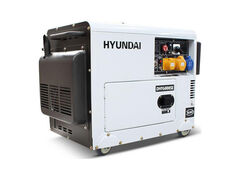
Outside this site's own catalog, the P7500i's most direct rival is the Honda EU70is, another well-known inverter in the professional segment, also built around 230V in its European form. Within the catalog, the closest unit by continuous power is the Hyundai DHY6000SE, already reviewed on this site, but built on a conventional AVR architecture rather than an inverter one, and also listed as out of stock on this catalog's US market.
| Criterion | Pramac P7500i | Honda EU70is | Hyundai DHY6000SE |
|---|---|---|---|
| Technology | Inverter | Inverter | AVR (conventional) |
| Continuous power | 6500W | 5500W | 5000W |
| Peak power | 7000W | 7000W | 5300W |
| Fuel | Gas | Gas | Diesel |
| Weight | 286.6 lb (130 kg) net | 260.4 lb (118.1 kg) dry | 335.1 lb (152 kg) |
| Wheels | Yes | Yes | Yes |
Of the three, the P7500i is the only one to combine the strongest continuous power with genuine inverter electronics. The Honda matches the same 7000W peak but only 5500W continuous, for 26 lb less; the Hyundai, diesel and 49 lb heavier, tops out at 5000W continuous without the benefits of an inverter's clean waveform. All three, in their form compared here, are built around 230V rather than the 120V standard in US homes, so this comparison is a technical one rather than a straightforward US shopping decision.
$1929.45 shown here, but this catalog's own US listing shows it out of stock
The price shown on this page is $1929.45. Before treating that as a checkout price, it's worth being direct about what this review could and could not confirm: this catalog's own US product listing shows the P7500i as out of stock, with no retailer name or purchase link attached, unlike the UK, German, Italian and French listings for the same model, which all show an active retailer and a real price.
| Market | Listed price | Status |
|---|---|---|
| United States | $1929.45 | Out of stock, no retailer listed |
| France | 3202.10 € | In stock |
| Germany | 2479.46 € | In stock |
| Italy | 2390.00 € | In stock |
| Spain | 2171.75 € | In stock |
| United Kingdom | £1425.00 | In stock |
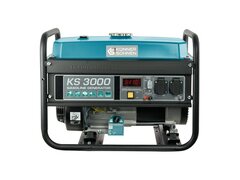
This isn't unique to the Pramac: the same catalog's US listings for the Güde ISG 3200-2, the Hyundai DHY6000SE and the Könner & Söhnen KS3000, all cited elsewhere in this review as points of comparison, are also shown out of stock with no US retailer. The common thread is voltage: all of these are 230V European-market units, and none was confirmed to have a 120V US-spec version or an active American distribution path at the time of this research. Only the much smaller Honda EU10i, sold in the US as the EU1000i, has a confirmed US retail listing among the generators named in this review, but at roughly 900-1000W it belongs to a completely different, far less powerful class and isn't a real substitute for the P7500i's output. Anyone in the US specifically interested in this scale of inverter power should confirm both a genuine purchase path and the voltage question directly with a retailer before relying on the $1929.45 figure shown here.
No carbon-monoxide detection confirmed: who the P7500i suits
As with almost every generator in this segment, no automatic carbon-monoxide shutoff is confirmed on the P7500i. The unit must run outdoors only, in a well-ventilated space, never in a garage, tent or any other enclosed space even partially, on pain of fatal poisoning within minutes.
It suits a buyer who can confirm a genuine purchase path for a 230V European-spec unit and needs real backup power for a whole house or a demanding job site full of power tools, without giving up an inverter's clean current.
It doesn't suit anyone shopping for a straightforward US checkout experience: with this catalog's own US listing showing no stock and no retailer, and a 230V-only design that doesn't match standard US household current, this specific model is a poor fit for someone who just wants to order a generator and plug it in at home. It also doesn't suit anyone who needs to move 286.6 lb of equipment alone, or anyone who prioritizes an already well-established, multi-year reliability record above all else.