1600 W continuous, 2000 W for two minutes: what the product name really covers
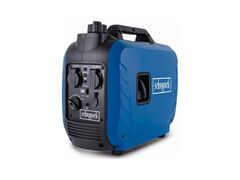
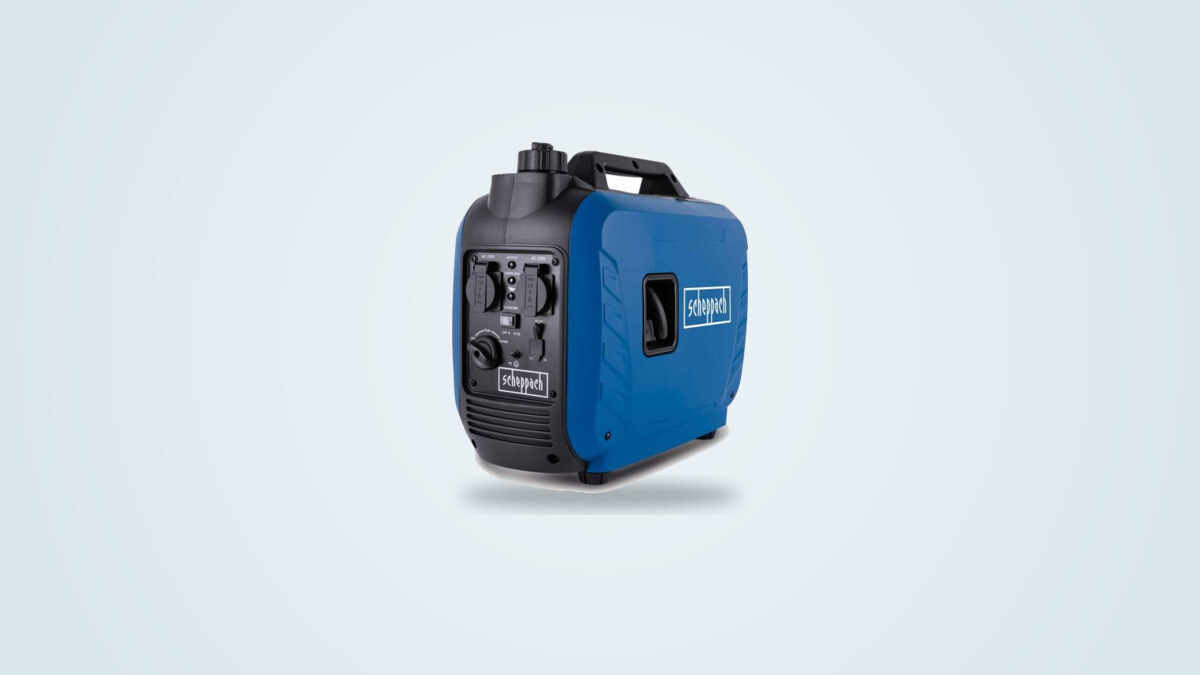
The Scheppach SG2500i is a portable gas inverter generator. Its official spec sheet lists two power tiers on its two 230V outlets: a continuous rated power P(S1) of 1600 W, held indefinitely, and a maximum power P(S2) of 2000 W, limited to two minutes. The product’s brand name and most retail listings feature only the 2000 W figure, without always making clear that it is a two-minute tier rather than power available around the clock.
This gap between the headline figure and the power actually usable over time is not unique to the SG2500i: it is common on compact inverter generators, where the S2 tier mainly absorbs a brief surge (starting a compressor or a small fridge, for example). But the proportional gap here stands out: 1600 W is 80 % of the advertised 2000 W figure, a tighter margin than some direct competitors in the same sub-category.
The engine itself, an air-cooled single-cylinder 4-stroke gas unit of 79 cc, puts out a maximum mechanical output of 2.2 kW (about 3 hp). That mechanical figure is not directly comparable to the electrical output: part of it drives the alternator and the inverter conversion electronics, which turn the raw alternating current from the engine into direct current and then back into alternating current at 230 V and 50 Hz, with a rated current of 6.95 A per outlet.
For most of what this generator is meant to do (lighting, charging electronics, small appliances, light power tools), 1600 W continuous is a comfortable amount, well above a Honda EU10i’s 900 W for a sizable price gap. The catch is mostly about how the headline figure gets marketed, not about how useful the real power on tap actually is.
A 4.1-liter tank: runtime that depends heavily on the load
The unleaded (E5-compatible) gas tank holds 4.1 liters. At the full continuous rating of 1600 W, the manufacturer states fuel consumption of around 1.27 liters an hour, giving a runtime of roughly 3.2 hours on a full tank. That figure covers the toughest load the unit can hold indefinitely: at a lighter load (lighting, charging a few devices, a small fridge), hourly consumption drops and runtime stretches out accordingly, though no precise official figure is given for those in-between tiers.
The crankcase takes around 350 ml of oil (10W30 or 15W40 grade depending on outdoor temperature), with an automatic engine shutoff if the level runs low, a useful safeguard since a small gas engine gives no other warning before running dry. The manufacturer specifies a usage range up to 3281 ft (1000 m) of altitude and 104 °F (40 °C) of outdoor temperature, limits rarely stated at this price point and worth knowing before use at altitude or in peak summer heat.
With only 4.1 liters of capacity, the SG2500i is clearly built for occasional top-up power rather than long-duration backup power: a generator with a bigger tank, such as the 15 liters on a much more powerful brushed model, will naturally ride out a prolonged outage with fewer refueling stops.
91.6 dB(A) of sound power: the real friction point of an inverter sold as quiet
This is the single most important point to understand before buying this model. The manufacturer’s official spec sheet states a sound power level of 91.6 dB(A) and a sound pressure level of 71.6 dB(A) (uncertainty of 1.13 dB(A)). Those are the figures in the manual’s spec table, and the unit’s rating label carries the rounded value of 93 dB(A). Yet most retail listings, including several European online stores, feature an entirely different figure: 64.1 dB(A), even worked into the product’s full name as it appears on some marketplaces. The two figures are not tied to the same load and distance conditions from one listing to another, but the roughly 30 dB(A) gap between them sets an expectation of quietness that the official spec sheet itself does not back up.
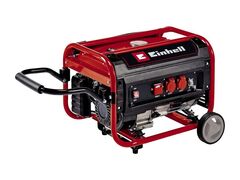
The 91.6 dB(A) sound power level is worth setting against other generators already covered on this site. It comes in below the 96 dB(A) of a brushed generator like the Einhell TC-PG 35/E5, but the 4.4 dB(A) gap is modest given the difference in design and power: the SG2500i is a genuine inverter and delivers less than half the Einhell’s continuous power. Against the Honda EU10i, also an inverter, the gap runs the other way and is far bigger: 87 dB(A) of sound power, or 4.6 dB(A) less than the SG2500i, for almost half the continuous power (900 W versus 1600 W).
| Criterion | Scheppach SG2500i | Honda EU10i | Einhell TC-PG 35/E5 |
|---|---|---|---|
| Sound power (LWA) | 91.6 dB(A) | 87 dB(A) | 96 dB(A) |
| Stated sound pressure (LpA) | 71.6 dB(A) | n/a | 74.1 dB(A) |
| Design | Digital inverter | Inverter | Conventional (AVR regulator) |
| Continuous power | 1600 W | 900 W | 2600 W |
At the user’s position, the SG2500i’s 71.6 dB(A) sound pressure level also sits close to the figure stated for the Einhell TC-PG 35/E5 at its own operator position (74.1 dB(A)), a gap of only 2.5 dB(A) despite an almost two-to-one difference in power between the two units. In practice, this means the SG2500i’s inverter technology brings a genuine benefit for power quality (see below), but it does not translate into the leap in quietness its marketing implies: use near homes, while camping, or on an evening patio remains best avoided, just as with a conventional generator.
A genuine inverter sine wave: the structural edge over a brushed generator
Unlike a conventional generator with an AVR regulator, such as the Einhell TC-PG 35/E5, which stabilizes voltage without touching the shape of the waveform, the SG2500i uses control electronics the manufacturer describes as a digital inverter: the raw alternating current from the alternator is converted to direct current and then electronically rebuilt into an alternating waveform at 230 V and 50 Hz. The stated result is a sine wave close to that of grid power, suited to sensitive electronics (a laptop, a TV, or the electronics inside a fridge or a router).
No total harmonic distortion (THD) figure is published for this exact model, a common gap on inverter generators at this price point, already noted on the considerably pricier Honda EU10i. Absent that figure, the product’s own design (a digital inverter, rather than a plain voltage regulator applied to a raw waveform) remains a solid indicator of power quality, consistent with the sensitive-electronics compatibility advertised across every market where the product is sold.
On the connections side, two 230V outlets rated at 6.95 A each and two fast-charge USB-A ports at 2.1 A round out the unit. Overload protection cuts the 230V outlets if exceeded, and the automatic low-oil shutoff protects the engine. The manufacturer does not publish any track record for the conversion electronics’ own long-term durability, a gap shared by almost every inverter generator at this price level next to premium brands such as Honda.
Starting, safeguards, and minor finish niggles
Starting is by manual recoil only, with no electric starter or battery to maintain. A manual choke helps with cold starts. One friction point comes up repeatedly about this exact model: the fit of certain covers (the fuel cap, the spark-plug cover) and how easy it is to get at the oil for a change are both considered somewhat lacking, without that calling the unit’s day-to-day operation into question.
The housing carries an IP23M rating (protected against solid objects larger than 12.5 mm and against water spray up to 60° from vertical while running), a common level for reasonable outdoor use that still does not allow direct, prolonged rain exposure. Overload protection automatically cuts the 230V outlets if the available power is exceeded.
Scheppach’s standard manufacturer warranty runs two years, a usual length on this market and the same as the Einhell TC-PG 35/E5 already covered on this site. Beyond the noise covered above and the finish niggles just mentioned, no recurring structural fault or recall flag turned up for this model.
38.6 lb on the handle: portable, but not the lightest in its sub-category
The SG2500i weighs 38.6 lb (17.5 kg) for dimensions of roughly 20.5 x 10.6 x 17.3 in (52 x 27 x 44 cm), housed in a rigid case with a built-in carry handle and no wheels. That weight and footprint stay one-hand portable for most adults, but it is noticeably heavier than the reference point of this sub-category, the Honda EU10i, which weighs 28.7 lb (13 kg) for a continuous rating that is still more than 40 % lower.
Against a brushed generator like the Einhell TC-PG 35/E5 (92.6 lb / 42 kg on a wheeled frame), the SG2500i sits in a completely different weight class and is far easier to load single-handed into a trunk or an RV storage bay. The more useful comparison plays out within the inverter sub-category itself, where the SG2500i sits toward the heavier end for its power without being either the lightest or the heaviest in its class: the Könner & Söhnen KS2000i S, for a comparable peak power, weighs around 44 lb (20 kg).
Scheppach: a mainstream German brand, a standard two-year warranty
Scheppach is a German maker of consumer tools and DIY equipment, founded in 1927 by Josef Scheppach in Niederraunau, near Krumbach, and based in Ichenhausen, Bavaria, since 1961. Long registered under the name « Scheppach Fabrikation von Holzbearbeitungsmaschinen GmbH », the company took its current name, Scheppach GmbH, in 2021. It occupies a mainstream, accessible spot in the European market comparable to Einhell’s: neither the prestige nor the price tag of a premium engine maker like Honda, but wide distribution and a broad lineup of gas and power tools.
Across Europe, the SG2500i is widely sold through general home-improvement retailers as much as specialty online sellers, typically priced around €380, well under premium-brand inverter generators for a continuous rating above the Honda EU10i’s. On the US listing, it is priced at $440.01, though availability through a retail partner varies. No product recall or recurring structural fault turned up for this model: the real friction points concentrate on noise and, occasionally, the fit of certain covers, not on early mechanical failure.
Against the competition: the Honda EU10i and the Könner & Söhnen KS2000i S
Within the catalog’s own « Portable inverter generators » sub-category, two models offer the most direct comparison, both primarily sold on the European market. The Honda EU10i, already covered on this site, takes a radically different approach: only 900 W continuous, but a sound power of 87 dB(A), a weight of 28.7 lb (13 kg), and a reputation for engine longevity that justify a considerably higher European price, around €1039. The choice between the two mostly comes down to priority: continuous power and price for the SG2500i, quietness and a reputation for long-term reliability for the Honda.
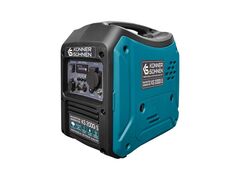
The Könner & Söhnen KS2000i S, for its part, targets a comparable peak power (2000 W, with no continuous rating published separately) in a case advertised as sound-insulated, at a mid-range European price around €489. It offers only a single 230V outlet against two on the SG2500i, and weighs around 44 lb (20 kg) against 38.6 lb (17.5 kg).
| Criterion | Scheppach SG2500i | Honda EU10i | Könner & Söhnen KS2000i S |
|---|---|---|---|
| Continuous power | 1600 W | 900 W | n/a |
| Peak power | 2000 W (2 min) | 1000 W | 2000 W |
| Stated noise level | 91.6 dB(A) LWA | 87 dB(A) LWA | 64 dB(A) at 23 ft (7 m) |
| Weight | 38.6 lb (17.5 kg) | 28.7 lb (13 kg) | 44 lb (20 kg) |
| Typical European price | ≈ €380 | ≈ €1039 | ≈ €489 |
Against a brushed generator like the Einhell TC-PG 35/E5 (2600 W continuous, 96 dB(A), 92.6 lb / 42 kg on wheels), the SG2500i offers far less power but genuine inverter technology and a completely different format, built to be carried rather than rolled. The choice ultimately comes down to intended use: raw power and a contained budget for a brushed generator, electronic safety and compactness for an inverter like the SG2500i, quietness and reputation for a Honda EU10i.
RVs, jobsites, backup power: who the SG2500i suits, and who should skip it
The SG2500i suits three specific uses well: powering an RV outside quiet hours for nearby neighbors, backup power at home during an outage for lighting, a fridge, or electronics, and light DIY work needing a small power tool. In all three cases, its 1600 W continuous rating comfortably covers everyday needs, and its inverter technology keeps electronics safe when plugged in.
It suits camping near other campers or evening use far less well, where its real sound power sits close to that of a much more powerful conventional generator: a noticeably quieter model like the Honda EU10i is the better fit there, even accepting far less power on tap and a higher price. It is also a poor match for backup power that needs to run unattended for hours at a stretch: its small 4.1-liter tank means frequent refueling stops as soon as the load nears its continuous rating.
It suits anyone after comfortable continuous power and genuine electronic safety at a contained price, for daytime RV use, DIY work, or the occasional home backup.
It does not suit anyone who needs quiet running above all (shared campgrounds, nighttime use near homes) or hours of runtime without refueling.