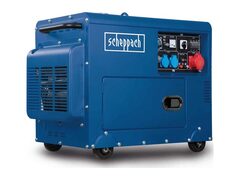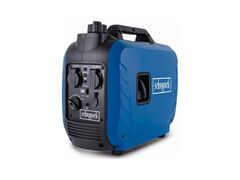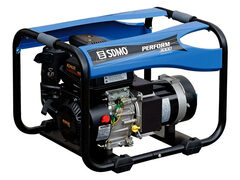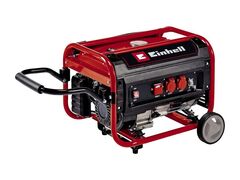
A job site diesel, not a recreational generator
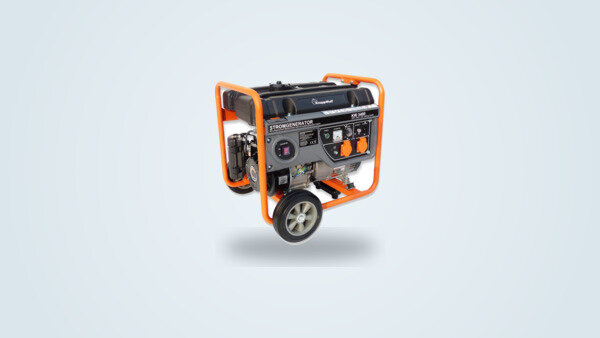
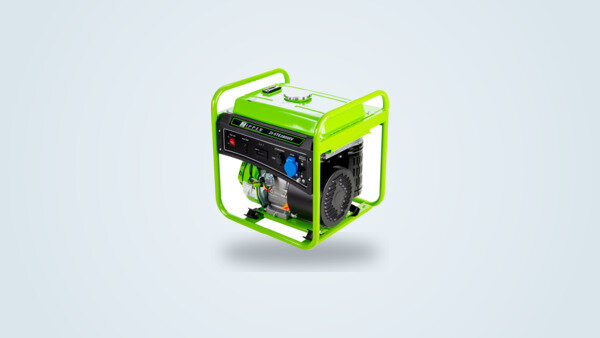
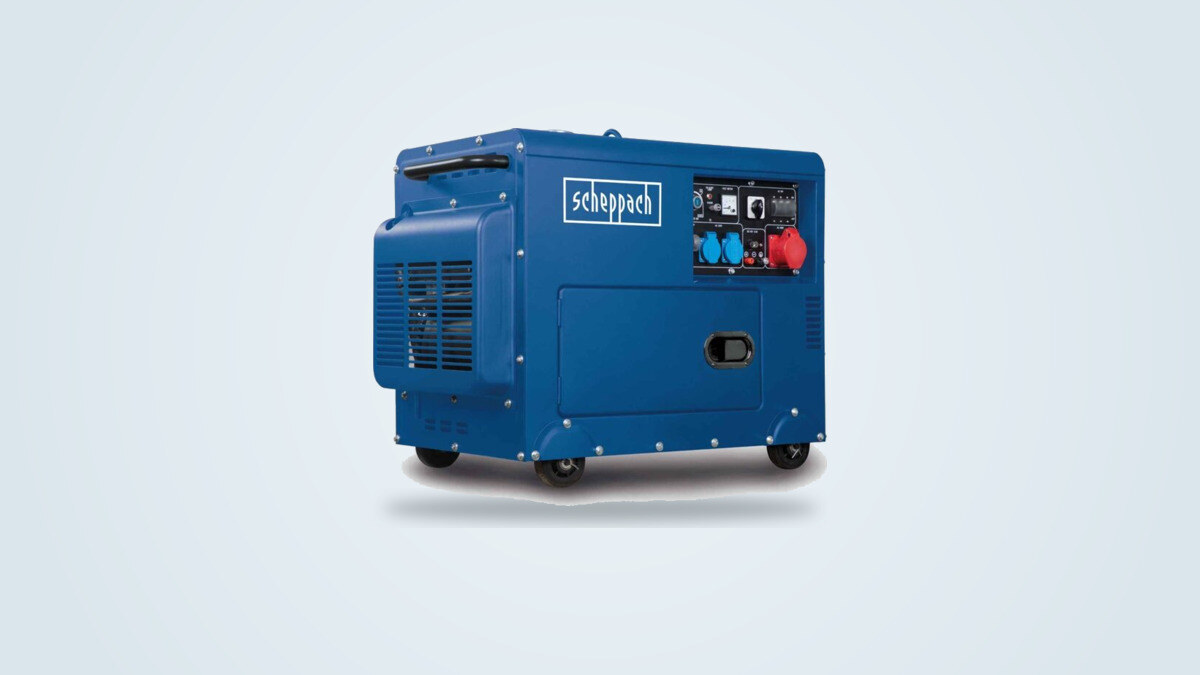
The Scheppach SG5200D shifts into a different league the moment it is set next to the gas generators in this catalog. Where the Einhell TC-PG 25/1/E5, the TC-PG 35 and the SDMO Perform 3000 all weigh between 81.1 and 99.2 lb (37 to 45 kg), this one comes in at 326.3 lb (148 kg), houses its engine in a full steel canopy rather than an open frame, and starts with a key from a 12V battery rather than a recoil cord. Its engine is an air-cooled four-stroke diesel of 418 cc, rated at 5.7 kW mechanical (7.7 hp), driving an alternator capable of 4200 W continuous and up to 5000 W for five minutes on its three-phase 400V outlet.
This format and price, around $1,490, place it halfway between a home backup unit and a professional rental generator. It targets a very different use from the gas generators already reviewed on this site: an all-day job site or extended building backup, not a weekend of camping. The sections below spell out exactly what that changes, outlet by outlet and pound by pound.
Three-phase 400V power: the unit's real signature
This is the single feature that justifies the SG5200D's place in this catalog: a three-phase 400V outlet, rated at 7.6 A, in addition to the two familiar 230V single-phase outlets. Combined across the three phases, that works out to an apparent power close to 5.3 kVA, consistent with the 5000 W peak rating quoted for that same outlet. None of the conventional gas generators already reviewed on this site, neither the Einhell TC-PG 35 nor the SDMO Perform 3000, offers this output.
Three-phase power changes what can be plugged in: a site concrete mixer, a stationary table saw, a compressor, a professional welder, all machines built around a three-phase motor rather than a simple single-phase one, for steadier starting torque and better electrical efficiency at equal power. This is a trade need, not a hobby one: anyone who has never had to plug in three-phase equipment gains nothing from it, while still paying the weight and price premium for a feature they will never use.
4200 W continuous, a tight margin up to 5000 W
The manufacturer declares two continuous power tiers depending on the outlet used: 3000 W on the 230V single-phase outlets, 4200 W on the three-phase 400V outlet. At maximum power, held for five minutes, these rise to 3300 and 5000 W respectively. The gap between continuous and maximum stays tight (10% on 230V, 19% on 400V), in the same range as the gas generators already reviewed on this site: this is not an inflated headline figure for the box.
| Outlet | Continuous power | Maximum power (5 min) | Rated current |
|---|---|---|---|
| 230V single-phase (x2) | 3000 W | 3300 W | 13 A per outlet |
| 400V three-phase | 4200 W | 5000 W | 7.6 A |
Against the three conventional gas generators already reviewed on this site, the gap is clear: 4200 W against 2100 to 2600 W continuous, 60 to 100% more power. That margin costs cylinder displacement (418 cc against 208 cc for all three gas engines) and weight, but it unlocks uses, stacking several heavy loads, three-phase machinery, that these three generators simply cannot cover.
The real math: what diesel buys you per kWh produced
The 16-liter diesel tank runs for around 11 hours at two-thirds load, for a stated consumption of 1.43 L/h at that rate. That runtime is close to the Einhell TC-PG 35's (10.7 hours from 15 liters of gas), for a far higher power output (4200 against 2600 W continuous). This is where diesel changes the math: at two-thirds load, the SG5200D produces around 2800 W for 1.43 liters burned, or roughly 1.96 kilowatt-hours per liter. The same math applied to the three gas generators already reviewed on this site gives 1.24 kWh/L for the TC-PG 35, 1.17 kWh/L for the TC-PG 25/1/E5 and 1.41 kWh/L for the SDMO Perform 3000 (manufacturer figures, at a comparable relative load).
These figures are measured at reduced load, not at the 4200 W continuous maximum: pushed hard, consumption rises and real runtime drops accordingly. For a working day at partial load, the practical effect is clear: sixteen liters of diesel cover a full shift, where an equivalent gas generator would run its tank dry before the day is out.
96.2 dB(A) rated, 77 dB(A) at the operator's position: far from the 71 dB quoted
The manufacturer's official technical documentation states a sound power rating of 96.2 dB(A) (measured to the ISO 3744 standard, 2.1 dB(A) measurement uncertainty). At the operator's position, the stated level is 77 dB(A) (measured to the ISO 11201 standard).
This does not match the roughly 71 dB "at a distance" figure quoted elsewhere on this site for the same product: that value, absent from the manufacturer's official documentation, gives the impression of a noticeably quieter unit than it actually is. The SG5200D does house its engine in a full steel canopy, unlike the open frame of the three conventional gas generators already reviewed on this site: yet that housing does not translate into a lower rated level, since its 96.2 dB(A) sits in the same range, and its sound pressure at the operator's position (77 dB(A)) even exceeds the 73 to 74 dB(A) quoted for the two Einhell units.
| Criterion | Scheppach SG5200D | Einhell TC-PG 35 | Einhell TC-PG 25/1/E5 | SDMO Perform 3000 |
|---|---|---|---|---|
| Rated sound power (LWA) | 96.2 dB(A) | 96 dB(A) | 96 dB(A) | 96 dB(A) |
| Pressure at operator position | 77 dB(A) (≈ 3 ft) | 74.1 dB(A) (≈ 3 ft) | 73.1 dB(A) (≈ 3 ft) | 67 dB(A) (23 ft) |
| Engine type | Diesel, full canopy | Gas, open frame | Gas, open frame | Gas, open frame |
In practice, this level rules out nighttime use near homes or camping, exactly like the gas generators already reviewed. A single-cylinder diesel engine also adds a mechanical noise character (injection knock, the diesel's characteristic clatter) that the ear perceives differently from a gasoline exhaust note, even at a comparable rated level.
The AVR regulator stabilizes voltage, the G1 class confirms the limit
Like the three conventional gas generators already reviewed on this site, the SG5200D fits an automatic voltage regulator (AVR) that keeps current amplitude close to its rated value whatever the load applied. This is not inverter technology: the alternator produces plain alternating current, with no electronic reconstruction of a smoothed sine wave.
The manufacturer's official technical data sheet rates the unit as performance class G1 and quality class B, under the international standard governing the electrical stability of generating sets (ISO 8528-5). Class G1 covers general-purpose use, lighting and everyday tools, with no particular requirement for fine voltage and frequency stability: it is the most common class on consumer and light job-site generators, but it explicitly excludes loads that demand a very stable supply, such as sensitive computing electronics.
For power tools, a welder, a pump or job-site lighting, this limit causes no practical problem: these are resistive or only mildly sensitive loads, exactly what the G1 class covers. The point of caution concerns only fine electronics, computers, screens, measuring equipment, for which an inverter generator remains the safer choice.
326.3 lb: a semi-permanent fixture, not a generator you carry along
The SG5200D weighs 326.3 lb (148 kg), more than three times the heaviest of the conventional gas generators already reviewed on this site (99.2 lb / 45 kg for the SDMO Perform 3000). A four-wheel frame with a built-in handle allows it to be rolled on hard ground, but loading it into a vehicle is another matter entirely: that needs a ramp or a tailgate lift, and two people at minimum. This is not a design flaw, it is the direct consequence of a 418 cc diesel engine, a 16-liter tank and a full steel canopy, altogether a far bulkier package than a small open-frame gas unit.
A less visible limit concerns elevation: the SG5200D's rated power is only guaranteed up to 3,281 ft (1,000 m), and use is discouraged above 6,562 ft (2,000 m). Like any naturally aspirated combustion engine, it loses power as the air thins out; that is not specific to this model, but it is rarely spelled out on retail listings and is worth knowing before mountain use or a high-elevation site.
In practice, the SG5200D behaves as a semi-permanent fixture: it gets positioned for the length of a job or kept in a utility room for building backup, not moved from site to site every day. A van with a liftgate or a trailer changes the equation; a small car's trunk will not be enough.
Diesel maintenance and reliability: more discipline than gas, customer support worth watching
Maintenance follows the usual rhythm of a small diesel: a first oil change after the initial 20 hours of running, then every 100 hours, using 15W40 oil (1.65 liters); the air filter needs cleaning every 20 hours and replacing when necessary. These are tight intervals compared with a simple recreational four-stroke gas engine, reflecting a unit built to run regularly rather than occasionally.
Electric key start, powered by a dedicated 12V battery, makes starting easier than a recoil cord, especially for frequent use or in cold weather. In exchange, it adds one more component to maintain: a battery that will discharge if the unit sits unused for long periods, an upkeep point a simple recoil start does not carry.
On reputation, Scheppach is a well-established German brand of consumer and semi-professional tools, with a standard manufacturer's warranty extendable through online registration. No recall or recurring structural fault has been identified for this specific model. The brand's customer support, however, draws recurring criticism over response times and returns handling, a point worth keeping in mind regardless of the unit's own mechanical quality.
Job sites and building backup: the two uses it suits well
The SG5200D suits two specific uses. On a job site, its three-phase outlet powers equipment that cannot run single-phase, a concrete mixer, a welder, a compressor, while its two 230V outlets cover everyday tools and lighting: enough to equip a full crew rather than a single tradesperson. As building backup during an extended power outage, its ability to run a full day on one tank, and enough power for several loads at once (a space heater, refrigeration, lighting, a pump), make it a credible option where a small backup generator would quickly show its limits.
It suits nomadic or occasional use far less well: RVs, off-grid camping, an occasional job at home. The 96.2 dB(A) noise level rules out use near homes or in the evening, the 326.3 lb (148 kg) rules out storage in a family car's trunk, and most one-off home needs justify neither the three-phase power nor the 4200 W continuous rating. A lighter conventional gas generator, or an inverter generator for quiet running, serves these specific needs better.
Against the conventional gas generators in the catalog
The SG5200D does not play in the same league as the three conventional gas generators already reviewed on this site, but the table below sets out exactly where the gap lies.
| Criterion | Scheppach SG5200D | Einhell TC-PG 35 | SDMO Perform 3000 | Einhell TC-PG 25/1/E5 |
|---|---|---|---|---|
| Fuel | Diesel | Gas | Gas | Gas |
| Continuous power | 4200 W (400V) | 2600 W | 2400 W | 2100 W |
| Three-phase outlet | Yes, 400V | No | No | No |
| Tank | 16 L | 15 L | 4.1 L | 15 L |
| Energy per liter | ≈ 1.96 kWh/L | ≈ 1.24 kWh/L | ≈ 1.41 kWh/L | ≈ 1.17 kWh/L |
| Rated sound power | 96.2 dB(A) | 96 dB(A) | 96 dB(A) | 96 dB(A) |
| Starting | Electric key | Recoil cord | Recoil cord | Recoil cord |
| Weight | 326.3 lb (148 kg) | 92.6 lb (42 kg) | 99.2 lb (45 kg) | 81.1 lb (36.8 kg) |
| Observed price | ≈ $1,490 | ≈ $397 | ≈ $758 | ≈ $411 |
Three-phase power and output alone justify double, or even triple, the price of an entry-level gas unit: without a need for 400V or more than 2600 W continuous, the weight and price gap is not worth it, and one of the three gas generators will serve the job better for less. With a genuine professional need for three-phase power or high continuous output all day long, the SG5200D has almost no direct rival under $1,700.
Who the SG5200D suits, and who should skip it
It suits a tradesperson or small job-site crew with a genuine need for three-phase 400V power, a building that wants backup capable of covering a full day's outage, or anyone needing to power several circuits at once without worrying about noise. Its favorable fuel efficiency per kWh also makes it the most rational choice for regular, extended use, where gasoline costs more to run.
It does not suit anyone after a generator to move around day to day (326.3 lb / 148 kg, no car trunk will take it), quiet running near homes or while camping (96.2 dB(A) rated, well above an inverter generator), sensitive electronics without a separate inverter or UPS in between (G1 class, no inverter technology), or simply an occasional, low-cost backup, for which a lighter conventional gas generator at a third of the price is more than enough.