A European plug-in solar station, not yet a US one
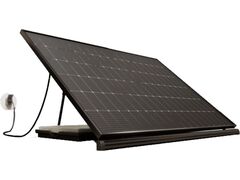
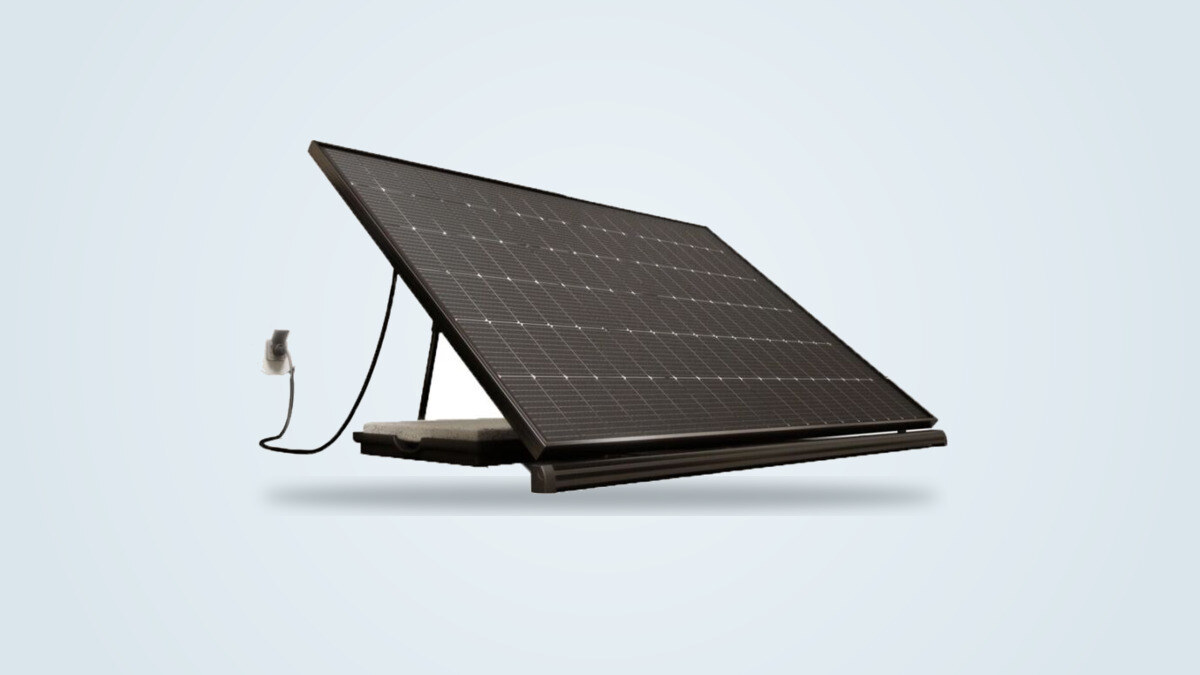
The Sunology PLAY 425W belongs to a European product category, ready-to-plug solar stations, built around a simple idea: the panel and its microinverter arrive already assembled, and hookup is a standard outdoor socket. Across the European markets where it's actually distributed, there's no work on the breaker panel, no contractor to call, and no advance permitting for undeclared, self-consumption-only use.
That last figure matters for a US reader: a standard American wall outlet supplies 120V, not 230V. The documentation available for this product does not describe a US-spec version, a voltage adapter, or a confirmed US retailer, and the fiche behind this review still lists the 230V European spec rather than a US equivalent. Nothing here plugs into a typical US driveway outlet as-is.
The rest of this review covers what the product does in the European markets where Sunology actually sells it, since that's the only context with real specs and real pricing to evaluate.
The bifacial panel: a real gain, but ground-dependent
The PLAY 425W's technical standout is its dual-glass bifacial panel: the cells capture direct light on the front face, but also light reflected off the ground on the rear face. Sunology claims output equivalent to at least 105% of what a standard monocrystalline panel of the same rated output would produce.
No independent measurement of this specific gain exists for this model to date: the 105% figure is a manufacturer claim, plausible given how bifacial technology physically works, but not verified under controlled conditions. The claimed 21% cell efficiency itself sits toward the upper end of current residential panels.
In practice, where the station is placed accounts for a meaningful share of its real-world performance, a factor entirely down to the buyer and their property, not the product itself, and this holds regardless of which country's grid it eventually plugs into.
A built-in microinverter, without excessive oversizing
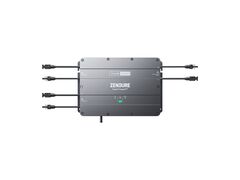
Unlike a bare solar panel that needs a separate charge controller or inverter, the PLAY 425W carries its own 400W microinverter, claimed at 99.8% conversion efficiency. This design accounts for most of the setup simplicity Sunology advertises: there's nothing else to wire up beyond a plug, in the markets where that plug matches the local outlet.
That 1.06 ratio between panel and microinverter output stays modest: some solar setups deliberately oversize the panel relative to the inverter to stretch production into the early morning and late afternoon, a common and unremarkable practice that other brands sometimes push further. Here, the tight margin means real output stays close to the panel's peak capacity most of the time.
As with the panel's own efficiency, no independent measurement of this specific microinverter's real conversion efficiency exists: the 99.8% figure is a manufacturer number, consistent with typical residential microinverter standards, but not independently verified.
No-construction setup: the real headline feature, where it applies
This is where the PLAY 425W stands apart most clearly from standard residential solar, in the European markets where it's sold. The kit includes the panel with its built-in microinverter, the tilting stand, a connected plug, a 3m cable, and two ballast trays for a stable ground installation with no drilling or permanent anchoring.
| Item | Included |
|---|---|
| Panel + microinverter | Yes, pre-assembled |
| Tilting stand | Yes (3 ground angles, 3 wall angles) |
| 230V cable (3m) and connected plug | Yes |
| Ballast trays (ground placement) | Yes, two included |
| Wall mounting hardware | No, sold separately |
The stand offers three ground angles (27°, 35°, 42°) and three wall angles (48°, 55°, 63°), enough to adjust orientation by season with no specialist tools. In the markets where it's sold, the station has to stay within 50m of an outdoor socket, a real constraint depending on the property layout.
None of this changes the core issue for a US buyer: the plug and cable described here are built for a 230V circuit. Running this specific unit off a US panel would require voltage conversion this review has no confirmed, manufacturer-backed solution for.
What a 425W station actually delivers
With no battery, the PLAY 425W stores nothing: the electricity it produces has to be used by the home at the moment it's generated, or it flows onto the grid with no compensation unless the installation is declared, under the net-metering rules of whichever country it's installed in. A station of this size mainly covers a household's constant baseline draw, fridge, router, standby devices, rather than any large, occasional load.
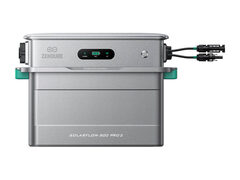
To go beyond that baseline draw, two options exist in the markets where the product is sold: link up to four stations on a single dedicated circuit, capped at 1700W total, or add a separately sold battery to store the surplus and release it later in the day.
Against other plug-and-play solar setups
Few products combine this much unit power, a bifacial panel, and a built-in microinverter at the level of simplicity the PLAY 425W offers, in the European market it's designed for. Comparing it against fundamentally different types of solar setups still helps place it.
| Criterion | Sunology PLAY 425W | Beem-style balcony kit | 12V nomadic panel (Zamp Solar-style) |
|---|---|---|---|
| Power output | 425W | Roughly 4x 75W | Roughly 130W |
| Built-in microinverter | Yes, 400W | Yes | No (12V controller) |
| Bifacial | Yes, dual-glass | No | No |
| Connection | 230V socket | 230V socket | 12V controller (van, boat) |
| Panel warranty | 25 years | 25 years | Not stated |
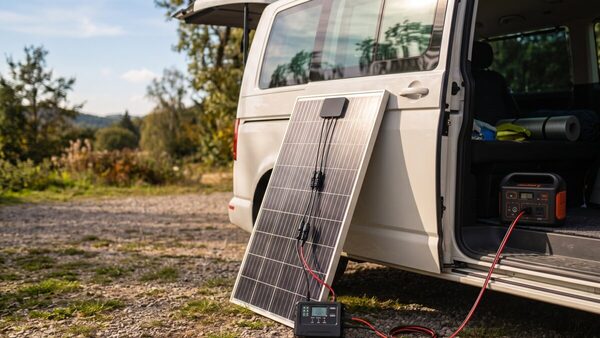
A Beem-style kit spreads its output across several smaller wall panels, more discreet but individually less powerful, where the PLAY 425W concentrates its output into a single unit. A 12V nomadic panel like a Zamp Solar targets a completely different job, and is genuinely US-relevant since it charges a 12V battery bank rather than plugging into household wiring at all. For a US reader specifically interested in nomadic, off-grid-style charging, that kind of 12V panel is the more directly applicable comparison of the three.
A 25-year warranty on a fairly young market
Sunology claims a 25-year warranty on the panel and a 12-year warranty on the microinverter, high figures that exceed most portable solar accessories and come close to standard residential photovoltaic norms, where the product is sold and serviced.
The ready-to-plug solar station segment is still fairly young, which limits how much real-world track record exists on how these warranties hold up over time, unlike roof-mounted photovoltaic panels installed for decades. No pattern of recurring failures specific to this model has turned up so far. Whether that warranty would even be honorable for a unit imported and adapted for US use is a separate, unresolved question this review can't answer.
The panel's IP65 housing protects against rain and dust for permanent outdoor placement, a protection level consistent with year-round outdoor use.
Who this review is actually useful for
As things stand, this isn't a buying recommendation for a US home: the PLAY 425W is built around 230V wiring, and there's no confirmed US-spec version, retailer, or voltage-conversion path in place. Readers based in the UK or continental Europe, where the product is properly sold, get a real and defensible case for it: no construction work, no contractor, a genuine bifacial panel, and a strong warranty.
For a US reader specifically curious about the concept, the more directly relevant comparison is a 12V nomadic solar setup designed from the ground up for US off-grid and van-life use, rather than a European plug-in station whose entire value proposition depends on infrastructure this side of the Atlantic doesn't share.
If a genuine US-spec version of this product line appears with confirmed 120V compatibility and a real US retailer, it would be worth revisiting this review against that specific configuration rather than assuming the European specs carry over directly.