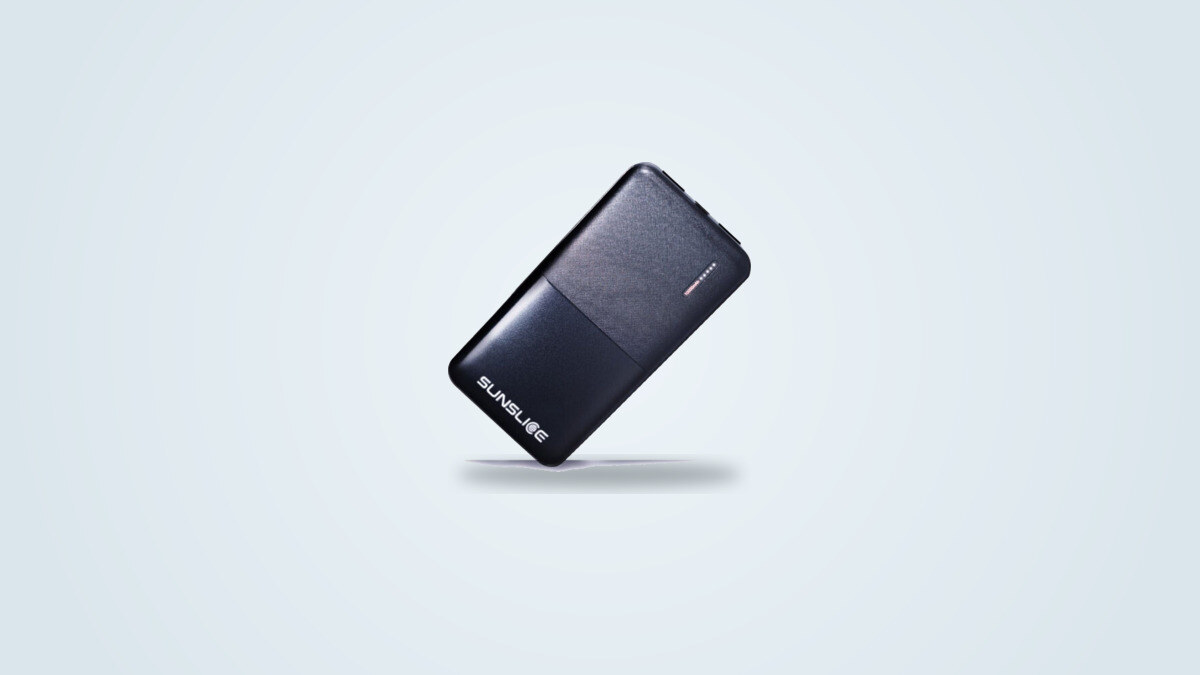
10,000mAh, 37Wh: what the Gravity 10 really returns
On the box, one figure stands out: 10,000mAh. Converted at the pack's real voltage, 3.7V, that comes to 37Wh, a figure confirmed by the manufacturer's own spec sheet (10,000mAh multiplied by 3.7V equals 37,000mWh, or 37Wh). This puts the Gravity 10 under the 100Wh threshold that allows carry-on with no special permit, with a comfortable 63Wh margin.
What matters more to a buyer is how many smartphone charges those 37Wh translate into once they pass through the output ports. Sunslice advertises two to three full charges. Over several days in mid-mountain terrain, between sun and cloud, the real-world return drops to 6,765mAh with a standard cable and 7,600mAh with the smartphone's original cable, or 68-76% of the advertised 10,000mAh depending on the cable used. Converted into pack energy, that gap works out to a real return of roughly 25-28Wh, 27Wh on average across the two figures obtained. On a 4,100mAh phone, that brings the number of full charges down to 1.65-1.85 rather than the 2.44 a purely theoretical calculation on nominal capacity would suggest.
This gap is nothing unusual for a power bank of this size: any voltage conversion through a fast-charge circuit uses up part of the stored energy, once on the cable side and once on the phone side. It is still wider than expected, and cable choice visibly accounts for several percentage points of it, a concrete reason to favor the charged device's original cable over a cheap generic one.
18W across three ports: a promise worth qualifying
The Gravity 10 offers three active outputs: a Power Delivery USB-C port and two Quick Charge 3.0 USB-A ports, each rated at 18W maximum. The brand allows charging up to three devices at once, each up to 18W. That is a generous promise: it implies delivering up to 54W combined across three simultaneous outputs, while the battery's single input itself caps out at 18W.
No published specification details how that power actually splits when all three ports are used together, short of the port-by-port breakdown some rivals publish. For one or two devices, the promise is easy to keep: 18W over USB-C with Power Delivery covers a standard smartphone fast charge, and Quick Charge 3.0 on the two USB-A ports gives broad compatibility with older Android phones.
On the 10,000mAh segment, 18W is now a modest ceiling: a good share of direct rivals in this price range now exceed 20, even 30W, on their main port.
Filling the 37Wh: charging that looks dated for 2026
The Gravity 10's charging input is capped, like each of its three outputs, at 18W maximum over its USB-C port. With the Sunslice Emperion 45W charger the brand recommends for this model, a full charge is advertised at around 3 hours. Over an extended multi-day trip in the mountains, a full charge from a standard wall outlet took up to 4 hours 40 minutes, a gap explained by the gradual drop in current a lithium cell accepts near the end of charging, on top of the usual conversion losses. For comparison, a constant-power calculation at 18W would give just over 2 hours for the pack's 37Wh: the gap between that theoretical floor and the 3 to 4h40 seen in practice illustrates the usual difference between a spec sheet and real-world use.
This 18W input ceiling puts the Gravity 10 well behind the newest power banks on the market, several of which now exceed 30, 45, or even 65W on input and fill up in an hour or less. For occasional backup use or a solar top-off, the difference barely matters. For anyone needing to top off during a short break, the gap is noticeable.
7.8 oz (220 g), 0.6 in thick: a shape built for a pocket
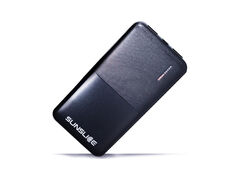
On the scale, the Gravity 10 comes in at 7.8 oz (220 g) for a 5.3 x 2.7 x 0.6 in (135 x 69 x 16 mm) footprint, a mere 0.6 in thickness that puts it closer to a phone case than a battery brick. Relative to its 37Wh, that works out to roughly 0.21 oz per Wh stored (6 g).
Against three similarly priced 10,000mAh power banks (full comparison further down this review), the Gravity 10 sits level with the Ugreen Nexode 10000mAh at 7.8 oz (220 g) and a touch heavier than the Xiaomi Mi Power Bank 3 at 7.1 oz (200 g). The shell is plastic with rounded corners, with no exposed metal parts. Its slim shape slips into a jacket pocket or a side pocket of a backpack without fuss, a genuine plus while traveling or on a day hike.
Four LEDs and a built-in flashlight: everyday connectivity
Four status LEDs show the remaining charge in 25% steps, a coarser solution than a digital display showing the exact percentage, but enough for a glance at whether there is enough charge left. No display comes with this model: for a precise percentage readout, a higher-end lineup is needed, from Sunslice or elsewhere.
The brand adds a built-in LED flashlight, missing from all three direct rivals covered further down this review. For camping, a night hike, or a power outage, that flashlight makes a genuine practical difference: it saves packing one more accessory in the same bag.
A USB-A to USB-C cable ships in the box, but no cable is built in or retractable on the unit itself. Reaching the full 18W input still needs a Power Delivery charger; a plain 5W USB-A adapter will charge the battery, just far more slowly. Pass-through charging, meaning the ability to charge a device while the battery itself is charging, is not advertised anywhere for this model.
Not water-resistant: don't confuse it with the Gravity 10 Extreme
The version covered here, the one the catalog lists, claims no IP rating at all. Neither the manual nor the product page mentions any particular resistance to water, dust, or sand for this specific model.
That distinction matters, because Sunslice also sells a “Gravity 10 Extreme,” a separate unit: larger at 5.5 x 2.9 x 0.7 in (140 x 73 x 17 mm), heavier at 9.1 oz (259 g), IP67-rated (water and sand resistant), with its USB-C output pushed to 20W and up to 38W combined across its two active ports, sold for noticeably more, around $81. The two products share much of their product name and official product page, which can cause confusion when buying.
| Spec | Gravity 10 (this model) | Gravity 10 Extreme |
|---|---|---|
| Weight | 7.8 oz (220 g) | 9.1 oz (259 g) |
| Dimensions | 5.3 x 2.7 x 0.6 in (135 x 69 x 16 mm) | 5.5 x 2.9 x 0.7 in (140 x 73 x 17 mm) |
| Water resistance | Not specified | IP67 |
| USB-C output | 18W | 20W |
| Combined output | Not specified | Up to 38W |
| Observed price | $47.31 | ≈ $81 |
For the standard version covered in this review, some caution outdoors remains sensible: a light shower on a closed unit is not usually an immediate problem, but prolonged exposure to heavy rain or a dunk in water falls outside the intended use the manufacturer specifies. For demanding use by the coast, in the rain, or while kayaking, the Extreme version suits that need better, at a higher price and a noticeably bulkier size.
Fusion Flex solar compatibility: the real math
The Gravity 10 charges over its single USB-C port, which makes it compatible with Sunslice's foldable Fusion Flex solar panels with no extra adapter. That is a genuine ecosystem argument, missing from all three direct rivals covered in this review.
With the smallest panel in the lineup, the Fusion Flex 6 (6W rated), a charge in full spring sun took around 11 hours. A constant-power calculation in uninterrupted full sun gives a theoretical floor of just over 6 hours to fill the pack's 37Wh: the gap between that floor and the 11 hours needed in this specific case reflects the reality of a flexible panel, whose angle to the sun shifts through the day and whose output drops sharply the moment a cloud passes.
Sunslice itself recommends plugging its Fusion Flex panels into a power bank rather than straight into a phone, precisely to smooth out these swings in output. The Gravity 10 plays that go-between role in the brand's ecosystem: a lineup choice that makes sense for anyone who already owns, or is considering, a Sunslice panel, but adds nothing for anyone who is not.
Sunslice, a Belgian brand banking on brick-and-mortar retail
Sunslice is a Belgian company founded in 2017 in Ottignies-Louvain-la-Neuve by two UCLouvain engineering graduates, Geoffroy Ghion and Henri Gernaey, out of an ultra-compact solar charger project built during their studies. The brand has since specialized in foldable solar panels and the power banks that go with them, with design claimed in Belgium while manufacturing runs in China, with part of the manual assembly handled in Tunisia.
Its products are now distributed through dozens of specialty stores across Europe, notably via sporting-goods and outdoor retail chains rather than online sales alone, a mark of credibility for a brand this size. Sunslice does not appear to have a dedicated retail presence in the US market at this time.
The Gravity 10 carries a 2-year warranty, the category standard. After-sales support generally runs through the retailer the unit was bought from. No product recall or safety issue is on record for this model to date, in a sector where several larger rival brands have had to recall entire product lines over fire risks in recent years. The pool of feedback available for this brand nonetheless remains smaller than for the biggest names in the category.
Against Anker, Xiaomi, and Ugreen: what justifies the gap
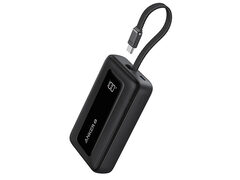
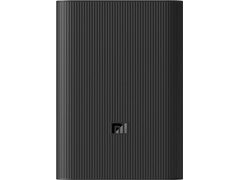
In the 10,000mAh segment selling around $35-40, the Gravity 10 faces dense competition. Three models of identical capacity compete for the same shelf space: the Anker Zolo 10000, more powerful at 30W; the Xiaomi Mi Power Bank 3, the most affordable option; and the Ugreen Nexode 10000mAh, a well-rounded all-rounder.
| Criterion | Sunslice Gravity 10 | Anker Zolo 10000 | Xiaomi Mi Power Bank 3 | Ugreen Nexode 10000mAh |
|---|---|---|---|---|
| Capacity | 10000mAh (37Wh) | 10000mAh (37Wh) | 10000mAh (37Wh) | 10000mAh |
| Max power | 18W | 30W | 22.5W | 20W |
| Weight | 7.8 oz (220 g) | ≈ 7.6 oz (215 g) | ≈ 7.1 oz (200 g) | ≈ 7.8 oz (220 g) |
| Built-in LED flashlight | Yes | No | No | No |
| Solar ecosystem | Yes | No | No | No |
| Observed price | $47.31 | ≈ $35.20 | ≈ $23.02 | ≈ $37.91 |
The Anker Zolo 10000 wins on raw power thanks to its 30W USB-C port, and the Xiaomi Mi Power Bank 3 remains the most affordable option. None of the three, however, offers a built-in flashlight or solar compatibility: the Gravity 10 wins on neither price nor power, but is the only one here combining a versatile triple port, a flashlight, and a solar ecosystem.
Gravity 10 or Gravity 20: which one to pick in the Sunslice lineup
Sunslice offers its Gravity lineup across several capacities, including a Gravity 20 also reviewed on this site. Both share the same port layout (1x USB-C and 2x USB-A, each up to 18W), the same Fusion Flex solar compatibility, an identical built-in LED flashlight, and the same 2-year warranty. The difference comes down mainly to capacity and size.
| Spec | Gravity 10 | Gravity 20 |
|---|---|---|
| Capacity | 10000mAh (37Wh) | 20000mAh (74Wh) |
| Weight | 7.8 oz (220 g) | 14.1 oz (400 g) |
| Dimensions | 5.3 x 2.7 x 0.6 in (135 x 69 x 16 mm) | 5.5 x 2.7 x 1.0 in (140 x 69 x 26 mm) |
| Power per port | 18W | 18W |
| LED flashlight / solar | Yes / Yes | Yes / Yes |
At double the weight (14.1 oz against 7.8 oz), the Gravity 20 offers exactly double the nominal capacity. For a weekend or a daily top-off, the Gravity 10's compact shape slips into a pocket more easily; for a multi-day trek, the Gravity 20's larger reserve leaves more of a margin, at the cost of extra bulk. As no real-world return figure for the Gravity 20 is available to date, the efficiency comparison between the two models is left open here.
Hiking, travel, everyday backup: who it suits
On a day hike, on a trip, or during a short work trip, the Gravity 10 fits a simple top-off role: topping off a smartphone, a pair of earbuds, or a smartwatch, with a built-in flashlight thrown in that saves packing one more accessory. Its slim shape makes it easy to forget in a bag or pocket until it's actually needed.
For a multi-day trek with no wall outlet at all, it's safer to plan on a little less than the two to three charges advertised, with some margin if a power-hungry phone or poor sun for the solar panel join the trip. In a family or small group, its three active ports can help out several devices at once, though without a guarantee of 18W on each simultaneously.
It suits anyone after a compact energy reserve for a smartphone and small USB accessories, who likes a built-in flashlight over a separate accessory, and who is considering a Sunslice solar panel down the line.
It suits less anyone who regularly charges a laptop, wants the fastest charging on the market at this price, or needs everyday protection against water and dust.