145W, four ports, one built-in cable: the all-in-one promise
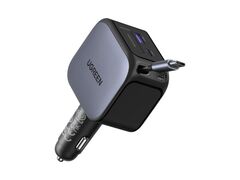
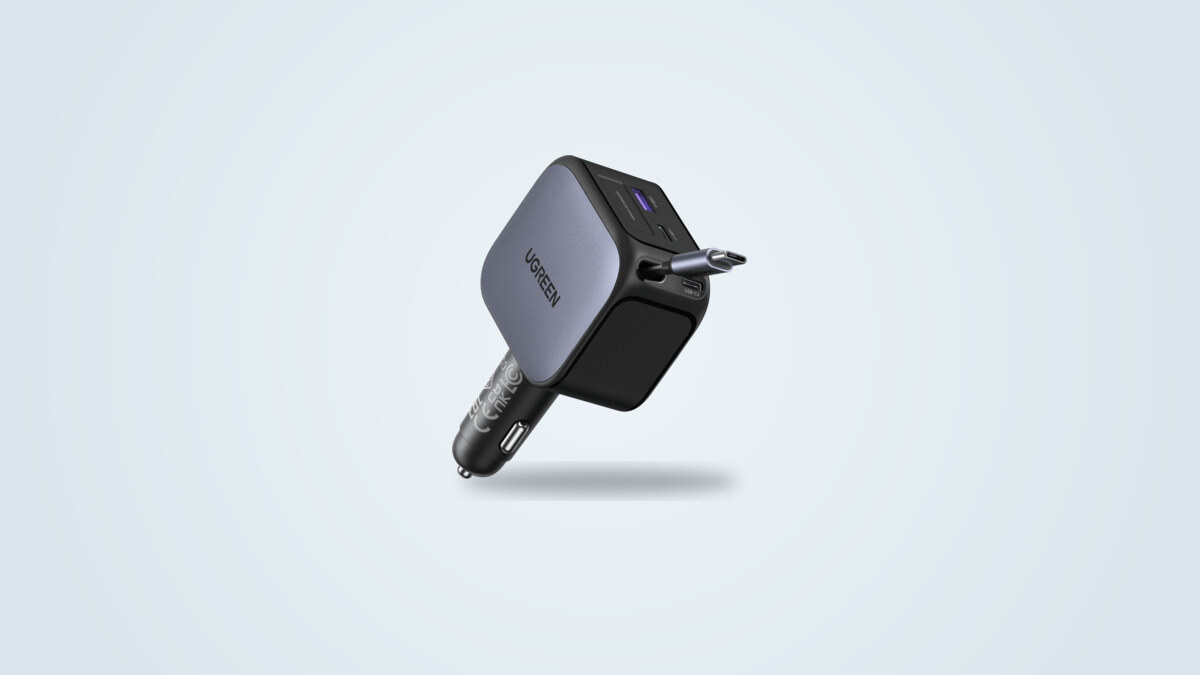
The Ugreen Nexode 145W car charger sits at the top of the brand's cigarette lighter charger lineup. It combines a built-in retractable USB-C cable, two additional USB-C ports, and a USB-A port, for a total of four outputs usable at once from the vehicle's single 12V socket. What sets it apart is less the power rating itself, already available elsewhere in the lineup, than the built-in cable, which removes the need to carry or hunt for a USB-C cable.
The unit plugs directly into the cigarette lighter socket and accepts both 12V and 24V input, covering a passenger car as well as a van or an RV. Four devices can in theory charge at the same time: the built-in cable, the two additional USB-C ports, and the USB-A port. What that promise is actually worth once all four outputs are in use together is covered in detail further down.
The retractable cable: 27.6 inches that tuck away with a single tug
The built-in USB-C cable extends up to 27.6 in (70cm) and locks into eight different positions, enough to reach a back-seat passenger or a center console without straining the mechanism. Release it and it retracts automatically back into the housing. Ugreen rates the mechanism for at least 25,000 pull cycles and 10,000 charge cycles, an order of magnitude aimed at years of daily use.
This cable alone delivers up to 60W, enough for a tablet or a phone on fast charge. Its real-world power sits between 57 and 62W, close to the rated ceiling rather than falling short of it, a result that is far from guaranteed on this kind of moving mechanism, where every pull cycle puts mechanical stress on the electrical contacts.
The 100W USB-C port: enough to charge a laptop
On the back of the unit, a second USB-C port climbs up to 100W, the power level needed to fast-charge a 16-inch MacBook Pro or a USB-C Power Delivery compatible Windows ultrabook straight from the 12V socket. Its real-world power sits between 95 and 106W, matching the rated ceiling with no notable drop, a stronger showing than the 100W port on the Ugreen 130W in the same lineup, whose power falls off noticeably after a few minutes of sustained charging.
Used together, the built-in cable and this USB-C port can combine for up to 145W, the charger's full rated output: that combination reaches up to 100W plus 45W, exactly the overall ceiling. The cable gives up part of its headroom (60W on its own, 45W combined) so the USB-C port can hit its own maximum, a logical trade-off since the unit cannot exceed 145W in total regardless.
Four ports, one budget: what is left once everything is plugged in
The math is simple: the cable is rated up to 60W, the dedicated USB-C port up to 100W, and the two remaining outputs, a second USB-C port and the USB-A port, up to 30W each. Added together, these four individual maximums reach 220W, well above the 145W actually available. That gap is not a hidden flaw: it simply means no charger of this format can power four devices at their individual maximum at the same time, regardless of brand.
In practice, the unit applies a clear priority order. The dedicated USB-C port and the built-in cable share the bulk of the budget, as shown by the 145W combination described above. As soon as the two remaining ports come into play, their share drops to a residual level, anywhere from a few watts to around 20W depending on the exact load at the time, well below their individual 30W maximum. The charger also applies stepped thermal throttling past a certain internal temperature: the dedicated USB-C port can then drop from 100 to 65 and then 45W, and the cable from 60 to 45 and then 30W, before returning to full output once the temperature comes back down.
For everyday use, this mechanism still works in the charger's favor: a laptop on the dedicated port and a phone on the cable share most of the 145W with no real compromise. It is the headline promise of "four devices at once" that needs qualifying: it holds up for four small, undemanding devices, far less so for four simultaneous fast charges.
PD, PPS, QC, SCP, AFC: the widest compatibility in its class
The Ugreen 145W's charging management circuit supports an unusually wide range of protocols for this kind of product: USB Power Delivery 3.0 with PPS for the Apple ecosystem and generic Android devices, Quick Charge 3.0 and 4+ for a large share of older Android hardware, plus FCP, SCP, and AFC, the proprietary protocols used by Huawei/Honor and Samsung respectively. Few car chargers stack up such a complete list: the Ugreen 130W and the Anker 167.5W in the same category each cover part of this list, but neither displays the full set of six protocols found here.
This protocol breadth translates into real compatibility with the vast majority of recent smartphones, from the iPhone 12 through 17, iPads, Galaxy S23 Ultra through S26, as well as Windows laptops and handheld gaming devices that support USB-C Power Delivery. The one gap, shared by the whole lineup, is that no legacy Apple Lightning protocol is covered, since every output here is natively USB-C.
Built-in cable: a genuine convenience, at a real cost
The built-in cable changes daily use in a concrete way: no more checking whether a cable is still in the glove compartment or unplugging it to lend to a passenger, just pull and let go. That is the central argument for this charger over the Ugreen 130W, which relies on a detachable, 100W-certified cable included in the box, or over the Anker 167.5W, which ships with a standard one-meter cable.
This design choice comes with two structural limits, inherent to any built-in cable rather than specific to a manufacturing flaw in this particular unit. First, a single connector type on that output: the cable is exclusively USB-C, which rules out a Lightning-port iPhone (14 and earlier) by default, forcing it onto one of the other three ports with its own cable. Second, the irreversibility of the choice: a detachable cable that wears out or frays can be replaced for a few dollars, while a built-in cable that jams or snaps inside its retraction mechanism puts the whole charger out of action. The cable's own build is described as feeling less thick and less premium than a cable sold on its own, a difference in feel that does not affect charging but is noticeable in use.
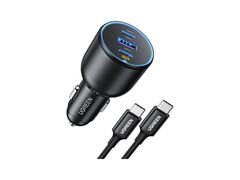
Another practical limit: the box includes no extra cable for the two additional USB-C ports or the USB-A port. Only the built-in cable is ready to use out of the box; the other three outputs assume you already own good-quality cables of your own.
4.2 ounces: the physical cost of the built-in cable
The retraction mechanism has a direct cost in size. The unit weighs 4.2 oz (118g) for roughly 4.2 x 2.4 x 1.4 in (106 x 62 x 36mm), well above other car chargers in the same price bracket: more than double the Anker 167.5W (1.8 oz / 50g, 3.1 x 1.4 x 1.4 in / 80 x 36 x 36mm), despite that unit delivering more power, and more than double the Ugreen 52.5W (2.0 oz / 57.2g) or the Ugreen 130W (1.6 oz / 45g) as well.
| Model | Total power | Weight | Dimensions | Built-in cable |
|---|---|---|---|---|
| Ugreen 145W | 145W | 4.2 oz (118g) | 4.2 x 2.4 x 1.4 in (106 x 62 x 36mm) | Yes, retractable |
| Ugreen 130W | 130W | 1.6 oz (45g) | 3.0 x 1.4 x 1.4 in (76 x 36 x 36mm) | No |
| Ugreen 52.5W | 52.5W | 2.0 oz (57.2g) | 2.6 x 1.2 x 1.2 in (65 x 30 x 30mm) | No |
| Anker 167.5W | 167.5W | 1.8 oz (50g) | 3.1 x 1.4 x 1.4 in (80 x 36 x 36mm) | No |
Part of this gap is logically explained by the retraction spool, absent from the other three models, plus one extra port compared with the 52.5W and the 130W. But the gap with the Anker 167.5W, which is more powerful and yet half the weight with no built-in cable, shows the housing is noticeably bulkier than the delivered power alone would explain. The unit does not get in the way of the gear shift once installed, but it visibly protrudes more than a basic cigarette lighter charger.
Five protections, a fire-retardant housing, and a two-year warranty
Ugreen lists five protections on this model: against overvoltage, undervoltage, overcurrent, short-circuit, and overheating, the latter managed by the stepped thermal throttling described above. The housing is made of V-0 rated fire-retardant plastic, and its surface temperature is said to stay around 149 °F (65 °C) even under sustained full-power use. Inside, the solder joints on the flat cable feeding the retractable spool are sealed, a build detail aimed directly at the most mechanically stressed point of the product.
The manufacturer's warranty is set at two years, the longest and most clearly stated among the three car chargers compared here: the 130W and the 52.5W both show a duration that varies from one retailer to another, while the Anker 167.5W stops at 18 months. No recurring failure or manufacturing defect specific to this 145W model has turned up, unlike the 100W port on the Ugreen 130W, which has drawn failure reports after a few months of use.
Against the rest of the lineup and direct rivals
How does the Ugreen 145W stack up against the three closest car chargers, inside and outside the brand?
| Criteria | Ugreen 145W | Ugreen 130W | Ugreen 52.5W | Anker 167.5W |
|---|---|---|---|---|
| Total power | 145W | 130W | 52.5W | 167.5W |
| Most powerful port | 100W | 100W | 30W | 100W |
| Built-in cable | Yes, 27.6 in (70cm) retractable | No (detachable cable included) | No | No |
| Protocols | PD, PPS, QC 3.0/4+, FCP, SCP, AFC | PD, PPS, QC 3.0/4.0, SCP | PD, PPS, QC 3.0, SCP | PD, PPS, PowerIQ 3.0 |
| Warranty | 2 years | Varies by retailer | Varies by retailer | 18 months |
| Street price | $34.99 | $25.99 | $14.61 | $37.79 |
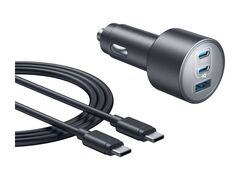
Against the 130W, the 145W holds its rated power better on the dedicated USB-C port, with a longer and clearer warranty, at the cost of a bulkier housing and a power budget shared across more outputs. Against the 52.5W, it targets a far more demanding use case, up to laptop charging, with a cable always within reach. Against the Anker 167.5W, the most powerful of the four, the 145W adds the convenience of a built-in cable and broader protocol support, but loses ground on bulk and on how cleanly power is shared across four ports, since the Anker splits its three outputs without having to scale one back to feed another.
Who is the Ugreen 145W for?
This charger is aimed first at anyone equipping a family car or a van with a complete charging station without ever having to hunt for a cable: the built-in cable covers most of a passenger's needs, and the dedicated USB-C port is enough to charge a laptop on the road. It also suits anyone who values a long warranty and a wide protocol list, useful in a household mixing iPhone, Android, and Huawei or Samsung devices.
It suits fewer buyers who prioritize a compact footprint: the Anker 167.5W remains more powerful and half the weight, with no built-in cable to manage. For simpler use, centered on two smartphones with no need to charge a laptop, the Ugreen 52.5W is plenty for a smaller budget. And for anyone who wants a certified 100W cable that is detachable rather than built-in, the Ugreen 130W remains a direct alternative within the same brand.