What the 30W rating actually gets you
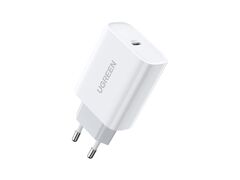
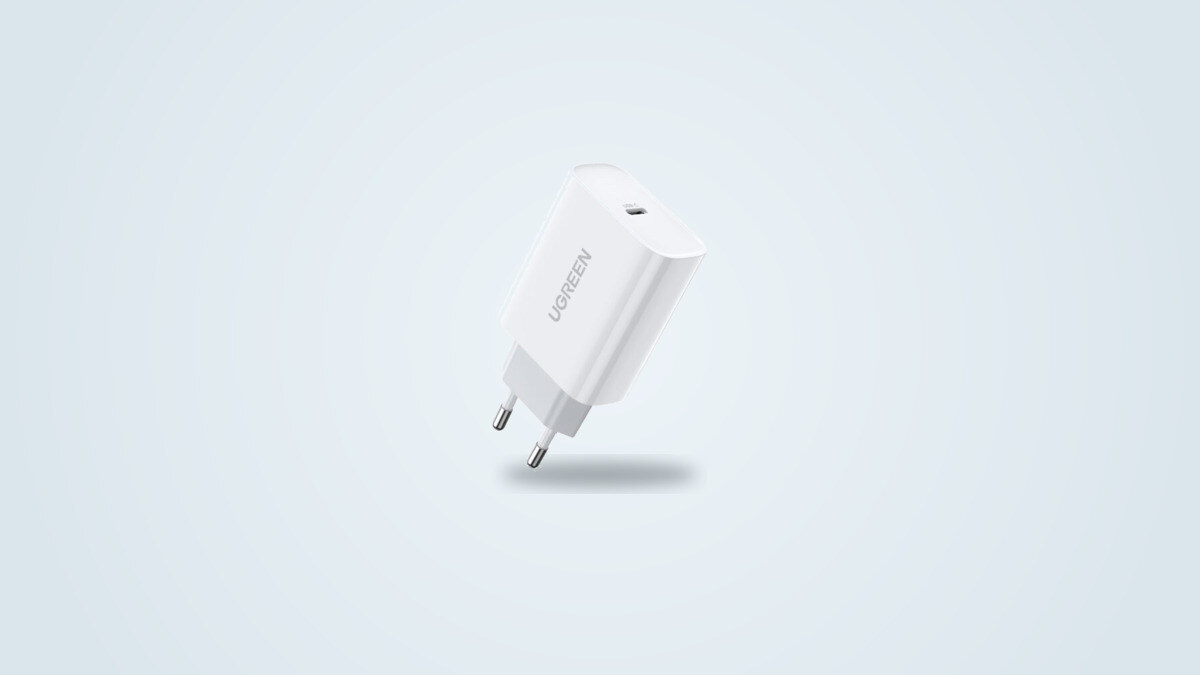
The Ugreen 30W USB-C Charger puts all of its power behind a single port: nothing to share, the full electrical budget stays available for whichever device is plugged in. The port negotiates its voltage with the connected device across a full Power Delivery 3.0 table from 5V to 20V, plus a continuous PPS range between 3.3V and 11V for compatible devices.
Full 30W output only shows up from 12V upward: below that, at 5V or 9V, the port tops out at 15W then 27W regardless of what is plugged in. A phone that negotiates a lower voltage will never actually see the 30W printed on the box, which is not a broken promise but simple physics (power equals voltage times current). The real question is not whether 30W gets reached at all costs, but whether the charger negotiates the right voltage for the device in hand, exactly the job Power Delivery 3.0 and PPS are there to do.
PD 3.0, PPS, QC: broad protocol compatibility
Six fast-charging protocols are supported at once: Power Delivery 3.0, PPS, Quick Charge, AFC, FCP and SCP. That list spans the Apple and Google ecosystem (PD, PPS), Samsung (PPS, AFC), Huawei (FCP, SCP), and most recent Quick Charge Android phones. PPS deserves a quick explanation: unlike classic Power Delivery, which offers fixed voltage steps (5V, 9V, 12V...), PPS adjusts voltage continuously in very fine increments, which limits heat build-up in the cable and phone during fast charging, the mechanism behind adaptive fast charging on recent Galaxy phones.
That protocol breadth goes beyond several direct competitors at the same price: a PD-only charger without PPS will not let a recent Galaxy reach its maximum advertised charging speed, no matter how high the wattage printed on the box. Apple's own 30W USB-C adapter, for instance, does not advertise PPS support, unlike this charger.
Compatible without any special setup with iPhone 12 through 17 (via PD and PPS), recent Galaxy and Pixel phones, iPad, and standard USB-C earbuds and accessories, this charger covers nearly every device a household is actually likely to own, with no brand exclusivity.
The GaN II format: a compactness promise that holds up
The GaN II chip (second-generation gallium nitride) replaces the silicon transistors of older chargers. At equal power, it wastes less energy as heat and fits into a noticeably smaller case. Weighed independently, this unit comes in at roughly 1.4 oz (40 g) on a square footprint of about 1.3 in (32 mm) per side, barely bigger than an old 5W iPhone charger for six times the power output. The US version folds its prongs flat against the case for travel, a detail some compact single-port chargers skip.
During a sustained charging cycle, the case turns warm to the touch but never crosses into genuinely hot, in line with the usual GaN pitch against older, heavier, hotter-running silicon chargers of comparable power. No screen or LED indicator of any kind is present, so there is no visual confirmation that fast charging has actually kicked in, unlike pricier multi-port siblings from the same brand.
The single-port trade-off, and what it costs
This charger makes a deliberate choice: one USB-C port, no USB-A port, so no charging two devices at once. That is a structural difference from multi-port models in the same range, where the wattage printed on the box never fully materializes once a second or third device gets plugged in. On the same brand's 90W model, for instance, the available budget drops to 75W once all three outputs are in use together, with the two secondary ports falling to just 7.5W each, far below their individual maximum.
The 30W charger sidesteps that trap by design: there is nothing to share, so nothing collapses when a second device shows up, for the simple reason that a second device structurally has nowhere to plug in. The trade-off is known upfront rather than discovered later: anyone who regularly charges several devices in the same spot should either plug in one after another or pick a multi-port model from the start, power-sharing compromise included.
The complete absence of any USB-A port is worth calling out separately: older USB-A cables and accessories (some watch chargers, legacy charging cables) find no direct socket on this brick and need a separate USB-C-to-USB-A adapter.
Safety and electronic protections
The charger runs a Thermal Guard system that takes 238 temperature readings per second across the internal electronics, on top of the protections expected on this kind of product: overload, short-circuit and overvoltage protection. No serious safety issue (uncontrolled overheating, unit failure, a genuine electrical hazard) is associated with this specific single-port model.
One thing worth flagging regardless: a handful of isolated reports mention a unit failing shortly after purchase. Nothing that looks like a widespread issue with this particular model, unlike some far more powerful multi-port chargers from the same brand, whose ports can degrade after prolonged use at full load, an electrical and thermal stress this small single-port, modest-wattage unit simply does not face.
Charging an iPhone, an Android phone, a tablet: the real-world numbers
The manufacturer states a 0 to 60% iPhone charge in about thirty minutes, a figure worth comparing against charge times on two Android phones whose charging speed is capped by the phone itself rather than by the charger: an 18W ceiling on one, a 25W ceiling on the other, neither ever asking this port for its full 30W.
| Device | Power accepted by the phone | Charging time |
|---|---|---|
| Compact Android phone (Pixel 8a) | 18 W maximum | About 1h30 from 15% to 100% |
| Mid-range Android phone (Galaxy A53) | 25 W maximum | About 1h20 to 1h25 for a full cycle |
| iPhone (manufacturer's own figure) | Up to 27 W over PD/PPS | 0 to 60% in about thirty minutes |
The practical takeaway fits in one sentence: on most phones on the market, the speed limit is almost never the charger, it is the phone itself. This charger's 30W mostly benefits devices that can actually put it to use: a recent iPad, a flagship phone with PPS support above 25W, or a MacBook Air topping up on the same port in a pinch. A more demanding laptop, on the other hand, will not see its usual charging speed with only 30W on tap.
Up against the competition
In the single-port 30W USB-C wall charger segment, several references play the same simplicity card. Apple's own 30W USB-C adapter remains the default pick for an iPhone and MacBook Air household but does not advertise PPS support, which keeps it from unlocking a Samsung phone's full-speed charging. Competing dual-port models at a similar price often carry the same structural catch already seen on Ugreen's own multi-port units: the two ports never simply add up and instead share one common power budget, short of the independence a quick glance at the total wattage might suggest.
Against that backdrop, this charger takes a third path: a single port, but with zero sharing compromise on that port, full protocol coverage (PD 3.0, PPS, QC, AFC, FCP, SCP), and one of the more compact GaN designs in its segment. What it does not do is talk to proprietary ultra-fast standards like SuperVOOC or Warp Charge: those brand-specific standards need their own maker's charger to hit top speed, a limitation shared by every generic charger on the market, not something specific to this unit.
Reliability, warranty and track record
This GaN II 30W charger design has been on the market for several years, giving it a substantially longer track record than accessories that only just launched. The manufacturer states a 24-month warranty. Given the sales volume involved, reports of early failure remain rare and isolated, with no recurring fault pattern tied to this specific single-port, modest-wattage model: the more serious failure reports found on the brand concern far more powerful multi-port chargers, which face electrical and thermal stress on an entirely different scale.
Who this charger is for
This charger makes the most sense for anyone after a compact, fast replacement for a single device at a time: a phone, a tablet, earbuds, or a MacBook Air as a travel top-up. Its broad protocol support makes it a solid pick regardless of whether the household runs on Apple, Samsung or Google devices, with no compatibility guesswork required beforehand. On the other hand, anyone who routinely charges two or three devices in the same spot, a nightstand or a shared desk, will get more out of a multi-port model, power-sharing compromise and all.
Worth keeping in the desk drawer or the travel bag rather than buried in a cupboard: at this size and this price, its natural role is as the spare charger that is always within reach, not the one and only charger for a household with several devices to juice up together.