Ugreen 60W Car Charger: our full review

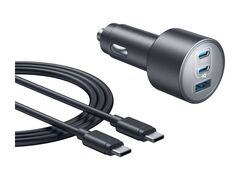
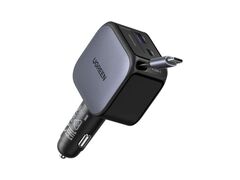
A 27.6 in (70 cm) retractable USB-C cable, a USB-C port and a USB-A port: the Ugreen 60W car charger charges up to three devices at once without ever leaving a cable trailing in the cabin.

Our rating
3.9/5
Safety and protections: 3.8 out of 5 (weighting 20%)Safety3.8Build and endurance: 3.8 out of 5 (weighting 15%)Build3.8Actually delivered power: 3.6 out of 5 (weighting 25%)Power3.6Multi-port power sharing: 4.2 out of 5 (weighting 20%)Sharing4.2Protocol compatibility: 4.0 out of 5 (weighting 12%)Protocols4.0Size and technology: 3.8 out of 5 (weighting 8%)Size3.8

How is this rating calculated?

Ugreen 60W car charger with its retractable USB-C cable

The essentials

The Ugreen 60W turns the car's power outlet into a small three-port charging station, headlined by a 27.6 in (70 cm) retractable USB-C cable that saves you from ever carrying a spare one. A separate USB-C port and a USB-A port round out the set at 30W each, for 60W total shared across connected devices. Ugreen rates this cable for 25,000 retractions and 10,000 charge cycles, and the body includes standard protections against overvoltage, overcurrent, short circuits and overheating. The catch is openly stated by the brand itself: with 30W maximum per output, this charger is not built for a laptop, only for smartphones, tablets and small accessories. Neither the weight, the dimensions, nor a warranty duration are stated on the product page. To equip a family car without ever seeing a trailing cable again, the value for money remains convincing.

Strengths

  • Built-in retractable USB-C cable (27.6 in / 70 cm, 8 lengths), never need a spare cable again
  • 3-in-1 design: retractable cable, USB-C port and USB-A port, 60W total
  • Cable rated for 25,000 retractions and 10,000 charge cycles
  • Compatible with PD 3.0, QC 3.0 and PPS for most recent smartphones and tablets
  • Multiple protections against overvoltage, overcurrent, short circuits and overheating

Limitations

  • 30W maximum per port or cable used alone, not enough for a laptop, Ugreen advises against it itself
  • Neither the weight, the dimensions, nor a warranty duration are stated on the product page
  • The separate USB-C port and the USB-A port both stay capped at 30W, no dedicated high-power port
  • No independent measurement confirms the power actually delivered across all three outputs at once
  • The retractable mechanism, while rated durable, is a unique moving part whose long-term reliability is documented only by the manufacturer's own figure
Ugreen 60W Car Charger: see the full details and price →

Three outputs, and a cable that stows itself

Most original car chargers are limited to a single low-power USB-A port. The Ugreen 60W goes further with a 3-in-1 design: a built-in retractable USB-C cable, a USB-C port and a USB-A port, turning the car's power outlet into a genuine little charging station.

60 W
Total power
27.6 in
Retractable USB-C cable
3
Simultaneous outputs

The retractable cable, the main selling point

The built-in USB-C cable extends up to 27.6 in (70 cm) and locks at 8 adjustable lengths: pull it out, let go, and it stows itself away, no more hunting for a cable in the glove box or leaving it trailing under the seat. Ugreen rates this mechanism for 25,000 retractions and 10,000 charge cycles, a figure that comfortably covers everyday use over several years. This cable alone delivers up to 30W, enough to fast-charge a smartphone or tablet.

30W per output, built for the phone rather than the laptop

Each output, cable included, caps at 30W when used alone, and total power rises to 60W when two outputs run at the same time. That 30W ceiling is plenty to fast-charge most recent smartphones and tablets, but it rules out laptops outright: Ugreen explicitly advises against it for a MacBook or a PC. For a use case centered on phones and small accessories, the available power is well matched.

PD 3.0, QC 3.0 and PPS

The Ugreen 60W supports the PD 3.0, QC 3.0 and PPS protocols among others, automatically matching most recent Android smartphones and iPhones, tablets and earbuds. It is not compatible with proprietary charging standards such as SuperVOOC or Warp Charge, which need the relevant manufacturer's own charger to reach their maximum speed.

Standard protections, but few figures stated

The body includes protections against overvoltage, overcurrent, short circuits and overheating, a baseline expected on this kind of accessory. The retractable cable, rated for 25,000 retractions and 10,000 charge cycles, is the only durability figure disclosed.

Worth knowing: neither the weight, the dimensions, nor a contractual warranty duration are stated on the product page, which makes a direct comparison with more transparent rivals on these points harder.

Against the Anker 323, the Baseus 65W and the Ugreen 63W

How does the Ugreen 60W compare with other car chargers on the market?

Technical comparison: Ugreen 60W against other car chargers (observed prices, indicative only)
CriterionUgreen 60WAnker 323 (52.5W)Baseus 65WUgreen 63W
Power60W52.5W65W63W
Outputs3 (cable + C + A)2 (USB-C + USB-A)2 (USB-C + USB-A)2 (USB-C + USB-A)
Built-in cableYes, retractableNoNoNo
Observed price$19.99≈ $23≈ $39≈ $16

The Ugreen 60W is the only one in this comparison with a built-in retractable USB-C cable, a real advantage for never hunting for a cable or leaving it trailing in the car again. The Anker 323 costs more with no built-in cable. The Baseus 65W and the Ugreen 63W aim for higher power per port (up to 45W over USB-C), useful for a small laptop, but without this storage comfort; the Ugreen 63W in particular undercuts it on price if a built-in cable is not a priority. For a family car where practicality matters most, the Ugreen 60W clearly stands out.

Who the Ugreen 60W is for

This charger suits anyone wanting to equip a family car without ever seeing a trailing cable again, to charge smartphones, tablets and small accessories. To charge a light USB-C laptop, the Ugreen 63W and its 45W port are a better fit; for a retractable cable with more power, the Anker 167.5W is worth considering.
The rating in detail

Our rating
3.9/5
Actual charging current not measured
Battery compatibility not measured
Safety and protections 3.8
Build and endurance 3.8
Cables and connectors not measured
Actually delivered power 3.6
Multi-port power sharing 4.2
Protocol compatibility 4.0
Size and technology 3.8
Format and chemistry compatibility not measured
Charging precision not measured
Display and control not measured
Ugreen 60W Car Charger: see the full details and price →

The product and its alternatives

Ugreen 60W Car Charger

Ugreen 60W Car Charger

See price (22)

The compact, clever cigarette-lighter charger: 60W to charge 3 devices at once, with a 27.6 in (70 cm) retractable USB-C cable always to hand in the car.

View product
Ugreen Car Charger 63W

Ugreen Car Charger 63W

See price (28)

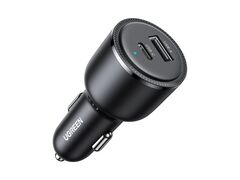
A powerful 63W car charger: one 45W USB-C fast-charging port and one USB-A port, to charge two devices at once in the car, even a laptop.

View product
Anker 167.5W Car Charger

Anker 167.5W Car Charger

See price (30)

Three ports, 167.5W in total and 100W on the first USB-C port: this ultra-compact Anker charger can even charge a MacBook Pro from your car's 12V socket.

View product

Frequently asked questions

Up to three: the built-in retractable USB-C cable, a USB-C port and a USB-A port. The 60W total power is shared between the connected devices, with 30W maximum on a single output used alone.

No, Ugreen explicitly advises against it: each output caps at 30W, enough for a smartphone or tablet but not a MacBook or laptop. For a laptop, a more powerful model like the 145W in the same lineup is a better fit.

The USB-C cable extends up to 27.6 in (70 cm) and locks at 8 lengths, stowing itself with a simple release. Ugreen rates it for 25,000 retractions, keeping cables from tangling in the center console.

Yes. It plugs into any standard 12V or 24V power outlet, found on almost all cars, vans and RVs.

PD 3.0, QC 3.0 and PPS, among others, to automatically match most recent Android and iPhone devices. It is not compatible with proprietary charging such as SuperVOOC or Warp Charge.