What the advertised 37 Wh are really worth
The technical sheet for the Xiaomi 33W Magnetic Power Bank 10000 advertises 10,000 mAh, a figure that actually covers two 5,000 mAh Lishen cells wired in parallel, for a nominal cell energy of 37 Wh (10,000 mAh at a nominal voltage of 3.7 V). That raw figure is not, however, what the device actually delivers to a smartphone: like any power bank, it has to convert that energy stored at 3.7 V to the 5 V of the USB standard, a conversion that consumes part of the energy along the way.
The manufacturer states this loss itself in the form of a rated output capacity of 5,900 mAh at 5 V and 3 A, or about 29.5 Wh actually available at the port, against 37 Wh of cells. The gap, around 20%, is typical for this kind of charging circuit and signals no flaw: it is the same conversion mechanism that explains why no power bank ever delivers its advertised mAh figure as is.
In practice, that 29.5 Wh recharges a recent smartphone (whose battery typically runs between 12 and 16 Wh) about twice, an order of magnitude the manufacturer claims itself on its own product page and that the math confirms starting from the declared rated capacity. For a weekend or a day of travel without an outlet in reach, that is a comfortable reserve without being exceptional: it matches exactly what rival magnetic batteries of the same nominal capacity offer, such as Anker's magnetic Zolo or Ugreen's MagFlow.
33 W solo, 15 W for two: the real wired power
The headline figure, 33 W, is real: it is the maximum power delivered equally by the built-in USB-C cable or the second USB-C port, provided only one device charges at a time. That is the fastest wired speed in the entire head-to-head comparison on this page, ahead of the 30 W offered by Anker's magnetic Zolo and Ugreen's MagFlow, and ahead of the 27 W offered by Anker's MagGo.
The manufacturer's own technical sheet sets a limit that gets far less attention, however: as soon as the built-in cable and the USB-C port charge two devices at the same time, the total power shared between the two drops to 15 W (5 V, 3 A), less than half the figure advertised for a single port. This is not a hidden flaw or a fault, it is a classic physical limit of this type of shared charging circuit, but it does not appear in the marketing highlights, even though it concretely changes things for anyone planning to charge a phone and earbuds at full speed at the same time rather than a single device.
7.5 W wireless: the MagSafe promise that isn't one
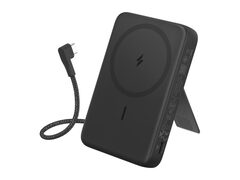
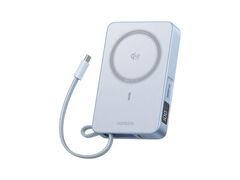
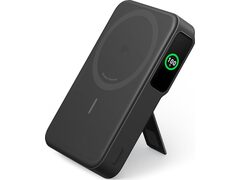
Magnetic wireless charging caps at 7.5 W, a modest figure next to the 15 W of Anker's MagGo and especially the 25 W of Ugreen's MagFlow, two rival magnetic batteries of the same nominal capacity. Only Anker's magnetic Zolo sits at the same level, with the same 7.5 W.
In practice, the 7.5 W remains usable for an occasional top-up, resting the phone on it during a meal or a meeting, but it does not replace the cable for a fast charge. The chart below places this figure within its head-to-head comparison.
The built-in cable, a real success with one small flaw
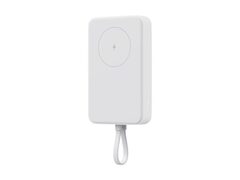
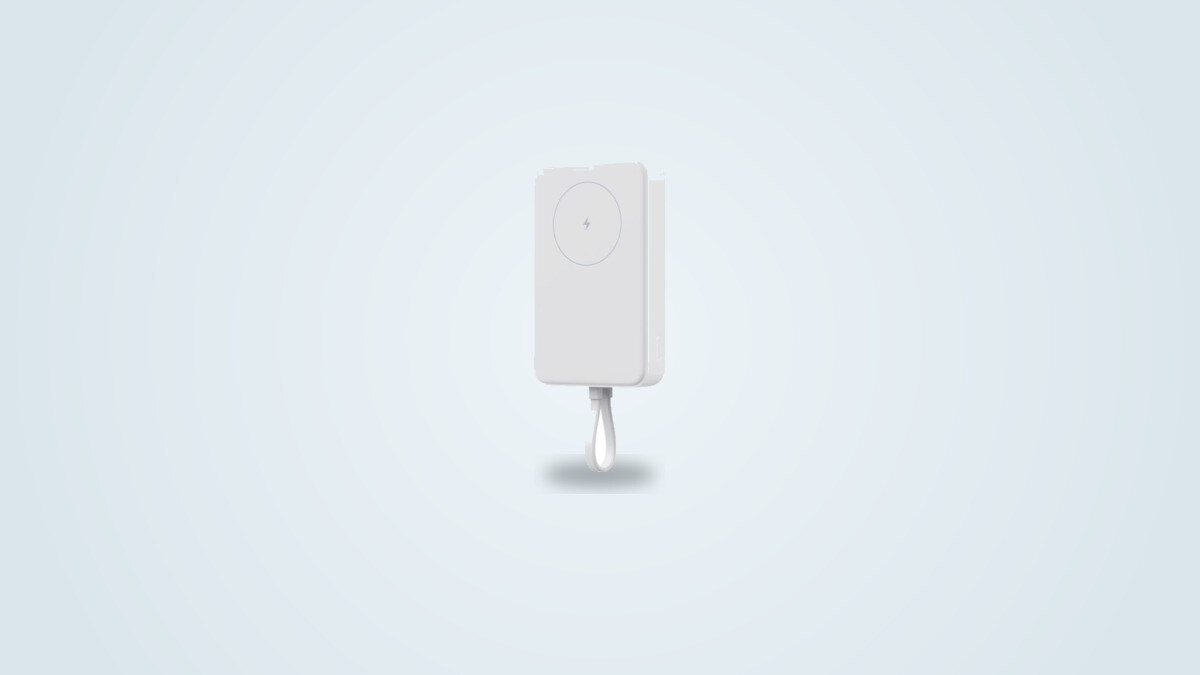
The USB-C cable built into the casing solves a real everyday problem: no cord to bring along or forget, and a device that can be plugged in even when nothing else is at hand. Paired with the second USB-C port and the wireless charging pad, it allows up to three devices to charge at the same time, within the 15 W shared between the two wired outputs detailed above. It is, along with the holding magnet, one of this object's two real successes.
A minor but real flaw comes with this cable: the magnet that holds it stowed against the casing between uses is noticeably weaker than the main magnet that attaches the battery to the back of the phone. Carried in a pocket or a bag, the battery can therefore end up with the cable unclipped and dangling freely. This does not affect charging or safety, but it does undercut the tidiness the built-in cable is meant to provide.
Recharging the battery itself: 30 W input, about 2h20
On input, the battery accepts up to 30 W (12 V, 2.5 A), on either of its two USB-C ports. Under that maximum power, a full recharge from empty takes around 2h20 to 2h30.
That 30 W input ceiling is higher than several direct rivals of the same nominal capacity, which partly explains this fairly contained recharge time for a battery of this size. As with most power banks, a charger weaker than this ceiling extends the charging time roughly in proportion to the power gap: an older smartphone charger limited to 10 or 12 W would multiply this time by two to three, a point the technical sheet never details but that holds true for nearly every power bank on the market.
What 0.78 in (19.8 mm) changes once stuck to the phone
At 8.4 oz (238 g) for 4.3 x 2.7 x 0.8 in (109 x 68.5 x 19.8 mm), the Xiaomi 33W Magnetic Power Bank 10000 sits squarely within its category's average: Anker's magnetic Zolo posts an almost identical weight, 8.5 oz (240 g), for a comparable footprint. This format is neither exceptional nor a drawback next to its direct rivals of the same capacity.
The point worth remembering concerns the thickness once the battery is attached to the back of the phone. An iPhone 15 Pro measures 0.32 in (8.25 mm) thick according to Apple's own technical sheet; adding the battery's 0.78 in (19.8 mm), the stack then exceeds 1.1 in (28 mm), more than double the phone's thickness on its own. This is not a manufacturing flaw or a gap with the advertised specifications, but an unavoidable physical consequence of the all-in-one magnetic format: housing two cells, a wireless charging coil and a retractable cable takes up volume that no ordinary case has to deal with.
Under the hood: cells, protection and build
The casing houses two soft-pack Lishen (力神) cells of 5,000 mAh wired in parallel, certified under China's mandatory 3C standard, paired with a CellWise (创芯微) protection chip and a Lingtai (领泰) protection board. The whole assembly sits on a stack of two circuit boards, with foam padding, insulating sheets and thermal pads for mounting and heat dissipation.
The wireless charging area includes a metal shield meant to isolate high-frequency interference, and an NTC thermal probe monitors the temperature of the battery pack. The internal layout, insulation and thermal management appear tidy, an aspect that concerns the design rather than real-world lifespan, which remains uncertain at this stage.
The product has been sold worldwide since April 2025 (July 2025 in the UK, May 20, 2025 in Japan), a little over a year of track record at the time this review was written. No recurring failure or manufacturing flaw specific to this exact model (reference WPB1007MI) has turned up over that period, but that track record remains short for judging how the retractable cable and the charging mechanism hold up over several years.
Xiaomi's 2025 recall does not concern this model
In September 2025, Xiaomi carried out an official recall of more than 100,000 power banks, following an overheating and fire risk linked to a raw-material quality defect from one cell supplier. The model concerned is the Xiaomi 33 W Power Bank 20,000 mAh with a built-in cable, reference PB2030MI, for units manufactured between August and September 2024 only, in blue and white.
This precedent nonetheless remains useful for judging the brand's reliability as a whole: it shows that a cell supplier defect can affect an entire range of built-in-cable batteries launched the same year, even though a different reference was affected in this specific case. Xiaomi's response (a large-scale recall, a refund process) works in favor of trust in the brand, without erasing the incident itself.
Against the direct rivals: Zolo, MagFlow, MagGo
| Criterion | Xiaomi 33W Magnetic 10000 | Anker Zolo Magnetic 10000 | Ugreen MagFlow 10000 | Anker MagGo 10000 |
|---|---|---|---|---|
| Capacity | 10,000 mAh | 10,000 mAh | 10,000 mAh | 10,000 mAh |
| Wired charging (one port) | 33 W | 30 W | 30 W | 27 W |
| Wired charging (two ports together) | 15 W total | 15 W total | not specified | not specified |
| Wireless charging | 7.5 W | 7.5 W | 25 W | 15 W |
| Built-in cable | Yes | Yes | Yes | No |
| Weight | 8.4 oz (238 g) | 8.5 oz (240 g) | not specified | not specified |
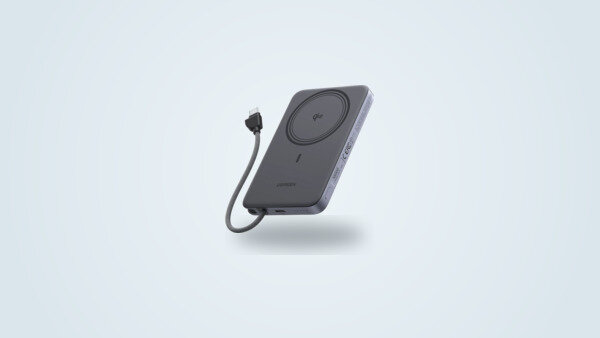
This Xiaomi stands out with the fastest solo wired charging in the group (33 W) and a tidy internal build, but shares with Anker's Zolo the slowest wireless charging (7.5 W) and the same 15 W limit as soon as both ports serve at once. Ugreen's MagFlow remains the reference for anyone favoring fast wireless (25 W), while Anker's MagGo keeps the most even balance between wired and wireless, at the cost of no built-in cable.
Who it suits, and who it does not
This battery suits anyone who charges mainly over cable, wants a single object with no separate cord to carry, and owns an iPhone 12 or later, or a compatible magnetically-charging Android phone. The firm holding magnet and the built-in cable make it a simple companion for daily urban use, with an internal build that inspires confidence on paper.
It suits less well anyone looking for the fastest possible wireless charging (the 7.5 W remains clearly behind the 15 to 25 W available elsewhere), anyone planning to charge two devices at full wired speed at the same time, or anyone seeking an official MagSafe or Qi2 certification rather than simple magnetic alignment compatibility.