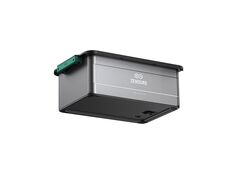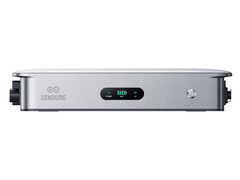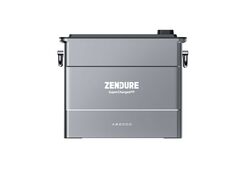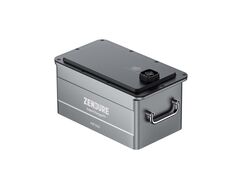
What the AB3000X actually is: a storage module, with no solar input of its own
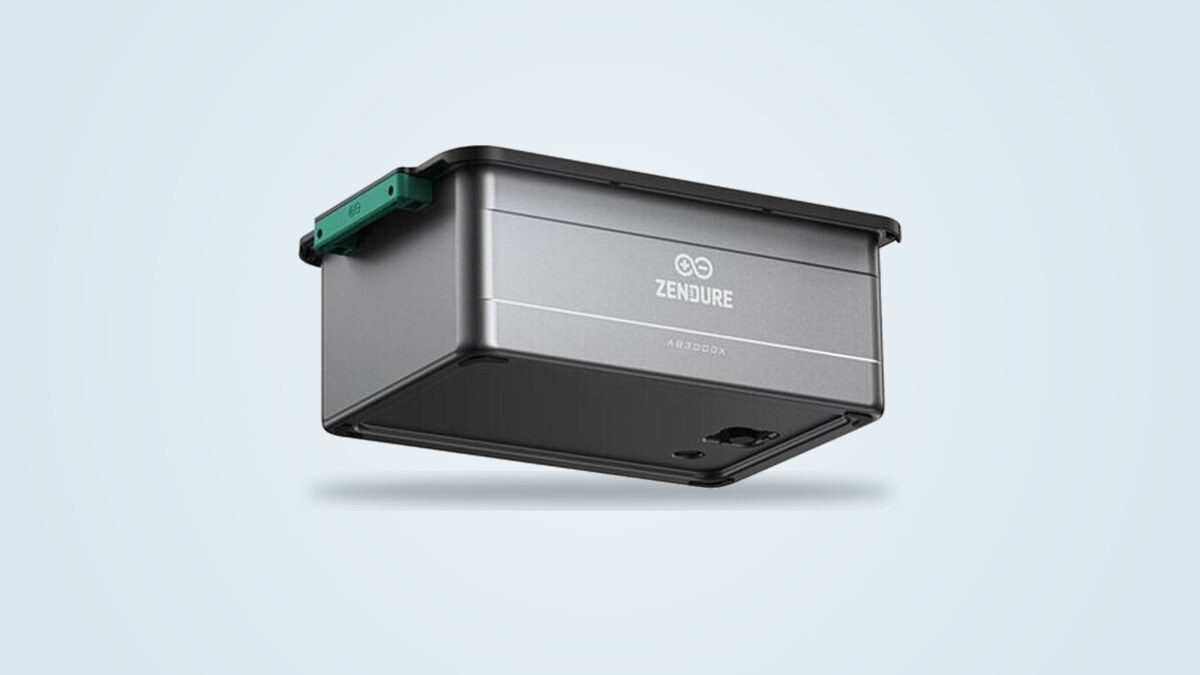
The AB3000X is not a solar battery in the usual sense. It is a pure LiFePO4 storage module, with no connector for solar panels and no MPPT tracker built in. It plugs exclusively into the SolarFlow 2400 AC hub, which handles charging, discharging, and grid feed-in on its own, and which is AC-coupled rather than directly coupled to a panel's DC output.
In practice, this module converts nothing: it stores whatever energy the hub sends it, whether that comes from solar surplus already converted elsewhere or from charging scheduled around a cheaper grid tariff. Without an existing SolarFlow 2400 AC, the AB3000X does nothing at all: no standalone mode, no usable output on its own, no way to charge it directly from a panel.
This total dependence on the hub is why the solar axis weighs so heavily on the overall score: no matter how many modules are stacked, the ability to capture sunlight directly never improves, it remains entirely the SolarFlow 2400 AC's job.
The real cost of storage: a system efficiency of 86-87%, not 93%
The round-trip efficiency across the hub-plus-module pair comes out to 87.3% for a 2000 W charge cycle followed by a 1000 W discharge, 86.0% for a continuous 200 W discharge (closer to everyday household use), and 86.1% for a daily cycle with variable solar surplus. All three figures sit well below the 93% claimed.
The module itself is only responsible for a small part of that gap: a recent LiFePO4 cell typically keeps a chemical efficiency above 95%. Most of the loss happens at the hub, in the bidirectional AC/DC conversion stage and in the regulation electronics, whose own draw at low load is estimated at around 50 W. Adding more AB3000X modules increases the reserve available, but changes nothing about this efficiency: every kWh stored, regardless of how many modules are stacked, passes through the same conversion electronics on the hub side.
In practice, that means a 1000 Wh solar surplus sent to storage comes back as roughly 860 to 870 Wh in the evening, a figure worth using in any payback calculation instead of the manufacturer's number.
Up to 17.28 kWh when stacked, but 345 lb (156.6 kg) of hardware at the max tier
Each module adds 2880 Wh to the system, with no particular software reconfiguration needed beyond automatic recognition by the hub. The system accepts up to six AB3000X modules, bringing total capacity to 17,280 Wh (17.28 kWh), the widest range found in this line of Zendure products. Maximum charge and discharge power also rises as soon as a second module is added: 2880 W with a single module, 3840 W from two onwards.
That last figure is worth keeping in mind before chasing the ceiling: at 57.5 lb (26.1 kg) apiece, six modules add up to more than 345 lb (156.6 kg) of hardware, before even counting the hub. Nothing suggests Zendure offers a dedicated rack or wall mount for that extreme configuration: the final position needs to be chosen from the start, since a module that has been installed and filled is not meant to be moved around afterwards.
No independent data was found on the capacity actually usable once the BMS protection reserve is subtracted: the manufacturer's spec sheet does not publish a maximum depth of discharge (DoD) separate from the nominal capacity. The figures above therefore remain nominal values, not a measurement of capacity actually available at the output.
A 10-year warranty on the cells, under a maintenance condition that is easy to miss
The official warranty covers 10 years on the AB3000X battery modules, one of the longest terms in the balcony-battery segment. One maintenance clause is nonetheless easy to overlook: cell coverage is voided if the buyer does not fully charge the battery within 30 days of receiving it, and then does not recharge it at least once every 3 months afterwards. A module bought and left in storage without being commissioned quickly, for instance to complete an installation later, can therefore lose its warranty without the buyer realizing it.
No specific clause was found covering electrical damage tied to a non-compliant installation of the associated hub. That point deserves clarifying in writing before purchase for anyone planning to use the SolarFlow 2400 AC's extended output mode.
ZenGuard safety architecture: IP65, dual BMS, and aerosol fire suppression
The module relies on Zendure's ZenGuard safety architecture: a dual monitoring system (local BMS plus cloud oversight), self-heating that keeps charging possible down to -4 °F (-20 °C), and a condensed-aerosol fire suppression system that triggers automatically if a cell goes into thermal runaway. The enclosure is IP65-rated, which allows outdoor installation exposed to water spray and dust.
A confirmed fire occurred in Germany on a Zendure AiO 2400, a different product from this one. According to the manufacturer's own explanation, the identified cause was a contact fault at a solar MPPT input connector. That specific mechanism does not apply structurally to the AB3000X or to its hub, the SolarFlow 2400 AC: neither one has a solar MPPT connector at all, so the failure point identified on the other product simply does not exist on this ecosystem. No separate incident has been identified on the AB3000X or the SolarFlow 2400 AC to date, an absence that comes with the usual caveat: product-safety databases could not be queried directly to confirm a total absence.
Tied to the SolarFlow 2400 AC, a generation Zendure has already superseded
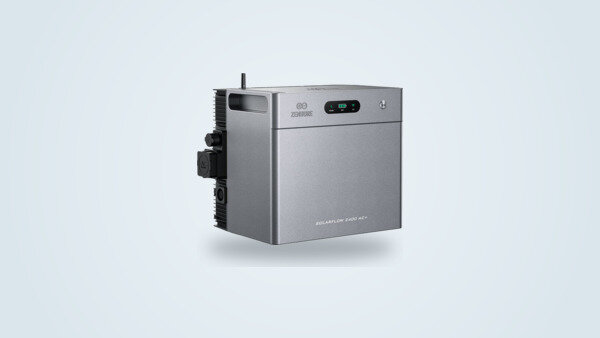
The AB3000X is compatible with exactly one hub: the SolarFlow 2400 AC, launched in April 2025. That model is no longer the current reference in Zendure's lineup: the SolarFlow 2400 AC+, with fully passive cooling, has held that spot since early 2026. The SolarFlow 2400 Pro, with dual direct solar input, targets a different use case, closer to an installation that already has its own solar production.
One point matters above all before buying: the newer SolarFlow 2400 AC+ and SolarFlow 2400 Pro hubs run on a different battery module, the AB3000L, explicitly incompatible with the AB3000X and with the SolarFlow 2400 AC. The reverse holds too: an AB3000L will never work on a SolarFlow 2400 AC. Buying into the AB3000X today means committing to a module ecosystem Zendure no longer develops further, a question worth asking seriously for anyone planning to expand capacity years down the line rather than with the first order.
For anyone who already owns a SolarFlow 2400 AC, the question looks different: the AB3000X remains the only module that will extend the existing installation, and Zendure keeps selling it for exactly that reason, generally at a meaningful discount from its launch price.
AB1000, AB2000, AB3000X, AB3000L: one shared prefix, separate ecosystems
Zendure's battery-module lineup shares a common prefix (AB) and overlapping capacity figures from one model to the next, which creates a real risk of confusion when ordering. The table below sums up what to check before buying: the number after AB is never enough on its own to guarantee compatibility, only the hub actually installed does.
| Module | Unit capacity | Matching hub(s) | Status in the current lineup |
|---|---|---|---|
| AB1000 | 960 Wh | Earlier SolarFlow lineup (Hub 2000, Hyper 2000) | Separate ecosystem, not covered here |
| AB3000X (this product) | 2880 Wh | SolarFlow 2400 AC exclusively | Already superseded in the current lineup |
| AB3000L | 2880 Wh | SolarFlow 2400 AC+ and SolarFlow 2400 Pro exclusively | Current reference for those two hubs |
The AB3000X and AB3000L show the most deceptive case: the same 2880 Wh, the same LiFePO4 chemistry, the same claimed cycle count, the same IP65 rating, the same aerosol suppression system, yet neither battery works on the other's hub. The one real technical difference actually favors the older module: the AB3000X delivers 2880 W alone and 3840 W from two modules onward, against 1680 W and 1920 W for the AB3000L. Checking the exact name of the hub already installed remains the only reliable habit, rather than trusting the module's number.
Cold-weather tolerance and IP65: a year-round outdoor installation
The self-heating function keeps charging possible between -4 °F and 32 °F (-20 °C and 0 °C), a range where most lithium batteries simply refuse to charge at all. Above 32 °F (0 °C), the module returns to its normal charging range. Discharge is specified over a wider range, from -4 °F to 140 °F (-20 °C to 60 °C), which covers year-round outdoor use even in regions with harsh winters.
Combined with the IP65 enclosure, this makes a credible case for outdoor installation without a dedicated shelter, which is far from true of every balcony battery sold at a similar price. The same caveat as elsewhere in the spec sheet applies: these are manufacturer-stated values, and no independent measurement of real-world performance in prolonged extreme cold was found for this specific module.
Price positioning: what a kWh of added capacity actually costs
At the price observed at the time of writing, the module trades at roughly $0.38 per Wh of nominal capacity added. That benchmark says nothing about real-world efficiency (see above, 86 to 87%), but it does allow an objective cost comparison against another storage option, module for module rather than system for system.
The price observed varies noticeably from one market to another for the same module, with no link to any technical difference: that is a matter of distribution and local promotions, not a signal about product quality.
Who the AB3000X is for, and who it is not for
This module suits a specific profile: someone who already owns a SolarFlow 2400 AC and wants to stretch their evening autonomy without drawing from the grid, or complete an existing installation before Zendure eventually discontinues this module for good. Its 10-year warranty, its cold-weather tolerance, and its safety architecture make it a serious choice for that exact use case.
It is not, on the other hand, a fit for anyone looking for a first standalone solar-storage system, or hoping to plug solar panels straight into it: without an existing SolarFlow 2400 AC, the AB3000X is simply unusable, and for a new purchase, the SolarFlow 2400 AC+ and Pro lineup is now the option Zendure supports better over the long run.