2800 W continuous, 3200 W peak: what this power figure is really worth
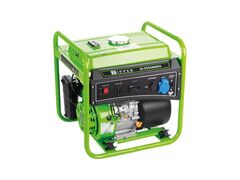
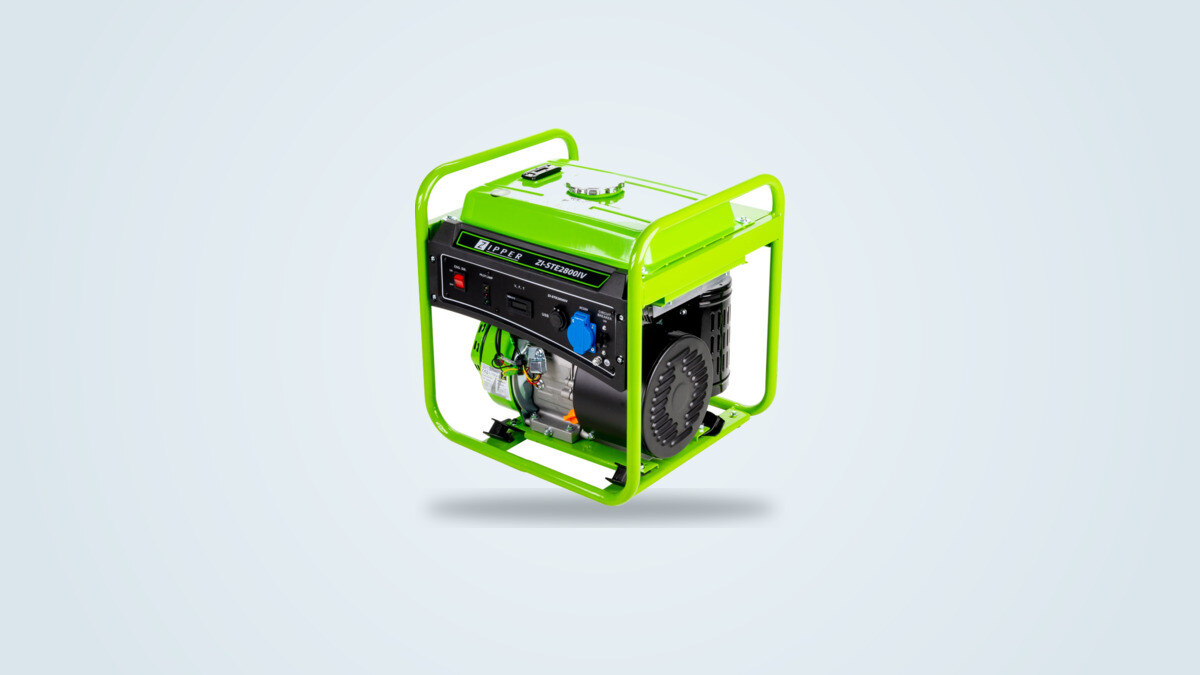
The Zipper ZI-STE2800IV runs on a single-cylinder 4-stroke engine displacing 212 cc, rated at 4.5 kW at 3000 rpm, driving an inverter alternator. The manufacturer states 3200 W peak and 2800 W continuous at 230V/50Hz, a margin of about 14% between the two figures. That is close to the margin on the Güde ISG 3200-2 and the maXpeedingrods MXR3800 (9% each), though both of those units claim 3200 W continuous, 400 W more than the Zipper.
At this continuous power level, the ZI-STE2800IV would comfortably run common power tools (a drill, a circular saw, an angle grinder) or, as home backup, a fridge, lighting and a sump pump at the same time, as long as combined draw does not sit above 2800 W for long, on a 230V circuit. Unlike the Güde and the maXpeedingrods, whose spec sheets state an output current that lets the claimed power be checked by simple arithmetic (13.9 A x 230V = 3197 W in both cases), no amperage figure was found for the Zipper: the consistency of the 2800 W figure cannot be checked the same way, a gap worth knowing rather than proof of an error.
5 liters for about 3 hours: runtime and estimated efficiency
The tank holds 5 liters of unleaded gasoline, for a runtime the manufacturer states at about 3 hours. Unlike the Güde ISG 3200-2 (7.5 h at 50% load, then about 4 h at full power from 7.8 L) and the maXpeedingrods MXR3800 (7 h at a quarter load, 4 h at half load from 4 L, with no figure published near full power), Zipper does not break this figure down by load level: a single value is given, without stating whether it applies at the full 2800 W continuous rating, at partial load, or at some mixed usage pattern.
Assuming, for the sake of comparison, that this figure applies at maximum continuous power (the harshest and most useful assumption for comparison purposes), hourly consumption works out to about 1.67 liters, or roughly 0.6 liters per kWh produced: a figure that would match the best calculated efficiency in the family, the Güde's 0.61 L/kWh at full power. If instead this runtime applies at a lighter load, real consumption at 2800 W would be noticeably worse than this optimistic estimate. Without the manufacturer specifying this point, the ZI-STE2800IV's full-load efficiency remains an open question rather than a settled fact.
In absolute terms, a 5-liter tank is modest next to the Güde's 7.8 liters, the most generous in the class, even if it beats the maXpeedingrods' 4 liters. On a jobsite or for extended backup use, keeping a spare fuel can on hand remains a reasonable precaution regardless of the load level actually used, wherever the unit ends up running.
95 dB LWA: the highest noise level of any inverter generator compared on this site
Zipper states two acoustic figures for the ZI-STE2800IV: a sound power level (LWA, a figure standardized under EU noise regulations, comparable between devices regardless of measuring distance) of 95 dB, and a sound pressure level of 68 dB(A) at 7 meters (about 23 ft). The first of these two figures allows the most reliable comparison with the rest of the class.
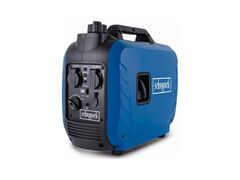
At 95 dB LWA, the ZI-STE2800IV posts the highest figure of any inverter generator already reviewed on this site: 3 dB above the Güde ISG 3200-2 (92 dB), itself already flagged as the loudest in its own comparison against conventional non-inverter units (96 dB for the Einhell TC-PG 35 and the SDMO Perform 3000). The Zipper edges toward the level of conventional generators, without the benefit of a sealed, sound-dampened housing: its frame stays open, like the Güde's. It also sits above the Scheppach SG2500i (91.6 dB) and well above the Honda EU10i (87 dB), still the quietest reference in the catalog, for a power rating three times lower.
The maXpeedingrods MXR3800 does not appear in this chart: its maker states a sound pressure level of 58 dB(A) at 7 meters, a different metric (and measured with no load, in Eco mode), which does not compare directly with the LWA sound power figures of the other three units. On the one comparable measurement available for the Zipper at the same 7-meter distance (68 dB(A)), the figure still comes in higher than the MXR3800's, even though the load conditions behind the two manufacturer figures are not stated in exactly the same way.
One 230V outlet and a USB port: the ZI-STE2800IV's real connectivity
The control panel is limited to one 230V outlet protected by a circuit breaker and one 5V/2A USB port under a rubber cap, alongside a digital voltage and frequency display and indicator lights. No 12V DC output is fitted on this inverter model, and there is no US-style 120V receptacle at all.
That connectivity detail is worth knowing regardless of the sourcing question below, since Zipper's lineup also includes an older ZI-STE2800, a non-inverter unit on a wheeled frame, which does carry two 230V outlets and a 12V output. The two units share part of their name but neither the same spec sheet nor the same use case: only the ZI-STE2800IV, the inverter model covered by this review, produces a clean sine-wave current suited to sensitive electronics.
Against the Güde ISG 3200-2: less power, less equipment
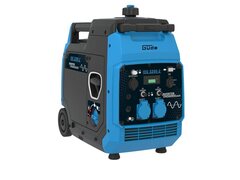
The Güde ISG 3200-2, already reviewed on this site at 4.1 out of 5 (and facing the same unconfirmed US availability), sits in the same power class and offers the most direct comparison for the Zipper.
| Criterion | Zipper ZI-STE2800IV | Güde ISG 3200-2 |
|---|---|---|
| Continuous power | 2800 W | 3200 W |
| Peak power | 3200 W | 3500 W |
| Displacement | 212 cc | 224 cc |
| Tank | 5 L | 7.8 L |
| Noise (LWA) | 95 dB | 92 dB |
| 230V outlets | 1 | 2 |
| Wheels | No | Yes, telescoping handle |
| Weight | 72.8 lb (33 kg) | 70.5 lb (32 kg) |
| Certification | CE | CE, TÜV/GS |
| Price shown | ≈ $1,029 | ≈ $716 |
On almost every criterion checked for this review, the Güde does as well or better: 400 W more continuous power, a 56% larger tank, a 3 dB lower noise level, wheels and a telescoping handle for almost the same weight, and an explicit TÜV/GS certification. Neither unit has a confirmed US retail path, so this comparison is mostly academic for a US buyer today, but it is worth knowing that the Zipper does not come out ahead on any verified technical point against its closest European rival.
Against the maXpeedingrods MXR3800: the one rival that is actually easy to find
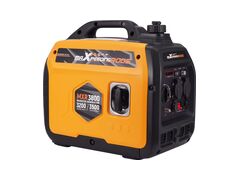
The maXpeedingrods MXR3800, already reviewed on this site at 3.9 out of 5, is the one direct rival in this comparison with a confirmed US buying path.
| Criterion | Zipper ZI-STE2800IV | maXpeedingrods MXR3800 |
|---|---|---|
| Continuous power | 2800 W | 3200 W |
| Displacement | 212 cc | 145 cc |
| Tank | 5 L | 4 L |
| Weight | 72.8 lb (33 kg) | 46.3 lb (21 kg) |
| Wheels | No | No (one-hand carry) |
| Parallel operation | Not found | Yes, cable included |
| Price shown | ≈ $1,029 | ≈ $491 |
The MXR3800 keeps the edge on continuous power (3200 W against 2800 W) and especially on weight: 46.3 lb against 72.8 lb, a 55% gap that changes how the unit gets loaded into a trunk. It also offers parallel operation with an included cable, something nothing in the Zipper's documentation confirms, and it ships on 120V-compatible listings that this Zipper model does not have. The Zipper's only real edge is the one full-power runtime figure actually stated for either unit: the MXR3800 publishes no runtime near its maximum output, while the Zipper, even without specifying the load level, gives at least a single figure, though that edge matters little without a way to buy or safely run the Zipper in the US.
72.8 lb with no wheels at all: portability, an acknowledged weak point
At 72.8 lb (33 kg) net (75 lb / 34 kg boxed per the manufacturer, up to 79.4 lb / 36 kg boxed per some retailer listings), the ZI-STE2800IV is the heaviest inverter generator compared on this site, apart from the Güde ISG 3200-2, which weighs barely 2.2 lb (1 kg) less.
The difference against the Güde comes down to how each unit is meant to move: the Güde offsets its weight with two wheels and a suitcase-style telescoping handle. The Zipper has no wheels at all: the manufacturer lists a carrying frame and rubber feet, plus two handles built into the tubular frame on either side of the tank. Moving it on flat ground means carrying it, not rolling it. Against the maXpeedingrods MXR3800 (46.3 lb / 21 kg, marketed as a one-hand carry), the gap widens further: 26.5 lb (12 kg) more, with no wheels on either unit, but a noticeably harder lift on the Zipper's side.
A conventional inverter waveform, an Austrian brand built for the European market
Zipper Maschinen GmbH is an Austrian manufacturer based in Schlüsslberg, Upper Austria, whose catalog also covers construction equipment and garden tools. The brand is distributed through several specialist retailers in Austria, Germany and Switzerland, as well as a major German home-improvement chain; nothing in this research points to any US distribution arm. The ZI-STE2800IV carries the standard 2-year statutory warranty in its home market, the same length as the maXpeedingrods MXR3800 but one year short of the Güde ISG 3200-2's 3-year Power-Engine warranty; whether that warranty would be honored on a unit imported into the US independently was not confirmed for this review.
The unit is covered by a CE declaration of conformity, the baseline regulatory standard in the EU; it carries no UL or ETL listing for the US market, consistent with a product not officially distributed here. No extra safety certification such as TÜV/GS, which Güde explicitly claims on its own model, was found for the Zipper. No total harmonic distortion figure for the inverter waveform is published either, a gap shared by nearly every generator in this price segment, the Honda EU10i included.
No product recall turned up for this model, but no independent measurement protocol backs up the manufacturer's figures either, unlike the Güde, where the arithmetic match between stated current and power adds to the spec sheet's credibility.
$1,028.89 shown here, but US availability is unconfirmed
The price shown on this page is $1,028.89. Research for this review found no active US retail listing for the ZI-STE2800IV: this site's own US product page currently carries no in-stock partner link, and no US big-box or online listing turned up. Zipper is primarily distributed through continental European DIY and machinery retailers; several of those, billing in euros, list the same unit well below this figure, in a range converting to roughly $270 to $475 at current rates, and this site's own German-market listing for the same unit shows $361 (350.90 €) once converted.
A second issue applies regardless of price: this is a 230V/50Hz European-market unit. Standard US household current runs at 120V/60Hz, so the ZI-STE2800IV cannot power ordinary US outlets or appliances without a step-down transformer, and motor-driven or clock-timed equipment may not run correctly on the wrong frequency even then. Anyone considering this specific model from the US should treat both the sourcing question and the voltage mismatch as open problems, not settled details, rather than taking the $1,028.89 figure at face value.
No carbon-monoxide detection confirmed: who the ZI-STE2800IV suits
It suits a buyer who can source a European-voltage (230V) unit through their own channels and needs close to 2800 W continuous for jobsite or home-backup use, with clean inverter current, and who can tolerate a higher-than-average noise level for this class.
It doesn't suit a typical US buyer looking for a straightforward checkout experience: with no confirmed US retailer and a 230V-only design, this model is a poor match for a standard US household outlet. It also doesn't suit anyone chasing the best power-to-weight ratio: the maXpeedingrods MXR3800, for only 400 W less continuous power, weighs 26.5 lb (12 kg) less and, unlike the Zipper, is actually easy to buy and run in the US.