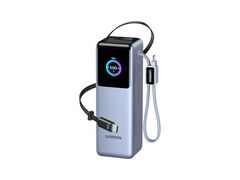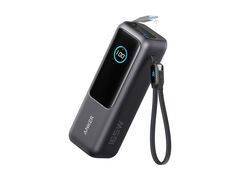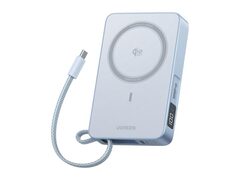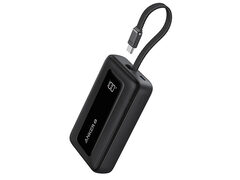
Two visions of mobile charging
Anker and Ugreen dominate the charging accessories aisle today, but they did not get there the same way. Anker is a pioneer: the brand built its reputation on reliable, innovative power banks, to the point of becoming the name people cite without thinking. Ugreen, long known for its cables and adapters, has established itself more recently as a formidable challenger, notably with its Nexode range and its aggressive pricing.
The marketing pitch from the two brands sounds very much alike: fast charging, USB-C, compactness. To settle the question, we relied on our own measurements. We tested 19 power banks from these two brands, 9 Anker and 10 Ugreen, scoring each one on six weighted criteria and measuring the energy actually delivered. Here is what those figures say, including where they contradict the received wisdom.
What our 19 tests say
First finding: Anker beats Ugreen on every one of the six criteria in our scoring grid. Second finding, just as important: the gaps are narrow, between 0.09 and 0.25 points out of 5.
| Scoring criterion | Anker | Ugreen | Gap |
|---|---|---|---|
| Capacity and runtime (25%) | 4.19 | 3.95 | +0.24 |
| Output power (20%) | 4.01 | 3.85 | +0.16 |
| Size and weight (20%) | 4.14 | 3.89 | +0.25 |
| Ports and cables (15%) | 4.27 | 4.05 | +0.22 |
| Recharging (10%) | 4.21 | 4.12 | +0.09 |
| Build and endurance (10%) | 4.26 | 4.02 | +0.24 |
| Overall score | 4.17 | 3.97 | +0.20 |
In plain terms: Anker does better, but the average gap amounts to roughly 5% of the score. It is real and measurable, it is not a chasm. The criterion where the two brands are all but level is recharging (+0.09), the very area Ugreen has worked on hardest in recent years. The clearest gaps concern size and finish, two areas where Anker's experience still shows.
Price: Ugreen's knockout argument
This is where the balance of power flips. Measured against the watt-hours actually on board, the average price of the batteries in our selection is €1.03 per Wh at Ugreen against €1.41 at Anker, or 27% cheaper. The quality gap measured above is 5%; the price gap is five times bigger.
That difference is not uniform. It widens above all on high-capacity, high-power models, where Ugreen lands its best blows. On compact entry-level models, by contrast, the two brands are neck and neck, and Anker sometimes moves back in front.
A word on the warranty, often cited as an Anker strong point: our records say the opposite. Ugreen states 2 years across its entire range (12 listings out of 12 in our catalog), while Anker varies between 18 and 24 months depending on the model. Ugreen's cover is therefore more consistent, even though both brands stay above the European legal minimum.
Four model-by-model head-to-heads
Comparing two brands remains a theoretical exercise: you buy a model, not a logo. Here are four face-offs at comparable specifications, drawn from our tests.
200 W: the Nexode Pro wins the match outright
The Anker Prime 20000 200W (72 Wh, $129.99, scored 4.0) takes on the Ugreen Nexode Pro 200W (92.5 Wh, $89.99, scored 4.1). Same output power, but Ugreen offers 28% more capacity for €15 less, with a slightly higher score. In this segment, the choice is quickly made.
High end: Anker takes back control
The Anker A1695 165W (90 Wh, $119.99) earns 4.5 out of 5, the best score of our 19 tests, thanks to a measured efficiency of 82% and exemplary build quality. Facing it, the Ugreen Nexode 145W (92.5 Wh) scores 4.0 but costs $68.41, close to half the price. What you pay for here is the difference between very good and excellent.
Magnetic: the myth of Anker's lead
Anker's MagGo ecosystem is often presented as unbeatable. The figures add nuance: the Anker MagGo Power Bank (38.5 Wh, 27 W, $79.99) and the Qi2-compatible Ugreen MagFlow 20000 (74 Wh, 45 W, $99.99) earn exactly the same score of 4.1 for an almost identical price. Except that Ugreen packs close to twice the capacity and 18 W more. Anker's lead on magnetic charging is no longer what it was.
Entry level: advantage Anker
On compact 10,000 mAh models the trend reverses: the Anker Zolo 10000 30W (37 Wh, $25.99) scores 4.2 while the Ugreen Nexode 10000 (37 Wh, $32.98) gets 4.0, for €3 more. At identical capacity, Anker is here both better and cheaper.
Power, GaN and Qi2: where the technologies stand
Both brands have mastered today's standards: USB-C Power Delivery, multi-device fast charging, PPS protocols. Ugreen built its reputation on gallium nitride (GaN), which allows chargers to be smaller and more efficient at a given power, an expertise that remains its signature on wall chargers.
On raw power, the gap even leans slightly towards Ugreen: 96 W of maximum output on average against 88 W at Anker across our selection, with both brands peaking at 300 W on their beefiest model. The image of an Anker that is systematically more powerful does not survive the figures.
Anker keeps two genuine advantages: a broader range, from the pocket model to the desktop station of the Prime series, and a more mature accessory ecosystem. Ugreen has closed much of its gap on magnetic charging by adopting Qi2, the standard that brings standardized magnetic alignment and up to 15 W wirelessly. To get to grips with these notions, see our guide to choosing a power bank.
Reliability: each brand's weak spot
Both brands use quality cells and good protection circuits (BMS), decisive for longevity as the specialists at Battery University point out. Not one of the 19 batteries tested gave us cause for concern on safety.
That does not mean everything is equal. The lowest-scoring model in our comparison is a Ugreen: the 300W 48000mAh, marked down to 3.4 out of 5. Its stated capacity is spectacular, but its measured efficiency collapses to 64%, the worst in our database: of the 153.6 Wh stored, only 99 Wh actually reach your devices. That is the flip side of the Ugreen strategy, which sometimes pushes the catalog figures at the expense of the rest.
At Anker, the flaw is more discreet: a warranty that varies from one range to the next, and prices that climb fast on the Prime and MagGo series. You pay for genuine consistency, but you do pay for it.
The match in one table
| Criterion | Anker | Ugreen |
|---|---|---|
| Average score (our tests) | 4.17 / 5 | 3.97 / 5 |
| Average price per watt-hour | €1.41/Wh | €1.03/Wh |
| Average output power | 88 W | 96 W |
| Maximum power in the catalog | 300 W | 300 W |
| Warranty | 18 to 24 months depending on model | 2 years across the whole range |
| Best score achieved | 4.5 (A1695 165W) | 4.1 (Nexode Pro 200W) |
| Strong point | Consistency, finish, broad range | Capacity and power at the best price |
| Weak point | High prices at the top of the range | A few models with disappointing efficiency |
These averages aggregate our individual tests: every model mentioned has its own detailed review, with the full set of measurements. You will find them all in our complete product reviews, filterable by device type.
Verdict: which one is for you?
Neither brand comes up short, and the match is tighter than their respective reputations suggest. Our reading of the figures:
Choose Anker if you want the absolute best without looking at the price, a flawless finish and the most complete range. It is also the safer choice in the compact 10,000 mAh formats, where the brand is both better scored and often cheaper.
Choose Ugreen if you are after the best capacity-to-price ratio, particularly above 100 W: for the same budget, you will walk away with more watt-hours and more power. The consistent 2-year warranty across the whole range is an extra reason for peace of mind.
The one real trap to avoid, whatever the brand: judging a battery on its advertised mAh alone. Look at the watt-hours, the output power and, where the data exists, the energy actually delivered. That is exactly what we measure for every model in our power bank selection, following our test methodology.