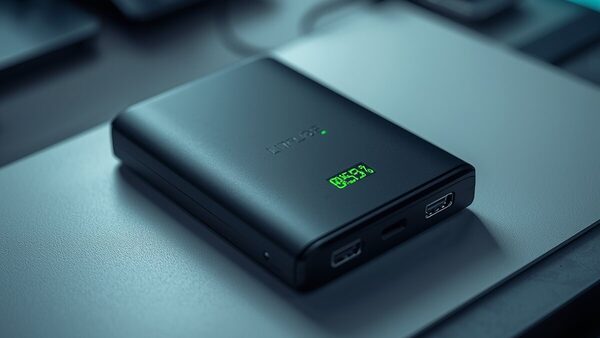

What a BMS is, and why no lithium battery ships without one
Open up almost any recent lithium battery (a power bank, a 12V LiFePO4 battery, a power station) and tucked against the cells you will find a small circuit board most people never notice: the BMS, short for Battery Management System. Without it, a cell charged past its voltage limit, or discharged too deeply, simply degrades, sometimes dangerously.
Lead-acid or NiMH chemistries tolerate some carelessness. Lithium does not: its chemistry sets precise limits on voltage, current and temperature, and enforcing those limits at all times, cell by cell, is exactly the BMS's job. A typical 12V LiFePO4 battery pack holds 4 cells in series; a large power station can stack dozens. The BMS watches every single one.
Its job boils down to three words: protect, balance, report. That is what this piece covers.
Protection: the function that actually saves the battery
This is the BMS's most critical function: cutting the circuit before a limit being exceeded turns into an incident. Standard protections cover:
- Overvoltage on charge: past a set threshold (around 3.65V per cell for LiFePO4), the BMS stops charging to prevent accelerated aging, or worse, thermal runaway.
- Undervoltage on discharge: below roughly 2.5V per cell, the BMS cuts the output. This is exactly what locks out a power station that has sat uncharged for too long, a mechanism that explains a good share of the "it won't turn on anymore" failures covered in our diagnosis guide.
- Overcurrent and short circuits: an abnormally high current (a big inverter starting up, a wiring fault) triggers an almost instant cutoff.
- Temperature: above or below certain thresholds (often close to 32 °F), the BMS blocks or limits charging, since lithium chemistry does not handle charging in cold weather well.
Cell balancing: why a pack ages cell by cell
Even cells coming out of the same production batch are never perfectly identical: slightly different internal resistance, slightly faster self-discharge, and the gap widens with every charge cycle. Left uncorrected, the weakest cell in a series pack always ends up limiting the whole battery, capped at its lowest capacity. Correcting that gap is exactly what balancing does.
| Balancing | How it works | Advantages | Limits |
|---|---|---|---|
| Passive | Bleeds the excess charge of the highest cells off as heat, through a resistor | Simple, cheap, built into most protection circuits | Only works while charging, low correction current, wastes energy |
| Active | Moves charge from the highest cells to the lowest ones (capacitors, inductors) | Faster, more efficient, also usable while discharging | More complex, more expensive, mostly found on higher-end or larger-capacity packs |
Across the consumer market, passive balancing remains by far the most common, even on good 12V LiFePO4 batteries: that is not a flaw in itself, since recent LFP cells are naturally well matched. Active balancing mostly shows up on larger installations, where the gap between cells carries bigger consequences.
Why the displayed percentage is never quite exact
The BMS is also the only source behind the charge percentage shown on a screen or app. That figure stays an estimate, never a direct measurement: no sensor actually "sees" the energy left inside a cell, the BMS derives it from voltage, accumulated current and a math model specific to each manufacturer. We cover this mechanism in detail, and why two devices can show two different percentages for the same real charge level, in our article on why battery percentage is never exact.
Beyond the instant charge level (state of charge, SoC), some more advanced BMS units also estimate state of health (SoH): the real remaining capacity compared with when the battery was new. That figure, rarely shown plainly, is what lets you know a battery has lost 20% of its original capacity before it fails outright.
Bluetooth and apps: when the BMS becomes a dashboard
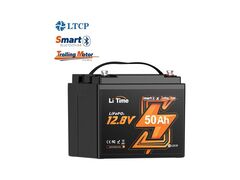
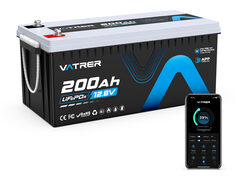
On recent 12V LiFePO4 batteries, the BMS no longer just protects quietly: it talks. Over Bluetooth, it streams individual cell voltage, instant current, internal temperature and the number of cycles already completed to a mobile app. That makes it possible to spot a drifting cell before it becomes a real problem, a real selling point on models like the LiTime 12V 50Ah Bluetooth or the Vatrer 200Ah Bluetooth.
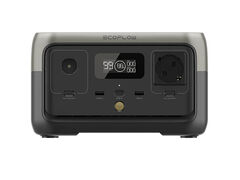
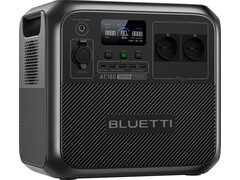
On power stations, that same communication usually runs through the built-in screen and the manufacturer's app, with the added bonus of live input and output power readings. Either way, the more detail a BMS reports, the easier it is to catch a problem before it turns into an outright failure.
How to spot a good BMS before buying
The BMS rarely gets top billing on a product page, yet it makes a real difference in everyday use. A few things worth checking before buying:
- How many protections are actually listed: a serious spec sheet details the thresholds (overvoltage, undervoltage, overcurrent, short circuit, temperature), not just "built-in protection".
- The BMS current rating, in amps (for example "100A BMS"): it needs to match the battery's maximum rated power. An undersized BMS cuts the output as soon as a large appliance starts up.
- Automatic cold-weather cutoff, specific to lithium: its absence, or a poorly implemented version, is a common cause of winter failures for batteries installed in a van, RV or boat.
- Access to a Bluetooth app, where available: it lets you monitor cell balancing yourself, rather than discovering a problem only once the battery refuses to charge.
For a full 12V setup, our comparison of 12V LiFePO4 batteries to replace a lead-acid battery covers several models whose BMS specs are documented in detail.
What to remember
Three ideas worth keeping in mind:
- The BMS protects the battery against voltage, current and temperature limits being exceeded, balances the cells against each other, and reports real charge and health levels.
- Passive balancing dominates the consumer market and suits a good LiFePO4 battery just fine; active balancing really only pays off on larger installations.
- A well-documented BMS, with precise thresholds and ideally a monitoring app, is a better sign of quality than an impressive but unverifiable capacity figure.
Check out our detailed reviews of 12V lithium batteries and our pick of the best power stations to choose a unit whose BMS actually does its job.