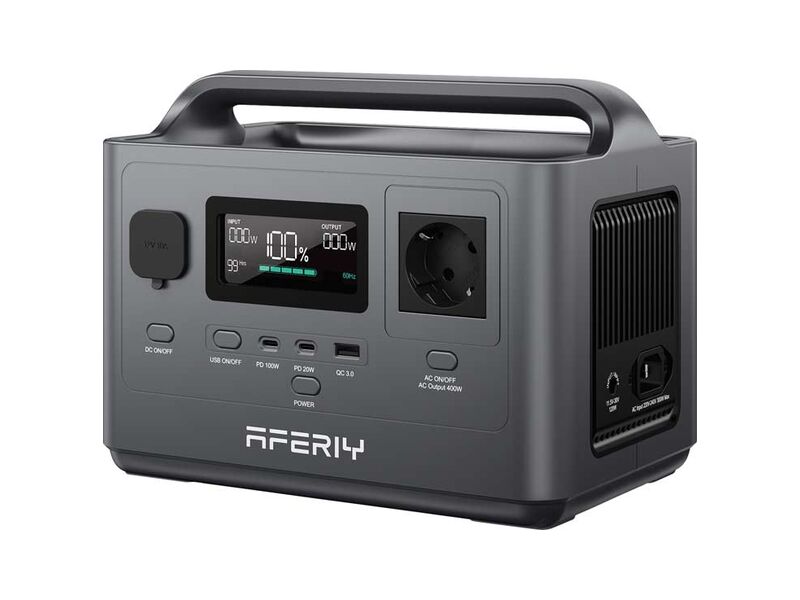
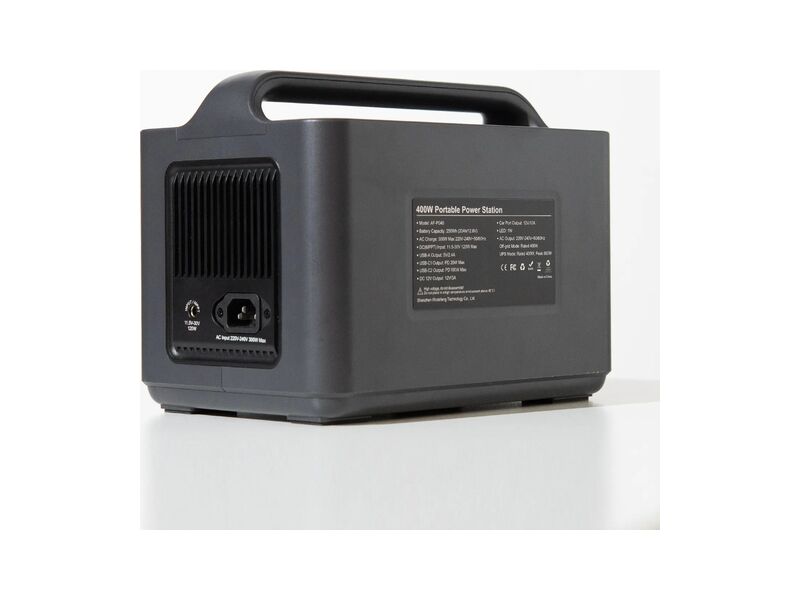
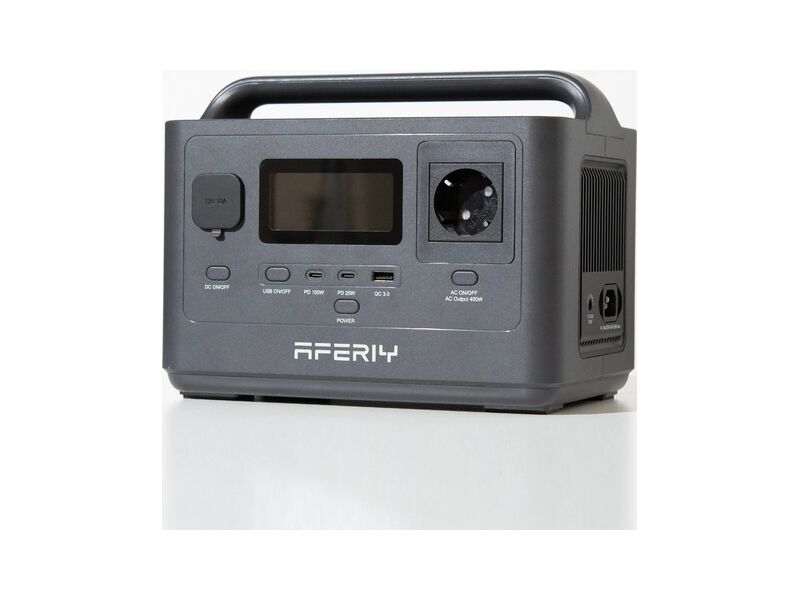
Aferiy P040
(3 reviews)
256Wh, 400W and a full recharge in about 1.2 hours, the Aferiy P040 is a light 8.8 lb (4 kg) backup, though one detailed US review flags a real UPS caveat.
Buy at AmazonAs an Amazon Associate I earn from qualifying purchases.
Characteristics
- Capacity: 256Wh LiFePO4
- Power: 400W, two AC outlets
- Charging: 300W mains, full in about 1.2h
- Ports: 100W USB-C, USB-A, 12V car output
- Two AC outlets, up to 7-year warranty
Detailed overview: Aferiy P040 400W Power Station
The Aferiy P040, sold in the US as the Nomad400, is a compact 256Wh portable power station built around a bidirectional pure sine wave inverter delivering 400W. It targets the same job as its larger sibling the P010: light camping, desk backup and short power outages, in a smaller 8.8 lb (4 kg) (8.8lb) body.
Connectivity on the US listing totals six simultaneous device ports: two AC outlets (confirmed directly by a verified buyer, since some listing copy implies only one), a 100W USB-C port, a USB-A QC3.0 port and a 12V car-style output. The 100W USB-C port is strong enough to charge a laptop directly, roughly three MacBook Air charges or twelve phone charges per full battery, according to one detailed US review.
Charging tops out at 300W from the wall, for a full charge in about 1.2 hours, and up to 120W from solar through the included MC4-to-DC5521 cable. A UPS function is rated to switch to battery power in under 10 milliseconds. One detailed US reviewer tested this extensively as a desktop computer backup and found it worked flawlessly at first, silent switchover, fan off in standby, only for the same unit to later run down to empty while still plugged into the wall, a passthrough failure that led to a return. They judged it a likely isolated manufacturing defect rather than a systemic flaw, and noted Aferiy reached out after the review was posted. A separate buyer reported an LED light fault with no response from support.
Warranty terms mirror the P010: the printed manual lists 2 years, while Aferiy's marketing references an extension up to 7 years after registration, worth confirming directly with Aferiy. The unit has no Bluetooth, WiFi or app, monitoring runs through its LCD screen alone.
With only 9 ratings on the US listing so far, the sample is thin. For light camping, desk charging or a modest power outage, the P040 performs well on price and connectivity, but we'd test its passthrough function over several days before trusting it with unsupervised critical backup.
Full specifications
Detailed characteristics
Battery and capacity
| Rated capacity?Total stored energy in watt-hours. The higher the figure, the longer the runtime. | 256 Wh |
|---|---|
| Delivered energy, measured?Energy that actually leaves the battery and reaches the devices. Always below the stored energy, as conversion costs heat. Taken from our in-depth review. | 200 Wh |
| Expandable capacity?Whether capacity can be increased with add-on batteries. | No |
| Removable battery?The main battery can be removed or replaced by the user. | No |
| Battery chemistry?LiFePO4 (LFP) lasts far longer and is safer than NMC. | LFP (LiFePO4) |
| Charge cycles?Number of full charges before capacity drops to the stated threshold. | 3500 cycles (80 %) |
| Pack nominal voltage?Internal battery voltage; higher voltage helps deliver high power. | 12.8 V |
AC output
| Continuous AC power?Power the unit can sustain continuously on its 230 V outlets. | 400 W |
|---|---|
| Inverter type?A pure sine wave is essential for sensitive electronics and motors. | Pure sine wave |
| AC voltage / frequency?Voltage and frequency of the AC output (230 V / 50 Hz in Europe). | 120 V / 60 Hz |
| Number of 230 V AC outlets?Number of mains outlets available on the unit. | 2 |
| RV / TT-30 outlet?Dedicated 30 A outlet for North-American style RVs. | No |
Recharging
| Max AC charging power?Maximum power drawn from a wall socket; higher means faster charging. | 300 W |
|---|---|
| AC charge 0-100%?Stated time for a full charge on mains power. | 72 min |
| Max solar input?Maximum solar power accepted at the input (PV panels). | 120 W |
| Accepted solar voltage?Panel voltage range compatible with the solar input. | 11.5 to 30 V |
| MPPT controllers?Number of independent MPPT solar inputs (yield optimisation). | 1 |
| Vehicle charging (12/24 V)?Can be charged from a vehicle's cigarette-lighter socket. | Yes |
| Pass-through charging?The unit can power devices while charging (pass-through). | Yes |
Ports and connectors
| USB-C ports?Number of USB-C ports and the fastest port's power (laptops, phones). | 2 × 100 W |
|---|---|
| USB-A ports?Number of USB-A ports and maximum power (small devices). | 1 × 18 W |
| 12 V output (car socket)?12 V cigarette-lighter output and its power (coolers, pumps…). | Yes (120 W) |
Portability
| Weight?Net weight of the unit, battery included. | 8.8 lb (4 kg) |
|---|---|
| Dimensions (L × W × H)?Overall size of the unit in millimetres. | 10.2 × 6.9 × 7.9 in (259 × 174 × 201 mm) |
| Form factor?Portable (hand-carried), transportable (heavy), or wheeled. | Portable |
| Wheels?Built-in wheels for moving the unit. | No |
| Telescopic handle?Retractable handle like a wheeled suitcase. | No |
Safety and environment
| Certifications?Standards and approvals obtained (CE, RoHS, UN38.3, UL…). | CE, FCC, RoHS, UN38.3 |
|---|---|
| Discharge temperature?Temperature range in which the unit can deliver power. | 14 to 104 °F (-10 to 40 °C) |
Backup / UPS
| UPS / EPS mode?Automatic switch to battery on a mains outage (backup). | Yes |
|---|---|
| Switchover time (rated)?Delay before switching to battery; under 20 ms suits a PC or router. | 10 ms |
Noise and thermal
| Noise level (rated)?Manufacturer-stated noise; a quiet room is around 30 dB. | 60 dB(A) |
|---|---|
| Quiet mode?Setting that limits fan noise, often by capping charge power. | No |
| Self-heating battery?Battery pre-heating to allow charging in cold weather. | No |
Display and connectivity
| Display?Type of screen showing power, runtime and alerts. | LCD |
|---|---|
| Bluetooth?Bluetooth link for nearby control. | No |
| Wi-Fi?Wi-Fi connection for remote control and monitoring. | No |
| Mobile app?iOS / Android app to control the unit. | No |
| Local control (no cloud)?Control possible over Bluetooth without an account or internet. | Yes |
| Solar connector?Connector type of the solar input (XT60, Anderson, MC4…). | DC5521 |
Availability and warranty
| Market launch?Date the model first became available on the European market. Useful to place its generation: technology moves fast in this segment, and a device several years old may be at the end of its commercial life. | October 2025 |
|---|---|
| Warranty?Length of the manufacturer's warranty. | 7 years |
⚡ How long will this power station run a device?
With 256 Wh, the Aferiy P040 external battery runs a fridge (50 W) for ~4h20 or an LED TV (90 W) for ~2h25.
| Home | Runtime |
|---|---|
| Refrigerator (50 W) | ~4h20 |
| Freezer (60 W) | ~3h40 |
| American fridge (150 W) | ~1h25 |
| Dehumidifier (300 W) | ~45 min |
| Outdoor & workshop | Runtime |
|---|---|
| Electric cooler (45 W) | ~4h50 |
| RV fridge (60 W) | ~3h40 |
| Games console (200 W) | ~1h05 |
| Sander (300 W) | ~45 min |
Rough estimate: real consumption varies, and very power-hungry appliances (heating elements) must stay below the output power.
What is this power station best for?
-
Camping & Tent Ideal
At 8.8 lb (4 kg) (8.8lb) with an ergonomic handle, the Aferiy P040 travels easily to a campsite. Its 256Wh cover LED lighting, phone and tablet charging, a camera, a drone and a fan for an evening or a full night, and one reviewer used it to camp comfortably through a snowy night, running lighting and small devices throughout. Two AC outlets (confirmed directly by a US buyer, despite some listings implying only one) plus a 100W USB-C port cover most gear without a power strip. Solar charging tops out at 120W through the included MC4-to-DC5521 cable, enough to recharge at camp in a few hours of good sun. Its LiFePO4 battery, rated for 3500+ cycles, holds up season after season, and the LCD screen shows remaining charge at a glance. One limit to keep in mind: at 400W rated output, it is not built for a kettle or a hotplate, but for lighting, electronics and camp comfort, it is a light, well-ported reserve of power.
-
Home & Power cuts Suitable
One detailed US review describes using the Aferiy P040 as a UPS for a desktop computer during utility generator cutovers: the initial switchover was silent and effective, matching the rated under 10ms spec, with the fan staying off in standby. However, the same reviewer later found their unit silently running on battery instead of drawing from the wall, draining to empty within hours despite being plugged in, and returned it, describing it as a likely isolated manufacturing defect rather than a design flaw. We would treat this as a genuine caution: test the passthrough function thoroughly over several days before trusting it with unsupervised critical backup duty.
-
Remote work Suitable
For a desk setup, the Aferiy P040's 100W USB-C port charges a laptop directly, roughly three full charges of a MacBook Air, or about twelve charges of a phone, useful figures from a US reviewer's real testing. Its 256Wh and 400W cover a laptop, a monitor and a small router for a few hours away from an outlet. Two AC outlets and a 12V DC output round out the connectivity. With no Bluetooth, WiFi or app, monitoring stays limited to the LCD screen, a plus for some, a limitation for anyone wanting remote alerts.
-
Road trip & Car Suitable
On the road or off-grid, the Aferiy P040's 12V DC output is a genuine asset beyond typical devices, US reviewers cite powering a Starlink Mini dish (roughly 20 to 30W) and 12V astronomy or radio gear directly, without running the AC inverter and its extra losses. At 8.8 lb (4 kg) it stows easily in a vehicle, and the 100W USB-C port keeps a laptop or phone topped up between stops. Charging from mains takes about 1.2 hours for a full top-up. Its 256Wh and 400W output stay modest for multi-day trips without a recharge source.
Our team's recommendations based on the model's capacity, output power and weight.
Comparison
Under $200, the Aferiy P040 competes with compact sub-300Wh stations sold in the US, in searches like "Aferiy P040 vs EcoFlow River 2" or "best budget power station under 300Wh". Here is how it compares to three alternatives.
| Criterion | Aferiy P040 | EcoFlow River 2 | GRECELL 330W | Bluetti Elite 30 V2 |
|---|---|---|---|---|
| Capacity | 256Wh | 256Wh | 230.88Wh | 288Wh |
| Continuous power | 400W, 2 AC outlets | 300W (600W X-Boost) | 330W (600W peak) | 600W (1500W lifting) |
| Mains recharge | full in 1.2h | full in 1h | Not stated | 0-80% in 45 min |
| UPS function | Yes, under 10ms (see caveat) | Yes, under 30ms | Not stated | Yes, 10ms |
| Observed price | $189.00 | $209.00 | $147.99 | $399.00 |
The Aferiy P040 undercuts the EcoFlow River 2 slightly on price with a higher rated wattage and two AC outlets, though the River 2 charges faster and carries a far larger, more consistent review base. The GRECELL 330W is the cheapest of the group, and the Bluetti Elite 30 V2 offers by far the most peak power for those willing to pay more. Given the thin review sample on the P040, budget-conscious buyers who value a longer track record may prefer the River 2 at a similar price.
Related video
Video: AFERIY P040 400W REVIEW PORTABLE POWER STATION UK UNBOXING - Published on 26/10/2025
Our tester's review: Christophe Delpuech
The Aferiy P040 drew the most detailed US review we've seen for a compact station in this price range, and it's worth reading before you buy. The reviewer, testing it specifically as a UPS for a desktop computer during utility cutovers, first found it worked exactly as advertised: a silent, sub-10ms switchover, a fan that stayed off in standby, and enough headroom to run a MacBook Air about three times or a phone around twelve times off the 100W USB-C port. Then, within hours of a fresh setup, the same unit silently ran down to empty while still plugged into the wall, the passthrough had stopped drawing mains power without any warning. They returned it, and called it a likely isolated defect rather than a design flaw, noting Aferiy reached out afterward. A separate buyer reported the LED light not working with no response from support, and another described inconsistent charging. On the plus side, two AC outlets (more than some listings suggest) and a genuine 1.2 hour full recharge are real strengths at this price. We'd test the UPS over several days first.
In-depth review Aferiy P040 Review 4.0/5 Read our full review → Capacity and efficiency 3.8 Delivered power 4.2 Recharging 4.3 Ports and control 3.8 Build and endurance 3.7 Noise not measuredFrequently asked questions: Aferiy P040 400W Power Station
Two, according to a verified US buyer who specifically corrected listing copy suggesting only one. Both share the unit's 400W rated output.
About 1.2 hours for a full charge on the wall (up to 300W). Solar charging, up to 120W through the included MC4-to-DC5521 cable, takes longer depending on sunlight.
Mostly, but one detailed US review documents a real passthrough failure: the unit ran down to empty while still plugged in. The reviewer judged it a likely isolated defect and returned the unit; we'd test the function over several days before trusting it unsupervised.
The printed manual lists 2 years; Aferiy's own marketing references an extension up to 7 years after registration. Confirm the exact terms with Aferiy support before relying on the longer figure.
Need help choosing?
Related articles
Other products in the "Compact power stations" category
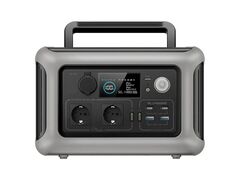
Allpowers R600
$219.00 (7)
Affordable and backed by a 5-year warranty, the Allpowers R600 delivers 299 Wh, 600 W and a one-hour recharge, plus a built-in wireless charger.
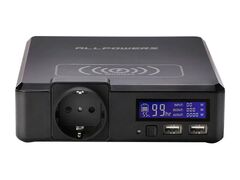
Allpowers S200
$99.00 (6)
154Wh and 200W in an ultra-compact, book-sized station with built-in wireless charging: the mini power station that goes everywhere without weighing you down.
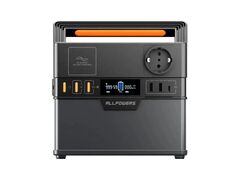
Allpowers S300 Plus
$189.00 (5)
Compact and clever, the Allpowers S300 Plus (288 Wh) combines USB-C 100 W, a wireless charger, an LED light and app control.
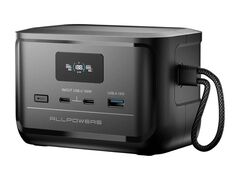
Allpowers Solax P100
$89.00
99Wh and 128W in a 2.1 lb (950 g) compact format, with no AC outlet: the all-USB-C mini power station that recharges almost everything while hiking or traveling.
Published on 02/09/2026, updated on 16/09/2026