Aferiy P180
(7 reviews)
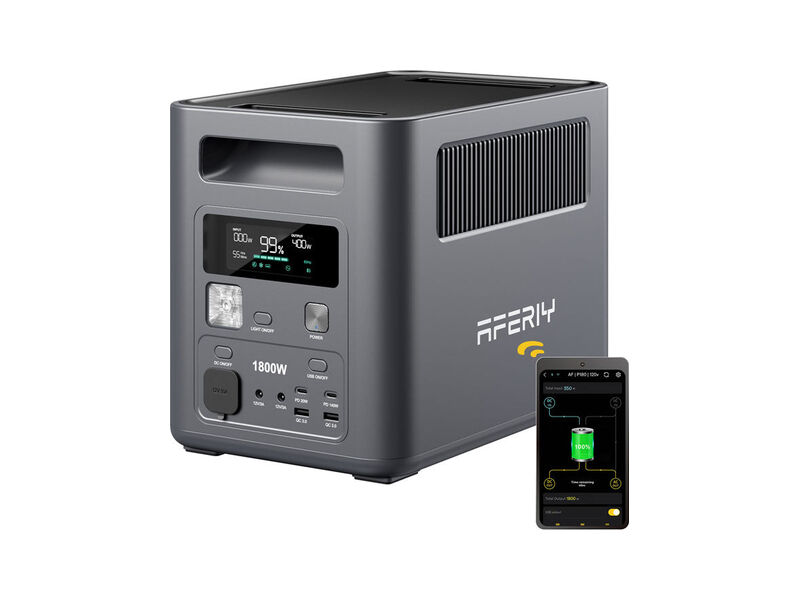
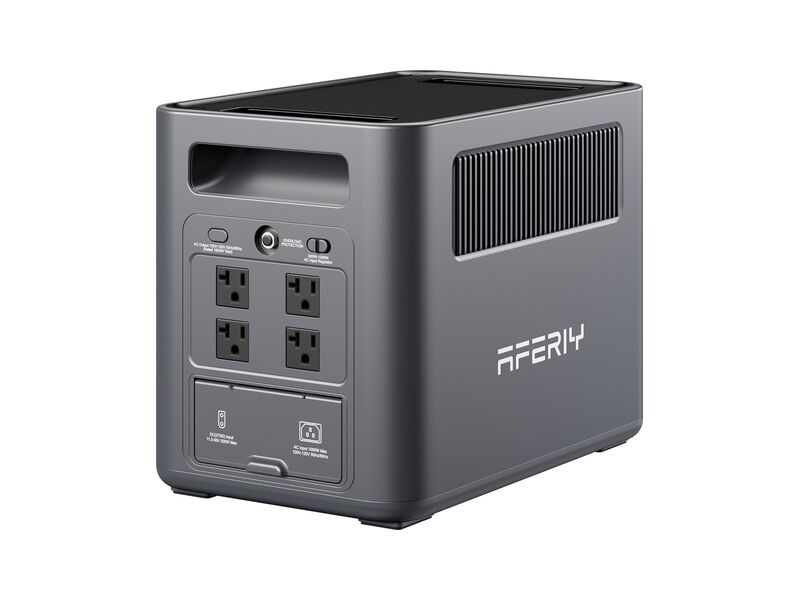
1024Wh expandable up to 5120Wh, 1800W (3600W peak) across four AC outlets, UL listed and under 30dB: the Aferiy P180 aims for quiet, flexible backup.
Buy at AmazonAs an Amazon Associate I earn from qualifying purchases.
Characteristics
- Capacity: 1024Wh (expandable to 5120Wh), LiFePO4
- AC output: 1800W, up to 3600W peak, 4 outlets
- Recharge: 0-80% in 55 min on mains, under 30dB
- Certifications: UL listed, 7-year support
- Expandable to 5120Wh, UL listed, under 30dB
Detailed overview: Aferiy P180 Portable Power Station
The Aferiy P180, sold in the US as the Nomad1800, is a 1024Wh portable power station built around a pure sine wave inverter delivering 1800W continuous and up to 3600W peak. Unlike the fixed-capacity spec sheet found on some regional listings, the US Amazon listing markets this line as expandable up to 5120Wh with additional battery packs, and several verified buyers describe doing exactly that, a genuine differentiator worth confirming directly with Aferiy if you plan to expand from day one.
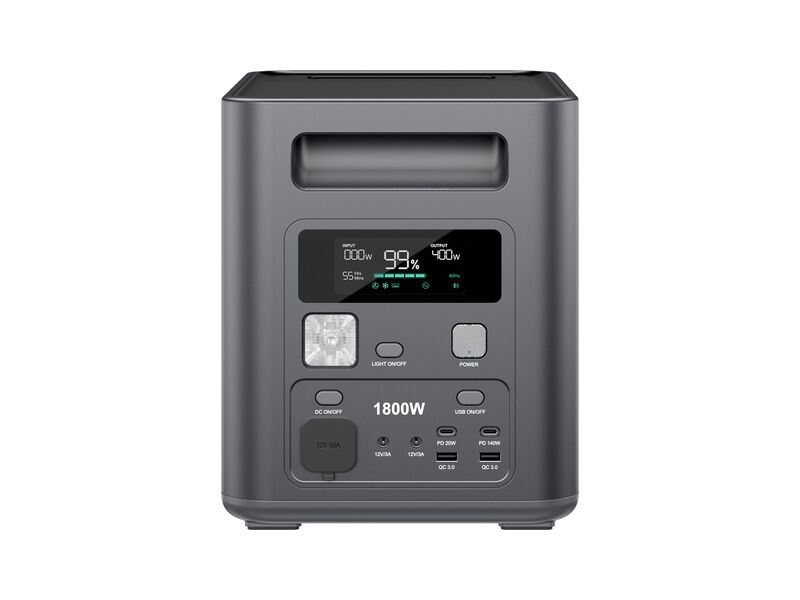
Its port count on the US model runs to 13 in total, headlined by four 1800W AC outlets (rare at this capacity), a 140W USB-C port for fast laptop charging, and two USB-A QC3.0 ports. A 12V car-style output rounds out the connectivity. The LiFePO4 battery is rated for over 4000 cycles, and Aferiy states a roughly 10-year service life.
Charging accepts four methods: AC alone (0 to 80% in about 55 minutes), solar, a car's 12V socket, or AC plus solar combined for a faster top-up. A UPS function switches to battery power in under 10 milliseconds, about twice as fast as many standard units, aimed at protecting routers, computers and security cameras through brief outages. Multiple US reviewers independently note how quiet the unit runs, under 30dB, whether idle or actively charging.
The unit is UL listed, and Aferiy advertises a 7-year support period, worth confirming the exact scope of coverage directly with Aferiy since support and a full parts warranty are not always the same thing. The companion app draws mixed feedback: most reviewers find it functional, but a handful describe it as unreliable, including one report of intermittent WiFi noise, so we would treat remote app control as a convenience rather than a dependency.
At 25.7 lb (11.64 kg) (25.6lb) and a compact 13.7 x 8.7 x 10.4 in (349 x 220 x 263 mm) footprint, the P180 stays easy to carry between a home office, a campsite and a vehicle. For US buyers after a quiet, well-ported station with room to grow, it is a strong option in its capacity class.
Full specifications
Detailed characteristics
Battery and capacity
| Rated capacity?Total stored energy in watt-hours. The higher the figure, the longer the runtime. | 1024 Wh |
|---|---|
| Delivered energy, measured?Energy that actually leaves the battery and reaches the devices. Always below the stored energy, as conversion costs heat. Taken from our in-depth review. | 865 Wh |
| Max capacity (with extensions)?Total capacity reachable by adding extra batteries. | 5120 Wh |
| Expandable capacity?Whether capacity can be increased with add-on batteries. | Yes |
| Removable battery?The main battery can be removed or replaced by the user. | No |
| Battery chemistry?LiFePO4 (LFP) lasts far longer and is safer than NMC. | LFP (LiFePO4) |
| Charge cycles?Number of full charges before capacity drops to the stated threshold. | 4000 cycles (80 %) |
AC output
| Continuous AC power?Power the unit can sustain continuously on its 230 V outlets. | 1800 W |
|---|---|
| Surge power?Brief peak tolerated when starting motor or compressor devices. | 3600 W |
| Inverter type?A pure sine wave is essential for sensitive electronics and motors. | Pure sine wave |
| AC voltage / frequency?Voltage and frequency of the AC output (230 V / 50 Hz in Europe). | 120 V / 60 Hz |
| Number of 230 V AC outlets?Number of mains outlets available on the unit. | 4 |
| RV / TT-30 outlet?Dedicated 30 A outlet for North-American style RVs. | No |
Recharging
| Max AC charging power?Maximum power drawn from a wall socket; higher means faster charging. | 1000 W |
|---|---|
| AC charge 0-80%?Stated time to go from 0 to 80% on mains power. | 55 min |
| Max solar input?Maximum solar power accepted at the input (PV panels). | 500 W |
| Accepted solar voltage?Panel voltage range compatible with the solar input. | 11.5 to 55 V |
| MPPT controllers?Number of independent MPPT solar inputs (yield optimisation). | 1 |
| Vehicle charging (12/24 V)?Can be charged from a vehicle's cigarette-lighter socket. | Yes |
| Pass-through charging?The unit can power devices while charging (pass-through). | Yes |
Ports and connectors
| USB-C ports?Number of USB-C ports and the fastest port's power (laptops, phones). | 1 × 140 W |
|---|---|
| USB-A ports?Number of USB-A ports and maximum power (small devices). | 2 × 18 W |
| 12 V output (car socket)?12 V cigarette-lighter output and its power (coolers, pumps…). | Yes (120 W) |
| Other DC outputs?Additional DC connectors (Anderson, DC5521, XT60…). | DC5521, car socket |
Portability
| Weight?Net weight of the unit, battery included. | 25.7 lb (11.64 kg) |
|---|---|
| Dimensions (L × W × H)?Overall size of the unit in millimetres. | 13.7 × 8.7 × 10.4 in (348 × 220 × 264 mm) |
| Form factor?Portable (hand-carried), transportable (heavy), or wheeled. | Portable |
| Wheels?Built-in wheels for moving the unit. | No |
| Telescopic handle?Retractable handle like a wheeled suitcase. | No |
Safety and environment
| Certifications?Standards and approvals obtained (CE, RoHS, UN38.3, UL…). | UL, CE, RoHS, FCC, PSE, TELEC, UN38.3 |
|---|
Backup / UPS
| UPS / EPS mode?Automatic switch to battery on a mains outage (backup). | Yes |
|---|---|
| Switchover time (rated)?Delay before switching to battery; under 20 ms suits a PC or router. | 10 ms |
Noise and thermal
| Noise level (rated)?Manufacturer-stated noise; a quiet room is around 30 dB. | 30 dB(A) |
|---|---|
| Quiet mode?Setting that limits fan noise, often by capping charge power. | No |
| Self-heating battery?Battery pre-heating to allow charging in cold weather. | No |
Display and connectivity
| Display?Type of screen showing power, runtime and alerts. | LCD |
|---|---|
| Bluetooth?Bluetooth link for nearby control. | Yes |
| Wi-Fi?Wi-Fi connection for remote control and monitoring. | Yes |
| Mobile app?iOS / Android app to control the unit. | Yes |
| Local control (no cloud)?Control possible over Bluetooth without an account or internet. | Yes |
| Solar connector?Connector type of the solar input (XT60, Anderson, MC4…). | XT60 |
Availability and warranty
| Market launch?Date the model first became available on the European market. Useful to place its generation: technology moves fast in this segment, and a device several years old may be at the end of its commercial life. | January 2026 |
|---|---|
| Warranty?Length of the manufacturer's warranty. | 7 years |
⚡ How long will this power station run a device?
With 1 024 Wh, the Aferiy P180 external battery runs a fridge (50 W) for ~17h or an LED TV (90 W) for ~9h40.
| Home | Runtime |
|---|---|
| Mini fridge (45 W) | ~19h |
| Refrigerator (50 W) | ~17h |
| Freezer (60 W) | ~15h |
| American fridge (150 W) | ~5h50 |
| Outdoor & workshop | Runtime |
|---|---|
| E-scooter (charging) (100 W) | ~8h40 |
| Desktop PC (250 W) | ~3h30 |
| Oxygen concentrator (300 W) | ~2h55 |
| Air compressor (1100 W) | ~45 min |
Rough estimate: real consumption varies, and very power-hungry appliances (heating elements) must stay below the output power.
What is this power station best for?
-
Home & Power cuts Ideal
With 1024Wh and a UPS switchover Aferiy rates at under 10ms, twice as fast as many standard units at up to 20ms, the Aferiy P180 makes a genuinely capable home backup: routers, security cameras, a small fridge and a computer keep running with no perceptible interruption during a storm-related outage. Its 1800W continuous output (3600W peak) across four AC outlets covers several appliances at once, and it operates below 30dB in most daily use, quiet enough to sit in a living room. What sets the US listing apart from the base spec sheet is real expandability: several verified buyers describe connecting an additional battery pack, and Aferiy advertises the line as expandable up to 5120Wh, useful for a multi-day outage rather than just a few hours. It is UL listed, a meaningful reassurance for equipment left running unsupervised. One mixed signal worth flagging: a handful of reviews describe the companion app as unreliable, including an odd intermittent WiFi noise, so we would not rely on remote app monitoring alone during a real outage.
-
Camping & Tent Ideal
At 25.7 lb (11.64 kg) (25.6lb) and a compact 13.7 x 8.7 x 10.4 in (349 x 220 x 263 mm) footprint, the Aferiy P180 travels well for car camping. Its 1024Wh and four AC outlets run an electric cooler, lighting and charging for a full group, while the 1800W continuous output (3600W peak) handles a hotplate or a small kettle without strain. The 140W USB-C port charges a laptop at full speed, and the smart app lets you check charge level and switch outputs from the tent, though a few US reviewers describe the app as glitchy, so treat it as a convenience rather than a must-have. Rechargeable via solar, wall or car socket, and combinable for a faster top-up, it stays flexible far from an outlet. Reviewers specifically praise how quiet it runs, below 30dB in normal use, both idle and while charging, a genuine plus next to a shared campsite.
-
Remote work Suitable
The Aferiy P180 covers a full day of mobile work: its 1800W output easily runs a laptop, a monitor, a router and a printer, and its UPS function is rated to switch over in under 10ms during a mains blip, aimed at protecting a video call or a document in progress. The 140W USB-C port charges a laptop directly. At 25.7 lb (11.64 kg) it moves easily between a home office, a backyard or a van. One caution from US reviews: the companion app is inconsistently rated, so for a work setup we would lean on the physical display rather than remote app control.
-
Job site & Tools Suitable
On a small job site, the Aferiy P180's 1800W continuous output (3600W peak) starts and runs light to medium power tools, drills, saws and a work light, across four AC outlets that let several tools share the station at once. Its LiFePO4 battery (4000+ cycles) is built for repeated daily use, and being UL listed adds real confidence for job-site use. Fast charging, 0 to 80% in about 55 minutes on the wall, means a quick turnaround between shifts. For the most demanding startup surges, a higher peak-power model will still suit better.
Our team's recommendations based on the model's capacity, output power and weight.
Comparison
Around $500, the Aferiy P180 goes up against the most searched 1kWh-class stations sold in the US, in queries like "Aferiy P180 vs Bluetti Elite 100 V2" or "best 1000Wh power station". Here is how it compares to three direct alternatives.
| Criterion | Aferiy P180 | Bluetti Elite 100 V2 | EcoFlow Delta 3 | Jackery Explorer 1000 v2 |
|---|---|---|---|---|
| Capacity | 1024Wh (expandable to 5120Wh) | 1024Wh | 1024Wh | 1070Wh |
| AC output | 1800W (3600W peak), 4 outlets | 1800W (3600W surge) | 1800W | 1500W (3000W peak) |
| Mains recharge | 0-80% in 55 min | 0-80% in 70 min | full in 56 min | full in about 60 min (fast mode) |
| UPS switchover | Under 10ms | 10ms | Not stated | Under 20ms |
| Observed price | $499.97 | $499.00 | $599.00 | $499.00 |
The Aferiy P180 stands out with the most AC outlets of the group (four, against one to three elsewhere) and, uniquely here, a path to expand past its base capacity. The Bluetti Elite 100 V2 matches it closely on price and charging speed, and the EcoFlow Delta 3 charges fastest of all but costs more. For anyone wanting several AC outlets and room to grow, the P180 is a compelling choice at this price.
Related video
Video: AFERIY P180 Review: I Tested It So You Don't Have To - Published on 04/07/2026
Our tester's review: Christophe Delpuech
We came into the Aferiy P180 expecting the same fixed-capacity unit sold in Europe, and the US listing tells a different story: real buyers describe connecting an expansion battery, and Aferiy markets this line as expandable up to 5120Wh, a genuine upgrade over the non-expandable EU spec. In use, the four AC outlets and 1800W continuous output ran a window AC unit, a coffee maker and a portable washing machine in separate reviewer accounts, with headroom to spare below the 3600W peak. Charging lives up to the claim, 0 to 80% in about 55 minutes on the wall, and multiple reviewers independently praised how quiet it stays, under 30dB, both idle and while charging. UL listing is a genuine reassurance for a unit meant to sit and wait for an outage. The one recurring gripe across the 109 US ratings (4.6 average): a handful of buyers call the companion app unreliable, one mentioning strange intermittent WiFi noise, so we would not lean on remote monitoring alone. For home backup or a camping setup that might grow, it is a strong pick.
In-depth review Aferiy P180 review: our full verdict 4.1/5 Read our full review → Capacity and efficiency 4.0 Delivered power 4.3 Recharging 4.3 Ports and control 4.0 Build and endurance 3.9 Noise not measuredFrequently asked questions: Aferiy P180 Portable Power Station
The US listing markets it as expandable up to 5120Wh, and several verified buyers describe connecting an additional battery pack. Confirm exact compatibility and pricing directly with Aferiy before planning around it.
Four, each rated for the station's 1800W continuous output (3600W peak), verified on the current US Amazon listing. That's a notably generous count for a 1kWh-class station.
About 55 minutes to reach 80% on a standard wall outlet. It also charges from solar or a car's 12V socket, and combining AC with solar speeds up the top-up further.
Feedback is mixed: most US reviewers report it working fine, but a handful describe it as unreliable, including one mention of intermittent WiFi noise. We'd treat it as a convenience rather than a must-have.
Need help choosing?
Related articles
Other products in the "Versatile power stations" category
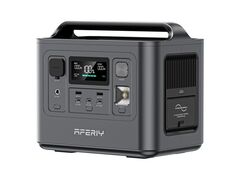
Aferiy P010
See price (3)
512Wh and 800W (1600W surge) in a 14.3 lb (6.5 kg)/14.3lb frame, UL/FCC/PSE certified for the US market, backed by up to a 7 year Aferiy warranty.
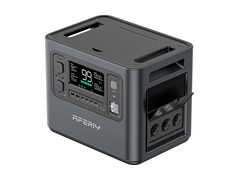
Aferiy P210
See price (7)
With 2048 Wh, 2400 W (up to 4800 W peak), a LiFePO4 battery and a 7-year warranty, the Aferiy P210 targets the best capacity-to-price ratio on the market.
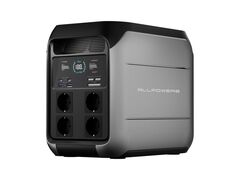
Allpowers P1800
$439.00 (6)
A 1 kWh LiFePO4 power station with plenty of punch, fast wall-outlet recharging and quiet running: a smart pick for camper vans, camping and power outages.
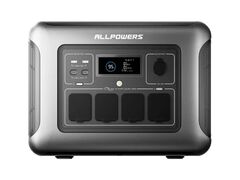
Allpowers R1500 LITE
$474.00
1056Wh and 1600W (3200W peak), 15ms UPS and 35dB quiet operation: the versatile power station for campervans, home backup or job sites.
Published on 02/09/2026, updated on 18/09/2026