Allpowers P1800
(6 reviews)
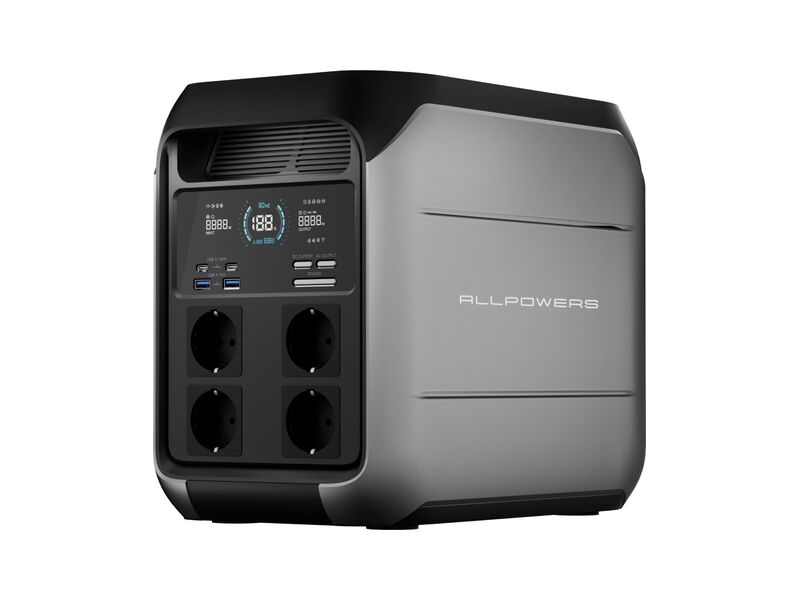
A 1 kWh LiFePO4 power station with plenty of punch, fast wall-outlet recharging and quiet running: a smart pick for camper vans, camping and power outages.
- Capacity: 1024 Wh, LiFePO4 battery (4000 cycles claimed)
- Power: 1800 W continuous, 3600 W peak, 4 AC outlets
- Recharge: Wall outlet up to 1200 W, solar up to 650 W, car socket
- Outputs: 2 USB-C 140W, 2 USB-A 18W, 12V 120W socket
- 1 kWh, 1800 W and 140 W USB-C in just 28.7 lb (13 kg)
Detailed overview: Allpowers P1800 portable power station
The Allpowers P1800 is a 1024 Wh portable power station aimed at the 1 kWh segment, where EcoFlow, Bluetti and Anker dominate. It is called VOLIX P1800 in its manual and ALLPOWERS P1800 on the brand's stores: it is the same product. Its LiFePO4 battery delivers 1800 W continuously and 3600 W at peak, through a pure sine wave inverter suited to laptops, routers and sensitive electronics.
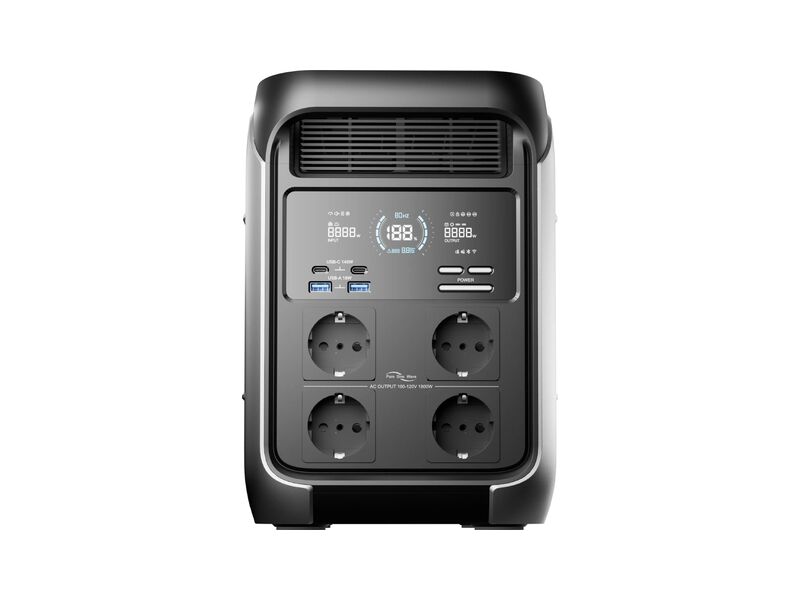
The connectivity is generous for the category: four AC outlets, two 140 W USB-C ports, two 18 W USB-A ports and a 120 W 12 V car socket. The 1800 W is a ceiling shared across all ports. The digital display shows input, output, remaining charge and estimated runtime, and the Allpowers app (Wi-Fi and Bluetooth) controls the station remotely.
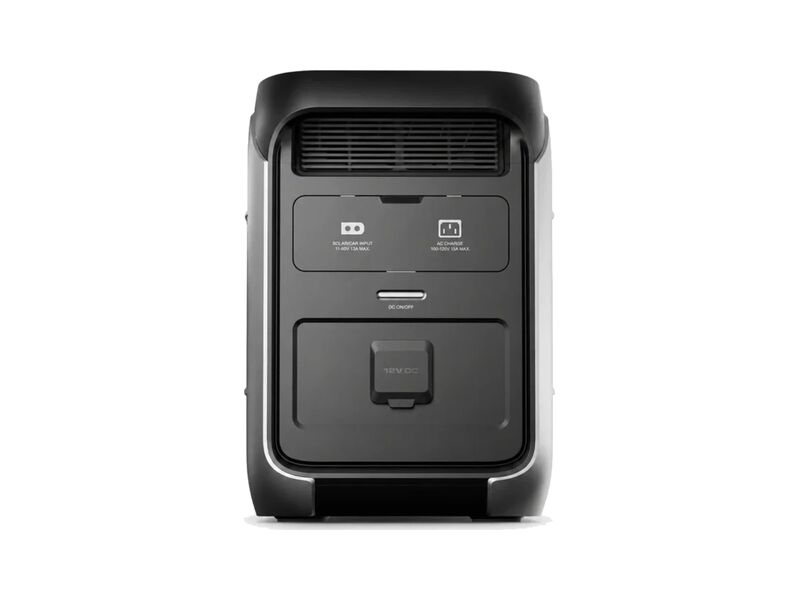
Recharging is its second selling point. From a wall outlet, three modes can be set in the app: fast (up to 1200 W), standard (800 W) and silent (500 W). The manufacturer quotes 0 to 100% in 54 minutes on some pages and 0 to 80% in about an hour on others, so allow roughly an hour to reach 80%. The solar input accepts up to 650 W (11 to 60 V, 13 A, XT60 connector), and charging from a car socket is possible with a cable sold separately.
Claimed reliability: 4000 cycles with at least 70% capacity remaining, a 5-year warranty, UPS switchover in under 10 ms and around 30 dB in operation. It discharges from 14 °F (-10 °C) to 104 °F (40 °C) and recharges from 32 °F (0 °C) to 104 °F (40 °C).
- Capacity: 1024 Wh LiFePO4 (51.2 V, 20 Ah)
- Output: 1800 W continuous, 3600 W peak, 4 AC outlets
- Ports: 2 USB-C 140 W, 2 USB-A 18 W, 12 V 120 W socket
- Recharge: wall outlet 1200 W, solar 650 W, car
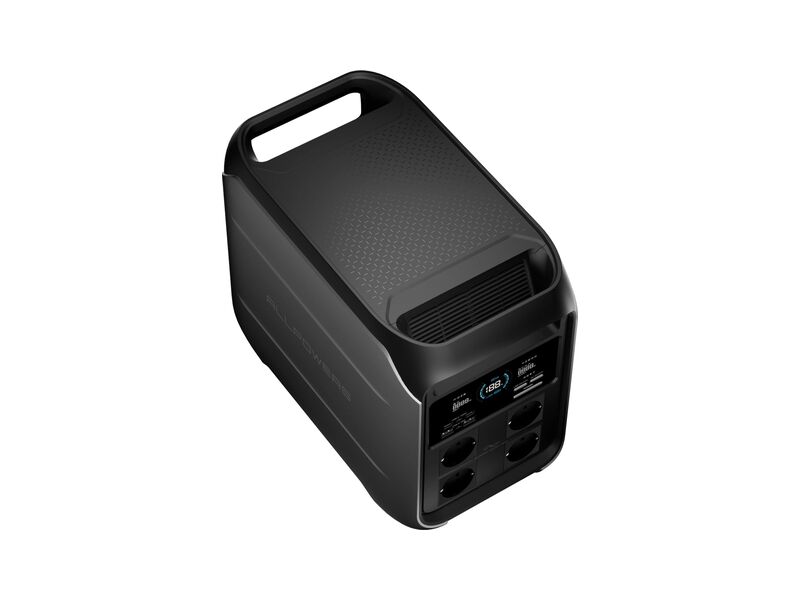
- Size: 28.7 lb (13 kg), 14.6 x 8.2 x 11.7 in (37.1 x 20.8 x 29.6 cm)
The limits are worth knowing. The capacity is not expandable (the manual shows no expansion port), wall-outlet charging tops out at 1200 W where some rivals reach 1400 or 1600 W, and several figures differ from one manufacturer page to another. The station is new and its review history is short. At this price it is still a very coherent choice for a camper van, a weekend of camping or an emergency reserve.
Full specifications
Detailed characteristics
Battery and capacity
| Rated capacity?Total stored energy in watt-hours. The higher the figure, the longer the runtime. | 1024 Wh |
|---|---|
| Expandable capacity?Whether capacity can be increased with add-on batteries. | No |
| Removable battery?The main battery can be removed or replaced by the user. | No |
| Battery chemistry?LiFePO4 (LFP) lasts far longer and is safer than NMC. | LFP (LiFePO4) |
| Charge cycles?Number of full charges before capacity drops to the stated threshold. | 4000 cycles (70 %) |
| Pack nominal voltage?Internal battery voltage; higher voltage helps deliver high power. | 51.2 V |
AC output
| Continuous AC power?Power the unit can sustain continuously on its 230 V outlets. | 1800 W |
|---|---|
| Surge power?Brief peak tolerated when starting motor or compressor devices. | 3600 W |
| Inverter type?A pure sine wave is essential for sensitive electronics and motors. | Pure sine wave |
| AC voltage / frequency?Voltage and frequency of the AC output (230 V / 50 Hz in Europe). | 230 V / 50 Hz |
| Number of 230 V AC outlets?Number of mains outlets available on the unit. | 4 |
| RV / TT-30 outlet?Dedicated 30 A outlet for North-American style RVs. | No |
Recharging
| Max AC charging power?Maximum power drawn from a wall socket; higher means faster charging. | 1200 W |
|---|---|
| AC charge 0-100%?Stated time for a full charge on mains power. | 54 min |
| Max solar input?Maximum solar power accepted at the input (PV panels). | 650 W |
| Accepted solar voltage?Panel voltage range compatible with the solar input. | 11 to 60 V |
| Max solar current?Maximum current accepted on the solar input. | 13 A |
| MPPT controllers?Number of independent MPPT solar inputs (yield optimisation). | 1 |
| Vehicle charging (12/24 V)?Can be charged from a vehicle's cigarette-lighter socket. | Yes |
| Pass-through charging?The unit can power devices while charging (pass-through). | Yes |
Ports and connectors
| USB-C ports?Number of USB-C ports and the fastest port's power (laptops, phones). | 2 × 140 W |
|---|---|
| USB-A ports?Number of USB-A ports and maximum power (small devices). | 2 × 18 W |
| 12 V output (car socket)?12 V cigarette-lighter output and its power (coolers, pumps…). | Yes (120 W) |
Portability
| Weight?Net weight of the unit, battery included. | 28.7 lb (13 kg) |
|---|---|
| Dimensions (L × W × H)?Overall size of the unit in millimetres. | 14.6 × 8.2 × 11.7 in (371 × 208 × 296 mm) |
| Form factor?Portable (hand-carried), transportable (heavy), or wheeled. | Portable |
| Wheels?Built-in wheels for moving the unit. | No |
| Telescopic handle?Retractable handle like a wheeled suitcase. | No |
Safety and environment
| Certifications?Standards and approvals obtained (CE, RoHS, UN38.3, UL…). | CE, RoHS, FCC, UN38.3 |
|---|---|
| Discharge temperature?Temperature range in which the unit can deliver power. | 14 to 104 °F (-10 to 40 °C) |
| Charge temperature?Temperature range in which the unit can be recharged. | 32 to 104 °F (0 to 40 °C) |
Backup / UPS
| UPS / EPS mode?Automatic switch to battery on a mains outage (backup). | Yes |
|---|---|
| Switchover time (rated)?Delay before switching to battery; under 20 ms suits a PC or router. | 10 ms |
Noise and thermal
| Noise level (rated)?Manufacturer-stated noise; a quiet room is around 30 dB. | 30 dB(A) |
|---|---|
| Quiet mode?Setting that limits fan noise, often by capping charge power. | Yes |
Display and connectivity
| Display?Type of screen showing power, runtime and alerts. | LCD |
|---|---|
| Bluetooth?Bluetooth link for nearby control. | Yes |
| Wi-Fi?Wi-Fi connection for remote control and monitoring. | Yes |
| Mobile app?iOS / Android app to control the unit. | Yes |
| Solar connector?Connector type of the solar input (XT60, Anderson, MC4…). | XT60 |
Availability and warranty
| Market launch?Date the model first became available on the European market. Useful to place its generation: technology moves fast in this segment, and a device several years old may be at the end of its commercial life. | June 2026 |
|---|---|
| Warranty?Length of the manufacturer's warranty. | 5 years |
User manual / Instructions for use (PDF)
⚡ How long will this power station run a device?
With 1 024 Wh, the Allpowers P1800 external battery runs a fridge (50 W) for ~17h or an LED TV (90 W) for ~9h40.
| Home | Runtime |
|---|---|
| Mini fridge (45 W) | ~19h |
| American fridge (150 W) | ~5h50 |
| Washing machine (500 W) | ~1h45 |
| Microwave (1000 W) | ~50 min |
| Outdoor & workshop | Runtime |
|---|---|
| CPAP machine (40 W) | ~22h |
| LED TV (90 W) | ~9h40 |
| Nebulizer (100 W) | ~8h40 |
| Desktop PC (250 W) | ~3h30 |
Rough estimate: real consumption varies, and very power-hungry appliances (heating elements) must stay below the output power.
What is this power station best for?
-
Motorhome & Van life Ideal
In a camper van or RV, the P1800 covers the essentials of an on-board setup. Its 1024 Wh power a compressor fridge, lighting, ventilation and device charging for a good day, and its 1800 W can occasionally handle an electric kettle, a coffee maker or a small microwave. Four AC outlets save you a power strip, the two 140 W USB-C ports charge a laptop at full speed and the 120 W 12 V socket plugs into on-board gear. On the road, the solar input of up to 650 W is the most effective way to refill, while charging from the car socket is only a top-up. At a claimed 30 dB you can sleep next to it without trouble. Allow for 28.7 lb (13 kg) to wedge in securely, and a larger model if you cook with electricity every day.
-
Camping & Tent Ideal
For a weekend in a tent or a car-camping bivouac, the P1800 offers quiet comfort. A 100 W device such as a projector or a fan runs for about 8 hours on its 1024 Wh, enough for a whole evening with lighting, phones and a small camera. The two 140 W USB-C ports charge a laptop or a drone without a wall adapter, and four outlets let you plug in a cooler, a lamp and a charger at the same time. Its claimed 30 dB will not disturb the night, and its 28.7 lb (13 kg) can be carried by hand from the trunk to the campsite. A 200 to 400 W solar panel tops it up by day, and wall-outlet charging (up to 1200 W) gets it ready again before you leave or at a rest stop.
-
Home & Power cuts Suitable
During a power outage the P1800 can keep the essentials going: its UPS function switches automatically to the battery (under 10 ms claimed, 20 ms in the manual) to keep the router, the computer and the lights on. Its 1024 Wh keep a 12 W router running for several days, or a small fridge and a few lamps for half a day, and solar charging at up to 650 W helps in a long outage. It suits short to medium outages on essential equipment. Its fixed 1024 Wh is not enough for heating or cooking, and to power a whole household for several days a larger model is a better fit.
-
Remote work Suitable
For a mobile or backup workstation the P1800 is an economical base: its 1800 W powers a computer, monitors, a printer and a router, and its two 140 W USB-C ports charge a demanding laptop without a power brick. The UPS function limits the risk of losing work during a brief outage. A 100 W workstation runs for about 8 hours on its 1024 Wh, enough for a day away from an outlet, and the station can recharge while it powers your kit. Claimed at around 30 dB, it fades into the background in the office or the yard. For everyday, intensive use, a dedicated UPS remains better suited.
-
Job site & Tools Suitable
On a job site without an outlet, the P1800 powers medium-duty tools such as a drill, a jigsaw or work lighting, thanks to its 1800 W and its pure sine wave inverter. Its four outlets save you a power strip, and fast wall-outlet recharging (up to 1200 W) limits downtime. Tools with a high starting current can exceed the 3600 W peak, so check before plugging them in. With 1024 Wh, a 1000 W tool runs for a little under an hour continuously, and its 28.7 lb (13 kg) suits transport by vehicle rather than long walks.
Our team's recommendations based on the model's capacity, output power and weight.
Comparison
At around $439 before tax, the Allpowers P1800 goes up against the most searched-for 1 kWh power stations, through queries such as "Allpowers P1800 vs EcoFlow Delta 3 Classic" or "Allpowers P1800 vs Bluetti AC180". Here is how it compares with three direct alternatives: the EcoFlow Delta 3 Classic, known for express recharging and quiet running; the Bluetti AC180, slightly larger in capacity; and the Anker Solix C1000, the fastest to recharge.
| Criterion | Allpowers P1800 | EcoFlow Delta 3 Classic | Bluetti AC180 | Anker Solix C1000 |
|---|---|---|---|---|
| Capacity | 1024 Wh | 1024 Wh | 1152 Wh | 1024 Wh |
| Continuous / peak power | 1800 W / 3600 W | 1800 W / 3600 W | 1800 W / 2700 W (boost) | 2000 W / 3000 W |
| Battery chemistry | LFP (LiFePO4) | LFP (LiFePO4) | LFP (LiFePO4) | LFP (LiFePO4) |
| Max wall-outlet recharge | 1200 W | 1400 W | 1440 W | 1600 W |
| Max solar input | 650 W | 500 W | 500 W | 600 W |
| Weight | 28.7 lb (13 kg) | 26.7 lb (12.1 kg) | 36.2 lb (16.4 kg) | 24.9 lb (11.3 kg) |
| Observed price (before tax) | ≈ $439 | ≈ $529 | ≈ $449 | ≈ $500 |
In short, the Allpowers P1800 is the most generous on solar input (650 W) and the cheapest of the group, narrowly ahead of the Bluetti AC180, with an 1800 W output and 3600 W peak in line with the EcoFlow Delta 3 Classic. It gives ground on recharge speed, where the Anker Solix C1000 (1600 W) and the Bluetti (1440 W) are ahead, and on weight, where the Anker and the EcoFlow are lighter. The Bluetti remains the largest in capacity (1152 Wh). For anyone who wants maximum power and solar input on a tight budget, the P1800 is the most convincing proposition in this comparison.
Related video
Video: ALLPOWERS P1800 Review - NEW 1800W Portable Power Station Fully Tested! - Published on 09/09/2026
Our tester's review: Christophe Delpuech
We have not put the P1800 on our own test bench yet, so this view rests on the manufacturer's data sheet, the manual and what can be cross-checked online. On paper it is very coherent for the price. The 1800 W output runs an electric kettle or a drill, four outlets save you a power strip, and the two 140 W USB-C ports charge a laptop at full speed. The claimed noise level of around 30 dB matters when you sleep next to it in a van or a tent. Wall-outlet recharging at up to 1200 W and 650 W of solar input are its two real strengths for life on the move. The caveats: 28.7 lb (13 kg) to carry, a fixed capacity, figures that change from one manufacturer page to another (cycles, charging time, UPS switchover) and a short track record of reviews. For a camper van, a weekend of camping or short outages it deserves a place on the shortlist; for heavy daily use, wait for independent measurements.
Frequently asked questions: Allpowers P1800 portable power station
The P1800 gains on power (1800 W against 1600 W), weight (28.7 lb, or 13 kg, against 33.1 lb, or 15 kg) and USB-C output (140 W per port against 100 W). Both share the 1200 W recharge and the 650 W solar input; the R1500 LITE offers 32 Wh more capacity (1056 Wh).
The 1800 W (3600 W peak) is a ceiling shared across all ports, AC and DC combined. It covers a computer, a router, a compressor fridge, an electric kettle, a coffee maker or a power tool. Avoid heaters and cooktops that draw more than 1800 W.
In fast mode from a wall outlet (up to 1200 W), the manufacturer quotes 0 to 100% in 54 minutes on some pages and 0 to 80% in about an hour on others, so allow roughly an hour for 80%. With solar (650 W maximum), the time depends on the panels and the sunshine.
Not as far as we know. Some retail pages mention an "expandable" capacity, but the manual shows no expansion port and no additional battery is announced for this model. Its capacity stays at 1024 Wh.
The manufacturer claims under 10 ms on its product pages, while the manual says 20 ms. That is a common order of magnitude for this type of station, but not a guarantee for every device: for a critical machine, choose a dedicated UPS.
The station accepts up to 650 W of solar input, at 11 to 60 V and 13 A maximum, through an XT60 connector. The manufacturer recommends 400 W panels for a good balance of charging speed and price. Stay within the 60 V limit if you wire several panels in series.
Need help choosing?
Other products in the "Versatile power stations" category
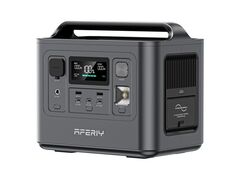
Aferiy P010
See price (3)
512Wh and 800W (1600W surge) in a 14.3 lb (6.5 kg)/14.3lb frame, UL/FCC/PSE certified for the US market, backed by up to a 7 year Aferiy warranty.
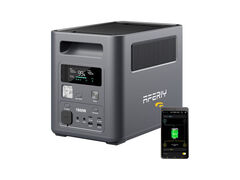
Aferiy P180
See price (7)
1024Wh expandable up to 5120Wh, 1800W (3600W peak) across four AC outlets, UL listed and under 30dB: the Aferiy P180 aims for quiet, flexible backup.
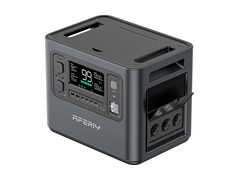
Aferiy P210
See price (7)
With 2048 Wh, 2400 W (up to 4800 W peak), a LiFePO4 battery and a 7-year warranty, the Aferiy P210 targets the best capacity-to-price ratio on the market.
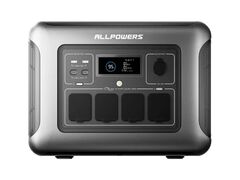
Allpowers R1500 LITE
$474.00
1056Wh and 1600W (3200W peak), 15ms UPS and 35dB quiet operation: the versatile power station for campervans, home backup or job sites.
Published on 08/10/2026