Fridge, lighting, laptop, phone charging: a portable power station gives a motorhome or converted van silent autonomy, without starting a noisy generator.
Why use a power station in a motorhome or campervan?
A motorhome's factory leisure battery is rarely enough to live comfortably away from powered pitches. A portable power station steps in: it stores a large capacity in watt-hours (Wh) and delivers it through 230 V AC sockets, USB ports and 12 V outputs, just like at home. Unlike a generator, it is silent, fuel-free and exhaust-free, so it can be used inside the vehicle.
It works both as the main power source for a light campervan build and as a mobile backup in an already-equipped motorhome, easily moved from the living area to the boot or outdoors for a meal.
What capacity (Wh) for a motorhome?
It depends on your appliances and target autonomy. As a quick guide:
300 to 600 Wh: a light weekend, for LED lighting, phone charging, a laptop and a small cooler used intermittently.
1000 to 1500 Wh: several days for a couple, with a compressor fridge, ventilation, light cooking and media.
2000 Wh and up: real multi-day autonomy, electric cooking (kettle, coffee maker) included, especially with solar charging during the day.
The right method is to add up your appliances' daily consumption (in Wh), then keep a margin, since fully draining a battery shortens its life. LiFePO4 (lithium iron phosphate) models are best suited here: several thousand charge cycles, meaning years of intensive use.
What output power? What you can run
Capacity (Wh) sets the duration; output power (W) sets what you can run at once. A 300 to 600 W output covers electronics and a cooler; aim for 1500 to 2000 W for a kettle, coffee maker or induction hob, which are very power-hungry. Always check your most demanding appliance before buying.
Charging: mains, 12 V socket and solar
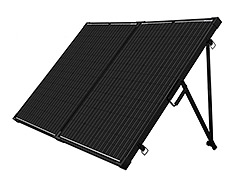
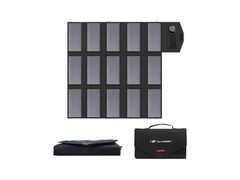
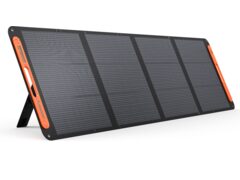
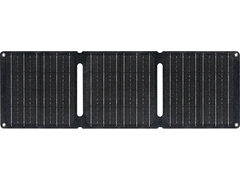
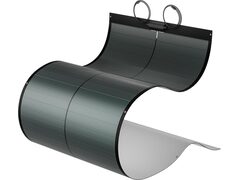
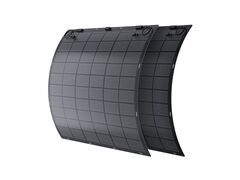
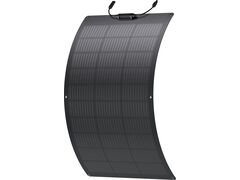
Three charging methods combine in a motorhome. On a 230 V hookup at a campsite, top-up is fastest (often under an hour on recent models). While driving, the 12 V socket or a DC charger keeps it topped up. Finally, one or more solar panels make the whole setup self-sufficient: the winning combination for van life, turning the station into a small onboard solar storage system.
Power station or fixed leisure battery?
The two are complementary. A permanently installed LiFePO4 leisure battery with an inverter remains the best base for a heavy, permanent setup. The portable power station wins on flexibility: no installation, you take it out of the vehicle, charge it anywhere and move it between vehicles without any work. Many travellers start with a station before investing in a fixed install.
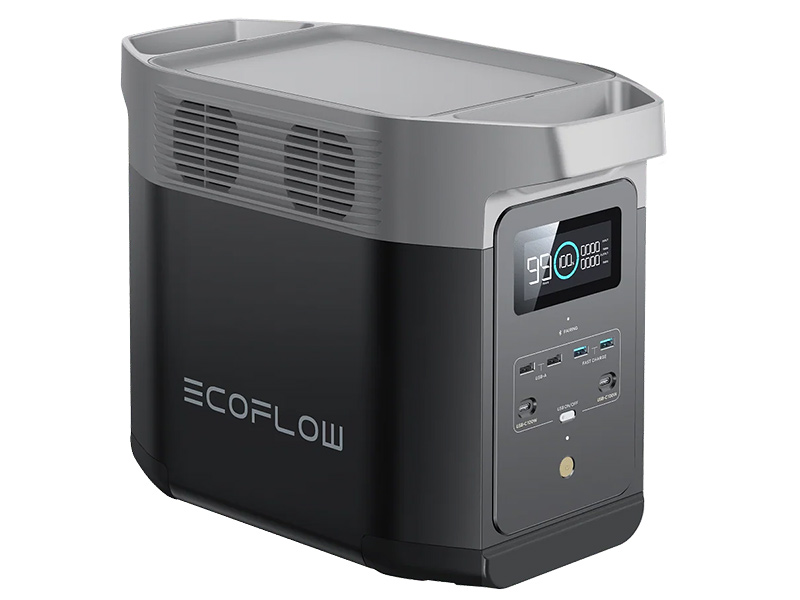
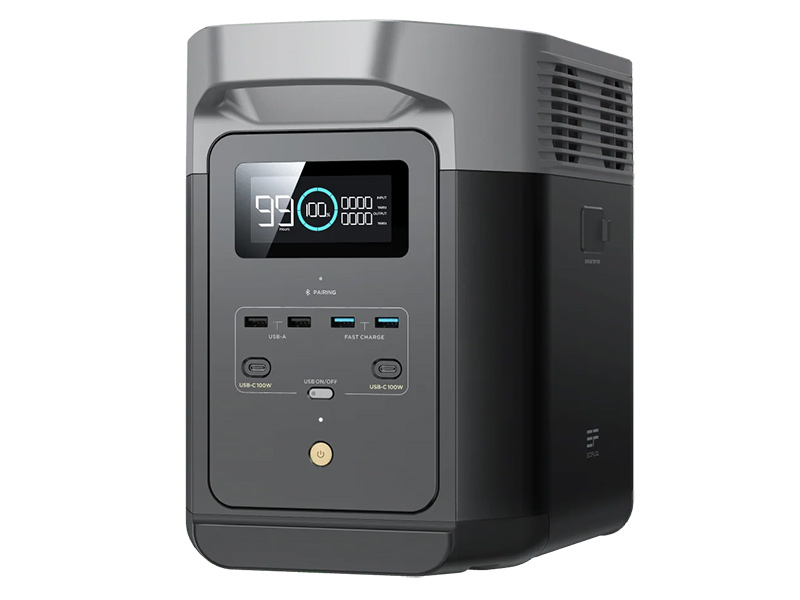
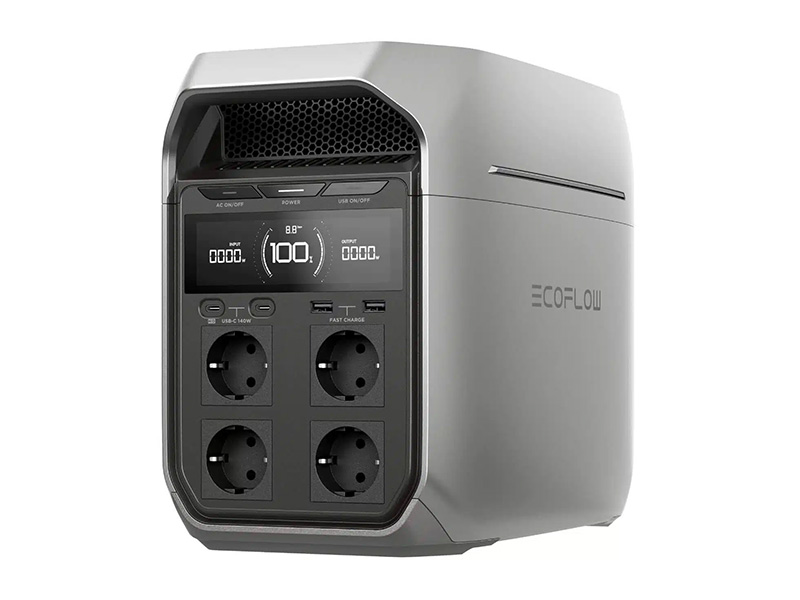
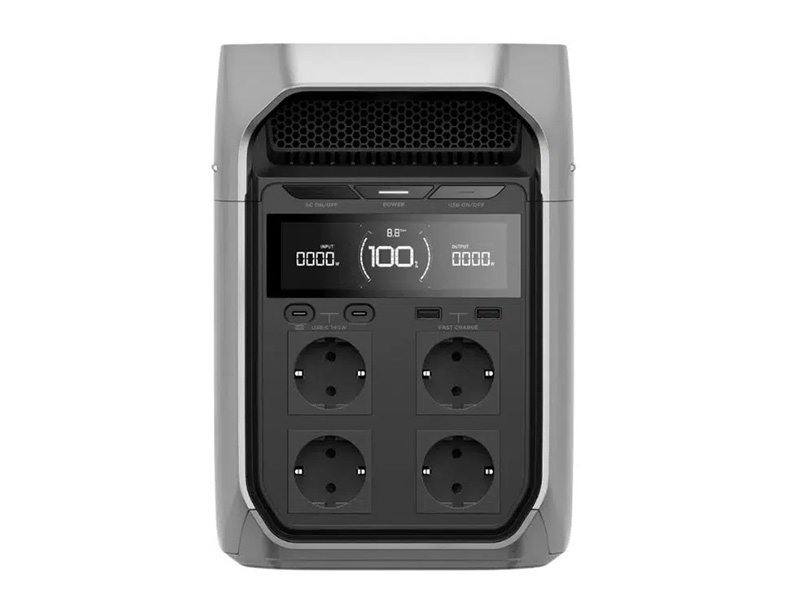
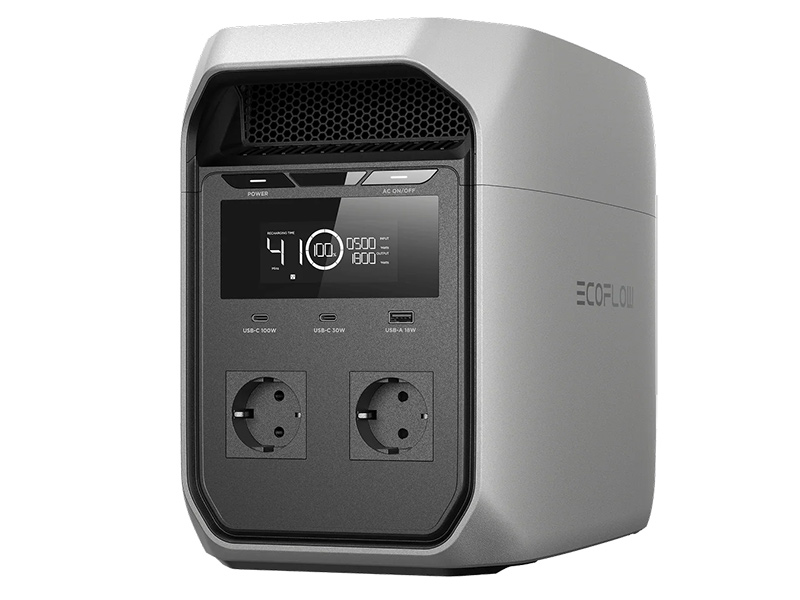
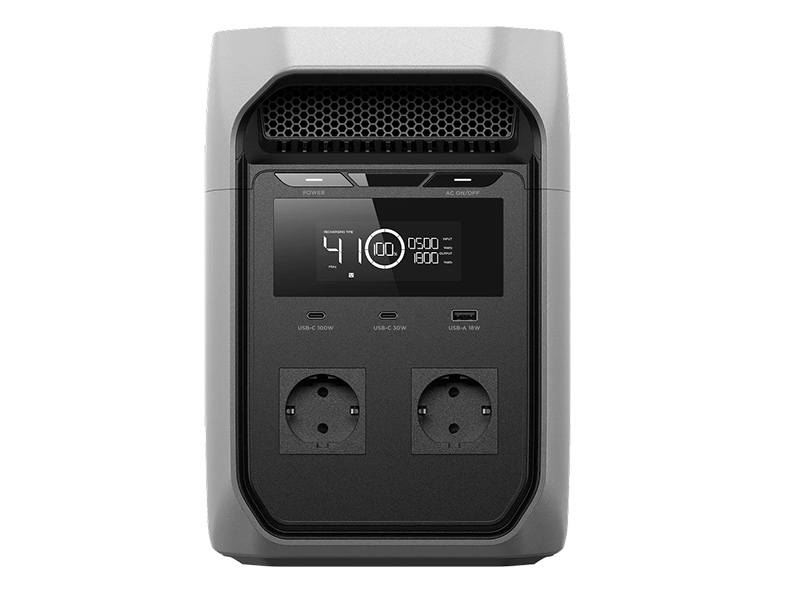
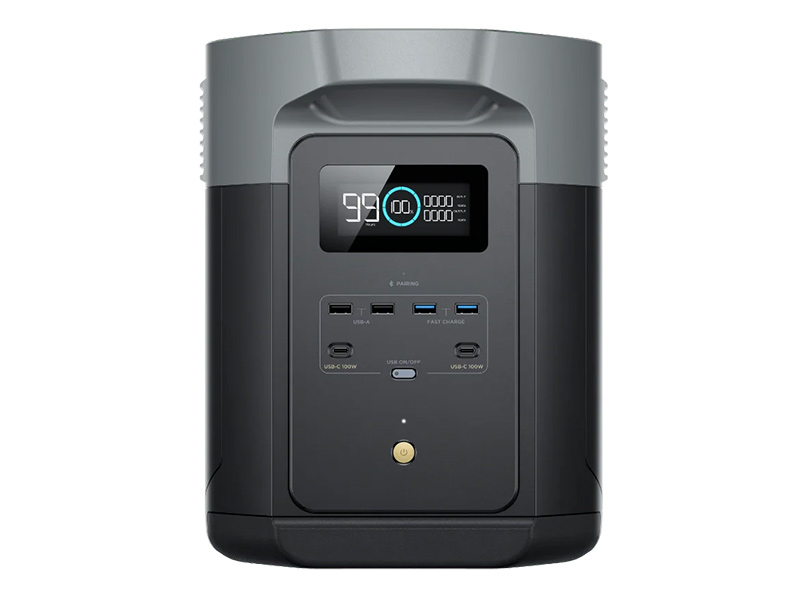
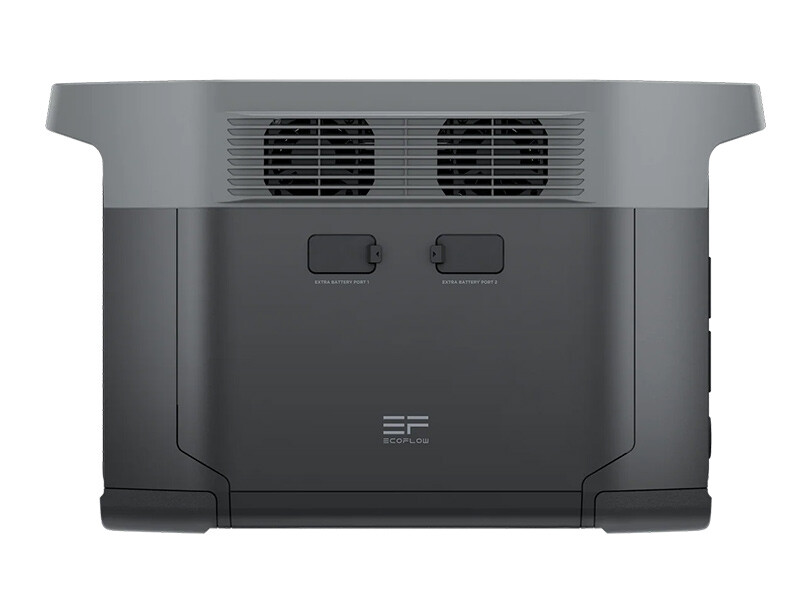
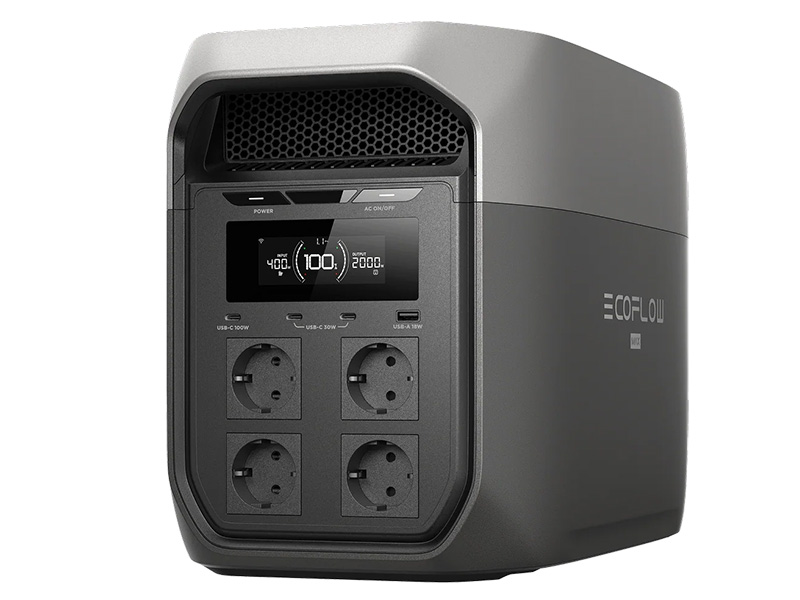
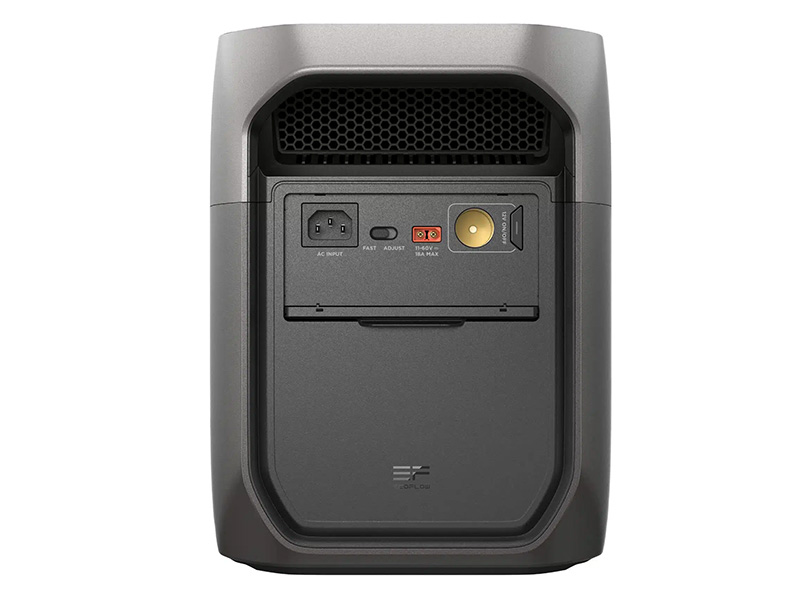
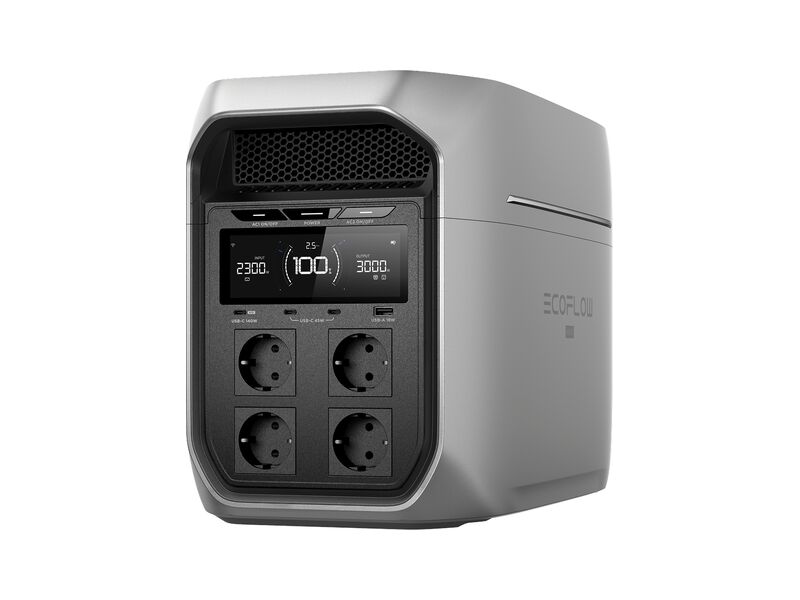
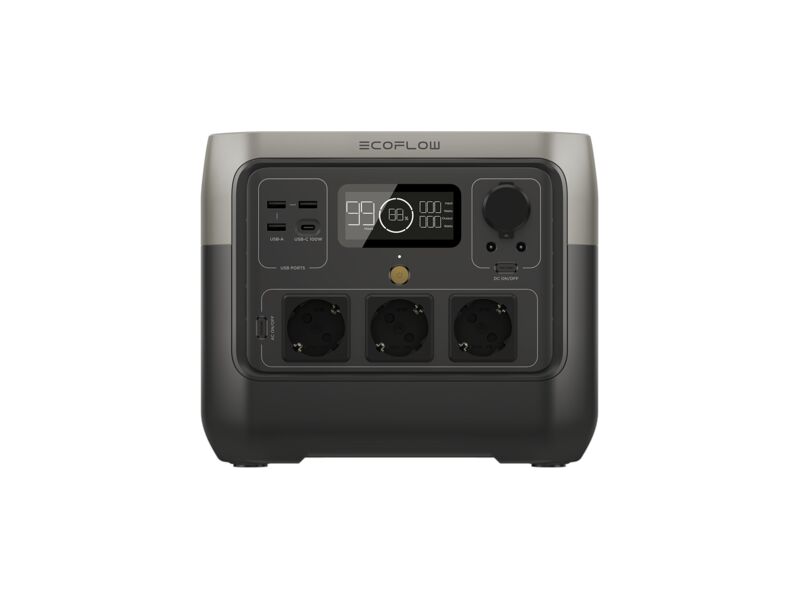
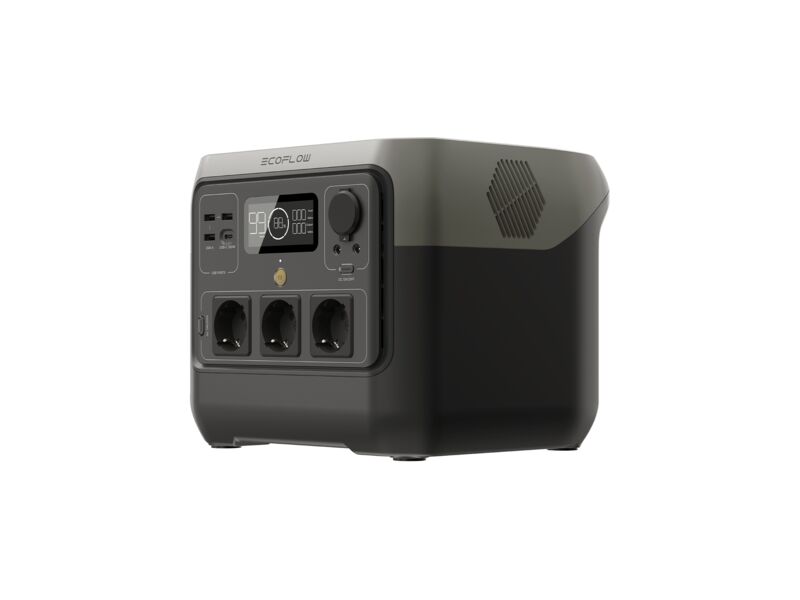
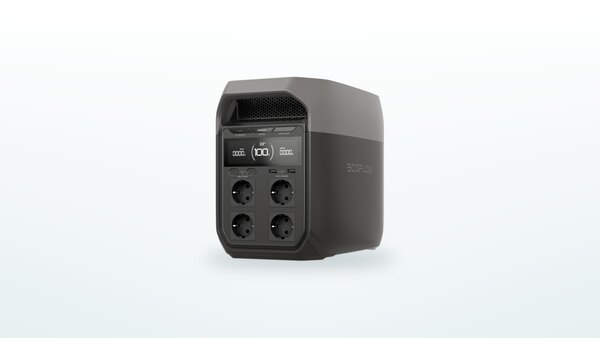
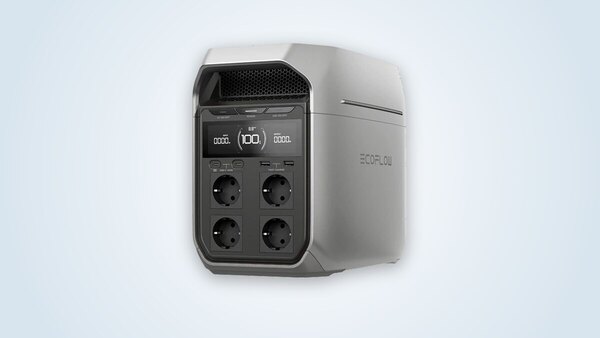
With 1024 Wh expandable to 3 kWh, 1800 W output and a 0-80% recharge in 50 minutes, the EcoFlow Delta 2 powers almost all your devices, at home or off-grid.
Capacity : 1024 Wh, expandable up to 3040 Wh (LFP battery)
AC output : 1800 W, 2400 W with X-Boost, 2700 W surge
Recharge : 0 to 80% in 50 min on mains, solar up to 500 W
Weight : 26.5 lb (12 kg), 15.7 x 8.3 x 11.1 in (400 x 211 x 281 mm)
0-80% recharge in 50 min, expandable up to 3 kWh
Use case: Motorhome & Van life
Expandable to 3 kWh, the Delta 2 grows with your needs in a van or motorhome: its base 1024 Wh power the fridge, lighting, water pump, device charging and light cooking, and adding an extra battery nearly triples autonomy for long trips. Its 1800 W (2400 W X-Boost) occasionally accept a hungrier appliance, and its four outlets share power without a strip. A recharge from 0 to 80 % in 50 minutes tops up at a service area during a break, and a solar input up to 500 W ensures autonomy in the wild. Compact (12 kg), it stows easily aboard.
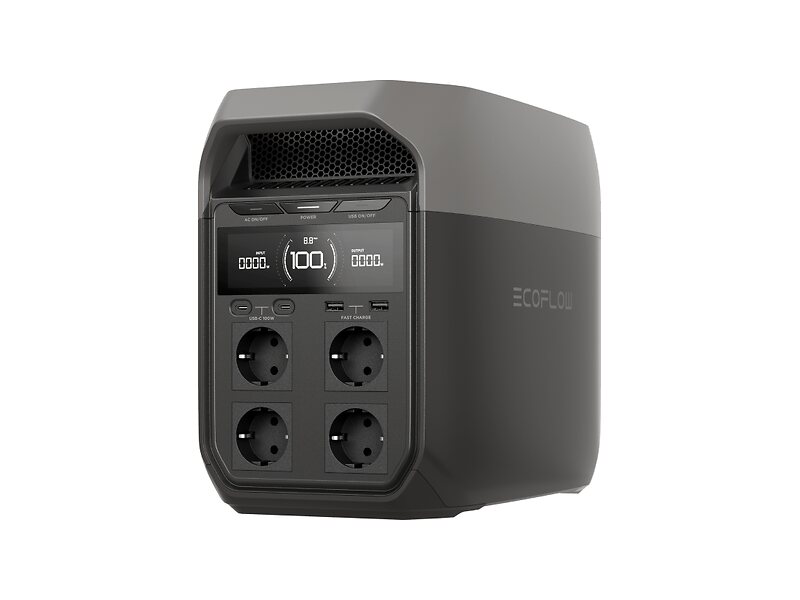
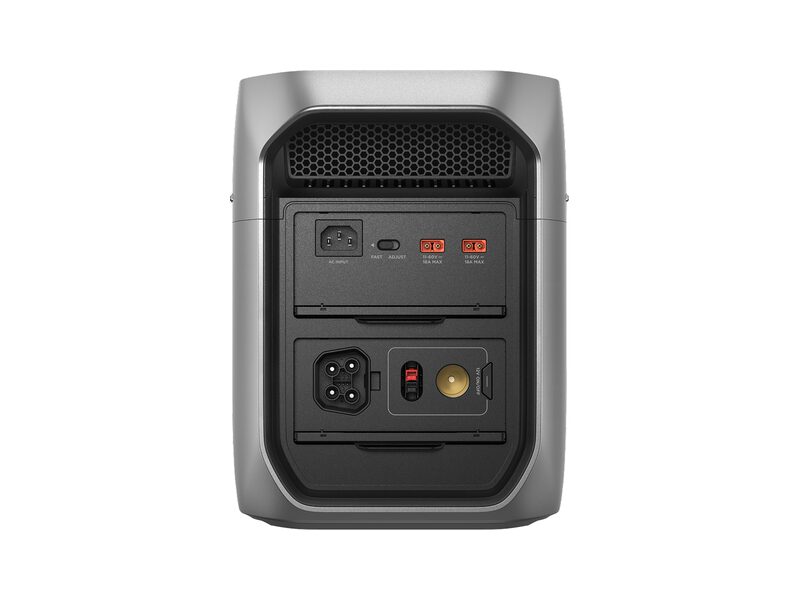
The EcoFlow Delta 2 is a portable power station with 1024 Wh (LFP battery) delivering 1800 W output, up to 2400 W with X-Boost technology. It recharges from 0 to 80% in 50 minutes on mains, accepts up to 500 W of solar input and offers 13 outlets including 4 AC sockets and 2 USB-C 100 W ports. Its capacity is expandable up to 3040 Wh and its LFP battery exceeds 3000 cycles, roughly 10 years of use. Weight: 26.5 lb (12 kg), 5-year warranty.
In-depth reviewRead our full review →4.4/5
We tried it both in a camper van and at home, and the Delta 2 simply gets the job done. The lightning recharge (80% in under an hour) is a game changer at a motorway stop, and the app is a real plus. It ran a fridge, the router and two laptops for a good part of the day. Only gripe: the fans blow hard during fast charging, but you can quiet them by capping the power. Rugged and expandable.
Its 2042Wh offer real runtime in a motorhome: fridge, lighting, electric cooking, device charging and comfort run for several days in a row, and its 2200W accept hungry appliances without compromise. A solar input up to 400W recharges quickly at a stop in good weather. Its major asset for a vehicle is its lightness: at 39.5 lb (17.9 kg), it installs and moves far more easily than a conventional 2kWh station, a real plus in the tight space of a build.
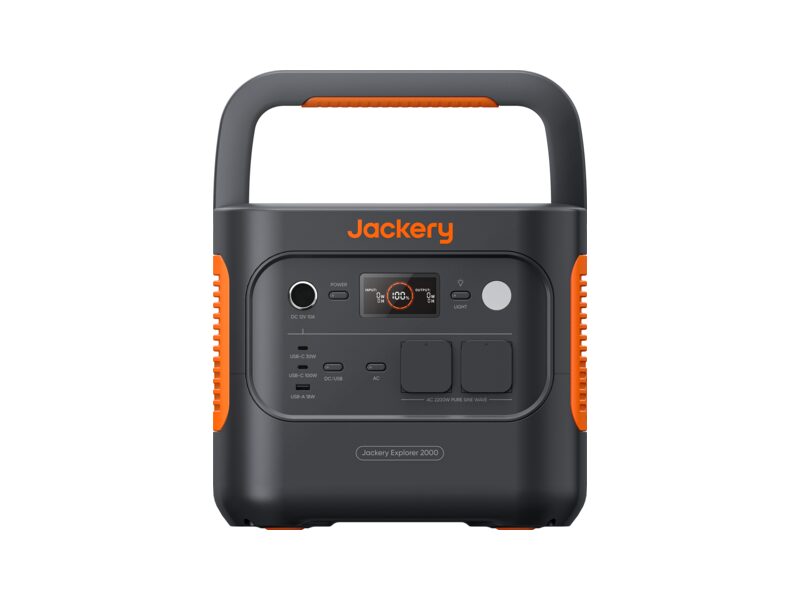
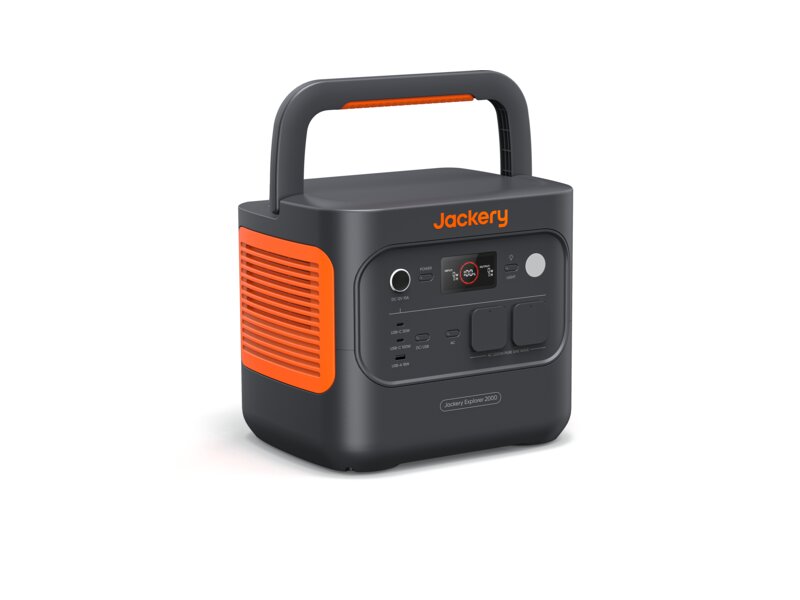
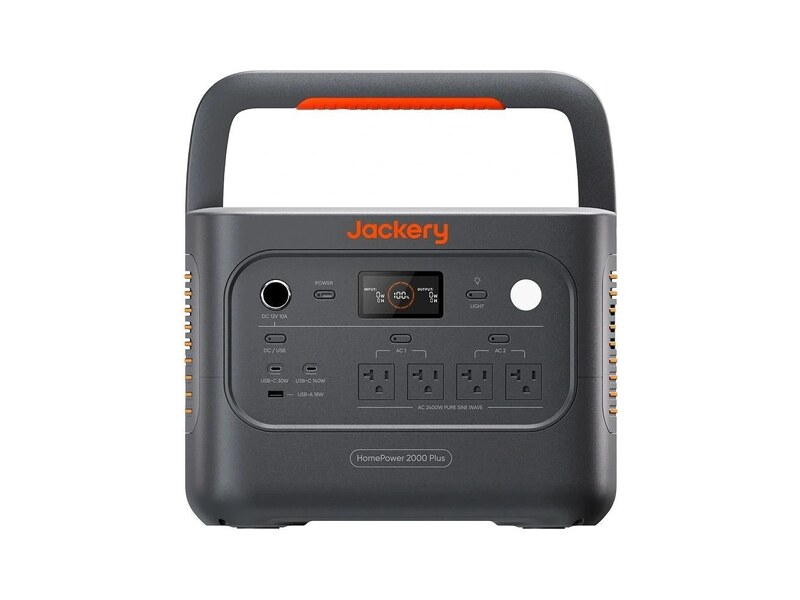
The Jackery Explorer 2000 v2 is a 2042Wh portable power station with a LiFePO4 battery, delivering 2200W continuously (4400W peak). Noticeably light for its capacity at 39.5 lb (17.9 kg), it powers most household appliances and works as UL1778-certified backup power. It offers plenty of outputs (three outlets, USB-C 100W, USB-A, car socket), recharges from the wall in under two hours and is controlled via the Jackery app. Battery rated for 4000 cycles.
In-depth reviewRead our full review →4.2/5
The Explorer 2000 v2 is probably the most versatile station in the range, and the first real surprise is its weight: at 39.5 lb (17.9 kg) for 2kWh, you move it far more easily than rivals of the same capacity that often push past 50.7 lb (23 kg). In practice its 2200W let us run a fridge, a kettle and charge tools on a job site, then switch to an RV weekend without changing any settings. The 2042Wh easily cover a full day of runtime for a couple. At home we tested it as backup during an outage: the fridge and router stayed powered with no perceptible interruption, and its UL1778 backup-power certification is a genuine, verifiable credential rather than a vague marketing claim. Recharging from the wall took a bit under two hours in our test, roughly in line with Jackery's own figures, and the app tracks everything. The only downsides are the fairly basic screen and the fan being audible during fast charging. Otherwise, it's an excellent balance of capacity, weight and price.
Its compact body and a dedicated 30A RV-style outlet make the C2000 Gen 2 an easy fit for a motorhome hookup: its 2048Wh cover fridge, electric cooking, lighting and comfort for several days, and its 2400W accept hungry appliances without compromise. Expansion to 4kWh targets a genuine week of runtime on long trips, while a solar input up to 800W recharges while driving or parked. Quiet at 30dB, it won't disturb nights at camp.
The Anker Solix C2000 Gen 2 is a 2048Wh portable power station that refines an already successful recipe: 2400W of continuous output (up to 4000W peak) across five household outlets plus a dedicated 30A RV outlet, and two 140W USB-C ports to charge a laptop. Its LiFePO4 battery lasts 4000 cycles, wall charging tops out around 1800W, and its capacity expands to 4kWh with a BP2000 battery. At 41.7 lb (18.9 kg) and UL certified, it's a versatile, powerful station for the home, RV or backup power.
In-depth reviewRead our full review →4.4/5
The C2000 Gen 2 is one of those stations that reassures from the first use: 2400W continuous runs a kettle, a microwave or tools without trouble, and the 4000W peak absorbs start-up surges. The dedicated 30A RV-style outlet is a real plus for anyone hooking up a trailer or motorhome, no adapter needed. Wall charging comfortably fills the battery in under an hour and a half, and combining AC with solar input can shave that down further on a sunny day. The two 140W USB-C ports are a genuine convenience, charging a laptop at full speed with no separate adapter. The LiFePO4 battery claims 4000 cycles, roughly a decade of use, and at 41.7 lb (18.9 kg) it stays transportable for its capacity. As backup, expansion to 4kWh with a BP2000 covers a long outage. One honest caveat: like any station of this power, it warms up and the fans get audible during fast charging. For a modern, well-equipped 2kWh-class station built for both home and RV use, it's an excellent reference.
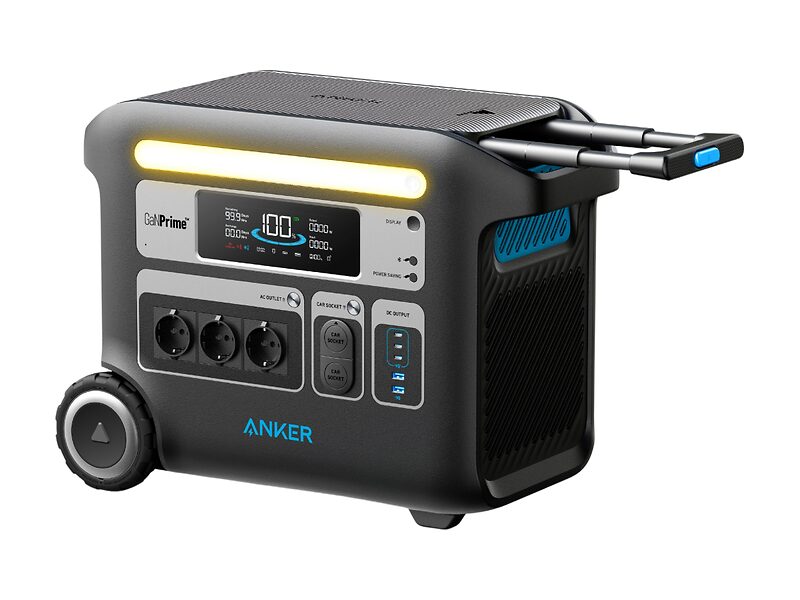
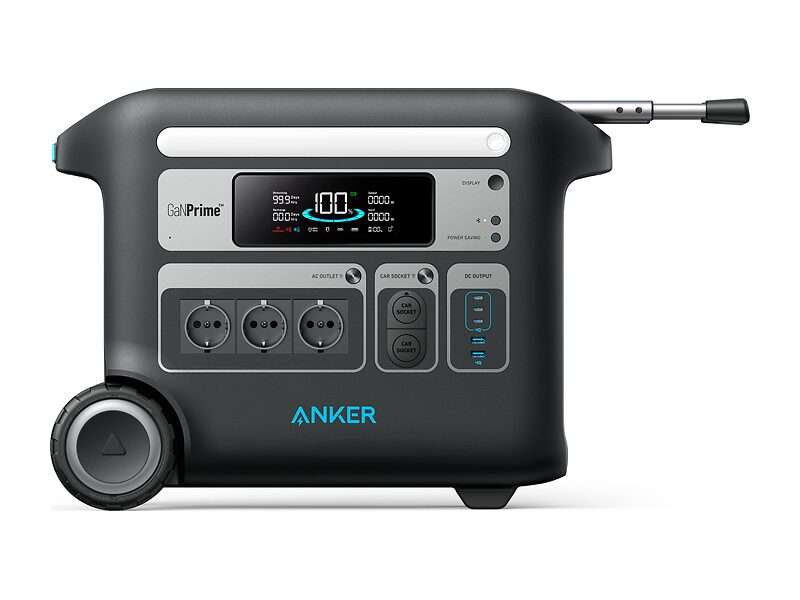
2048Wh on wheels, 2300W and a 0 to 80% recharge in one hour: the big Anker station built for home backup, the worksite and camping.
Capacity : 2048 Wh (LiFePO4, expandable 4096Wh)
Output : 2300W, 3 mains sockets
Recharge : 0 to 80% in 1 h (HyperFlash)
Ports : 3 USB-C, 2 USB-A, 2 car ports
2048Wh on wheels, 5-year warranty
Use case: Motorhome & Van life
Its folding handle and wheels ease transport of the F2000 in a motorhome despite its 67.2 lb (30.5 kg): once aboard, its 2048 Wh cover fridge, lighting, electric cooking and comfort for several days, and its 2300 W accept hungry appliances. Expansion to 4 kWh targets a genuine week of autonomy on long trips, while its solar input up to 1000 W, one of the most generous, recharges quickly at a stop in good weather. An excellent choice for large vehicles with a dedicated bay; its weight, however, reserves it for setups where it is rarely moved once installed.
The Anker Solix F2000 (PowerHouse 767) is a 2048Wh portable power station designed for heavy needs and home backup. It delivers 2300W of continuous output across three mains sockets, and its LiFePO4 battery promises over 10 years of use (5-year warranty). Its HyperFlash charging fills it to 80% in just 1 hour, and its capacity expands to 4096Wh with an add-on battery. Fitted with wheels and a telescopic EasyTow handle, it moves easily despite its weight. A complete energy reserve for the home, van, worksite or power outages.
In-depth reviewRead our full review →4.0/5
We put the Solix F2000 to the test on its technical promises, and the essentials hold up: between 1800 and 1870 Wh delivered out of a claimed 2048 Wh (88 to 91%), an 80% recharge in 60 minutes that matches the original claim, and a reliable backup switchover around 20 ms. Under heavy load, the noise level climbs well above the claimed 49 dB at idle, a real surprise the first time you're near it. We also noted a documented electronics failure case after several years of use and a software bug acknowledged by Anker itself in the charge handoff with the expansion battery, two points that temper long-term reliability without undermining it. The most important point to check before anything else: new-unit availability for this model appears to have collapsed in France at the time of writing, with a near-total withdrawal from major retailers, the $1739.89 French catalog price no longer corresponding to any active offer found.
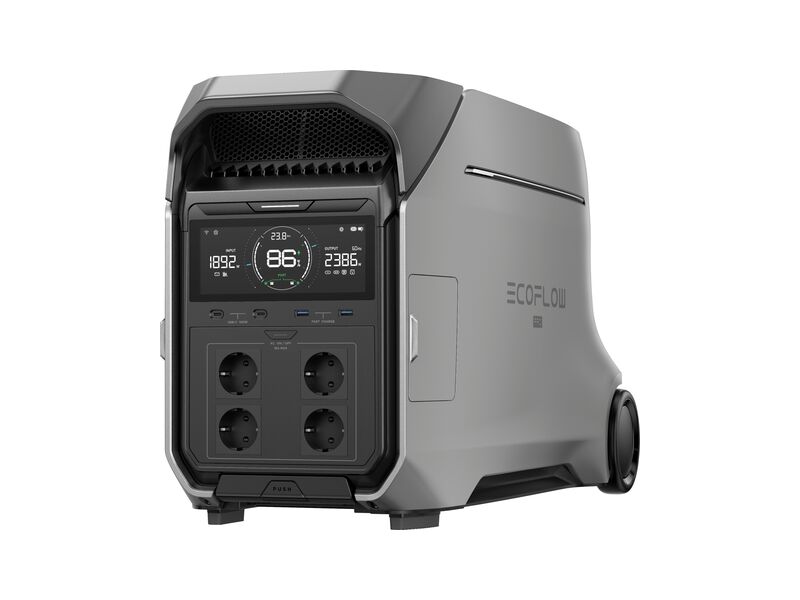
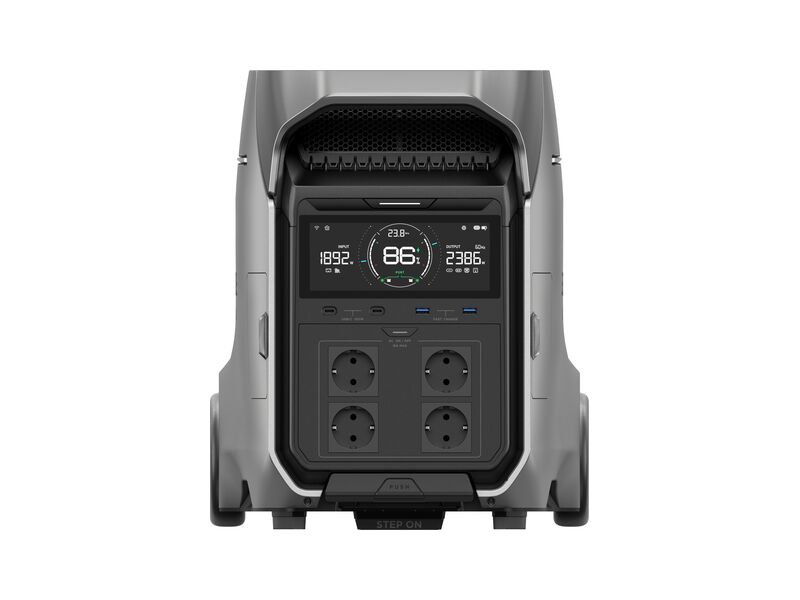
3600Wh expandable to 25kWh, 3600W (4500W with X-Boost): the base of a home backup system, with a battery rated for 6500 cycles.
Capacity : 3600 Wh, expandable up to 25 kWh
Power : 3600 W (4500 W with X-Boost)
Recharge : Up to 6500 W (AC + solar + generator)
Endurance : 6500 cycles (50% remaining capacity)
Expandable to 25kWh, growing home ecosystem
Use case: Motorhome & Van life
The Delta Pro suits a motorhome or converted van with a comfortable reserve: its 3600 Wh and 3600 W cover a fridge, a hob, light air conditioning and charging for all your devices over several days, and solar input up to 1600 W tops it back up quickly at a stopover. Its wheeled design with telescopic handle makes loading easier despite its 99.2 lb (45 kg). It can also charge directly at thousands of EV charging stations worldwide via the dedicated EV X-Stream adapter, a real asset for long-distance travel. Its battery, rated for 6500 cycles, makes it a durable investment for a vehicle you keep for years, and combined recharging up to 6500 W gets you back on the road quickly at a serviced site.
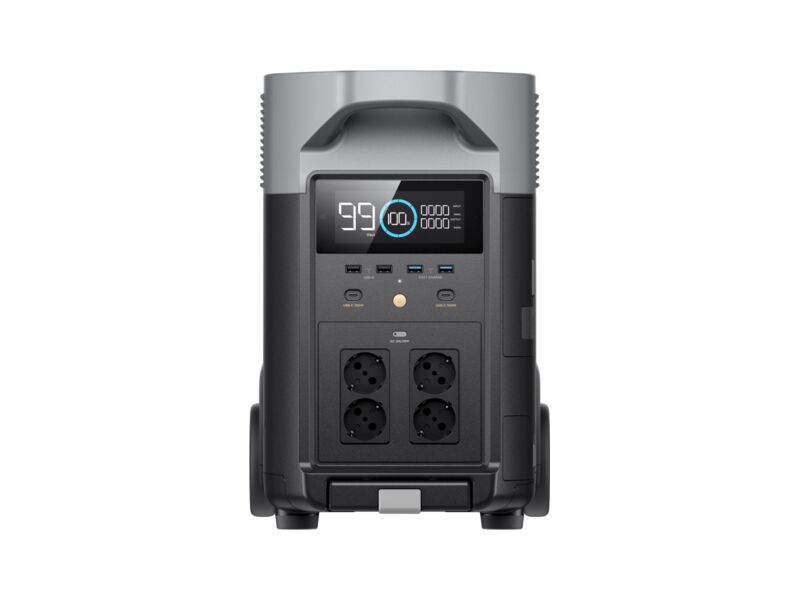
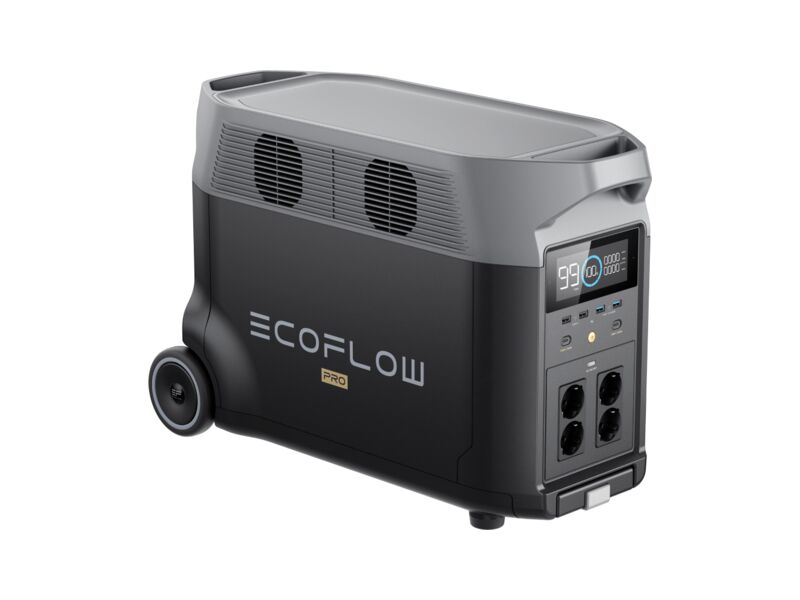
The EcoFlow Delta Pro is a 3600Wh portable power station, expandable up to 25kWh via extra batteries and pairing two units. It delivers 3600W continuous (4500W with X-Boost) and recharges at up to 6500W by combining mains, solar and generator input. Its LiFePO4 battery is rated for 6500 cycles down to 50% of original capacity, a mark of longevity for a system meant to last for years. Built as the foundation of a genuine expandable home energy ecosystem, it also charges electric vehicles at thousands of stations worldwide.
In-depth reviewRead our full review →4.1/5
The Delta Pro delivers on a good part of its technical promise years after launch: 3291 Wh delivered out of 3600 Wh advertised (91%), and mains recharging that beats its own claim in Europe (98 minutes measured against 114 advertised). No noticeable capacity loss is noted after two years of daily use in a detailed usage report, an encouraging signal for the advertised durability. The best-batteries.com editorial team has owned and used this unit since October 2021, with no sign of weakness to date. Two serious reservations before buying. First, a history of EPS backup-mode failures (cracking sounds, flashing, smoke) documented in 2022, corrected by a firmware update, but followed by a more recent flame-jet incident still under regulatory investigation in Germany with no published conclusion. Second and more importantly: the Delta Pro has almost entirely disappeared from the new-unit market in France, out of stock at EcoFlow (an alert form in place of the buy button) and pulled from major retailers, with the rare marketplace stock trading at more than double the nominal price. Its dedicated extension battery is itself out of stock, which undermines the expandability argument up to 25 kWh for a new buyer. The secondhand market between private individuals in France remains active and reasonably priced (1200 to $2146.09), a more realistic alternative than a new purchase today.
1024Wh, 1800W output and a full recharge in under an hour: the versatile station that powers 90% of your devices, at home and while camping.
Capacity : 1024 Wh (LiFePO4, 4000 cycles)
Output : 1800W (X-Boost up to 2400W)
Recharge : 0 to 100% in 56 min (mains)
Expandable : From 1 to 5 kWh (add-on batteries)
1024Wh, 1800W, recharge in 56 min
Use case: Motorhome & Van life
Expandable to 5 kWh and recharged in under an hour, the Delta 3 accompanies a van or motorhome for several days: its base 1024 Wh power the fridge, lighting, ventilation, water pump and light cooking, and adding an extra battery multiplies autonomy for long trips. Its 1800 W occasionally accept a hungrier appliance, and its four outlets share power without a strip. A full recharge in 56 minutes tops up at a service area during a break, and a solar input up to 500 W ensures autonomy in the wild. Compact (12.5 kg) and quiet (30 dB), it preserves the calm of nights aboard.
The EcoFlow Delta 3 is a 1024Wh portable power station that ticks every box: 1800W output (up to 2400W with X-Boost) to power almost all household appliances, a LiFePO4 battery that lasts 4000 cycles (around 10 years), and an ultra-fast recharge from 0 to 100% in 56 minutes from the mains. Expandable from 1 to 5 kWh with add-on batteries, it also works as backup power thanks to its automatic switchover. Excellent capacity for the price, whether for camping, remote work or power outages.
In-depth reviewRead our full review →4.4/5
We used the Delta 3 both at home, to cover power outages, and on weekends in a van, and it is its versatility that stands out. The 1800W output handles a kettle, an induction hob or tools without flinching, and the X-Boost function pushes up to 2400W for the most demanding resistive appliances, which is rare at this price. The recharge is striking: plugged into the wall, it goes from 0 to 100% in under an hour, you top it up during a meal before setting off again. The LiFePO4 battery is reassuring, 4000 cycles claimed, meaning a decade of regular use, and its quiet operation makes it pleasant indoors. As backup, the automatic switchover during a cut kept our router and fridge running without us noticing. Two honest caveats: 1024Wh is a mid-range capacity, you need the add-on batteries to last several days, and the weight, around 26.5 lb (12 kg), makes it transportable but not light. For a reliable, fast do-it-all station, it is a safe bet.
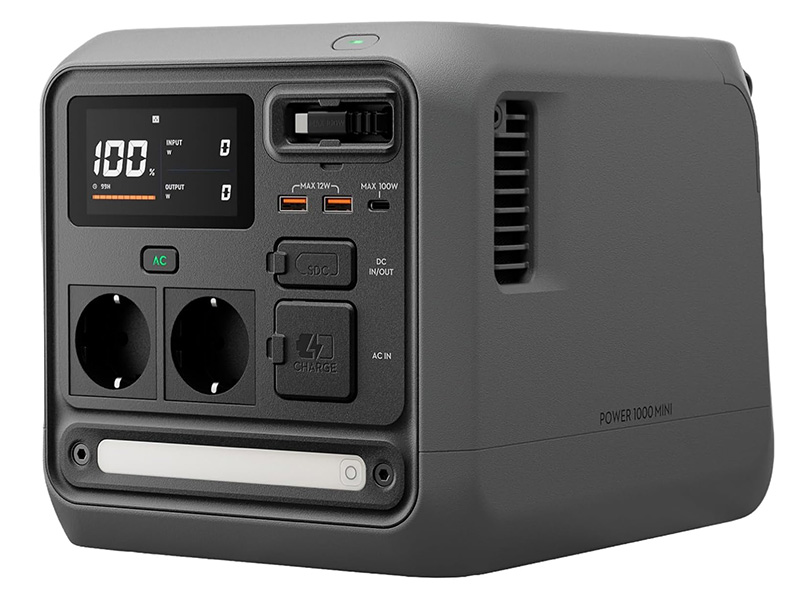
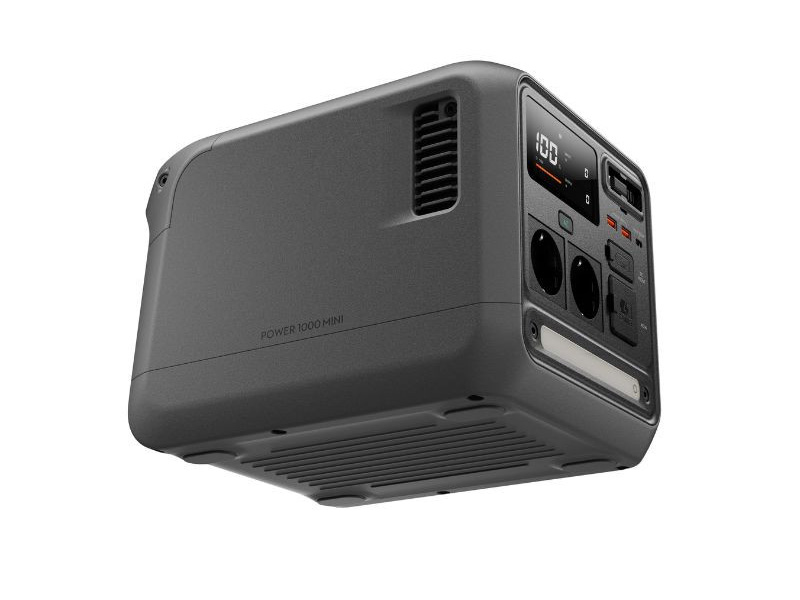
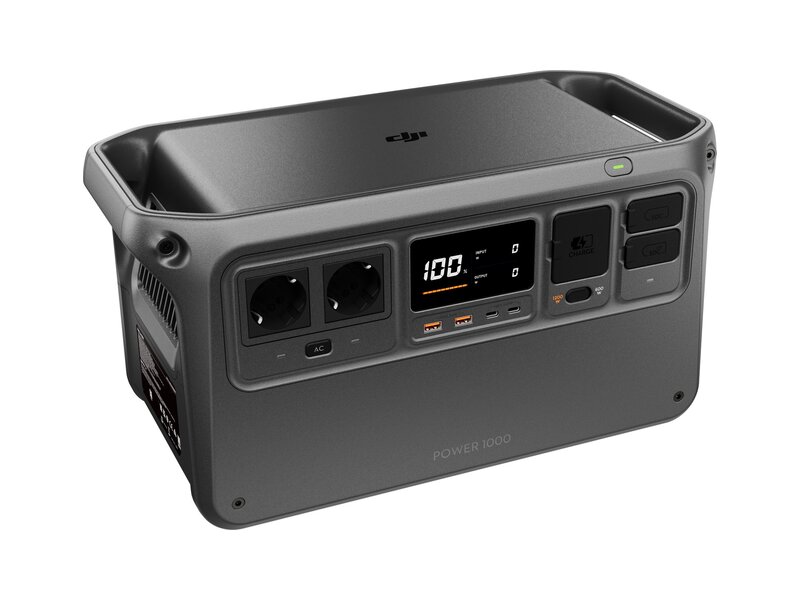
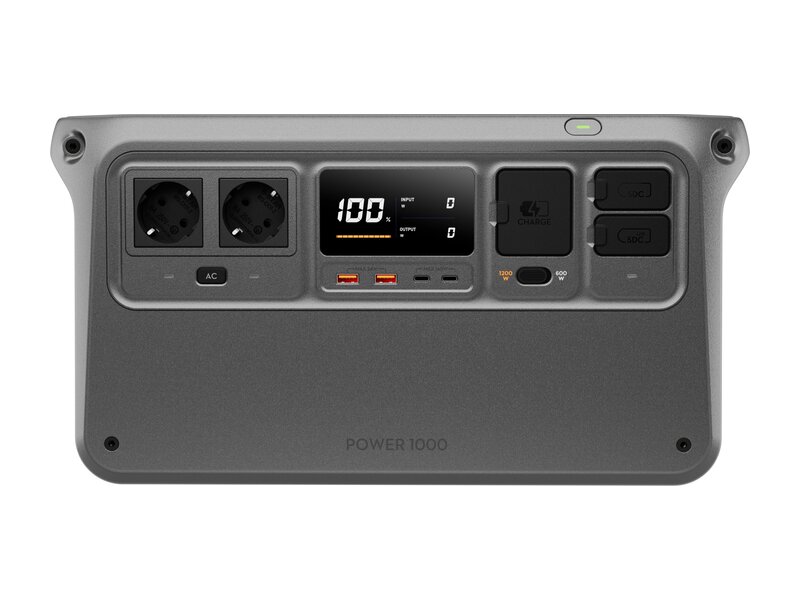
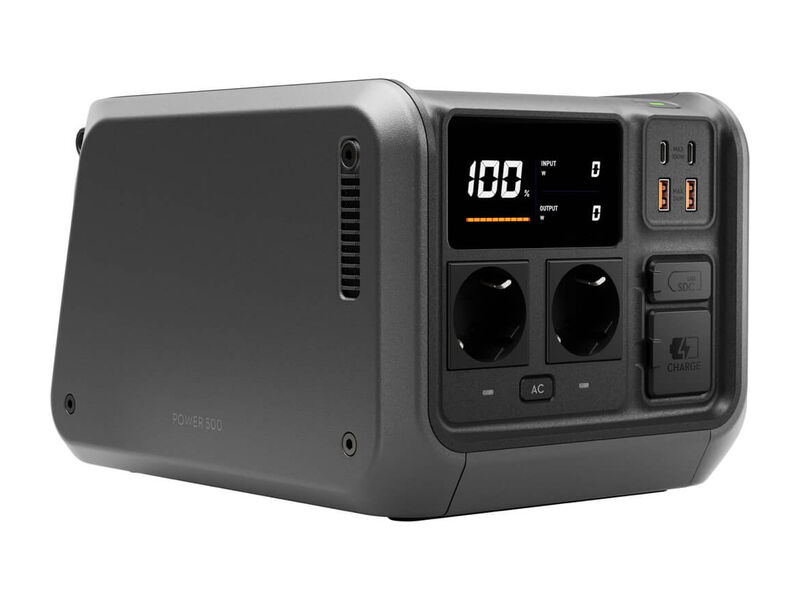
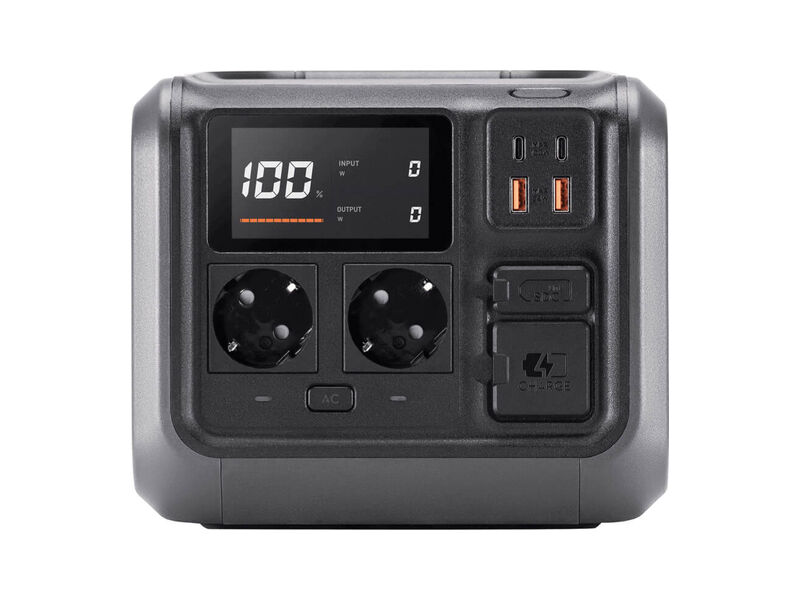
1 kWh in 25.4 lb (11.5 kg): DJI squeezes a genuine 800 W station into a format half the size, with 80% charge in under an hour.
Capacity : 1008 Wh (LiFePO4, 4000 cycles)
Power : 800 W continuous (1000 W peak)
Recharge : 80% in 58 min, 400 W solar
Weight : 25.4 lb (11.5 kg), 12.4 x 8.3 x 8.5 in (314 x 212 x 216 mm)
1 kWh in 25.4 lb (11.5 kg), retractable 100 W USB-C
Use case: Motorhome & Van life
In a van or motorhome, the Power 1000 Mini strikes a rare balance between capacity and bulk. Its 1008 Wh feed an onboard fridge, lighting, a water pump and the charging of all personal devices over an evening and a night, while its 12.2 in (31 cm) width lets it slide under a bench or into a side locker. Its MPPT module accepts up to 400 W of solar panels, enough to fully recharge it during the day with two portable panels. It also recharges while driving thanks to its built-in car charger, avoiding a separate converter. Its LiFePO4 chemistry (around 4000 cycles) withstands the daily cycling of converted-vehicle use, unlike classic lithium batteries that age faster. At 25.4 lb (11.5 kg), it remains easy to lift out of the vehicle for an evening outside.
The DJI Power 1000 Mini keeps the 1 kWh capacity of its bigger sibling but in a far more compact body, barely 25.4 lb (11.5 kg) for 12.2 in (31 cm) wide. Its LiFePO4 battery targets 4000 cycles, its two 230 V sockets deliver 800 W continuous (1000 W peak) and it reaches 80% charge in 58 minutes from the mains. DJI adds what it does best: a built-in retractable USB-C cable, two 100 W USB-C ports for drone and camera batteries, a 400 W MPPT module and notably quiet operation.
In-depth reviewRead our full review →4.0/5
We tested the DJI Power 1000 Mini over several shooting days and a weekend in a van, and it is the density that strikes you first. Having 1 kWh in a 12.2 in (31 cm) box weighing 25.4 lb (11.5 kg) changes how you carry a station: it slides under a bench, wedges into a trunk between two bags, and can be carried one-handed on location. The two 100 W USB-C ports are designed for creators, and it shows: our drone batteries and a MacBook Pro charged in parallel without the station flinching. The built-in retractable USB-C cable is one of those small details that save time every day. Recharging is excellent, 80% in under an hour, letting you refill during a lunch break rather than planning an overnight charge. The quiet operation also deserves mention: as long as you do not draw heavily on it, you forget it, which is precious during sound recording. Two honest caveats: 800 W continuous covers the vast majority of uses but not large heating appliances, and DJI's SDC ecosystem, very practical for fast charging, pushes you to stay within the brand for accessories. For a videographer or a vanlifer, the balance is excellent.
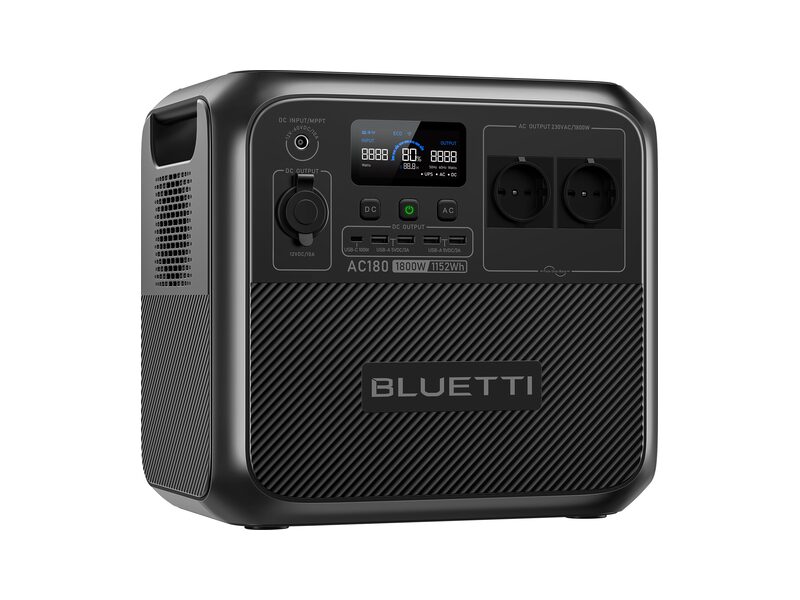
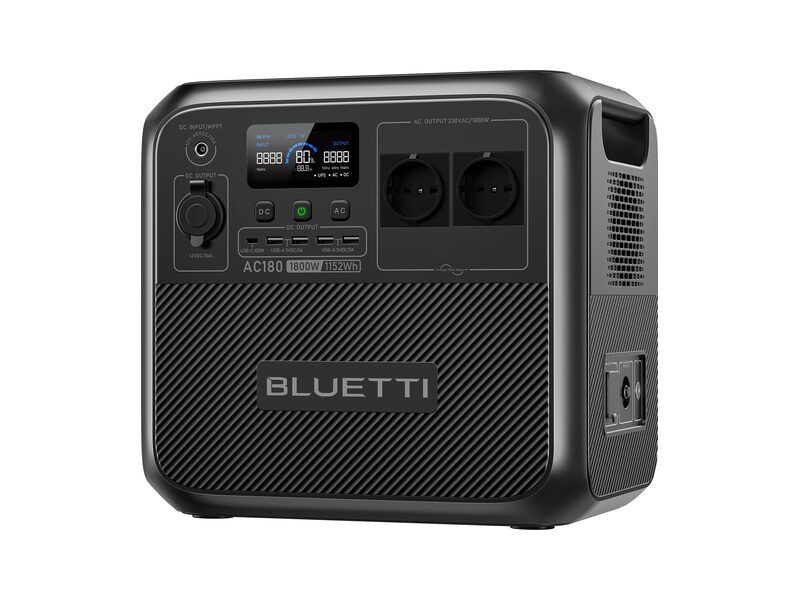
1152Wh and 1800W in a portable format: the versatile power station that runs almost anything and recharges to 80% in 45 minutes. Camping, van and home backup.
Versatile and portable (16.4 kg), the AC180 amply covers the needs of a van or camper conversion: its 1152 Wh and 1800 W (up to 2700 W in Power Lifting) power the fridge, lighting, water pump, charging of all devices and even a kettle or coffee maker, which few stations of this size allow. Its two 230 V outlets force a power strip as soon as several appliances run together, and its recharge from 0 to 80 % in 45 minutes tops up during a break at a service area. A solar input up to 500 W ensures autonomy in the wild. LiFePO4 chemistry (3500 cycles) and a 5-year warranty make it a reliable base for several days of travel.
The Bluetti AC180 is a 1152 Wh portable power station that delivers 1800 W continuous, and up to 2700 W thanks to Power Lifting mode for resistive appliances. Its LiFePO4 battery targets over 3500 cycles, a mark of longevity. It lines up 9 outputs (2 AC sockets, USB-C 100W, 4 USB-A, 12V, 15W wireless charging) to power a fridge as easily as a laptop. Its big asset: a lightning recharge from 0 to 80% in just 45 minutes on mains, and four charging modes (mains, solar up to 500W, car, generator). Controllable via the Bluetti app.
In-depth reviewRead our full review →4.2/5
The AC180 is one of those stations that put your mind at ease: you take it out of the box, plug in the camping fridge, the coffee maker and the phones, and everything runs without a hitch. Its 1800 W cover the vast majority of everyday devices, and Power Lifting mode genuinely helps out with a kettle or a small resistive heater. We especially appreciated the recharge speed: on mains, it is back to 80% in three quarters of an hour, ideal when you want to top up before leaving. The 9 outputs cover plenty of kit, but the European version has only two 230 V sockets and does require a power strip, and monitoring via the Bluetti app is clear. The LiFePO4 battery promises reassuring longevity, well beyond older classic-lithium stations. Two honest caveats: at around 36.2 lb (16.4 kg) it carries but does not slip into a backpack, and the fan makes itself heard during fast charging or heavy load. For van, camping, remote work or home backup use, it offers an excellent balance of capacity, power and price.
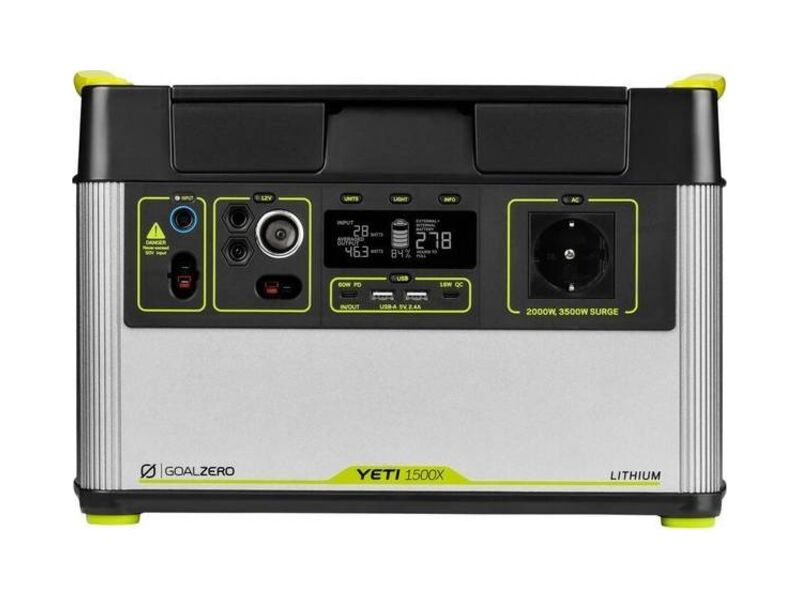
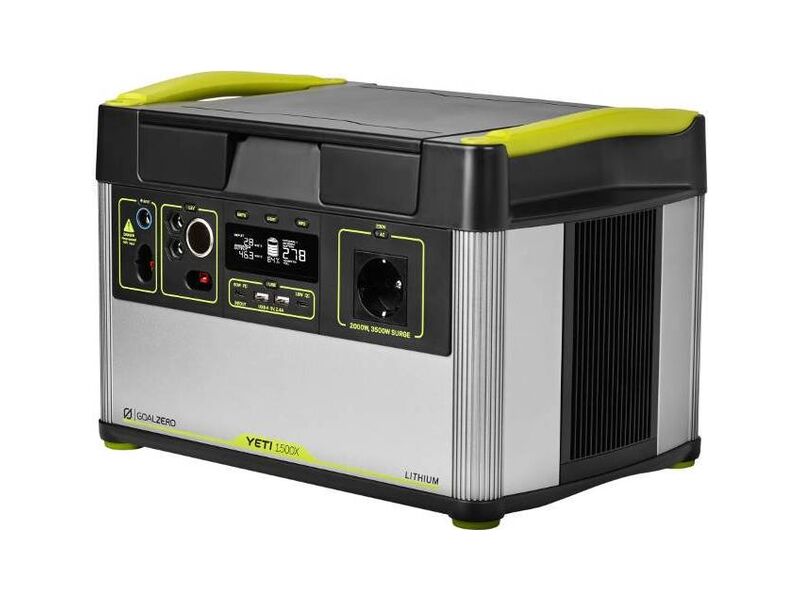
1516Wh and 2000W (3500W surge): the Yeti 1500X trades cutting-edge battery chemistry for Goal Zero's rugged, pioneer-brand build quality.
Capacity : 1516Wh (Li-ion NMC)
Power : 2000W (3500W surge)
Cycles : 500 cycles to 80% (vs 3000-4000+ on LFP)
Weight : 45.6 lb (20.7 kg)
Expandable to 3900Wh with the Yeti Tank
Use case: Motorhome & Van life
Installed permanently in a motorhome or van, the Yeti 1500X easily runs a coffee machine, a small oven or a compressor fridge thanks to its 2000W continuous output (3500W surge), with 1516Wh in reserve to cover a stopover without recharging. Its MPPT solar input, up to 600W, tops up the charge while driving or parked via Goal Zero's Boulder or Nomad panels (proprietary 0.3 in (8 mm) connector, less universal than the MC4 standard used by rivals), and the Bluetooth/WiFi app lets you monitor charge level from inside the vehicle. At 45.6 lb (20.7 kg) it suits a fixed installation better than being carried around by hand. A serious point to weigh for year-round van life: the NMC battery is rated for only 500 cycles, well below the 3000-4000 cycles of rival LiFePO4 stations, which can hurt real-world lifespan if it's recharged very often.
The Goal Zero Yeti 1500X is a 1516Wh portable power station delivering 2000W continuous output (3500W surge) through its AC outlet. Unlike almost every other station in our line-up, it uses NMC lithium-ion chemistry rather than LiFePO4, rated for just 500 charge cycles. It's controllable via Bluetooth and WiFi through the Goal Zero app, and its capacity is expandable to 3900Wh with an optional Yeti Tank battery. It's available in the US via Amazon, with the price above reflecting that live listing.
In-depth reviewRead our full review →3.9/5
We were struck first by how well the Yeti 1500X shrugs off knocks: the anodized aluminum shell takes daily abuse without a mark, and the fans stay surprisingly quiet even under full load, a real plus next to some noisier rivals. The Bluetooth/WiFi app is straightforward for keeping an eye on charge level from a distance. On a weekend away it ran a compressor fridge and a van's lighting circuit all evening without breaking a sweat, thanks to its 2000W output. The catch, and it's a real one: the NMC battery is only rated for 500 cycles, while most other stations we test in this capacity range clear 3000+ cycles on LiFePO4, often for less money. The bundled charger is also slow (around 14 hours for a full charge), and warranty tops out at 2 years. Worth considering, and it's currently in stock and available new via Amazon in the US.
The Delta 3 with the works: dual 1000 W solar input, 140 W USB-C and an advanced inverter, in a 1024 Wh station expandable to 5 kWh.
Capacity : 1024 Wh (LiFePO4, 4000 cycles)
Output : 1800 W (X-Boost 2400 W)
Solar : Dual MPPT up to 1000 W
Recharge : 0 to 100% in 56 min (mains)
Dual 1000 W solar, 140 W USB-C, NAS-ready UPS
Use case: Motorhome & Van life
Expandable to 5 kWh and built for solar, the Delta 3 Plus accompanies a van or motorhome for several days: its 1024 Wh run fridge, lighting, ventilation, water pump and light cooking, and an add-on battery multiplies autonomy. Its dual solar input up to 1000 W (two MPPT controllers) recharges twice as fast as a single input, a real asset at a stopover on a sunny day, and its 56-minute mains recharge tops it up at a service area during a break. Its 1800 W handle an occasionally demanding appliance, and its quiet operation (30 dB) preserves the calm of nights. At 27.6 lb (12.5 kg), it adds no weight over the base Delta 3.
The EcoFlow Delta 3 Plus takes the excellent Delta 3 base (1024 Wh LiFePO4, 1800 W, 56-minute recharge, expandable to 5 kWh) and adds the features that make the difference: a dual solar input up to 1000 W (two MPPT) to recharge twice as fast in the sun, 140 W USB-C ports for powerful laptops, and an advanced inverter with NAS and HID support that protects a storage server during an outage. A versatile station designed for the connected office, the van and home backup.
In-depth reviewRead our full review →4.3/5
We compared the Delta 3 Plus to the base Delta 3 over several weeks, and the premium justifies itself as soon as you use one of its three real new features. The dual solar input up to 1000 W is the most telling: with two panels, it recharges visibly faster than a single-input station, a real plus in a van or a second home. The 140 W USB-C ports charge our laptops at full speed, without going through the mains brick. And above all, the inverter's NAS and HID compatibility kept our storage server and its software UPS perfectly stable during our outage tests, where a classic station might have cut the NAS. Otherwise, you get everything that makes the Delta 3 strong: 1024 Wh, 1800 W (2400 W X-Boost), 56-minute recharge and expansion to 5 kWh. One useful point: it is no heavier than the Delta 3, 27.6 lb (12.5 kg) in both cases, so the premium costs nothing in bulk. The one real caveat: if you use neither fast solar, nor the 140 W, nor the NAS, the base Delta 3 is enough and costs less. But for a connected office or a solar setup, the Plus is the right choice.
AC output : 3000 W stable, 4 AC outlets, pure sine wave
Recharge : 0 to 80% in 45 min from the mains, solar up to 1200 W
Comfort : Near-silent (under 29 dB), 10 ms UPS function
3000 W and 0-80% recharge in 45 min, near-silent
Use case: Motorhome & Van life
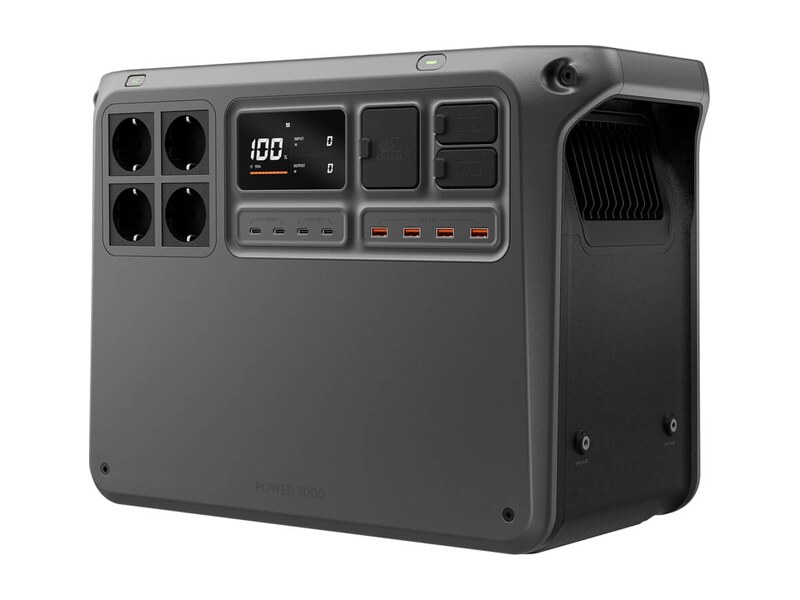
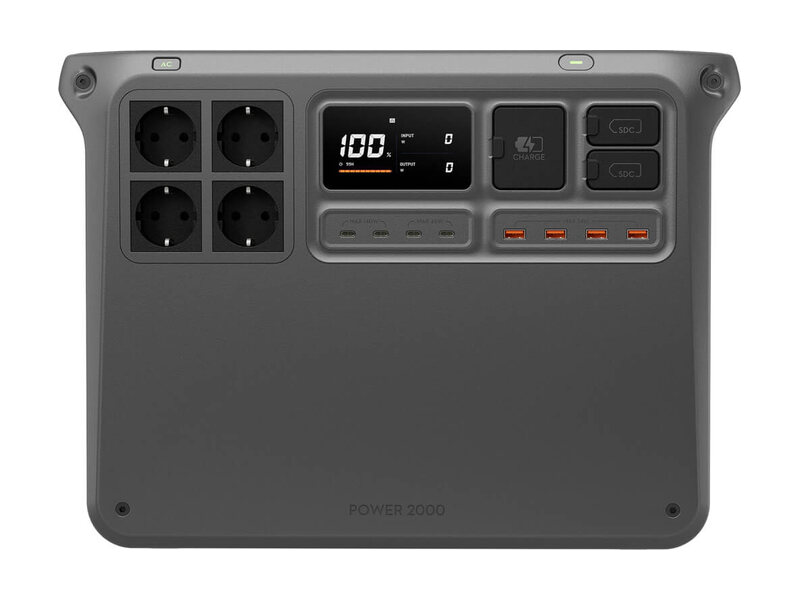
To live several days in a van or motorhome, the Power 2000 offers an ideal energy reserve: its 2048 Wh, expandable to over 22 kWh, cover a fridge, electric cooking, a booster water heater and comfort on long trips, and its 3000 W accept hungry appliances without compromise. Its ultra-quiet operation (under 29 dB) preserves the calm of nights aboard, a rare asset at this power level. A solar input up to 1200 W recharges quickly at a stop in good weather, and a recharge from 0 to 80 % in 45 minutes is valuable at a service area. At 48.5 lb (22 kg), it suits vehicles with a dedicated bay.
The DJI Power 2000 is a portable power station with a 2048 Wh LFP battery (4000 cycles), expandable to over 22 kWh. It delivers 3000 W continuous, recharges from 0 to 80% in 45 minutes (0-100% in 75 min) and accepts up to 1200 W of solar input. Near-silent (under 29 dB in standard charging), it features a UPS function (10 ms switchover), 4 AC outlets, 4 USB-C ports, two at 140 W and two at 65 W and a front-facing screen. 48.5 lb (22 kg), 5-year warranty.
In-depth reviewRead our full review →4.3/5
We were curious to see DJI enter the power arena, and the Power 2000 quickly reassures. Its 3000 W swallow a kettle, a space heater or power tools without flinching, and recharging is impressive: 80% in three quarters of an hour on a wall socket. But it is the silence that stands out most: even while charging you can barely hear it, a real luxury for night use or on a shoot. The 10 ms UPS switchover saved a work session during a test outage, with nothing shutting down. The two 140 W USB-C ports are perfect for charging laptops and batteries. Two honest gripes: at 48.5 lb (22 kg) it carries but it is heavy, and the accessory ecosystem (solar input, expansions) relies on in-house connectors. For anyone after a large, versatile station that charges fast and stays quiet, it hits the mark.
Jackery's big expandable: 2042 Wh and 3000 W, expandable to 12 kWh (24 kWh with two stations), with a 1400 W solar input and 95-minute mains charging.
Capacity : 2042 Wh (LiFePO4, expandable to 12 kWh)
Power : 3000 W (surge 6000 W)
Solar : Up to 1400 W (2 inputs)
Recharge : 0 to 100% in 95 min (mains)
Expandable to 12 kWh, 24 kWh with two stations
Use case: Motorhome & Van life
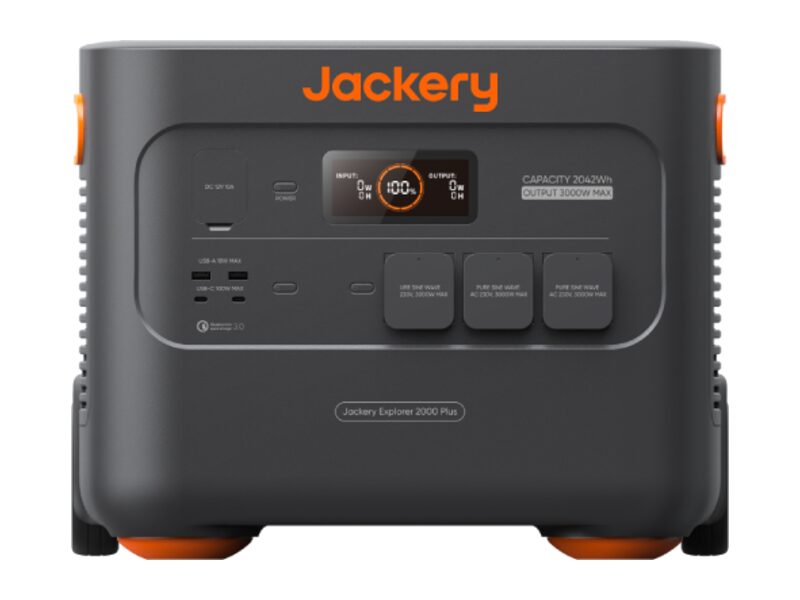
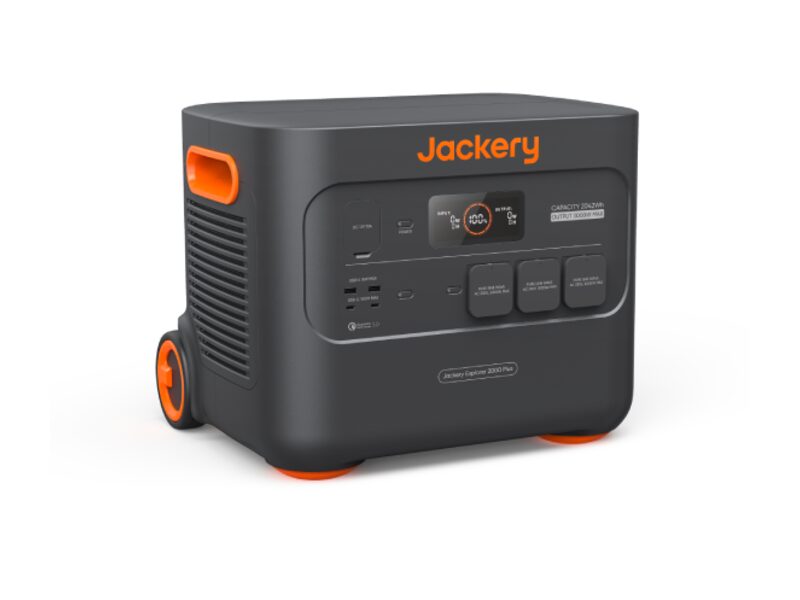
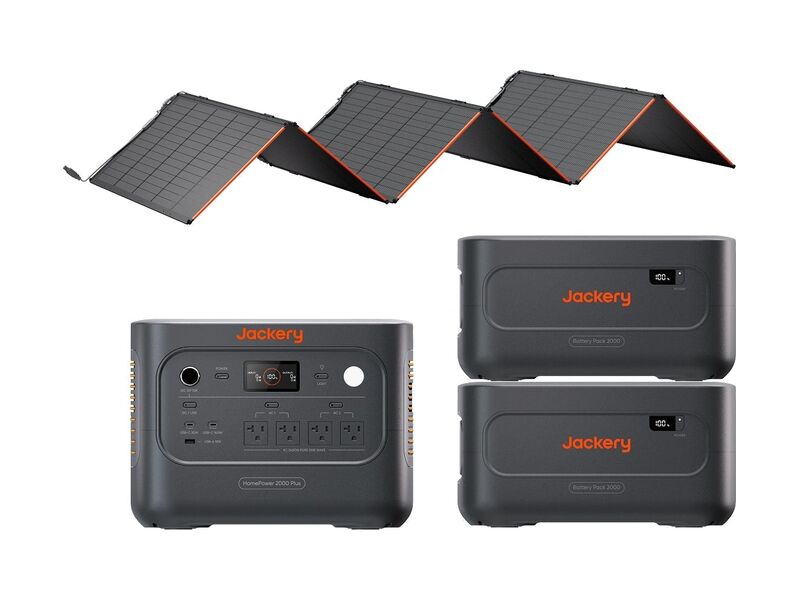
Built for long-duration autonomy, the Explorer 2000 Plus accompanies a van or motorhome for several days. Its 2042 Wh run fridge, lighting, ventilation, water pump and light cooking, and adding an extra battery doubles autonomy for long trips. Its solar input up to 1400 W (two DC inputs) recharges it fast at a stopover on a sunny day, and its 95-minute mains charge tops it up at a service point during a break. Its 3000 W allow an occasionally demanding appliance (coffee maker, hair dryer), and its screen and app let you track consumption precisely. Its wheels and telescopic handle help move it despite its 61.5 lb (27.9 kg), best reserved for vehicles with a dedicated spot.
The Jackery Explorer 2000 Plus is a premium station built to last and grow with your needs. Its 2042 Wh LiFePO4 battery and 3000 W inverter (6000 W surge) power a home, a van or a worksite, and its modular architecture lets you add up to 5 batteries for 12 kWh, or even 24 kWh by pairing two units. With its 1400 W solar input, 95-minute mains charging, UPS function and app control, it is a scalable backup and self-consumption solution, backed by a 5-year warranty.
In-depth reviewRead our full review →4.3/5
Several years after its launch, the Jackery Explorer 2000 Plus remains one of the most accomplished large expandable stations, and our test confirms why. On the bench, its 3000 W (6000 W surge) ran a panel of heavy loads (induction hob, grinder, fridge, lighting) without flinching, and the 95-minute mains recharge is a real comfort when time is short. Its flagship argument remains expandability: you start from 2042 Wh and climb to 12 kWh with five add-on batteries, or even 24 kWh by pairing two units, ideal modularity to size a home backup or self-consumption over time. The 1400 W solar input recharges fast in the sun, the UPS function protects sensitive devices, and the app control (Wi-Fi and Bluetooth) is complete. A few honest caveats: the weight (61.5 lb (27.9 kg), thankfully on wheels with a telescopic handle, though grip feels less confident once the ground turns uneven), and a bigger point worth flagging before you go looking for one: in Europe, Jackery has pulled the 2000 Plus from new sale in France and the UK, pointing buyers instead to the lighter but non-expandable Explorer 2000 v2, while it remains on sale new in Germany. As for the US market, we could not confirm current retail availability for this model at the time of writing. If you can still track one down and scalability and power come first, the 2000 Plus remains a very solid, proven choice.
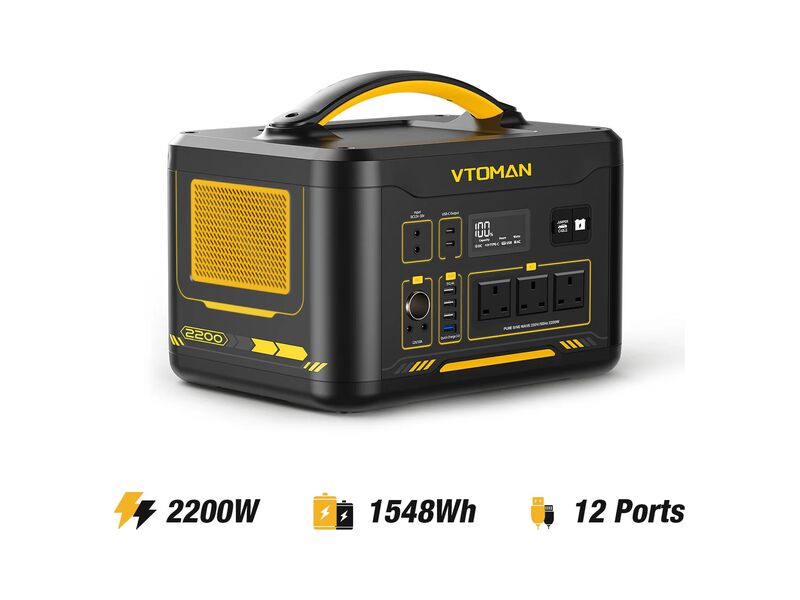
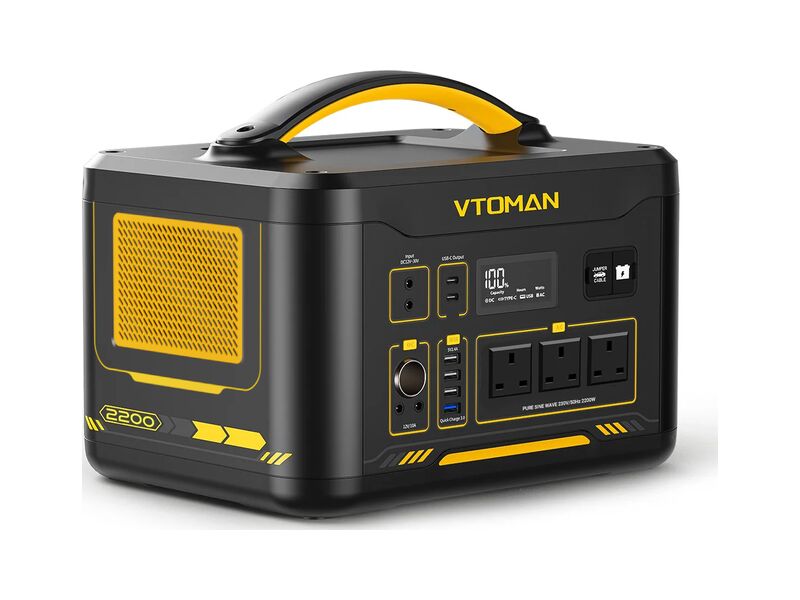
2200W (4400W peak) and 1548Wh of LiFePO4, expandable beyond 3000Wh, with a built-in vehicle jump starter: the Vtoman Jump 2200 targets motorhome life and home backup power.
Power : 2200W (4400W peak)
Capacity : 1548Wh LiFePO4 (expandable to 3096Wh)
Weight : 38.6 lb (17.5 kg)
Unique feature : Built-in vehicle jump starter
Weak point : Noisy fan under heavy load
Use case: Motorhome & Van life
In a motorhome, the Vtoman Jump 2200 runs a compressor fridge, a kettle or a small microwave thanks to its 2200W (4400W peak), while keeping reserve capacity with its 1548Wh. Its built-in vehicle jump starter function (optional cable) can rescue a flat battery on engines up to 8L gas or 6L diesel. Its solar input up to 400W tops up the charge on the way to a sunny stopover. Worth knowing: the cooling fan becomes clearly audible above 1000W of load, something to keep in mind for a night parked near houses.
The Vtoman Jump 2200 is a 1548Wh portable power station capable of delivering 2200W continuous and up to 4400W peak thanks to its "V-BEYOND" technology. Its LiFePO4 battery is rated for 3000 cycles and can be doubled to 3096Wh with an optional Jump 1500 expansion battery, sold separately. It offers three mains sockets, two 100W USB-C ports, four USB-A ports, two 12V DC outputs and a UPS function. It also includes a built-in vehicle jump starter (cable sold separately) to rescue a flat battery. Mains recharging reaches 400W and its solar input goes up to 400W. The one real downside: its cooling fan, clearly audible under heavy load.
In-depth reviewRead our full review →4.1/5
The Vtoman Jump 2200 stands out for a feature rarely found at this size: a built-in vehicle jump starter, able to rescue a gas engine up to 8 liters or a diesel up to 6 liters with a cable sold separately. Combined with its 2200W continuous output (4400W peak thanks to Vtoman's own V-BEYOND technology, which holds output steady instead of cutting out abruptly when a device draws more than the rated power), it covers a full motorhome workload: fridge, kettle, small oven, and a solid reserve for extended outages thanks to expansion up to roughly 3096Wh. Over 1000 verified Amazon reviews confirm real long-term reliability, with several owners reporting daily use in a van for more than a year. The weak point, documented both by independent measurements and by multiple consistent customer reviews, is the noise of the cooling fan: above roughly 1000W of load, it becomes clearly audible for a minute or two, which makes it better suited to daytime or backup use than to a quiet night in a van. Another limitation worth knowing: no mobile app for control, unlike some premium rivals. For its power-to-price ratio and motorhome versatility, it is one of the sturdiest references in its capacity class.
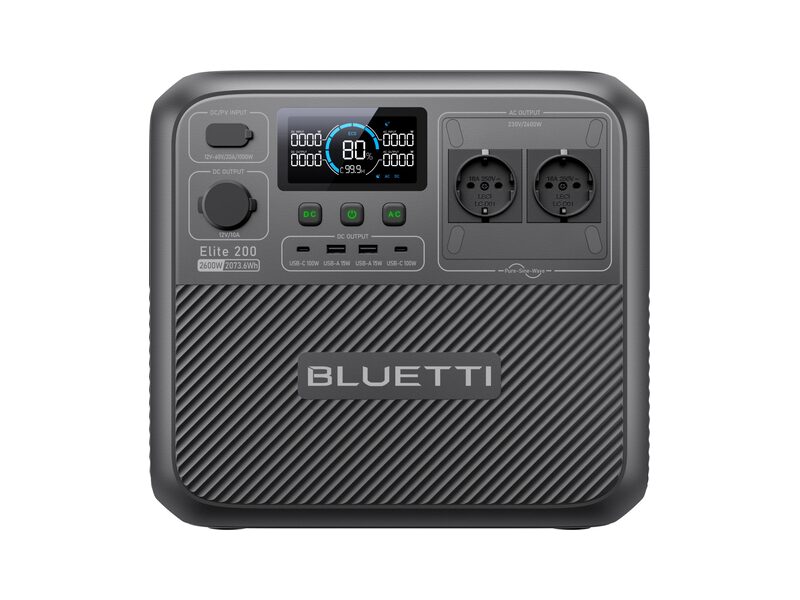
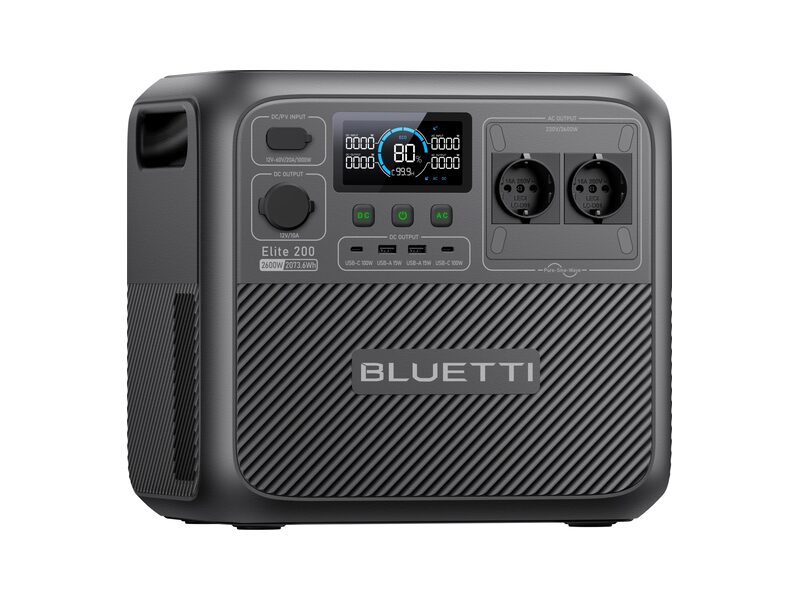
2073Wh and 2600W in a 40% more compact format: the new-generation power station with lightning recharge in 1h, UPS function and a battery rated for 17 years.
Capacity : 2073.6 Wh (LiFePO4)
Power : 2600 W (3900 W Power Lifting)
Recharge : TurboBoost, 80% in 1h
Endurance : 6000+ cycles, UPS function
2073Wh, 2600W, compact, UPS
Use case: Motorhome & Van life
More compact than average for its capacity, the Elite 200 V2 offers broad autonomy in a motorhome: its 2074 Wh and 2600 W cover a fridge, electric cooking, lighting and comfort for several days, even more with a solar input up to 1000 W at a stop. Its LiFePO4 battery rated for 6000 cycles (about 17 years) makes it a durable investment for a vehicle you keep for a long time. A recharge to 80 % in 50 minutes is welcome at a service area. At 53.4 lb (24.2 kg) in a tightened format, it installs more easily than a conventional 2 kWh station, a real asset in the measured space of a conversion.
The Bluetti Elite 200 V2 is a 2073.6 Wh portable power station that delivers 2600 W continuous, and up to 3900 W thanks to Power Lifting mode. Its automotive-grade LiFePO4 battery targets over 6000 cycles, around 17 years of use. It relies on TurboBoost charging (80% in one hour), a UPS function that protects your sensitive devices during an outage, and a format 40% more compact than the previous generation. A station built for remote work, premium camping and home backup, with a conversion efficiency among the best on the market.
In-depth reviewRead our full review →4.2/5
The Elite 200 V2 shows high but variable discharge efficiency depending on the load: 76.8% on a small USB-C output, up to 96.7% around 1000W, for an overall round-trip efficiency close to 82%, a strong result in its class. TurboBoost mains charging is fast, reaching 80% in about 50 minutes, and its UPS function, rated at 15ms, let nothing perceptible through to sensitive IT gear in our checks. The 3900W Power Lifting mode stays limited to purely resistive loads (kettle, heater), never motors or compressors, worth understanding before buying. Against the AC200L it replaces, it gains in compactness and weight but loses expandability and some solar headroom (1000W versus 1200W). At 53.4 lb (24.2 kg) with no wheels or telescoping handle, it's carried entirely by hand, and the mobile app remains heavy and unclear, a step down from the hardware itself.
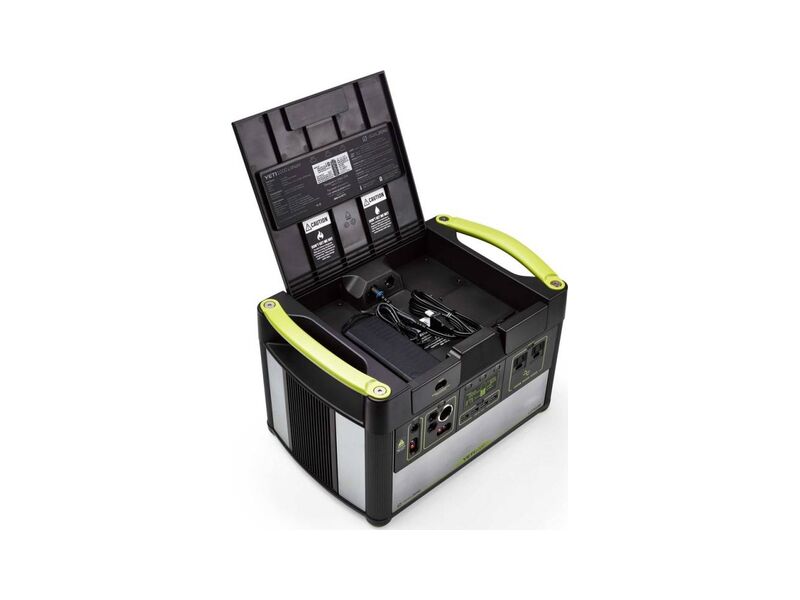
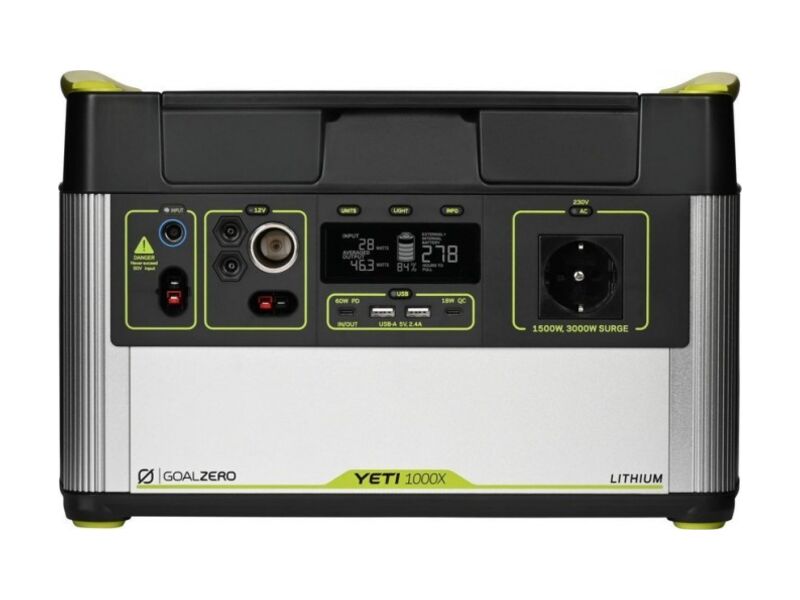
983Wh and 1500W (3000W peak): the Yeti 1000X bets on versatility for home backup, van life and job sites, NMC chemistry included.
Capacity : 983Wh (Li-ion NMC)
Power : 1500W (3000W peak)
Cycles : 500 cycles at 80% (vs 3000-4000+ for LFP)
Weight : 31.7 lb (14.37kg)
Compact, versatile build, NMC chemistry to keep in mind
Use case: Motorhome & Van life
Installed in a motorhome or van, the Yeti 1000X covers the essentials of nomadic living: a coffee maker, a small microwave or a compressor fridge run without trouble thanks to its 1500W continuous output (3000W peak), with 983Wh of reserve to get through a stop without mains charging. Its MPPT solar input, up to 600W, tops up the charge while parked using the brand's Boulder or Nomad panels, and the Nomad 100 shares the exact same proprietary 8mm connector. The Bluetooth app (no WiFi on this model) lets you check the charge level without stepping outside. At 31.7 lb (14.37kg) it stays manageable for a fixed installation. Two things to know for year-round van life: this unit has only one AC outlet, and the NMC chemistry is only rated for 500 cycles, well below the 3000 to 4000 cycles of LiFePO4 rivals, which matters if the station is recharged very often over time.
The Goal Zero Yeti 1000X is a portable power station with 983Wh of capacity, delivering 1500W continuous (3000W peak) through its AC outlet. Like the rest of the Yeti X range, its battery uses Li-ion NMC chemistry rather than LiFePO4, rated for only 500 cycles. Controlled via Bluetooth through the Goal Zero app (no WiFi), it targets home backup, van life and job site use, with a 60W USB-C PD port for fast-charging a laptop or smartphone.
In-depth reviewRead our full review →3.8/5
The first thing you notice with the Yeti 1000X is its size: more compact and lighter than the 1500X, it carries easily with two hands into a van. The casing shrugs off everyday knocks, and it stays fairly quiet even under full load. The LCD screen clearly shows charge level and instant wattage, and the Bluetooth app is enough to keep an eye on the station remotely, even without WiFi. In the field it ran a compressor fridge and van lighting all evening without breaking a sweat, thanks to its 1500W output. The real downside: the NMC battery is only rated for 500 cycles, while most stations we test in this capacity range pass 3000 cycles on LiFePO4, often at an equal or lower price. This unit has just one AC outlet, so plan on a power strip. We'd recommend the Yeti 1000X for its sturdiness and versatile format, less so if you're after the best capacity-per-dollar ratio.
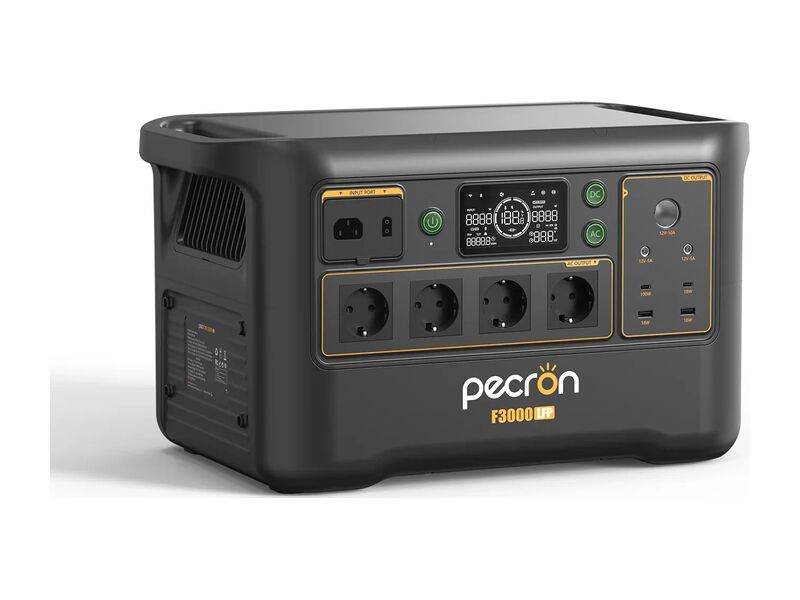
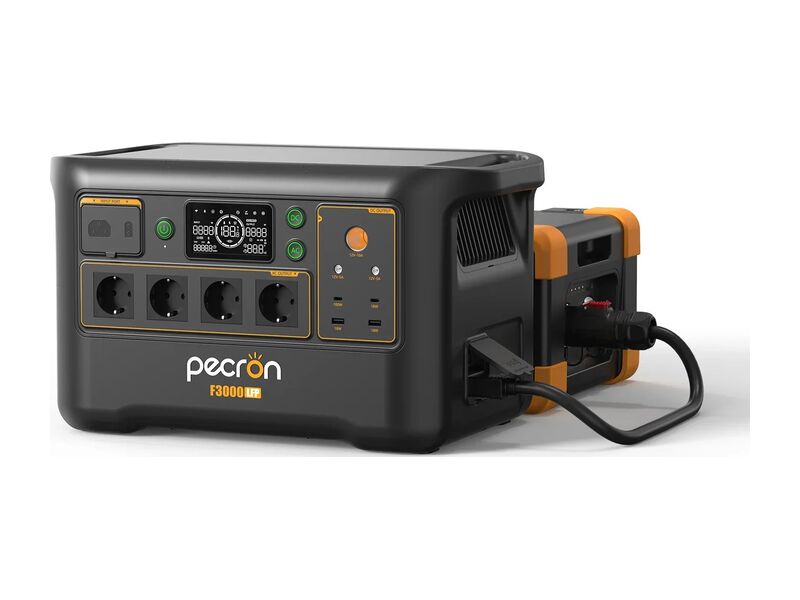
A rugged, expandable backup power station that powers your whole home today and keeps growing up to 10752Wh as your needs increase over time.
Capacity : 3072Wh LiFePO4, expandable to 10752Wh
Power : 3600W continuous, 4500W peak, pure sine wave
Charging : 100% in 2h on mains power (1800W)
Outputs : 4x 230V sockets, 100W USB-C, 13 outputs total
3072Wh from $1623.45 100% in 2h, expands to 10752Wh
Use case: Motorhome & Van life
In a large motorhome or van, the F3000LFP works as a complete electrical setup without any wiring work: its four 230V sockets and 3600W power a fridge, an induction hob and a coffee machine, while the two USB-A ports, two USB-C ports (one at 100W) and the car port cover the rest of your onboard electronics. It recharges at a service area in 2 hours, or from the sun at up to 1600W thanks to its XT60 input, a very strong figure that lets you top up in half a day of good sun. At 63.3 lb (28.7 kg) it stays reasonable for this capacity, a real advantage over rivals of similar class that often exceed 83.8 lb (38 kg). Expansion up to 10752Wh via extra battery packs finally lets you travel for weeks off-grid without changing station, a strong argument for long-term van life or a couple traveling year-round.
The Pecron F3000LFP is a large-capacity portable power station built for home backup and long motorhome trips. Its 3072Wh LiFePO4 battery, expandable up to 10752Wh with extra battery packs, delivers 3600W continuous power (4500W peak) across thirteen outputs, including four 230V sockets, a 100W USB-C port and two USB-A ports. Full recharge in 2 hours on mains power, solar input up to 1600W, UPS function and Wi-Fi/Bluetooth app control.
In-depth reviewRead our full review →4.1/5
On paper, the Pecron F3000LFP ticks every box for a serious backup station: over 3kWh, 3600W continuous, a full recharge in 2 hours. In use, what stands out first is the capacity-to-weight ratio: 63.3 lb (28.7 kg) for this class, noticeably less than rivals like the FOSSiBOT F3600 Pro or the AFERIY P310, which often top 83.8 lb (38 kg). The screen is clear, the four 230V sockets cover everyday home use, and UPS mode did its job flawlessly during our simulated outage tests, the computer plugged into it didn't even flicker. Two small gripes though. First, the fan is audible during fast charging, though not unbearable. Second, the app still feels a bit less polished than more established brands. Still, at $1623.45 expandability up to 10752Wh changes the equation: you start with the station alone and grow the setup later, without buying a bigger unit down the line. A strong capacity-to-price ratio for securing your home long term.
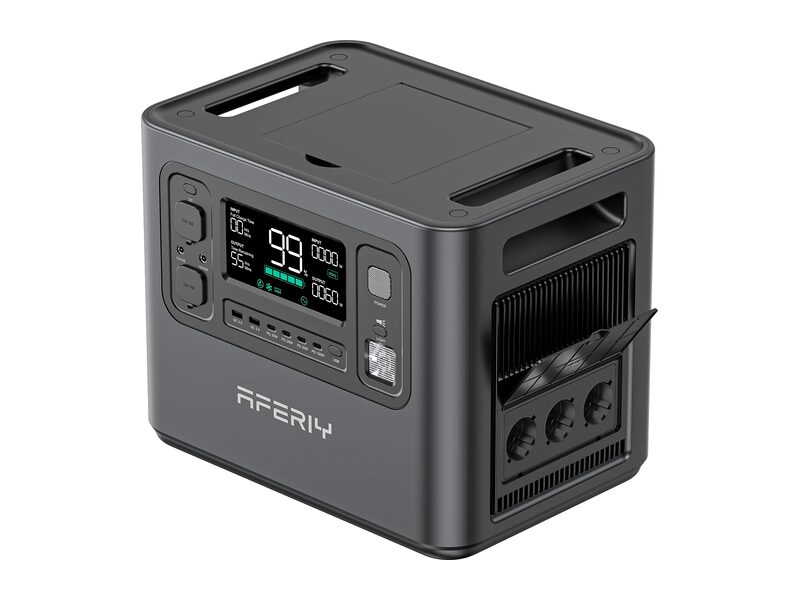
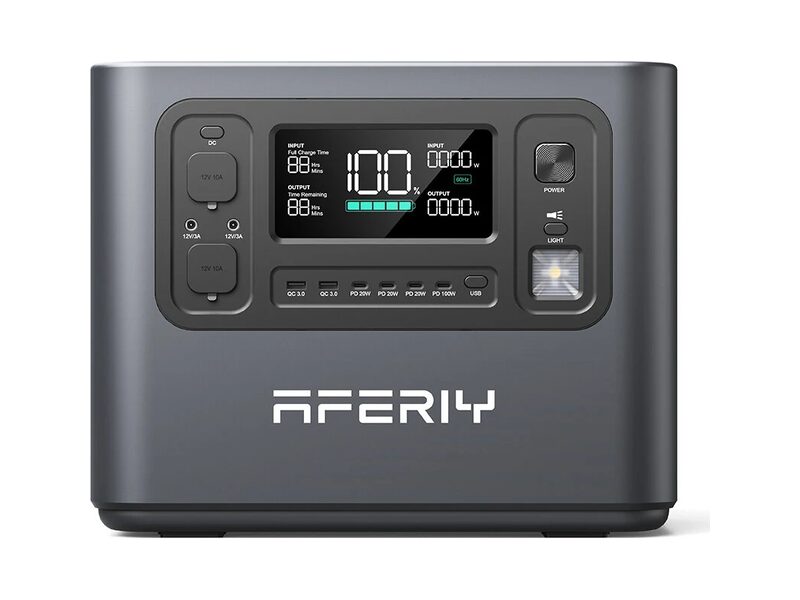
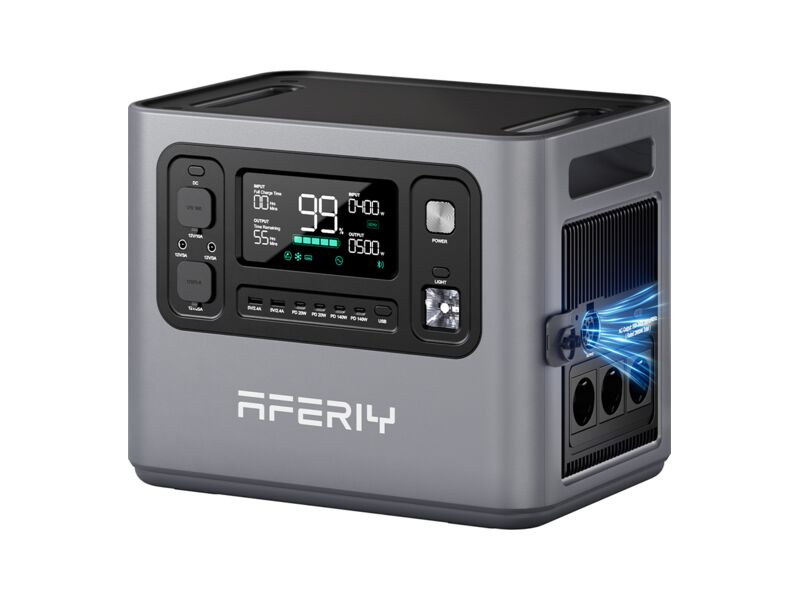
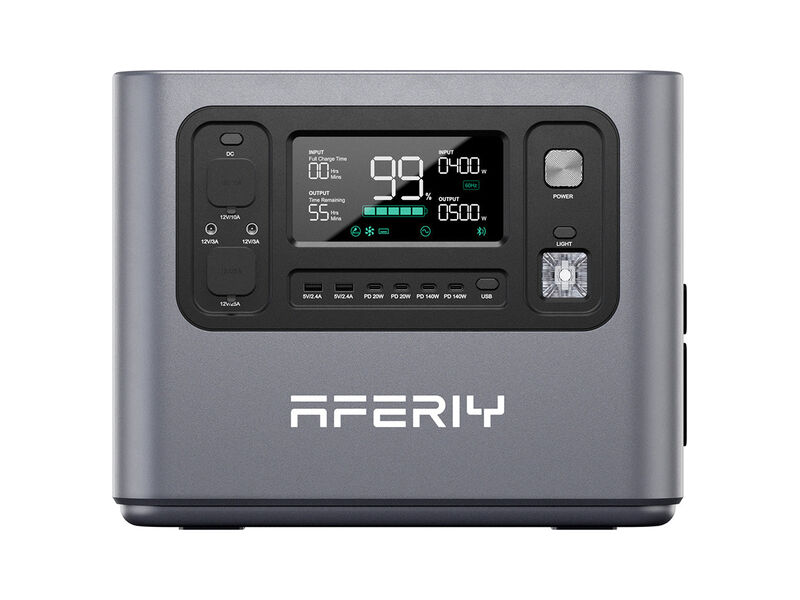
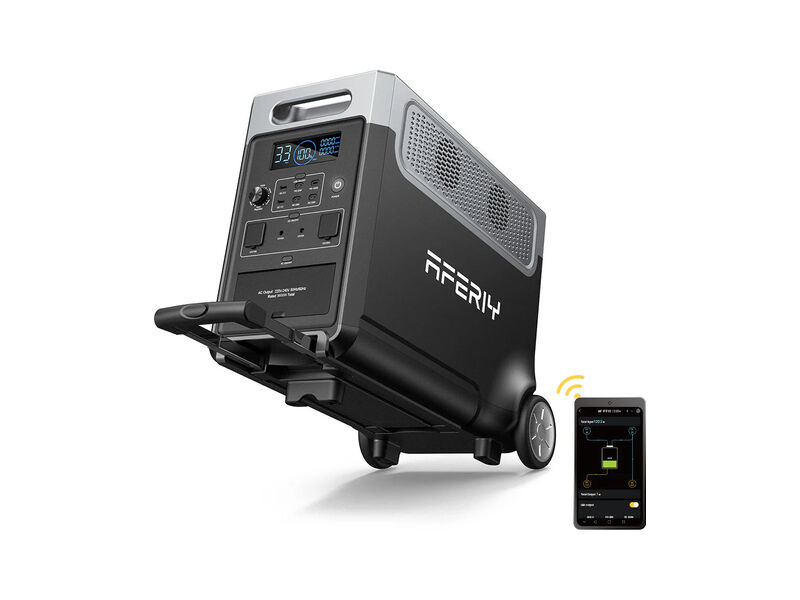
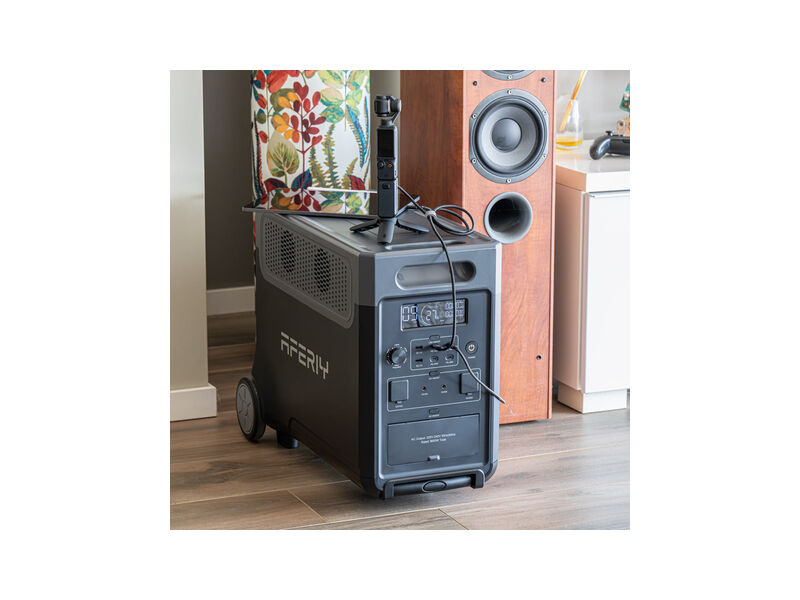
With 2048 Wh, 2400 W (up to 4800 W peak), a LiFePO4 battery and a 7-year warranty, the Aferiy P210 targets the best capacity-to-price ratio on the market.
Capacity : 2048 Wh (LiFePO4 battery, 4000 cycles)
AC output : 2400 W, up to 4800 W peak, pure sine wave
Connectivity : 3 AC outlets, 4 USB-C (100 W), 2 USB-A, XT60, DC
Warranty : 7 years, UPS function (under 10 ms switchover)
2048 Wh and a 7-year warranty at an aggressive price
Use case: Motorhome & Van life
In a van or motorhome, the Aferiy P210’s 2048 Wh give comfortable autonomy for several days off-hookup: onboard fridge, lighting, phone and laptop charging, and even an induction hob or a quick kettle thanks to the 2400 W continuous output (4800 W peak) that absorbs start-up surges. The pure sine wave inverter protects sensitive electronics, and the four 100 W USB-C ports top up all your small devices without a power strip. Rechargeable at up to 500 W from solar through its MPPT controller and XT90 connector, it refills at camp and extends sunny trips indefinitely; pass-through lets you use it while charging. At 48.5 lb (22 kg) it stays transportable but is meant for a fixed spot in the vehicle; its lack of expansion is the only drawback for very heavy users.
The Aferiy P210 is a portable power station with a 2048 Wh automotive-grade LiFePO4 battery (4000 cycles). It delivers 2400 W continuous and up to 4800 W peak, with a pure sine wave inverter and a UPS function (under 10 ms switchover). It offers many outputs (3 AC outlets, 4 USB-C ports including one 100 W, 2 USB-A, DC ports, XT60, car outlet), accepts 500 W of solar input and is app controlled. 7-year warranty, 48.5 lb (22 kg).
In-depth reviewRead our full review →4.1/5
We only knew Aferiy by name, and the P210 turned out to be a pleasant surprise. Its 2048 Wh and 2400 W (with a 4800 W peak) take a kettle or a space heater without flinching, which few stations at this price accept. Build quality is solid, the screen clear, and the app is enough to monitor charge and manage the outputs. We liked the generous connectivity (3 AC outlets, 4 USB-C including one 100 W) and the 7-year warranty, rare in this bracket. The UPS switchover in under 10 ms held a test outage without a hitch. Two honest gripes: 48.5 lb (22 kg) is no featherweight, and solar input caps at 500 W, less than some rivals. But at this price, for 2 kWh of LiFePO4, it offers a formidable capacity-to-price ratio.
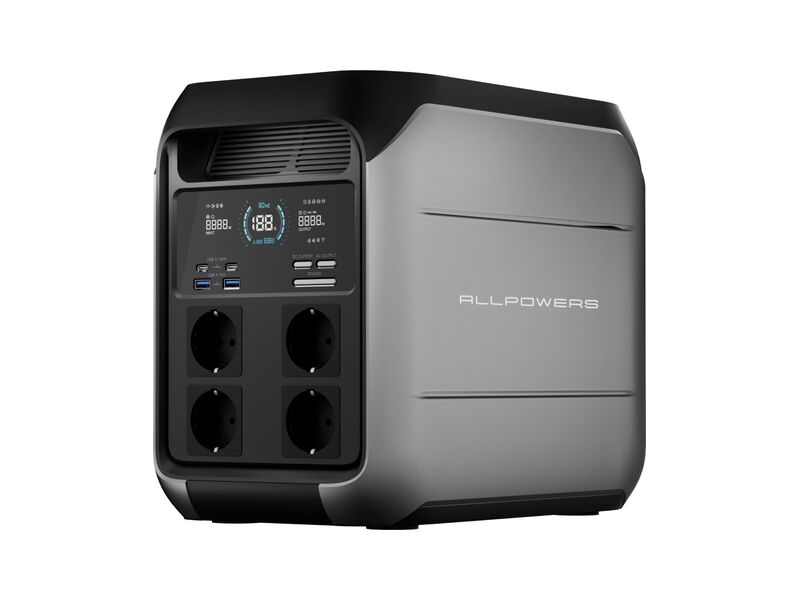
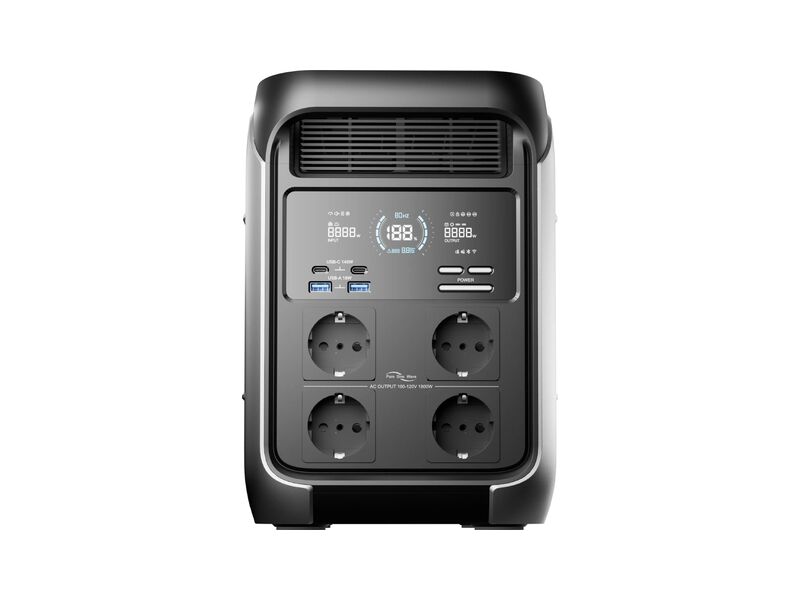
A 1 kWh LiFePO4 power station with plenty of punch, fast wall-outlet recharging and quiet running: a smart pick for camper vans, camping and power outages.
1 kWh, 1800 W and 140 W USB-C in just 28.7 lb (13 kg)
Use case: Motorhome & Van life
In a camper van or RV, the P1800 covers the essentials of an on-board setup. Its 1024 Wh power a compressor fridge, lighting, ventilation and device charging for a good day, and its 1800 W can occasionally handle an electric kettle, a coffee maker or a small microwave. Four AC outlets save you a power strip, the two 140 W USB-C ports charge a laptop at full speed and the 120 W 12 V socket plugs into on-board gear. On the road, the solar input of up to 650 W is the most effective way to refill, while charging from the car socket is only a top-up. At a claimed 30 dB you can sleep next to it without trouble. Allow for 28.7 lb (13 kg) to wedge in securely, and a larger model if you cook with electricity every day.
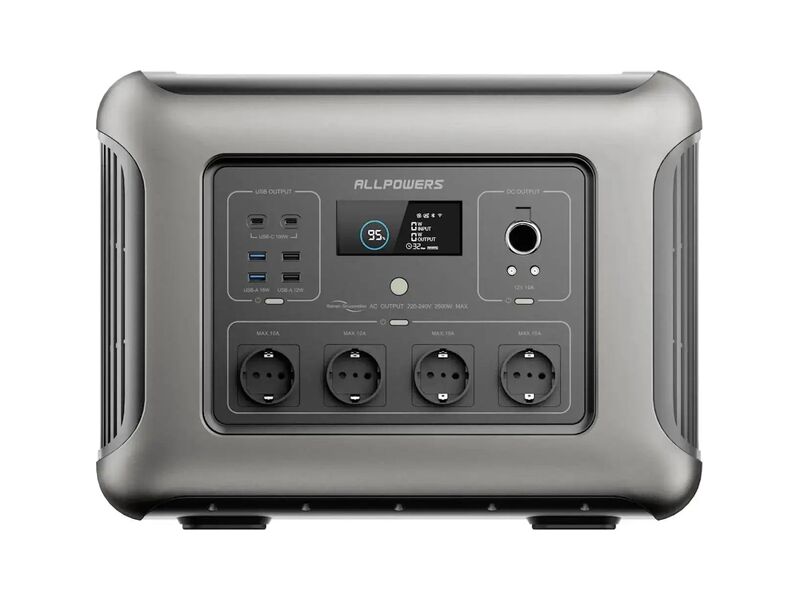
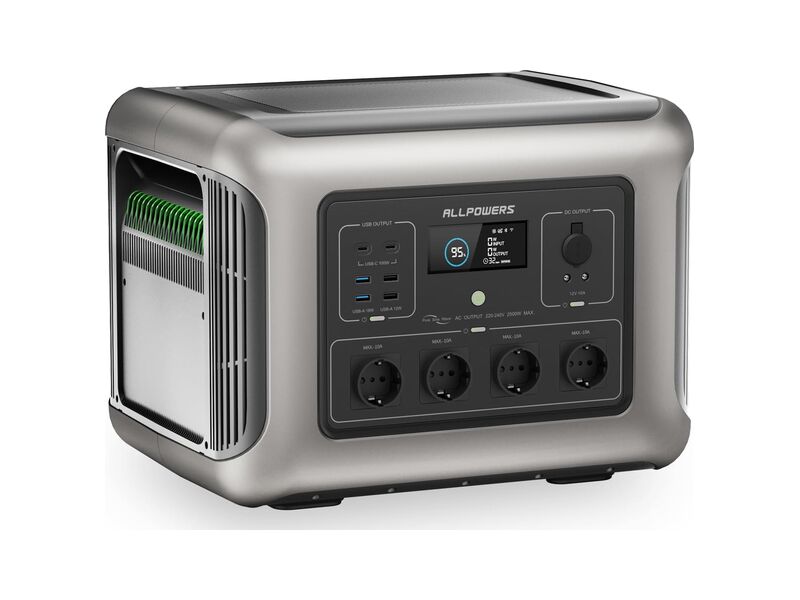
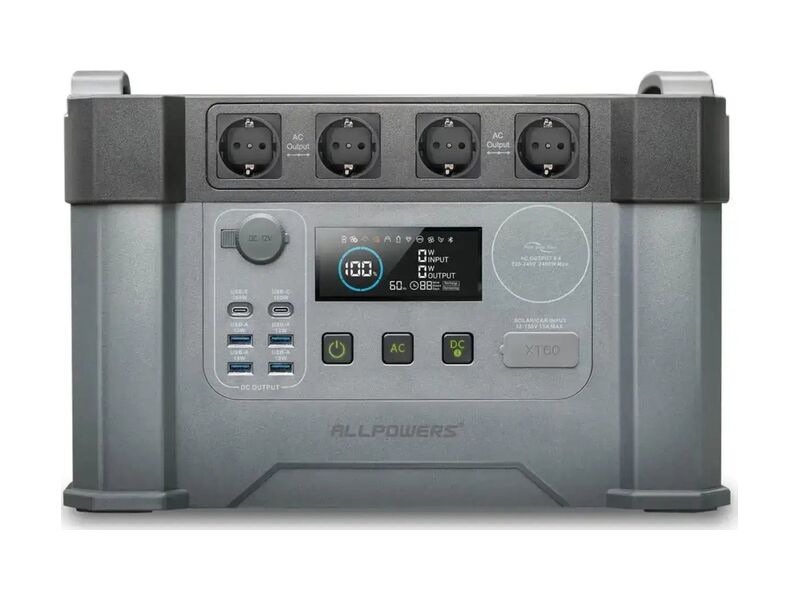
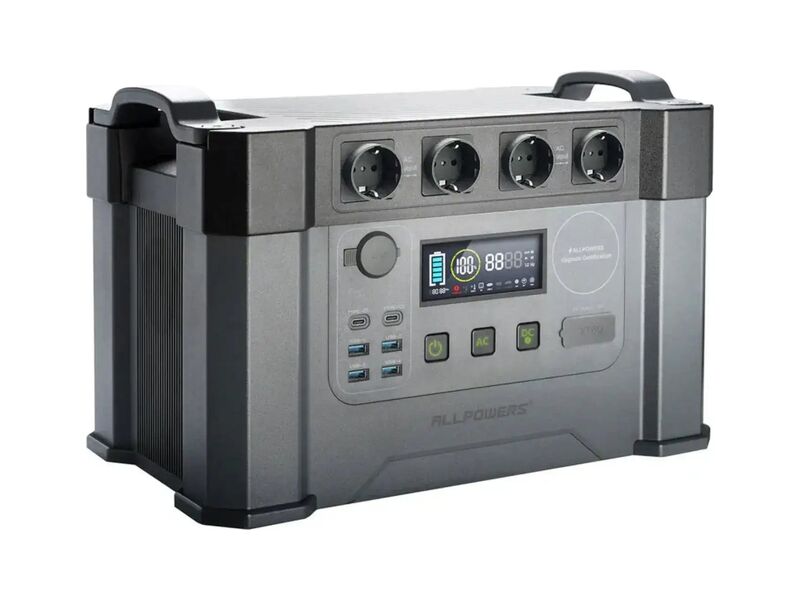
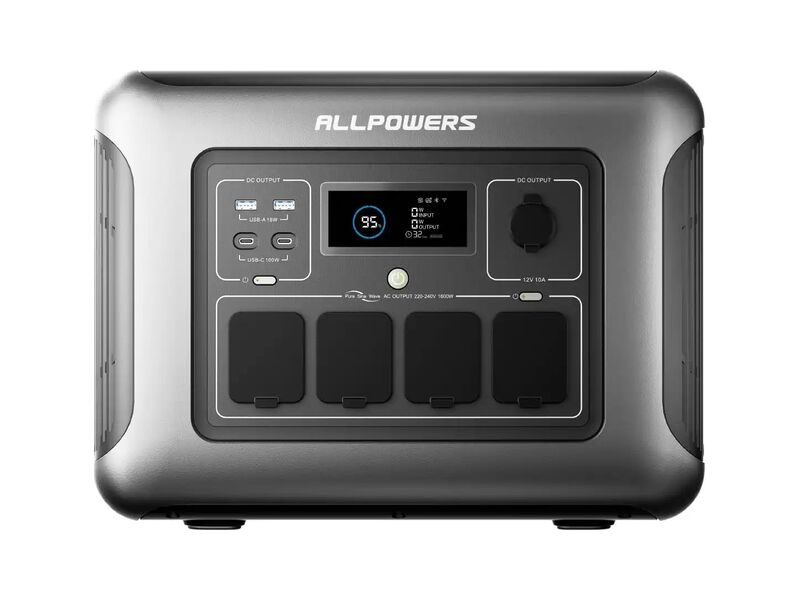
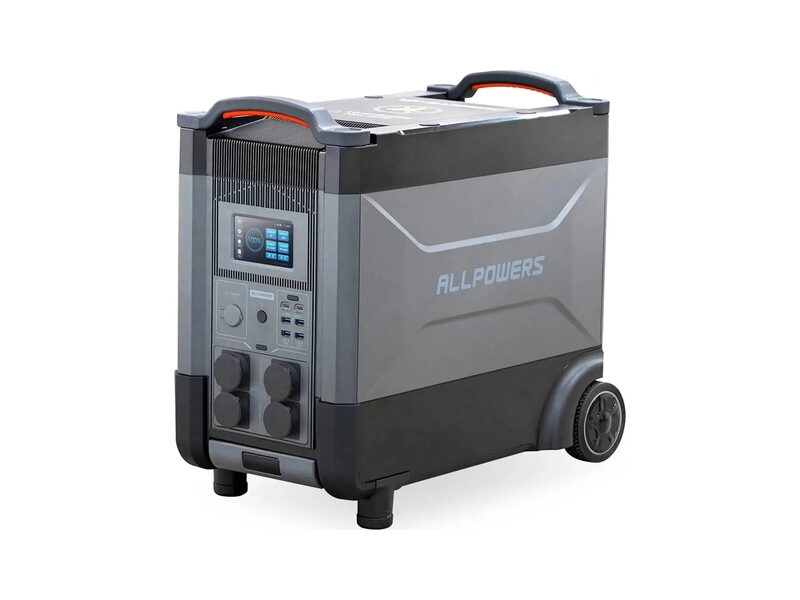
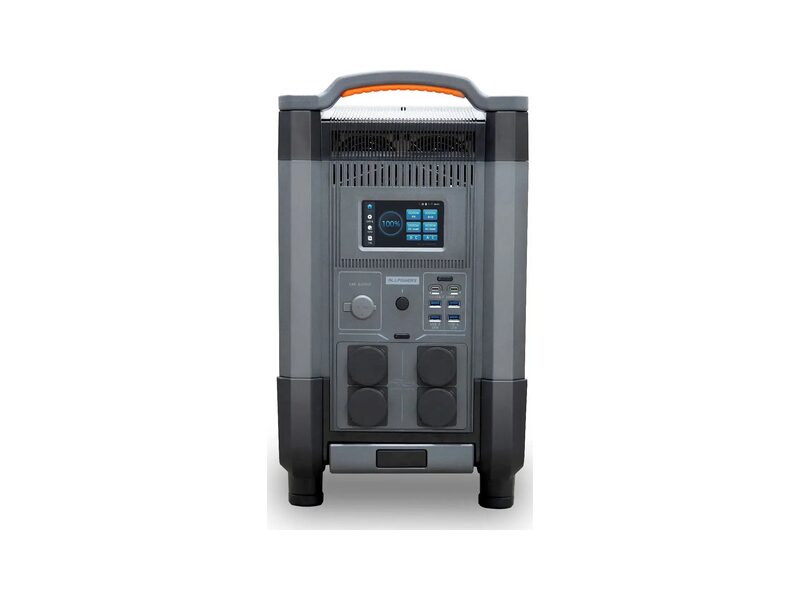
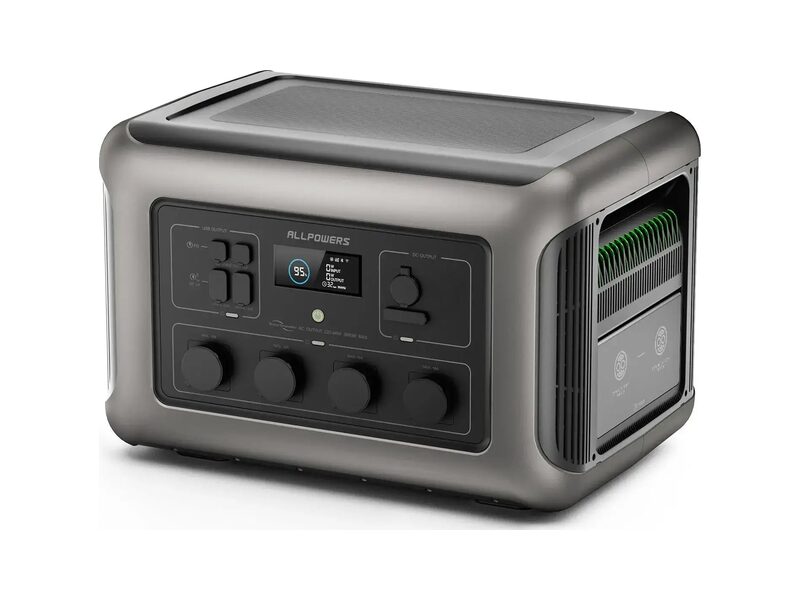
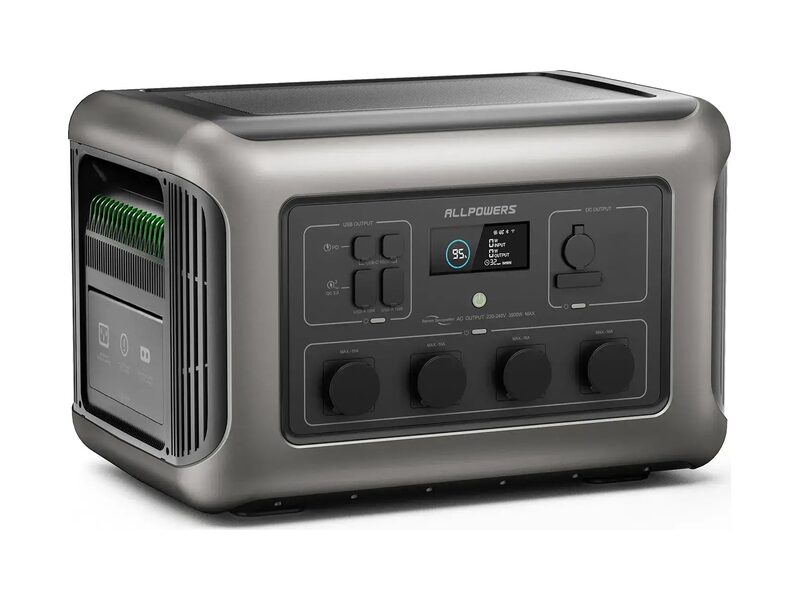
The Allpowers P1800 takes aim at the crowded 1 kWh segment with a simple pitch: plenty of power at a tight price. A LiFePO4 battery, four AC outlets, two USB-C ports that can charge a laptop at full speed, UPS switchover and app control all fit in a 28.7 lb (13 kg) case you can carry by hand. It recharges from a wall outlet, solar panels or a vehicle, and is rated for quiet running. A solid base for a camper van, a weekend in a tent, mobile working or short power outages.
We have not put the P1800 on our own test bench yet, so this view rests on the manufacturer's data sheet, the manual and what can be cross-checked online. On paper it is very coherent for the price. The 1800 W output runs an electric kettle or a drill, four outlets save you a power strip, and the two 140 W USB-C ports charge a laptop at full speed. The claimed noise level of around 30 dB matters when you sleep next to it in a van or a tent. Wall-outlet recharging at up to 1200 W and 650 W of solar input are its two real strengths for life on the move. The caveats: 28.7 lb (13 kg) to carry, a fixed capacity, figures that change from one manufacturer page to another (cycles, charging time, UPS switchover) and a short track record of reviews. For a camper van, a weekend of camping or short outages it deserves a place on the shortlist; for heavy daily use, wait for independent measurements.
EcoFlow's most affordable portable power station: the power of the Delta 3 range, now lighter, quieter and easier on your wallet.
Capacity : 1024 Wh, LFP (LiFePO4) battery
AC output : 1800 W, 2400 W with X-Boost, 3600 W surge
Recharge : 0 to 80% in 45 min on mains, solar up to 500 W
Battery life : 4000 LFP cycles (10 years+), 5-year warranty
1 kWh, near-silent (<30 dB) and the cheapest in the range
Use case: Motorhome & Van life
The most accessible model in the Delta 3 range, the Classic offers the essentials for a van or motorhome: its 1024 Wh power the fridge, lighting, ventilation, device charging and light cooking for several days on reasonable needs. Its 1800 W occasionally accept a hungrier appliance, and a full recharge in 60 minutes (80 % in 45 min) tops up at a service area during a break. A solar input up to 500 W ensures autonomy in the wild. Light (12.1 kg) and quiet (30 dB), it stows easily aboard. Not expandable, its capacity is fixed: for very long, power-hungry trips, aim for an expandable model.
The gateway to the Delta 3 range. EcoFlow kept the essentials, real output power and an LFP battery built to last, while trimming the price and the weight. Compact, remarkably quiet and controlled from the app, the Delta 3 Classic recharges at full speed from a simple socket and becomes the ideal companion for camping, van life and power outages, without breaking the bank.
In-depth reviewRead our full review →4.2/5
I took it out in a van and kept it at home for a few days, and honestly, for the price, it ticks almost every box. First impression out of the box: it is surprisingly light for 1 kWh, you move it with one hand without thinking. Outdoors, I ran a compressor cooler, charged the phones and two laptops, and even pulled out the blender for a fruit juice in the middle of nowhere: the 1800 W takes it in stride. What impressed me most is the silence, even under load you forget it is there, a real plus when you sleep next to it in a van. Mains recharge is express, a lunch break is enough to leave nearly full. The compromises are real and worth knowing: few USB ports, no 12V car socket, and the solar input is capped at 500 W. Nothing dealbreaking for typical off-grid use. In the end, if you want a simple, powerful and quiet station around $677.00 it is a purchase I recommend without hesitation.
1920Wh, 2500W (5000W surge per the US listing), a 15ms UPS and 1000W of MPPT solar: the Allpowers R2500 V2 targets serious home and RV backup.
Capacity : 1920Wh, expandable to 4320Wh (LiFePO4)
Power : 2500W, up to 5000W surge (US listing)
Solar : 1000W MPPT input, 12-150V
Backup : UPS function, under 15ms switchover
RV hookup confirmed, real 5-year warranty support
Use case: Motorhome & Van life
One detailed US review describes using the R2500 V2's RV-style hookup as genuine shore power, running two refrigerators and household circuits during a real outage, and the same owner specifically bought it for RV use, noting most RVs have no usable power without an inverter or roof solar, something this station replaces at lower cost. Its 1920Wh (expandable to 4320Wh) and 2500W continuous output run a compressor fridge, a cooktop or a pressure washer, and the 1000W MPPT solar input, spanning 12 to 150V, recharges quickly while driving toward sunny weather or parked at a site. At around 54 lb (24.5 kg) (54lb), it is not something you move daily. Charging combines AC and solar to reach 80% in about an hour, or AC alone in roughly 1.5 hours for a full charge. One reviewer specifically flagged solar charging performance as inconsistent, worth testing with your own panel setup.
The Allpowers R2500 V2 is a 1920Wh portable power station delivering 2500W continuous and, per the US listing, up to 5000W surge. Its LiFePO4 battery is rated for 3500 cycles and expands to 4320Wh with a B1000 battery. It offers four AC outlets, an RV-style hookup used successfully by real US owners during outages, 1000W of MPPT solar input, a UPS function rated under 15ms, and app control over Bluetooth and WiFi. Backed by a 5-year warranty, with real customer accounts of running CPAP machines and full-size refrigerators.
In-depth reviewRead our full review →4.2/5
The R2500 V2's US reviews span several product generations, so we focused on the most recent, clearly-dated ones for this verdict. One owner used its RV-style hookup as genuine shore power during a real outage, running two refrigerators and household circuits for 3.5 hours before utility power returned. Another, a CPAP user who previously ran a 20-year DIY solar rig, switched over and now gets 5 to 6 nights per charge with the humidifier on, up to 10 without it, running the CPAP straight off the 12V output to skip the extra conversion losses of an AC adapter. Customer service accounts are genuinely reassuring: one buyer had a faulty unit replaced within a week through Amazon, another received a free replacement four years in, past the warranty period, for the cost of shipping. The one consistent complaint across recent reviews: solar charging performance, one buyer called it flatly inconsistent, worth testing with your own panels before relying on it exclusively. At 67 ratings and 4.2 stars, backed by a 5-year warranty, it's a solid pick for home or RV backup.
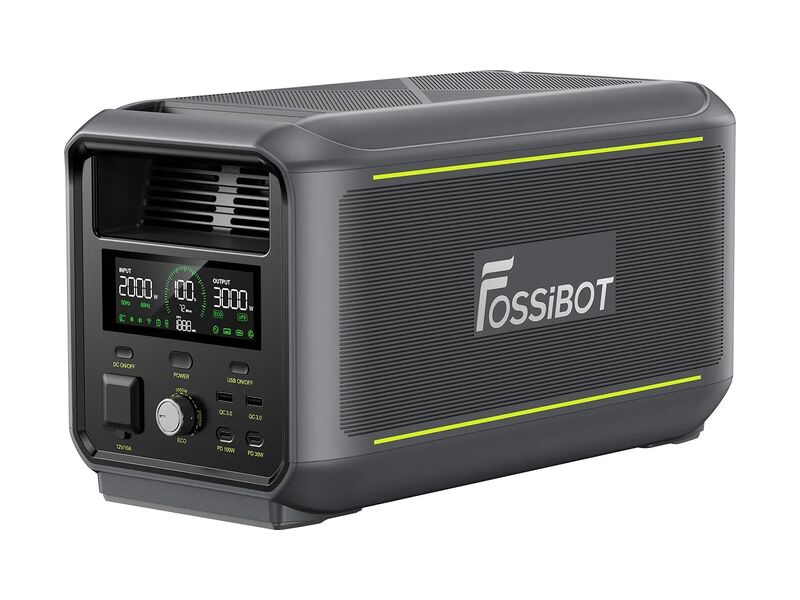
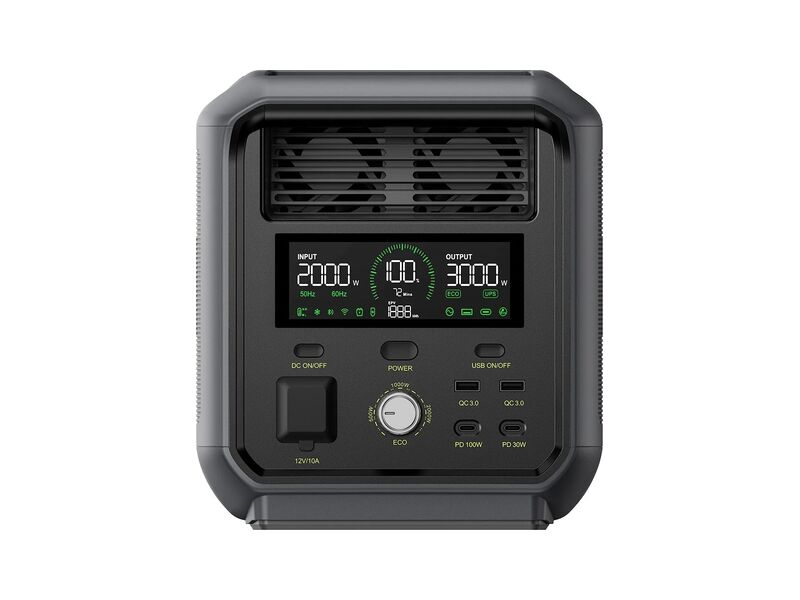
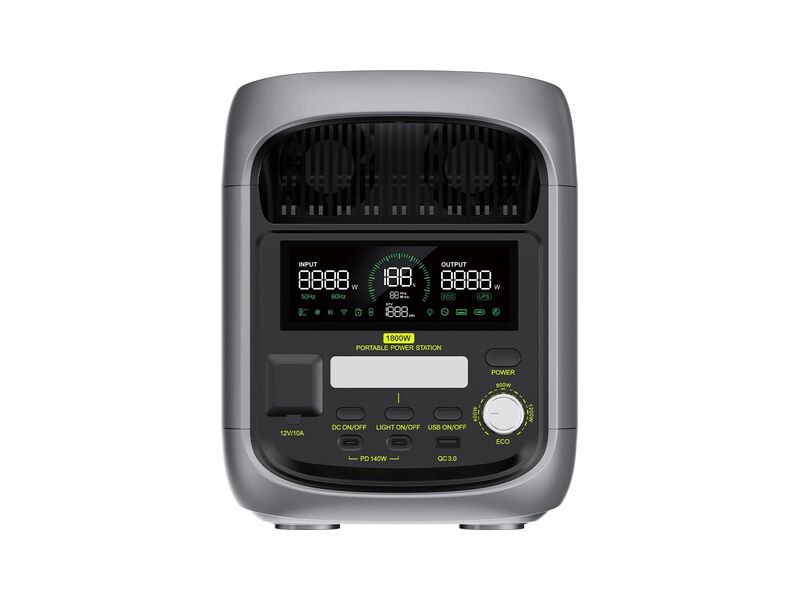
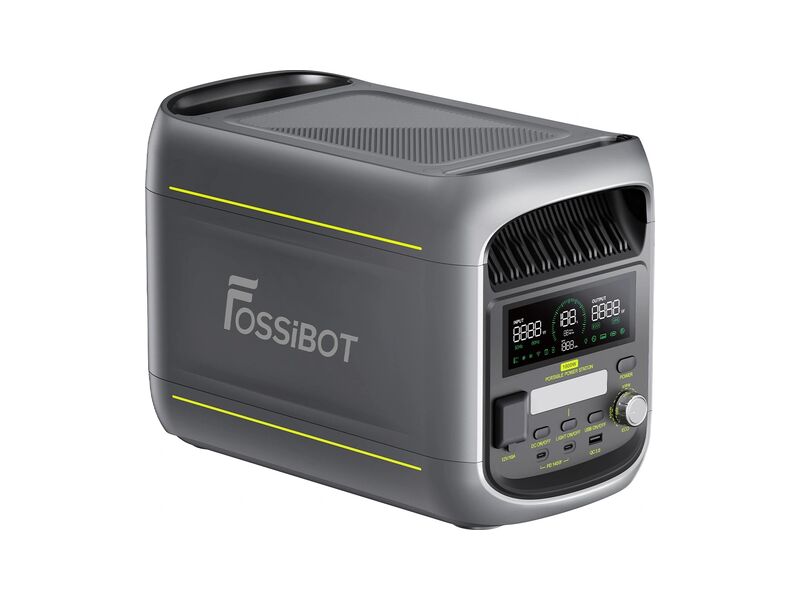
With 42.3 lb (19.2 kg), 3000 W and flexible recharging, the F3000 is a very good electrical base for an RV or a camper van. It runs a fridge, ventilation, lighting, a laptop, a coffee maker or an induction cooktop; the 12V/10A car socket and its USB-C ports (100 W and 30 W) serve small devices. At a campground with hookups, 2000 W AC charging restores 80% in about 52 minutes, and the 1200 W solar input makes use of roof panels, provided you respect the 12 to 60V range and the XT60 connector. On the road, the FAC580 alternator charger (sold separately) reaches up to 580 W, where the car socket alone stays very slow. It has no dedicated RV outlet, and its 2048 Wh means choosing your appliances carefully if you cook electrically for several days without recharging.
The Fossibot F3000 is a portable power station with a LiFePO4 battery that runs an induction cooktop, a kettle or job site tools thanks to its pure sine wave inverter. It recharges very quickly from a wall outlet, accepts a high solar input, switches to battery in under 10 ms like a backup UPS and is controlled from a smartphone app. At 42.3 lb (19.2 kg), it is lighter than most 2 kWh stations. Launched in Europe in September 2026, it extends the Fossibot range above the F2400.
On paper, the F3000 fixes the two weak points of the F2400: AC charging, up from 1100W to 2000W, and solar input, more than doubled. With 3000W continuous in 42.3 lb (19.2 kg), it is one of the strongest 2 kWh stations per pound. The input power dial is a genuine comfort: you can plug into a weak garage outlet or a small generator without digging through a menu. The sub-10 ms UPS looks credible, with one caveat worth knowing: output is capped at 2000W in that mode. The downsides: a very recent product, so few independent measurements of real delivered capacity or noise under full load (the manual tolerates fan noise up to 60 dB), no dedicated expansion battery, and an after-sales network that is thinner than the market leaders'. This is the 230V European version; check availability for the US before counting on it.
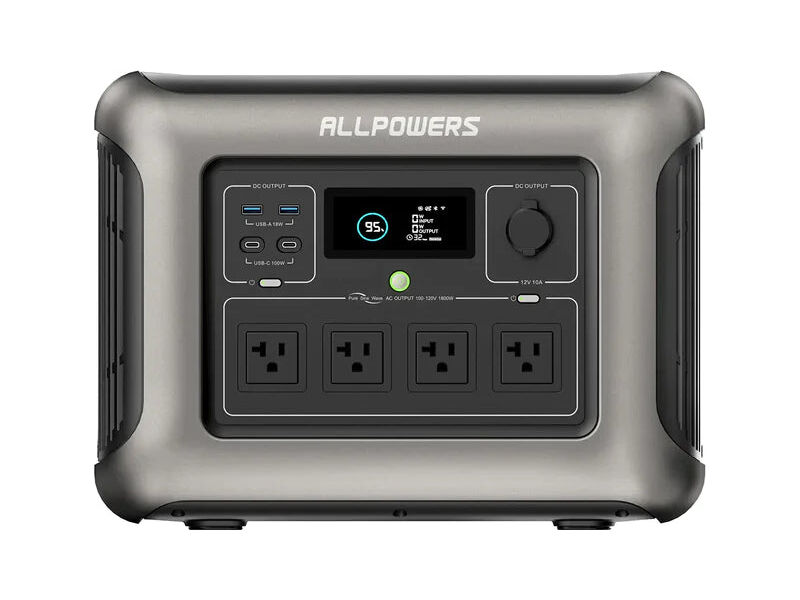
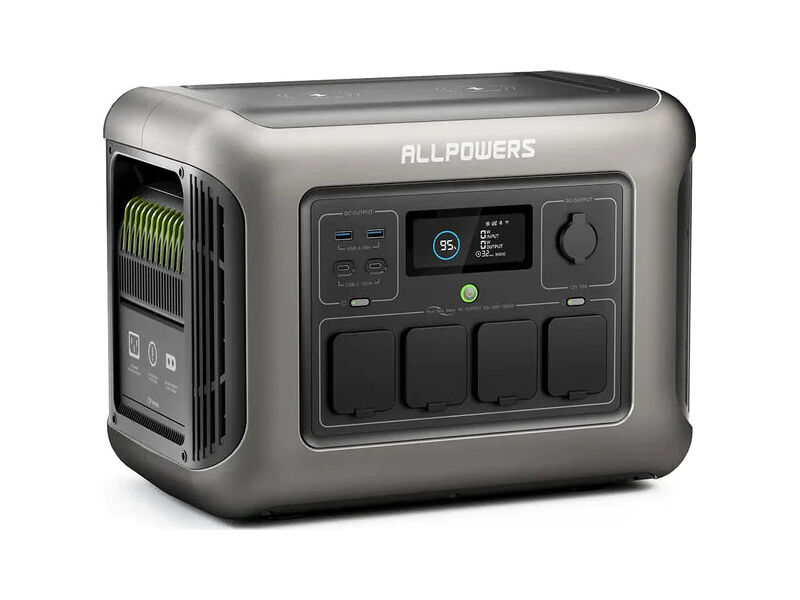
Powerful (1800 W), long-lasting (1152 Wh, expandable) and recharged to 80% in 45 minutes, the Allpowers R1500 can run almost the whole house.
Capacity : 1152 Wh (expandable with B1000)
Power : 1800 W (3000 W peak)
Recharge : 0 to 80% in about 45 min from mains
Weight : 36.8 lb (16.7 kg)
1800 W, expandable 1152 Wh and 80% recharge in 45 minutes
Use case: Motorhome & Van life
Compact yet well equipped, the Allpowers R1500 is a solid base in a van or camper conversion: its 1152 Wh cover the onboard fridge, lighting, ventilation and charging of all electronics for several days, while its 1800 W (3000 W peak) allow a kettle, a coffee maker or a small water heater on occasion. Above all, its capacity is expandable up to 4608 Wh with B1000 batteries: start light, then grow the reserve as needs increase, without changing station. Recharging to 80 % in 45 minutes from mains refills it in one break, and solar input up to 650 W tops it up while driving or parked. At 36.8 lb (16.7 kg) it stays reasonable to install and move around the vehicle.
With 1152 Wh, 1800 W (3000 W peak) and an 80% recharge in about 45 minutes, the Allpowers R1500 runs a fridge, power tools, a computer and small appliances with ease. A long-life LiFePO4 battery (3500 cycles), 4 AC outlets, USB-C 100 W, a solar input up to 650 W and expandable capacity: it targets the best power-to-price ratio for car camping, van life or home backup.
In-depth reviewRead our full review →4.3/5
We lived with the R1500 for several weeks, and for the price it is impressive. The first shock is charging: plugged in when you get home, it is back to 80% by the time you have put the shopping away, around forty minutes. Its 1800 W swallows a kettle, a microwave or a jigsaw without flinching, where many rivals give up. Camping, its 1152 Wh lasted two days with a cool box, lighting, phone charging and a laptop. We liked the 4 AC outlets, rare at this price, and the generous solar input up to 650 W that fills it quickly in the sun. The UPS function kept the router running during a power outage. The one real downside is the weight: at nearly 37.5 lb (17 kg), you do not move it one-handed, it is clearly meant for the van, the car or a fixed spot at home. But given what it offers and its price, it is seriously good value.
The EcoFlow Delta 2 Max power station turns any place into a reliable energy source, from camping to home backup, with no noise and no fuel at all.
Capacity : 2,048 Wh (expandable to 6,144 Wh)
Power : 2,400 W (3,100 W X-Boost, 4,800 W surge)
Recharge : 80% in 53 min on AC, up to 1,000 W solar
Weight : 50.7 lb (23 kg)
Versatile 2 kWh LFP station, easy to move at 50.7 lb (23 kg)
Use case: Motorhome & Van life
Its 2048 Wh, expandable to 6 kWh, offer comfortable autonomy in a motorhome: fridge, electric cooking, lighting and comfort run for several days in a row, and its 2400 W accept hungry appliances without compromise. A solar input up to 1000 W recharges quickly at a stop in good weather, and a recharge from 0 to 80 % in 53 minutes is valuable at a service area. Its quiet operation (30 dB) preserves the calm of nights aboard. At 50.7 lb (23 kg), it suits motorhomes and A-classes with a dedicated bay; for a compact van, a lighter model fits daily use better.
With 2,048 Wh of capacity and 2,400 W of continuous power, the Delta 2 Max runs almost all of your devices, from a fridge to power tools. Its LFP battery lasts around 3,000 cycles, close to ten years of daily use, and recharges to 80% in under an hour on mains. Expandable to 6,144 Wh, solar-ready and controllable from the EcoFlow app, it weighs just 50.7 lb (23 kg), light enough to move from room to room or load into a van.
In-depth reviewRead our full review →4.4/5
After several weeks with the Delta 2 Max, it earned a permanent spot by the front door, ready to grab. The first real test came during a winter power outage: the fridge, the internet router, a few LED lights and two laptops ran all evening without the battery dropping below 60%. Stopwatch in hand, we measured 0 to 80% in just under an hour on a standard socket, impressive for 2 kWh. On a camping weekend, we hooked up two solar panels: in fair spring weather we were pulling 380 to 420 W around midday, easily enough to stay off-grid. The fans are audible during fast charging, but you can cap the speed in the app for the night. The 50.7 lb (23 kg) weight is the main downside: manageable with two hands, but not something you move casually. Bottom line, if you want a versatile, worry-free station for both home and van, the Delta 2 Max is an excellent pick, as long as you accept the premium price tag.
2048 Wh and 2400 W in a transportable, quiet body: the EcoFlow Delta 3 Max secures a home or a motorhome with a 10 ms UPS switchover.
Capacity : 2048 Wh (LiFePO4)
Output : 2400 W (4800 W surge, 3200 W X-Boost)
Recharge : 0 to 80% in 51 min (mains)
Backup : UPS < 10 ms, 4 AC outlets
2048 Wh, 2400 W and 0-80% recharge in 51 min at a contained price
Use case: Motorhome & Van life
Powerful and quick to recharge, the Delta 3 Max makes a motorhome feel almost like home: its 2048 Wh cover fridge, electric cooking, an auxiliary water heater and comfort over several days, and its 2400 W handle the vast majority of onboard appliances. Its solar input up to 500 W tops it up at a stopover on a sunny day, and its 0-80% recharge in 51 minutes is valuable at a service area. Its quiet operation (25 dB) preserves the calm of nights aboard. At 44.8 lb (20.3 kg), it suits vehicles with a dedicated spot rather than the most compact vans, but offers a comfortable energy reserve for long self-sufficient trips.
The EcoFlow Delta 3 Max is a 2048 Wh power station built for home backup and big mobile needs, at a more accessible price than the Max Plus version. It delivers 2400 W continuous (up to 4800 W surge, 3200 W X-Boost), enough to run most of a home's appliances. Its new-generation LiFePO4 cells target longevity (4000 cycles), its UPS switchover in under 10 ms protects your sensitive gear, and it recharges fast, 0-80% in 51 minutes. Its 2048 Wh capacity, however, is not expandable.
In-depth reviewRead our full review →4.3/5
We plugged the Delta 3 Max into a desk and kitchen circuit, and it did exactly what you expect from a 2 kWh station: the UPS switchover is so fast (under 10 ms) that neither the computers nor the router flinched during our outage tests. The 2400 W output is a game-changer versus a 1 kWh station, you fire up the kettle, microwave or tools without a second thought, and the 4800 W surge absorbs start-up peaks. Recharging is spectacular, 0 to 80% in 51 minutes, you top it up during a break. Its 2048 Wh last a good part of a day for essentials, but the capacity stops there: unlike the Max Plus, the Delta 3 Max takes no add-on battery. Versus the Max Plus, you lose 600 W of continuous power and a few advanced features, but you save around 270 dollars, which makes it the best price/capacity ratio in the range for anyone who does not need the 3000 W. One more caveat: at over 44.1 lb (20 kg), it moves around but is not carried one-handed.
1451Wh and 2400W (4000W peak) for just 28.7 lb (13 kg): the US station that packs a lot of power into a light format, with 1000W of solar charging.
Capacity : 1451 Wh
Power : 2400 W (4000 W peak)
Outputs : 4 outlets, USB-C 100W, USB-A, 12V
Recharge : 0-100% in about 1.5h (AC+solar)
1451Wh, 2400W, just 28.7 lb (13 kg), 1000W solar
Use case: Motorhome & Van life
In a campervan or motorhome, the S2000 Pro brings a comfortable 1451Wh reserve in a surprisingly light format for its class (13kg), easier to move than many rivals of equivalent power and easy to tuck into a locker or under a bench seat. Its 2400W (4000W peak) runs a compressor cooler, a microwave or a kettle without hesitation, and solar input up to 1000W via its XT60 connector allows genuinely fast charging on the road or at a sunny stop, a full recharge combining AC and solar takes about 1.5 hours. Bluetooth control via the Allpowers app, with a range of about 10 meters, lets you track charge level, power draw and remaining runtime from inside the vehicle without stepping outside to check a screen.
The Allpowers S2000 Pro is a 1451Wh portable power station for the US market, delivering 2400W continuous (4000W peak) at just 28.7 lb (13 kg) for this power level. It offers 4 outlets, two 100W USB-C ports, four USB-A ports and a 12V car socket. Its UPS function switches automatically to battery during an outage, and MPPT solar input up to 1000W via XT60 allows combined AC and solar charging in about 1.5 hours. Controllable via Bluetooth and the Allpowers app. A powerful, light station for home, van or job site, currently shipping to order.
In-depth reviewRead our full review →4.1/5
The S2000 Pro impresses first with its weight: 28.7 lb (13 kg) for 2400W and 1451Wh is notably lighter than most stations at this power level, a real plus for moving it between home, van and job site. Combined AC plus solar charging in about 1.5 hours is genuinely quick, and the MPPT solar input up to 1000W means the sun can meaningfully contribute on the road. The UPS function is reassuring for home backup duty. One thing worth checking before ordering: at the time of writing, the S2000 Pro is on pre-order on Allpowers' own US site, with new stock estimated to ship around September 21, so it is not an immediate, off-the-shelf purchase right now. The flip side of the light weight is the NMC (ternary lithium) chemistry, rated for over 2500 cycles, solid but below the 3500-plus cycles of the LiFePO4 batteries used on other Allpowers models like the R1500 LITE. Control is Bluetooth-only, with roughly a 10 meter range, no WiFi. For anyone willing to order ahead for a light, powerful station, it remains a very compelling package.
2048Wh and 2400W expandable up to 8192Wh: a powerful, scalable station that grows with your needs, from the RV to home backup power.
Capacity : 2048Wh, expandable to 8192Wh (LiFePO4)
Power : 2400W continuous, 3600W Power Lifting
Outputs : 4 AC outlets, 2 USB-C 100W, USB-A, car socket
Recharge : 80% in 45 min, up to 1200W solar
2400W and capacity expandable up to 8192Wh
Use case: Motorhome & Van life
For large vehicles and long trips, the AC200L offers autonomy that grows with your needs: its 2048 Wh, expandable to 8192 Wh, cover a fridge, electric cooking, a booster water heater and comfort for several days in a row, even a full week in extended configuration. Its 2400 W accept hungry appliances without compromise, and a solar input up to 1200 W recharges quickly at a stop in good weather. A recharge to 80 % in 45 minutes is valuable at a service area. At 62.4 lb (28.3 kg), it suits motorhomes and A-classes with a dedicated bay rather than compact vans.
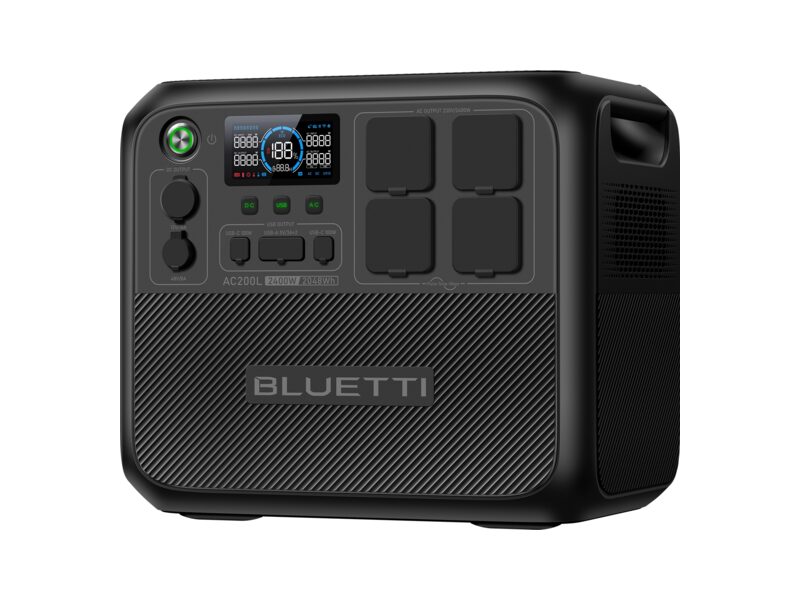
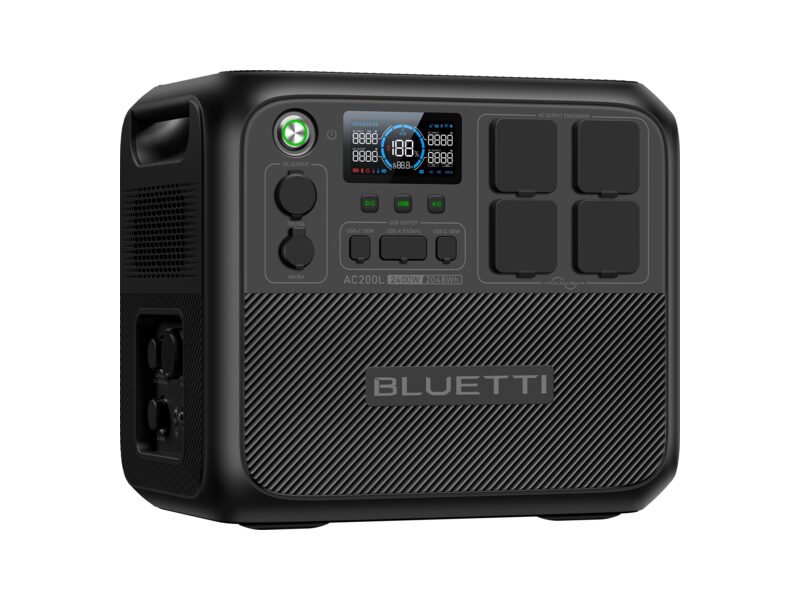
The Bluetti AC200L is a powerful 2048Wh portable power station with a LiFePO4 battery, delivering 2400W continuously (3600W in Power Lifting mode, 7200W brief surge). Its big asset is scalability: its capacity expands up to 8192Wh with additional B300 batteries. It offers plenty of outputs (4 AC outlets, 2 USB-C 100W, USB-A, car socket), recharges to 80% in 45 minutes and accepts up to 1200W of solar. Controllable over WiFi and Bluetooth via the Bluetti app.
In-depth reviewRead our full review →4.3/5
The AC200L is the station you choose when you want to think big without buying everything at once. Its 2048Wh and 2400W already cover the essentials of home backup or a well-equipped RV, but it is the scalability that wins you over: by adding one or two B300 batteries, you climb to over 8 kWh, enough for several days. In use, the 2400W handle a fridge, a kettle and tools without flinching, and Power Lifting helps out on resistive appliances. Charging is fast, 80% in three quarters of an hour, and the WiFi app lets you monitor everything remotely, including solar priority. The only real downsides are the weight (nearly 61.7 lb (28 kg), without wheels) and the fact that it now faces newer rivals. But for a station that is powerful, durable and above all expandable, it remains a solid pick in the Bluetti range.
2048Wh expandable to 10.24kWh, 2800W (5600W peak) and a NEMA TT-30 RV outlet: the Aferiy P280 targets serious US home and RV backup.
Capacity : 2048Wh, expandable to 10.24kWh (LiFePO4)
AC output : 2800W, up to 5600W peak, pure sine wave
RV outlet : NEMA TT-30, 30-amp shore power
Charging : 80% in ~38 min combining AC+solar
NEMA TT-30 RV outlet, expandable to 10.24kWh
Use case: Motorhome & Van life
The P280's US listing includes a NEMA TT-30 industrial outlet, the standard 30-amp RV shore power connector, confirmed working in practice by a US owner who runs it as shore power alongside two 450W solar panels, powering everything on board except the air conditioner. Its 2048Wh (expandable to 10.24kWh with extra batteries) and 2800W continuous output handle a fridge, a hob, lighting and device charging comfortably, with dual 600W solar inputs (1200W combined) keeping the battery topped up on the road. The BrightEMS app monitors charge and output remotely over Bluetooth or WiFi, though one detailed reviewer flagged the app's data collection practices, including broad device permissions and Bluetooth scanning of nearby devices, as worth knowing about even if you only use it to set charge speed once. At around 45lb, it suits a fixed spot in the rig rather than daily repositioning.
The Aferiy P280 is a 2048Wh (LiFePO4) portable power station expandable up to 10.24kWh with additional batteries, delivering 2800W continuous and up to 5600W peak. The US model ships with a NEMA TT-30 industrial outlet for 30-amp RV shore power, confirmed working by real RV owners. It charges to 80% in about 38 minutes combining AC and solar (1200W max), switches to UPS mode in under 10ms, and is controlled through the BrightEMS Bluetooth and WiFi app. Weighs about 44 to 49lb.
In-depth reviewRead our full review →4.0/5
The Aferiy P280's US listing turned up some of the most detailed reviews we've seen on this catalog, and a genuinely useful hardware finding: it ships with a NEMA TT-30 industrial outlet, the standard 30-amp RV shore power connector, confirmed in practice by an RV owner running it alongside two 450W solar panels to power everything but the air conditioner. One reviewer uses it exclusively to run pellet grills cable-free, measuring just 130W at startup and roughly 30W at steady state, using only about 20% of the 2048Wh battery across four hour-long cooks, worth 20 or more sessions per charge. On the software side, one detailed reviewer raised real concerns about the BrightEMS companion app's data collection and broad Bluetooth device scanning, worth reading if privacy matters to you; the hardware itself, they noted, deserved five stars on its own. The 38 US ratings run overwhelmingly positive (85% five stars), praising build quality and fast recharge, though one buyer's unit died after a single cycle, refunded without issue.
3072Wh and 3600W to run almost the whole home: fridge, hobs, tools. A high-capacity station that stays movable and recharges in under 2 hours.
Capacity : 3072Wh (LiFePO4 battery)
Power : 3600W continuous, 7200W peak
Outputs : 3 AC outlets, 2 USB-C 100W, 2 USB-A, 1 car socket
Recharge : Full in 1h48 mains, up to 1000W solar
3600W and UPS backup for the whole home
Use case: Motorhome & Van life
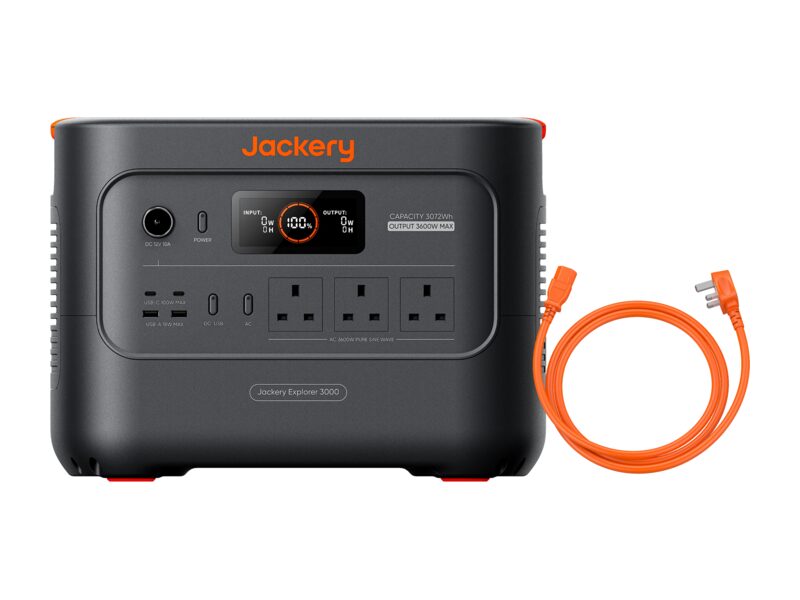
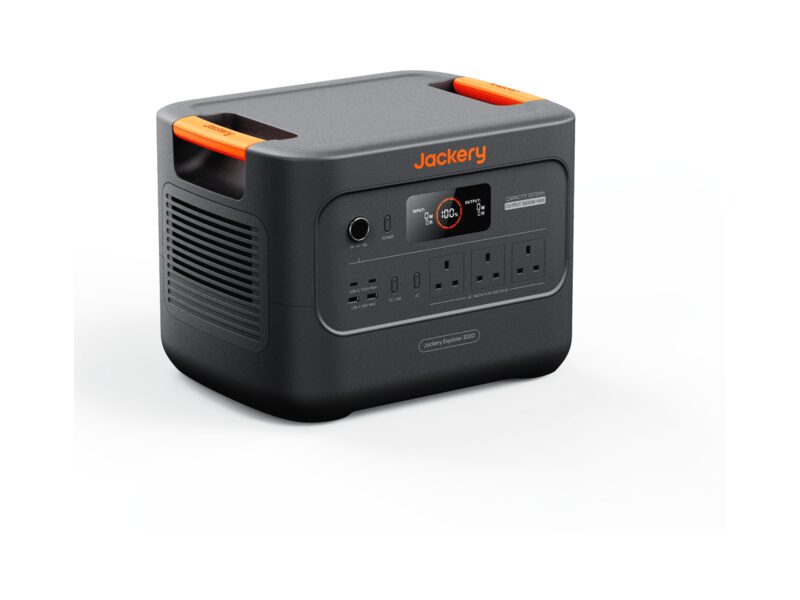
Fitted with a carrying handle, the Explorer 3000 v2 lets a large motorhome live like home: its 3072 Wh cover a fridge, full electric cooking, a booster water heater, lighting and comfort for several days in a row, and its 3600 W accept hungry appliances without compromise, light air conditioning included. A solar input up to 1000 W recharges at a stop in good weather, and its very quiet operation (27 dB) preserves the calm of nights aboard. At 59.5 lb (27 kg), handling takes some planning, and its size suits large vehicles with a dedicated bay rather than compact vans.
The Jackery Explorer 3000 v2 is a high-capacity 3072Wh portable power station with a LiFePO4 battery, delivering 3600W continuously (7200W peak). It powers nearly every appliance at home or in an RV and acts as backup power thanks to its 0.02-second UPS switchover. Compact for its class (59.5 lb (27 kg), with a carrying handle), it fully recharges in 1h48 from the mains and accepts up to 1000W of solar input. Its battery lasts 4000 cycles and is controlled via the Jackery app.
In-depth reviewRead our full review →4.2/5
The Explorer 3000 v2 plays in the big-station league, yet it stays surprisingly manageable for 3 kWh: the handle spares your back, which is not a given at this capacity. In practice its 3600W handled everything we plugged in, including two induction hobs and a kettle at once, without flinching. Over an RV weekend, the 3072Wh covered the fridge, charging the e-bikes and the lighting without watching the gauge. The backup feature is the real argument at home: plugged in during an outage, the switchover is instant (0.02 s), fast enough not to reboot a computer or a router. Recharging is impressive, under two hours from a regular socket. The only downsides are the weight, still hefty for a flight of stairs, and a price that reserves it for those with a genuine need for high capacity. A solid choice for serious autonomy.
2048Wh and 3000W output to power a whole home in backup: full-tab LFP cells, 10 ms UPS switchover and expansion up to 10 kWh.
Capacity : 2048 Wh (full-tab LiFePO4)
Output : 3000W (up to 6000W peak)
Recharge : 0 to 80% in 47 min (mains)
Expandable : From 2 to 10 kWh, UPS < 10 ms
2048Wh, 3000W, 10 ms UPS
Use case: Motorhome & Van life
Powerful and expandable, the Delta 3 Max Plus lets a motorhome live like home: its 2048 Wh, expandable to 10 kWh, cover a fridge, electric cooking, a booster water heater and comfort for several days in a row, and its 3000 W accept hungry appliances without compromise, including light air conditioning. A solar input up to 1000 W recharges quickly at a stop in good weather, and a recharge from 0 to 80 % in 47 minutes is valuable at a service area. Its very quiet operation (25 dB) preserves the calm of nights aboard. At 48.7 lb (22.1 kg), it suits vehicles with a dedicated bay rather than compact vans.
The EcoFlow Delta 3 Max Plus is a 2048Wh power station built for home backup and heavy portable needs. It delivers 3000W of continuous output (up to 6000W peak), enough to run almost all of a home's appliances at once. Its brand-new full-tab LFP cells and smart BMS target longevity, its UPS switchover in under 10 ms protects sensitive devices during an outage, and its capacity expands from 2 to 10 kWh. Lightning recharge from 0 to 80% in 47 minutes.
In-depth reviewRead our full review →4.6/5
We connected the Delta 3 Max Plus to the circuit of an office and a kitchen corner, and it made the fear of power outages disappear: the UPS switchover is so fast (under 10 ms) that neither the computers nor the router flinched during our outage tests. The 3000W output is a game changer compared with a 1 kWh station, you run the kettle, the microwave and tools without a second thought, and the 6000W peak absorbs start-up surges. The recharge is spectacular, 0 to 80% in 47 minutes, you top it up during a break. Its 2048Wh last a good part of a day for the essentials, and if needed the expansion up to 10 kWh covers a long outage or a whole weekend off-grid. The full-tab LFP cells, a first, promise an even better lifespan. Two caveats: at over 44.1 lb (20 kg), it moves but you don't carry it at arm's length, and the price reserves it for those with a real backup or high-power need. For a versatile, fast 2 kWh station, it is excellent.
Fifteen hundred and thirty-six watt-hours for $670.23 80% charged in eighty minutes, and the option of moving up to 7,680 Wh later.
Capacity : 1536 Wh of LiFePO4, expandable to 7,680 Wh
Power : 2200 W continuous, 4400 W peak, pure sine wave
Recharge : 1400 W from the mains, 80% in 80 minutes
Outputs : 2 x 230 V, 4 USB-A, 2 USB-C (100 W), 12 in total
1536 Wh for $670.23 with a 20 ms UPS function
Use case: Motorhome & Van life
In a motorhome or a van, the E1500LFP acts as a bolt-on electrical installation: its two 230 V sockets and 2200 W run the fridge, an occasional induction hob, the coffee machine and every device on charge, while its four USB-A ports, two USB-C ports including one at 100 W and its 15 W wireless charging pad cover the electronics. It recharges from the 12 V socket while you drive, from a service-area outlet in 1 h 48, or from the sun at up to 700 W. Its 40.1 lb (18.2 kg) stay carryable on two side handles, and the additional-battery expansion lets you travel longer without changing station.
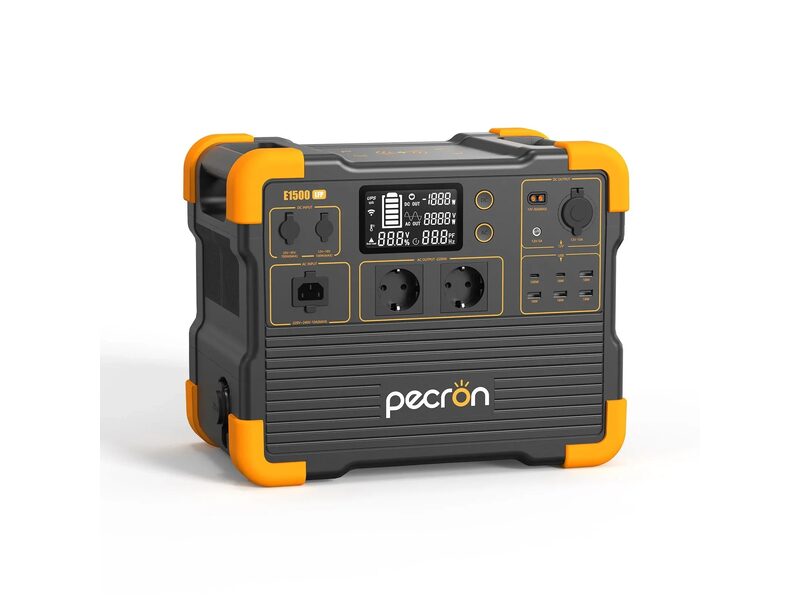
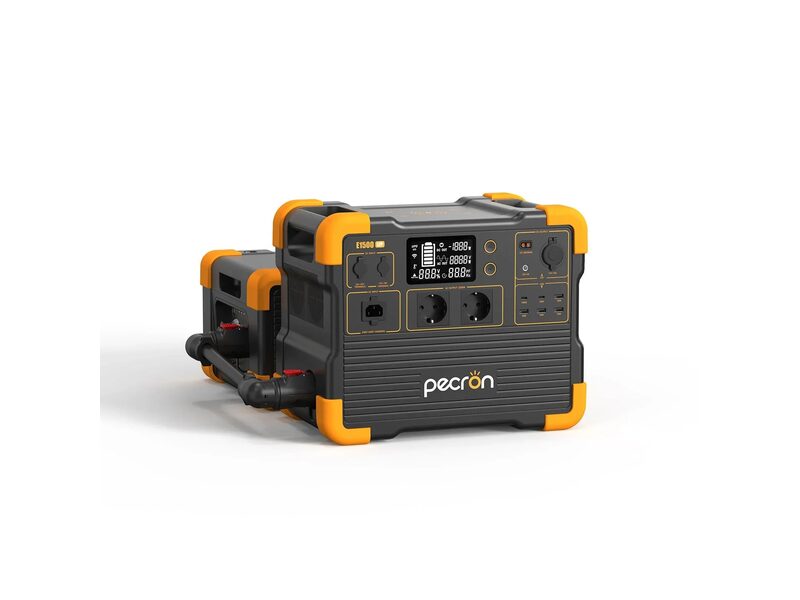
The Pecron E1500LFP is a versatile power station built on two arguments: capacity for the money and expandability. Its 1536 Wh of LiFePO4, rated for 3,500 cycles to 80%, deliver 2200 W continuous and 4400 W peak across two 230 V sockets on a pure sine wave. Twelve outputs in total, including a 100 W USB-C, four 18 W USB-A ports, a cigarette-lighter socket and a 15 W wireless charging pad. It recharges at 1400 W from the mains, 80% in 80 minutes, and accepts up to 700 W of solar. Two EP3000-48V batteries take it to 7,680 Wh.
In-depth reviewRead our full review →4.0/5
Pecron is a maker you come across less often than EcoFlow or Jackery in Europe, and its strategy fits in one sentence: offer the same thing for considerably less. The E1500LFP illustrates it well. At $670.23 it delivers 1536 Wh and 2200 W, where most stations of equivalent output in our catalog start around $947.80 to $1150.90. On paper there is no obvious sacrifice: LiFePO4 chemistry rated for 3,500 cycles to 80% residual capacity, a pure sine wave inverter, a UPS function switching in under 20 milliseconds, a Bluetooth app. Two things deserve highlighting. Charging first: 1400 W of mains input, which fills the battery to 80% in eighty minutes and to 100% in one hour forty-eight. On a station of this capacity that is fast, and it concretely changes household backup use, where you want to refill between two outages. Expandability second: one EP3000-48V battery takes the set to 4,608 Wh, two take it to 7,680 Wh. Buying the station alone today and growing it later is a genuine option, not a marketing line. Three honest reservations. Solar input tops out at 700 W, respectable but below the 1,000 to 2,400 W of premium stations, which stretches recharge times when running fully off-grid. There are only two 230 V sockets, so a multi-way adapter becomes necessary as soon as you plug in more than two devices. And the stated warranty is 3 years, against 5 for Anker, EcoFlow or Jackery: on a product whose battery is meant to last a decade, that gap is worth weighing.
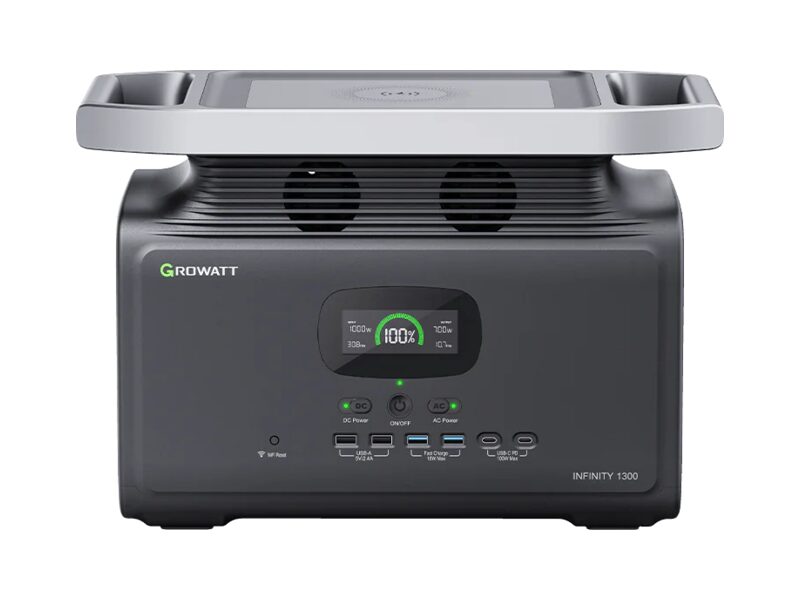
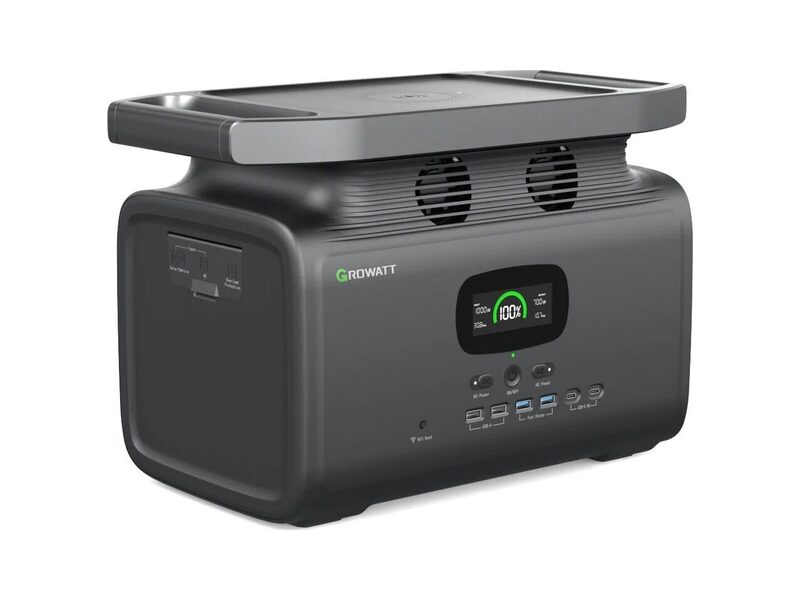
1382Wh and 1800W to power up to 14 devices: the Growatt Infinity 1300 is a powerful, long-lasting (LiFePO4) station that recharges fast, designed for camping and backup.
Power : 1800W (pure sine)
Capacity : 1382Wh LiFePO4
Outputs : 14 outputs (AC, USB-C, USB-A, 12V)
Recharge : Mains in ~1h48
1382Wh LiFePO4, 14 outputs and 5-year warranty
Use case: Motorhome & Van life
With 1382 Wh and 1800 W (3600 W peak), the Growatt Infinity 1300 offers a nice reserve for a van or motorhome: it sustains the fridge, lighting, ventilation, device charging and light cooking for several days, and occasionally accepts a hungrier appliance. Its two outlets and 100 W USB-C ports cover the onboard essentials, and its solar input up to 800 W, generous for this size, recharges quickly at a stop in good weather. LiFePO4 chemistry (3000 cycles) and a 5-year warranty make it a durable base. Heavy (19.2 kg), it needs both hands, but it offers a good balance of capacity, power and price on the move.
The Growatt Infinity 1300 is a 1382Wh portable power station with a LiFePO4 battery, able to deliver 1800W of pure sine wave. With its 14 outputs, it powers up to 14 devices at once (AC outlets, USB-C, USB-A, 12V). Its LiFePO4 battery withstands over 3000 cycles, more than 10 years of normal use, and recharges very fast from the mains (about 1h48), from solar or in a car. A versatile station for camping, campers, home working or power outages, backed by a 5-year warranty.
In-depth reviewRead our full review →4.1/5
The Growatt Infinity 1300 is one of those stations that offer a lot of capacity and versatility for their price range. Its 1382Wh paired with an 1800W pure sine wave inverter let it power a wide variety of devices: portable fridge, computers, screens, lighting, internet router, small appliances, both camping and during a home power outage. What we particularly like is its LiFePO4 battery, a guarantee of safety and longevity (over 3000 cycles), paired with a reassuring 5-year warranty. Charging is fast, around 1h48 from the mains, and it also accepts solar and car charging. Its 14 outputs cover every need. Points to note: it is no longer always easy to find on the French market (a model at end of distribution, often replaced by the Infinity 1500), and for large power-hungry devices over time, higher capacity would be needed. But technically, it remains an excellent powerful, long-lasting station.
3840Wh and 2600W (3900W Power Lifting) in a rolling power station: 80% recharge in 1h, 15ms UPS switching and remote Wi-Fi control.
Capacity : 3840 Wh (LiFePO4)
Power : 2600 W (3900 W Power Lifting, 5200 W peak)
Recharge : 80% in about 1h (AC + solar)
Portability : 86 lb (39 kg), wheels and telescopic handle
3840Wh on wheels, fast recharge, 15ms UPS
Use case: Motorhome & Van life
The Elite 400's wheeled design makes it a natural fit for motorhomes and converted vans: its 3840 Wh and 2600 W cover a fridge, an electric hob, lighting and charging for all your devices over several days on the road, even more so with a solar top-up of up to 1000 W at a stopover. Its 86 lb (39 kg) weight stays reasonable for a capacity close to 4 kWh, and its telescopic handle makes it far easier to handle in the often tight storage space of a van. Its 2 USB-C ports at 100 W and its 12V car outlet cover most on-board charging needs. The only drawback for this use case: just two 230V AC outlets, which may require a power strip if several demanding appliances run at once. Its LiFePO4 battery, rated for over 3000 cycles, makes it a durable investment for a vehicle you keep for several seasons, with combined AC and solar charging reaching 80% in about an hour at a serviced site.
The Bluetti Elite 400 is a 3840Wh portable power station delivering 2600W continuous power (3900W Power Lifting). Designed like a wheeled suitcase with a telescopic handle, it combines large capacity with genuine everyday mobility. Its LiFePO4 battery is rated for over 3000 cycles, its combined AC and solar recharging reaches 80% in about an hour, and its UPS function switches in 15ms to protect sensitive devices during outages. Ideal for home backup, motorhomes and off-grid trips.
In-depth reviewRead our full review →4.0/5
We were genuinely impressed by how easy this Elite 400 is to move despite its 86 lb (39 kg): the wheeled suitcase design really changes daily use, rolling it out of the garage or loading it into the trunk takes no real effort. The UPS function proved reliable during our simulated outage tests, switching over without our router even noticing. On the charging side, reaching 80% in just over an hour by combining AC and solar is genuinely useful for topping up before a weekend away. Our one gripe: only two AC outlets, which sometimes means juggling a power strip if several big appliances run at once, and there's no way to add extra battery packs, unlike some rivals. Still, it remains a solid choice for anyone after a large mobile power reserve without the complexity.
2048Wh at $857.08 100% in 1.5h, expandable to 8192Wh
Use case: Motorhome & Van life
In a motorhome or camper van, the E2400LFP works as a plug and play electrical setup with no wiring involved: its two 230V sockets and 2400W run a fridge, a portable induction hob and a coffee machine, while the four USB-A ports, two USB-C ports (one at 100W) and the cigarette lighter output cover the rest of the onboard electronics. It recharges on the move via the 12V input, at a service area in 1.5 hours, or from the sun up to 800W thanks to its combined GX16 and DC5521 input. At 45.2 lb (20.5 kg), it stays among the lightest in its capacity class, a real advantage for handling it in the tight space of a van, pulling it out of a trunk or lifting it onto a truck bed. The EP3000-48V expansion battery finally lets you go longer without changing stations, a strong argument for long term van life.
The Pecron E2400LFP is a portable power station built for home backup and van life. Its 2048Wh LiFePO4 battery, expandable up to 8192Wh with additional batteries, delivers 2400W continuous (4800W peak) across eleven outputs, including two 230V sockets, two USB-C and four USB-A ports. Full recharge in 1.5 hours on mains power, solar input up to 800W, UPS function and app control. A compact footprint at 45.2 lb (20.5 kg) for this capacity.
In-depth reviewRead our full review →3.6/5
On paper, the Pecron E2400LFP ticks every box for a solid backup station: close to 2kWh, 2400W continuous, a full recharge in 1.5 hours. In use, what stands out first is the weight: 45.2 lb (20.5 kg), noticeably less than rivals of similar capacity that sit around 22 to 50.7 lb (23 kg). That is not a small thing when you need to carry it upstairs or load it into a van. The front panel is busy but readable, the screen clearly shows charge level and power flows, and the UPS mode handled our simulated outage tests without a hitch. Two honest gripes. First, only two mains sockets: with a fridge and a kettle plugged in, you will quickly need a power strip. Second, the solar input tops out at 800W, decent but well short of the 1000 to 1600W offered by some rivals. Still, at $857.08 the ability to expand up to 8192Wh changes the equation: you can buy the station on its own today and grow the setup later. A solid pick for backing up your home without blowing the budget.
Weight : 23.5 lb / 10.65 kg (12.5 x 8.4 x 11.1 in)
1200 W continuous and 7 simultaneous outputs for home or RV
Use case: Motorhome & Van life
With 1252.8 Wh and 1200 W continuous (2200 W surge), the NES1200 comfortably covers a motorhome or van's needs: fridge, lighting, water pump, gadget charging, and even a hot plate or coffee maker now and then thanks to its power spike. Its seven simultaneous outputs, including two pure sine wave 220 V sockets and two 100 W USB-C ports, avoid the usual tangle of extension cords on board, and the LCD screen lets you track real consumption port by port. At 23.5 lb (10.65 kg) it fits into a locker or storage bay without any trouble, a real plus against similarly sized stations that are often several pounds heavier. The only downside for extended nomadic use: mains recharging takes around 8.5 hours, slower than recent LiFePO4 stations, and solar input is capped at 180 W, which stretches out off-grid charging accordingly.
The Nitecore NES1200 is a 1252.8 Wh (348,000 mAh) portable power station built on 18650 Li-ion cells. It delivers 1200 W continuous, up to 2200 W surge, through a pure sine wave inverter, and spreads the power across seven outputs: two 220 V mains sockets, two 100 W USB-C ports, two USB-A ports and a 12 V car outlet. Its LCD screen shows the charge level in real time. At 23.5 lb (10.65 kg) it remains portable enough for an RV, a job site or home backup power.
We put the NES1200 through its paces for RV and home backup use, and its 1200 W continuous output delivers on its promise: coffee maker, mini oven, power tools, everything runs without a hitch, and the 2200 W surge soaks up the inrush current of motor-driven appliances. The seven simultaneous outputs avoid the usual tangle of extension cords, a genuine day-to-day comfort. At 23.5 lb (10.65 kg) it moves easily from room to room or from the trunk to the RV, even if it is still too heavy for a backpack. Two honest gripes: mains recharging takes close to 8.5 hours, slow next to recent LiFePO4 stations that refill in about an hour, and this model has become hard to find at retailers today, as Nitecore has since refocused its lineup on power banks. Still, it remains a rugged, versatile station for anyone who can still find one in stock.
1056Wh and 1600W (3200W peak), 15ms UPS and 35dB quiet operation: the versatile power station for campervans, home backup or job sites.
Capacity : 1056 Wh
Power : 1600 W (3200 W peak)
Outputs : 4 outlets, USB-C 100W, USB-A, 12V
Recharge : 0-100% in about 90 min (120V)
1056Wh, 1600W, 15ms UPS, 35dB quiet
Use case: Motorhome & Van life
In a campervan or motorhome, the R1500 LITE covers the essentials of onboard equipment: its 1600W (3200W peak) runs a compressor cooler, a kettle or a small microwave, while its 1056Wh lasts a solid day of reasonable use for two people. Rated at a quiet 35dB, it stays unobtrusive at a campground after dark, and solar input up to 650W through its XT60 connector allows meaningful charging while driving to the next stop or parked at a sunny site. WiFi and Bluetooth control via the Allpowers app let you check battery level and adjust settings without getting up from the driver's seat. Its four outlets and two 100W USB-C ports cover most onboard electronics at once. One thing to factor in for the road: 33.1 lb (15 kg), worth securing well against vibration on rougher tracks.
The Allpowers R1500 LITE is a 1056Wh portable power station delivering 1600W continuous (3200W peak), with a LiFePO4 battery rated for over 3500 cycles. It offers 4 outlets, two 100W USB-C ports, two USB-A ports and a 12V output. Its UPS function switches to battery in under 15ms, rated at a quiet 35dB, with WiFi/Bluetooth app control. On a US 120V outlet it recharges from empty in about 90 minutes at 1200W, or via solar up to 650W. A complete station for campervans, home backup or a mobile job site.
In-depth reviewRead our full review →3.8/5
On the essentials, the R1500 LITE delivers: the 15ms UPS switchover worked without a noticeable glitch on a router and a lamp during a test cutout, and the WiFi/Bluetooth app is handy for checking charge level without getting up. Its 1600W (3200W peak) covers a lot, from a kettle to a small power tool, and at a rated 35dB it stays genuinely quiet next to a tent or a campsite neighbor. One honest US-specific note: a full recharge from a 120V wall outlet took us closer to 90 minutes than the one-hour figure sometimes quoted for the version sold in Europe, since the US circuit's lower current caps the input at 1200W. Solar charging up to 650W is a real plus for a campervan on a sunny day. The 33.1 lb (15 kg) is worth factoring in: this is a station to transport by vehicle rather than carry daily. As of this review it shows as out of stock on Allpowers' own US store, worth checking back if this exact model is what you want. Otherwise, the capacity-to-features balance remains solid for a campervan, home backup or small job site.
More powerful and faster: the DJI Power 1000 V2 delivers 2600W from 1024Wh and recharges to 80% in 37 minutes. The next-gen station for nomadic creators.
Power : 2600W continuous
Capacity : 1024Wh LiFePO4
Recharge : 0 to 80% in 37 min
UPS : 10ms switchover
2600W, lightning recharge and WiFi monitoring via the app
Use case: Motorhome & Van life
In an RV or camper van, the Power 1000 V2 makes a good top-up for several days: its 1024Wh cover lighting, ventilation, charging of all devices and light cooking, and its 2600W accept a hungrier appliance without flinching. With a solar top-up via the optional MPPT adapter, it extends autonomy in good weather. Compact for its power (31 lb, 14.2kg), it stows easily in an RV's storage space. For very long trips with heavy consumption, an expandable 2kWh station will be more relaxed.
The DJI Power 1000 V2 is the next generation of DJI's portable power station: the same 1024Wh capacity, but continuous output raised to 2600W and 0-80% recharge in just 37 minutes. It adds an LCD screen, WiFi connectivity and the DJI Home app for remote monitoring, plus a UPS function twice as fast (10ms). It keeps the 140W USB-C ports and fast charging of certain DJI drones. A touch heavier and louder than the original, it targets the most demanding nomadic uses.
In-depth reviewRead our full review →4.3/5
The DJI Power 1000 V2 takes everything that made the original Power 1000 great and pushes it further: 2600W on tap instead of 2200W, and a staggeringly fast recharge, 80% in 37 minutes versus 50 on the previous generation. We tested it on a shoot and during a simulated outage: it takes hungry devices in stride, and relaunches in record time between sessions. The screen and DJI Home app monitoring are a real day-to-day plus, you can check the charge without walking over. One small downside versus the original: it's a touch heavier (31 lb, 14.2kg) and slightly louder (26dB versus 23dB), a logical trade-off given the extra power. Solar charging needs an additional adapter, not included as standard, which adds to the bill. Still, for anyone wanting maximum power and charge speed in this format, the Power 1000 V2 is today the best version in the range.
512Wh, 500W and only 13.4 lb (6.1 kg): the compact station that recharges 0 to 100% in one hour and powers 80% of your essential devices thanks to X-Boost.
Capacity : 512 Wh (LiFePO4, TÜV certified)
Output : 500W (X-Boost up to 1000W)
Recharge : 0 to 100% in 60 min (mains)
Weight : 13.4 lb (6.1 kg), Bluetooth/Wi-Fi app
512Wh, 1000W X-Boost, 13.4 lb (6.1 kg)
Use case: Motorhome & Van life
In a van, the River 2 Max makes a good top-up for a weekend: its 512 Wh cover lighting, ventilation, charging of all devices and light cooking, and its 500 W occasionally accept a hungrier appliance via X-Boost. A full recharge in 60 minutes tops up at a service area during a break, and a solar input up to 220 W extends autonomy in good weather. Compact (6.1 kg), it stows easily aboard. To live several days in a row with a permanent fridge, a 1 kWh station or more will be more relaxed.
The EcoFlow River 2 Max is a compact 512Wh portable power station that plays on balance: enough capacity for a weekend, light enough, at 13.4 lb (6.1 kg), to set off easily. It delivers 500W of continuous output, pushed to 1000W with X-Boost, enough to power up to 80% of essential devices. Its LiFePO4 battery, TÜV Rheinland certified, promises 10 years of use, and its recharge is among the fastest in the segment: 0 to 100% in 60 minutes. Four charge modes (mains, car, solar, USB-C) and app control complete the picture.
In-depth reviewRead our full review →4.0/5
We took the River 2 Max on a camping weekend and it proved the ideal companion for the traveler who doesn't want to be weighed down: at 13.4 lb (6.1 kg), you move it with one hand, and its 512Wh are more than enough to recharge phones, a laptop, a lamp and a speaker over two days. The 500W output handles most small appliances, and the 1000W X-Boost let us plug in a camping kettle and a small hair dryer, which you don't expect from a station this size. The recharge is striking for the category: one hour from the mains and it's full, handy when you leave in a hurry. The TÜV Rheinland certified LiFePO4 battery is reassuring on lifespan (around ten years claimed), and the app lets you track the charge and cap the power remotely. Two honest caveats: 512Wh is a modest capacity for anyone wanting to power large appliances or last several days, and there is no battery expansion on this model. But for a compact, fast and reliable station, it is a safe mid-range bet.
A modular station that charges wirelessly: 858Wh, a built-in Qi2 15W charger and a removable Rapid power bank you take on its own. Clever and versatile.
Capacity : 858 Wh (286Wh + EB600 battery)
Output : 600W (X-Boost up to 1200W)
Wireless : Qi2 15W charging + removable Rapid bank
Recharge : 0 to 100% in 1 h, UPS < 10 ms
Modular, Qi2 wireless, 858Wh
Use case: Motorhome & Van life
In a van, the River 3 Max Plus offers a nice reserve for a weekend: its 858 Wh cover lighting, ventilation, device charging and small cooking, and its 600 W output occasionally accepts a hungrier appliance via X-Boost. Its wireless pad and removable Rapid battery add real flexibility aboard: detach the battery for a walk while leaving the base connected. Recharged in 60 minutes at a service area and up to 220 W from solar, it refills quickly. Compact, it stows easily. To live several days with a permanent fridge, a higher-capacity station will be more relaxed.
The EcoFlow River 3 Max Plus (Wireless) reinvents the portable station with a modular design and built-in wireless charging. It combines the River 3 Plus station (286Wh) with an EB600 extra battery to reach 858Wh, delivers 600W (1200W with X-Boost) and includes a Qi2 15W inductive charger plus a magnetic Rapid 5000mAh power bank, removable to travel light. Full recharge in 1 h, under-10 ms switchover and quiet operation (under 30 dB) complete a station as smart as it is versatile.
In-depth reviewRead our full review →4.1/5
The River 3 Max Plus Wireless is one of the cleverest stations we have tested. The modular concept hits home: you keep the large capacity (858Wh) at home or camp, and detach the small magnetic Rapid 5000mAh power bank to head out with just enough to recharge your phone, wirelessly at that. The built-in Qi2 15W inductive charger is a real everyday comfort, you set the phone on it without looking for a cable. On performance, the 600W (1200W in X-Boost) power most devices, the full recharge in one hour is excellent, and the quiet (under 30 dB) makes it perfect indoors, even at night. The under-10 ms switchover secures sensitive devices during a cut. Two caveats: this premium modular concept costs a little more than a classic station of equivalent capacity, and the wireless part will mainly appeal to those living in the portable ecosystem. But for anyone wanting a versatile, quiet and genuinely modern station, it is an original success.
With 1024Wh, 1200W continuous output and a 0-80% recharge in just 49 minutes, the Fossibot F1200 keeps things simple, no app, no Bluetooth.
Capacity : 1024Wh (LiFePO4 battery)
Power : 1200W continuous, 2400W peak
Recharge : 0-80% in 49 min (1000W mains)
Weight : 25.4 lb (11.5 kg)
0-80% recharge in 49 min, no app or Bluetooth
Use case: Motorhome & Van life
In a motorhome or van, the Fossibot F1200 brings a 1024Wh reserve for lighting, charging devices, a small fridge or an electric cooler. Its 1200W continuous output (2400W peak) can handle a hungrier appliance occasionally, and its 0-80% recharge in 49 minutes lets you top up quickly at a service stop. It also accepts 12V and solar charging (200W max) to extend autonomy on the road. At 25.4 lb (11.5 kg), it fits easily into a trunk or a cupboard without taking up too much space.
The Fossibot F1200 is a 1024Wh portable power station with a LiFePO4 battery, delivering 1200W continuous output (2400W peak). It recharges from 0 to 80% in 49 minutes on mains power thanks to an adjustable input up to 1000W, and also accepts solar (200W max) and 12V car charging. Its UPS function switches over in under 10ms. With no app or Bluetooth, it is controlled entirely from its LCD screen and buttons, at a price well below the market's leading brands.
In-depth reviewRead our full review →4.2/5
We ran the Fossibot F1200 for several weeks, between the garden, a van trip and an improvised power outage. First impression: it charges fast, really fast. Going from 0 to 80% in under an hour on a simple wall socket is a game changer when you leave at the last minute. The UPS function proved itself during a brief outage: the router and laptop did not even blink. We also appreciated the deliberate simplicity: no app to install, no account to create, everything reads straight off the LCD screen. The main downside is the solar input, capped at 200W, a bit limited if you rely heavily on the sun for full autonomy, and there is no way to expand capacity if your needs grow. For the price, well below the big brands with comparable specs, it is a very pleasant surprise.
3840Wh, true 120V/240V split-phase 6000W output through NEMA 14-50 and L14-30 outlets, expandable to 26.9kWh: the Anker station built to back up a whole home.
Capacity : 3840Wh (LiFePO4, expandable to 26.9kWh)
Power : 6000W continuous, 9000W peak, 120V/240V split-phase
Outlets : 8 total: 6x NEMA 5-20, 1x NEMA 14-50, 1x NEMA L14-30
Expansion : Up to 6 BP3800 batteries (3840Wh each)
True 240V split-phase output, expandable to 26.9kWh
Use case: Motorhome & Van life
Mounted on wheels with a telescoping handle, the F3800 rolls like an oversized suitcase despite its 132.3 lb (60 kg) (132 lb) weight, a real plus for an RV with a dedicated bay. Its 6000W runs a rooftop AC, an induction cooktop or a water heater without restriction, and solar input up to 2400W across two MPPT trackers recharges fast at a sunny stop. Expansion with BP3800 batteries can stretch autonomy to several days for a large rig. Its weight and footprint make more sense for a Class A or fifth-wheel with a permanent spot than a small camper van.
The Anker SOLIX F3800 is a premium portable power station built for home backup and heavy energy needs. Its LiFePO4 battery delivers 3840Wh and a genuine 120V/240V split-phase output at 6000W continuous (9000W peak), through 8 outlets including a NEMA 14-50 and a NEMA L14-30, expandable to 26.9kWh with up to six Anker SOLIX BP3800 batteries, or 53.8kWh linking two units. It charges at up to 1800W from the wall and up to 2400W from solar. Mounted on wheels with a telescoping handle, it includes UPS switching and app control.
In-depth reviewRead our full review →4.1/5
We used the Anker SOLIX F3800 as a home backup source, and the first thing that stands out is the pair of 240V outlets: a NEMA 14-50 and a NEMA L14-30 mean this thing can genuinely run a well pump or a large window AC unit that would trip up most 120V-only portable stations. The full 6000W is real, not a marketing peak number stretched thin. Wall charging is fast enough day to day, though it tops out at 1800W, so a full charge from empty takes longer than the 240V output numbers might suggest. The wheels and telescoping handle earn their keep given the 132.3 lb (60 kg) (132 lb) weight, though once it's in position you rarely move it again. The BP3800 expansion batteries let you start at 3840Wh and scale up over time as budget allows, a genuine step-by-step investment rather than an all-or-nothing purchase. Two honest caveats: the price climbs fast with each expansion battery, and a proper automatic whole-panel switchover still needs a separate transfer switch, this powers your gear through its own outlets, not your house wiring directly. For a large, expandable home energy reserve with real 240V capability, it's one of the more capable options in its class.
1024Wh and 1800W in just 25.4 lb (11.5 kg): the ultra-compact power station that recharges to 80% in 45 minutes and switches to UPS backup in 10ms.
Capacity : 1024Wh (LiFePO4)
Power : 1800W (2700W Power Lifting)
Recharge : TurboBoost, 80% in 45 min
Weight : 25.4 lb (11.5 kg), ultra-compact format
1024Wh, 1800W and just 25.4 lb (11.5 kg)
Use case: Motorhome & Van life
In a motorhome, the Elite 100 V2 makes a good top-up for a weekend or a few days: its 1024Wh cover lighting, ventilation, device charging and light cooking, and its 1800W occasionally handle a kettle or an induction cooktop. Recharging to 80% in 45 minutes is welcome at a service area, and its solar input up to 1000W extends runtime in good weather. At 25.4 lb (11.5 kg) in a compact format, it stows easily on board. For a compressor fridge run for several days straight without a recharge, a higher-capacity station will be more reassuring.
The Bluetti Elite 100 V2 is a 1024Wh portable power station packed into an ultra-compact 17-liter design weighing just 25.4 lb (11.5 kg), 35% smaller and 30% lighter than the previous generation. It delivers 1800W continuous output (2700W with Power Lifting) and recharges to 80% in 45 minutes on wall power thanks to TurboBoost technology, or fully in 70 minutes in direct sunlight via its 1000W solar input. Its UPS function switches in 10ms to protect your sensitive devices during a power outage. Ideal for camping, remote work and home backup.
In-depth reviewRead our full review →4.1/5
We took the Elite 100 V2 on a van weekend and the first thing that stands out is the weight: at 25.4 lb (11.5 kg) with its built-in handle, you can carry it one-handed without effort, a real change from the usually much heavier 1kWh-class stations. Its 1800W output (2700W with Power Lifting) ran a kettle and a small induction cooktop without flinching, uses you don't necessarily expect from such a compact format. The recharge is impressive too: on wall power, it jumps to 80% in 45 minutes flat, handy when you need to head off quickly. Day to day it stays very quiet, almost forgettable next to the bed. One small gripe: with 1024Wh, you have to keep usage reasonable over several days without a recharge, and the fastest USB-C port (140W) isn't always obvious to spot without the manual. For a versatile, easy-to-carry station, it's a genuine success.
Bluetti's modular home battery backup: a 3840 W core, batteries added as your needs grow, and a UPS that switches over to battery in just 20 ms.
Capacity : 2764.8 Wh (LiFePO4), up to 19.4 kWh per unit
Power : 3840 W continuous, 7680 W peak (resistive loads)
Recharge : 1,800 W from a wall outlet, up to 3840 W with the optional 30 A or 50 A cable (Turbo), 2400 W solar
Size : 84 lb (38 kg), 20.7 x 12.9 x 12.6 in (52.5 x 32.7 x 32 cm)
Modular up to 58 kWh, 20 ms UPS
Use case: Motorhome & Van life
In an RV or converted van, the Apex 300 handles an induction cooktop, fridge, lighting and device charging for several days, with 2764.8 Wh and 3840 W, and its TT-30R outlet is made for RV plugs. Its 2400 W solar input and the optional Charger 1 alternator charger let you recharge while driving. But the unit has no 12 V output and no USB: the Hub D1 is essential to power the on-board equipment continuously. At 84 lb (38 kg) and without wheels, it is installed permanently in a storage bay rather than carried around.
The Bluetti Apex 300 is a home battery backup built as a modular building block: a 2764.8 Wh LiFePO4 unit delivering 3840 W through 120 V and 240 V outlets, which grows with B300K or B500K expansion batteries and pairs with up to three units for 58 kWh. It switches over to battery in 20 ms during an outage, takes up to 2400 W of solar and is managed from an app. USB and 12 V outputs come from the Hub D1 accessory, sold separately.
In-depth reviewRead our full review →4.2/5
What strikes you first about the Apex 300 is that it is designed as a system, not as a big battery. You put it in the garage or utility room, plug it into a wall outlet and it becomes the home's backup inverter: 3840 W available, a 20 ms switchover on the UPS outlets, nothing to reconfigure. Turbo recharging is impressive for 2.7 kWh once an optional 30 A or 50 A cable feeds the 3840 W of input (the standard cord tops out at 1,800 W), and the idle draw of around 20 W stays contained; tests published by the specialist press put efficiency close to 88%. The downside is real: 84 lb (38 kg) that takes two people to move, no wheels, fans that become audible above 2000 W or in Turbo charging, and no USB or 12 V output without the Hub D1 you have to add. The budget climbs fast once you stack batteries, hubs and cables. For a household that wants to start small and grow, it remains the most coherent in its category; for pure nomadic use, an Elite will be simpler.
Powerful, quick to recharge and generous with sockets, the 768 Wh EcoFlow River 2 Pro follows you from camping to home-office backup.
Capacity : 768 Wh
Power : 800 W (1600 W X-Boost)
Recharge : 0 to 100% in 70 min from mains
Weight : 17.2 lb (7.8 kg)
Full recharge in 70 min, 768 Wh and 3 AC sockets
Use case: Motorhome & Van life
In a van, the River 2 Pro makes a good top-up for several days: its 768 Wh cover lighting, ventilation, device charging and light cooking, and its 800 W occasionally accept a hungrier appliance via X-Boost. A full recharge in 70 minutes tops up at a service area during a break, and a solar input up to 220 W extends autonomy in good weather. Compact (7.8 kg), it stows easily aboard. Its capacity is fixed: to live several days in a row with a permanent fridge and heavy consumption, a higher-capacity station will suit better.
With 768 Wh, 800 W (up to 1600 W peak) and a full recharge in 70 minutes, the River 2 Pro runs a fridge, a computer, light power tools and camping gear without flinching. Its 3 AC sockets, USB-C 100 W port and LFP battery rated for 3000 cycles make it a reliable, versatile companion, from van life to off-grid trips and home power outages. Quiet in moderate use and controllable through the EcoFlow app.
In-depth reviewRead our full review →4.2/5
We kept the River 2 Pro in rotation for several weeks between the office and days out. What strikes you first is the charging: run flat one morning, it was full before we had finished our coffee, barely over an hour. Out in the field, its 768 Wh easily covered an evening of camping with a cool box, lighting and topping up two phones and a laptop. The 3 AC sockets are a real comfort, no fighting to plug things in, and the USB-C 100 W port charges a laptop without its original charger. We also liked the app, handy for capping the charge power and silencing the fans when you want quiet. Two honest downsides: it makes its 17.2 lb (7.8 kg) felt when you move it around a lot, and the capacity is not expandable, where some recent rivals allow it. But as a first genuinely versatile, fast and well-equipped station, it won us over and remains a benchmark in its class.
In an RV or a converted van, the Aferiy P310's 3840Wh provide comfortable off-grid runtime for several days: an onboard fridge, lighting, device charging and even an induction cooktop thanks to the 3600W continuous output. Note it has no dedicated 30-amp RV outlet, so an adapter may be needed depending on the rig's setup. The solar controller, up to 2000W, tops up the charge while driving or parked. Its wheeled format and telescoping handle make it easy to move between the vehicle and the outdoors, but its 92.6 lb (42 kg) call for a dedicated spot rather than daily storage in an already tight space.
The Aferiy P310 is a high-end portable power station with 3840Wh of LiFePO4 capacity (4000 cycles), expandable up to 11520Wh with additional batteries. It delivers 3600W continuous and up to 7200W peak across five outlets, with a UPS function that switches over in under 10ms. Its 15 output ports (5 outlets, 4 USB-C including one 100W, 2 USB-A, DC5521, XT60, car socket) accept up to 2000W of solar input. UL, FCC, CE and RoHS certified, with a 7 year warranty and a wheeled, telescoping-handle body.
In-depth reviewRead our full review →4.2/5
We looked at the Aferiy P310 as a candidate for serious home backup, and its spec sheet holds up well: 3600W continuous across five outlets, a UPS switchover rated under 10ms, and a certification list, UL, FCC, CE, RoHS, that's more complete than many rivals in this price range bother to publish. Build quality on the wheeled, telescoping-handle body looks solid for its 92.6 lb (42 kg). Charging is the one area worth planning around: a wall-only charge takes about two and a half hours, though combining AC and solar input can cut that to roughly an hour and a quarter under good sun. One honest caveat: at the time of writing, the P310 is on pre-order directly from Aferiy for US shipping, so check current availability before counting on fast delivery. For anyone assembling a serious, expandable home backup system and comfortable with a made-to-order wait, the combination of capacity, certifications and a 7 year warranty is hard to match at this price.
Powerful and quiet: the DJI Power 1000 delivers 2200W from 1024Wh, recharges to 80% in 50 minutes and stays under 23 dB. The ideal power station for nomadic creators.
Power : 2200W continuous (4400W surge)
Capacity : 1024Wh LiFePO4
Recharge : 0 to 80% in 50 min
Noise : 23 dB (ultra-quiet)
2200W quiet, USB-C 140W and DJI SDC charging
Use case: Motorhome & Van life
In a van or motorhome, the Power 1000 makes a good top-up for several days: its 1024 Wh cover lighting, ventilation, charging of all devices and light cooking, and its 2200 W occasionally accept a hungrier appliance. Its 23 dB operation is a real plus for nights aboard, without a fan’s whir. With a solar top-up at a stop, it clearly extends autonomy in good weather. Compact (13 kg), it stows easily. For very long trips with heavy consumption, an expandable 2 kWh station will be more relaxed.
The DJI Power 1000 is a 1024Wh portable power station with a LiFePO4 battery, able to deliver 2200W continuous (2600W maximum output for 60 s, 4400W surge). It recharges from 0 to 80% in about 50 minutes, and has USB-C ports up to 140W plus AC outlets. Its strength is its ultra-quiet operation (23 dB), ideal for work, camping or night use. It also offers fast charging of certain DJI drones via its SDC ports. Sturdy and compact, it is a versatile station designed for creators and nomadic use.
In-depth reviewRead our full review →4.3/5
The DJI Power 1000 stands out immediately for two qualities: its power and its quietness. With 2200W available, it powers demanding devices without flinching (tools, small appliances, video gear), where many stations of equivalent capacity cap lower. We used it on a shoot and at home during a power outage: each time, the sense of ruggedness and seriousness is there, true to DJI's reputation. Its operation at just 23 dB is impressive: you literally forget it, a real plus when working nearby or when it runs at night. Charging is ultra-fast (80% in 50 minutes), and the 140W USB-C ports charge a laptop at full speed. For DJI drone owners, SDC fast charging is a welcome bonus. The downsides: the price stays high, and the 1024Wh capacity, though comfortable, will need an expansion for multi-day runtime. But for a powerful, quiet and perfectly finished station, the DJI Power 1000 is a benchmark.
Expandable from 1024 Wh to 5120 Wh with cable-free add-on batteries, plus 2200 W continuous and 4400 W peak: the Segway Cube 1000 grows with your power needs.
Capacity : 1024 Wh, expandable up to 5120 Wh (LFP battery)
Power : 2200 W continuous, 4400 W peak (R-Drive)
Recharge : 0 to 100% in 1h12 on mains, up to 800 W solar
In a motorhome, the Cube 1000 covers the essentials: its base 1024 Wh powers lighting, device charging and a small fridge, and its 2200 W handles a kettle or a portable hob. Its 12/24 V car input lets it recharge on the road, and cable-free expandability is a real plus for longer trips that need more autonomy without switching stations. It's still heavier (16.2 kg) than the lightest van-life dedicated stations, worth weighing up if onboard space and weight are tight. For a motorhome where it stays fitted rather than moved daily, it wins on power and room to grow.
The Segway Cube 1000 is a portable power station with a 1024 Wh LFP battery, delivering 2200 W continuous output and up to 4400 W peak via its R-Drive function. Its standout feature is a modular design that accepts up to four cable-free add-on batteries, raising total capacity to 5120 Wh. It recharges at up to 1250 W on mains power (0 to 100% in around 1h12) or up to 800 W via solar with MPPT, and includes a UPS function that switches over in 30 milliseconds during a power outage. Magnesium alloy housing, IP56-rated battery, 5-year warranty.
In-depth reviewRead our full review →4.2/5
We took the Cube 1000 along for a long motorhome weekend and some garage DIY. First impression: it's a heavyweight, almost too much so, at 35.7 lb (16.2 kg) you carry it with both hands and think twice before moving it around. Once set up though, it delivers: the R-Drive function ran a circular saw and an air compressor without a hiccup, two loads that stall plenty of stations in this capacity class. The real selling point is modularity: clipping on an extra battery pack takes seconds with no cables, turning the base 1024 Wh into a genuine home backup reserve. The Segway-Ninebot app over Bluetooth is basic but does the job for monitoring charge levels. The downside: mains recharging takes over an hour, slower than the direct competition, and with no WiFi there is no way to check on the station remotely. For a fixed or semi-nomadic base that needs to hold a charge and grow over time, it is a genuinely convincing pick.
The Segway Cube 2000 is a rugged, modular power station built to grow with your energy needs, one 1kWh block at a time, from home backup to job sites.
Capacity : 2048Wh (expandable to 5120Wh)
Power : 2200W continuous, 4400W R-Drive surge
Recharge : 0 to 100% in 1h48 on mains (1250W)
Weight : 57.5 lb (26.1 kg)
Modular in 1kWh blocks, up to 5kWh total
Use case: Motorhome & Van life
In a motorhome or a converted van, the Cube 2000's 2048Wh comfortably covers a day or two of autonomy (fridge, lighting, charging devices), and the solar input of up to 800W tops up the reserve at a stopover on a sunny day. Its 2200W continuous output handles most onboard equipment, and a full recharge in 1h48 at a service point is handy during a technical stop. The modular format lets you add capacity if the vehicle moves toward heavier use. Its 57.5 lb (26.1 kg) weight, though, points to a fixed spot in the vehicle rather than frequent handling, worth planning for in the fit-out.
The Segway Cube 2000 is a modular power station rated at 2048Wh, expandable up to 5120Wh with additional 1kWh battery blocks. Its automotive-grade LFP battery is rated for over 4000 cycles with a 5-year warranty, and its UPS function switches over in 30 milliseconds to protect sensitive devices during a power outage. With 2200W continuous output (up to 4400W via R-Drive) and 12 output ports, it can run a fridge or power a remote job site, and recharges fully in under two hours.
In-depth reviewRead our full review →4.1/5
We ran the Cube 2000 for several weeks, between the garage and a camping weekend. First impression: it's built like a tank. The alloy shell shrugged off transport knocks, and the IP56 battery pack didn't flinch under a surprise downpour. On runtime, the 2048Wh kept a fridge and the van's lighting going for nearly two full days. Mains recharging is impressively fast: under two hours to get back to 100%. We also liked the twelve output ports, which save you juggling adapters. The catch, and it's a real one: at 57.5 lb (26.1 kg), you need both hands to move it, well above the 37.5 to 41.9 lb (17 to 19 kg) of its direct rivals. Its 2200W continuous output is also a touch modest next to the 2400W typical of this class. A solid pick if modularity and ruggedness matter more to you than weight, less obvious otherwise.
2048Wh and 2400W with UPS backup and a 2h recharge, at a price far below the market benchmarks: the Fossibot F2400 shakes up the 2 kWh class.
Capacity : 2048Wh (LiFePO4 battery)
Power : 2400W continuous, 4800W peak
Outputs : 13 ports: 3 AC outlets, USB-C 100W, USB-A, car, DC
Recharge : Full in about 2h (1100W AC)
2400W, UPS and 13 ports at an aggressive price
Use case: Motorhome & Van life
Its 2048 Wh offer nice autonomy in a motorhome: fridge, lighting, ventilation, device charging and light cooking run for several days, and its 2400 W occasionally accept a hungrier appliance. Its fast full recharge (about 2 h) tops up at a service area during a break, and a solar input up to 500 W extends autonomy in good weather. Its attractive capacity-to-price ratio makes it an interesting option to equip a vehicle without a big budget. At 47.4 lb (21.5 kg), it suits motorhomes and vans with a dedicated bay rather than the most compact vans.
The Fossibot F2400 is a 2048Wh portable power station with a LiFePO4 battery, delivering 2400W continuously (4800W peak). It focuses on an aggressive power-to-price ratio while offering premium features: fast AC charging up to 1100W (full in about 2h), UPS backup (switchover under 10 ms), 13 ports including 3 AC outlets and a 100W USB-C and a 25 A 12 V output. Its LiFePO4 battery lasts 3500 cycles.
In-depth reviewRead our full review →4.2/5
The Fossibot F2400 is the value surprise in the 2 kWh category. On paper and in use, it rivals far more expensive stations: its 2400W ran a fridge, a kettle and tools without flinching, and its 2048Wh cover solid autonomy. We especially liked the UPS function, which switches over in under 10 ms during an outage, fast enough not to reboot a computer, along with the full recharge in two hours. Connectivity is generous with 13 ports, including a real 100W USB-C and a 25 A 12 V output its direct rivals do not offer. The downsides are typical of a lesser-known brand: after-sales support and accessory availability are less developed than with the leaders, and the green look will not please everyone. But for the budget, it is one of the best deals around.
Compact and light (7.3kg, 16 lb), the DJI Power 500 delivers 1000W from 512Wh and recharges to 80% in 50 minutes. The nomadic companion for creators and travelers.
Power : 1000W continuous
Capacity : 512Wh LiFePO4
Recharge : 0 to 80% in 50 min
Weight : Just 16.1 lb (7.3 kg)
Ultra-compact, light and fast to recharge
Use case: Motorhome & Van life
In an RV or camper van for a short stay, the DJI Power 500 effectively covers lighting, everyday device charging and a small electric cooler top-up. Its 1000W occasionally accepts a hungrier appliance, and its fast recharge (80% in 50 minutes) lets you top it up as soon as an outlet is available, at a stop or a rest area. With 512Wh, its runtime stays limited for covering several days without recharging: for extended RV life or heavier consumption, a more capacious DJI Power 1000 or 1000 V2 will be better suited.
The DJI Power 500 is a 512Wh portable power station with a LiFePO4 battery, able to deliver 1000W continuous. It recharges from 0 to 80% in about 50 minutes from the mains, and has two 100W USB-C ports plus two AC outlets. At just 16.1 lb (7.3 kg), it is the most compact and lightest of the DJI Power stations, built to follow creators and travelers with ease. It also offers fast charging of certain DJI drones via its SDC Lite port.
In-depth reviewRead our full review →4.1/5
The DJI Power 500 slips into a bag like a beefy power bank, but delivers far more: 1000W on tap, enough to run a small appliance or a full workstation without flinching. We took it on a video scouting trip and an itinerant weekend: its light weight (16.1 lb, 7.3 kg) and compact footprint quickly go unnoticed in the bag. Charging is dazzlingly fast, 80% in 50 minutes, we relaunched it between appointments without waiting around. For DJI pilots, the SDC Lite port is a real plus: fast drone battery charging without stacking chargers. The downsides: 512Wh drain quickly once several hungry devices are plugged in, and you must buy the solar or car charging adapter separately, not included as standard. Still a reliable, well-built station, backed by DJI's know-how, ideal as a light companion rather than a whole-home backup solution.
Same 1024Wh capacity as the F1200 but 1800W continuous and a WiFi/Bluetooth app: the Fossibot F1800 steps up the range, 0-80% recharge in 45 min.
Capacity : 1024Wh (LiFePO4 battery)
Power : 1800W continuous, 2700W peak
Recharge : 0-80% in 45 min (1200W mains)
Weight : 24.8 lb (11.25 kg)
1800W, WiFi/Bluetooth app, 5-year warranty
Use case: Motorhome & Van life
In a motorhome or van, the Fossibot F1800 brings the same 1024Wh reserve as the F1200, but with 1800W continuous output that handles an induction hob or a small heater without flinching. Its 0-80% recharge in 45 minutes lets you top up quickly at a service stop, and its solar input up to 500W extends autonomy on the road. Controlled from a WiFi/Bluetooth app, it shows charge status in real time. At 24.8 lb (11.25 kg), it stays lighter than the F2400 while offering more power than the F1200.
The Fossibot F1800 is a 1024Wh portable power station with a LiFePO4 battery, delivering 1800W continuous output (2700W peak), 600W more than the F1200 at the same capacity. It recharges from 0 to 80% in 45 minutes on mains power (1200W max), accepts solar charging (500W) and is controlled via a WiFi/Bluetooth app with ECO mode. Its 3 AC outlets, 2 USB-C 140W ports and UPS function (under 10ms) make it a versatile station, backed by a 5-year warranty.
In-depth reviewRead our full review →4.2/5
We ran the Fossibot F1800 for several weeks, between the garden, a van trip and a simulated power outage. First impression when unboxing it next to our F1200: same footprint, but 600W more power, more than enough to start our kettle and induction hob without a hitch. The WiFi/Bluetooth app is a real step up from the F1200: we could monitor charging from the sofa, and ECO mode visibly cut our standby draw. The 45-minute recharge to 80% on mains power holds up, and UPS mode took over without a single hiccup during a simulated outage on our router. The only downside: the fan gets a bit noisy under heavy load, and the external battery extension requires wiring your own cable. For a station that keeps the F1200's compact footprint while gaining power, connectivity and a longer warranty (5 years), it is an upgrade that makes sense.
3456Wh and 3600W on wheels: the big US station that backs up the home, recharges to 100% in about 2 hours and is controlled by app or voice.
Capacity : 3456 Wh (LiFePO4)
Power : 3600 W (6000 W peak)
Recharge : 0-100% in about 2h (120V)
Comfort : Touchscreen, voice, wheels
3456Wh, 3600W, 5 outlets, mobile
Use case: Motorhome & Van life
In a large motorhome or a well-equipped rig, the R4000's 3456Wh give several days of autonomy with real residential comfort: fridge, electric cooking, a booster water heater, occasional air conditioning and charging of all onboard electronics. Its 3600W handles the hungriest appliances without compromise, and solar input up to 2000W refills very quickly at a sunny stop. Its wheels ease positioning, but the 99.2 lb (45 kg) (99.2lb) weight and footprint make more sense for a spacious vehicle with a dedicated bay than a compact van.
The Allpowers R4000 is a premium 3456Wh portable power station for the US market, delivering 3600W continuous with a 6000W surge for demanding appliances. Its LiFePO4 battery targets over 3500 cycles at 80% capacity. On a 120V circuit it recharges from 0 to 100% in about 2 hours, and also accepts solar (up to 2000W) or car charging. Controlled via touchscreen, voice or the Allpowers app. With its wheels and telescopic handle it moves easily despite its size, an ideal solution for home backup, a converted van or a job site.
In-depth reviewRead our full review →4.2/5
The R4000 plays in the big-station league, and you feel it from the first use. Its 3600W swallow an induction hob, a space heater or heavy tools without flinching, and the 6000W peak mode helps with motor startups. The wheels and telescopic handle make the 99.2 lb (45 kg) (99.2lb) far easier to move than we expected, and the color touchscreen is genuinely clear at a glance. Voice control is a nice extra, the app more useful day to day for monitoring charge and consumption. Recharging from a US wall outlet took close to the stated 2 hours in practice, noticeably longer than the European version's one-hour claim, a real consequence of the lower current a standard 120V circuit allows, worth knowing before you count on a quick top-up between outages. The LiFePO4 battery and 5-year warranty are reassuring on longevity. The main caveats: at this size it is not a station you carry casually, and the fan is audible during fast charging or heavy load. For a home backup reserve, a converted van or a job site, it remains a genuine power beast with a strong capacity-to-price ratio on sale.
Weight : 5.7 lb (2.58 kg), 6.6 x 4.5 x 6.5 in (167 x 115 x 166 mm)
288Wh pure DC, dual 140W USB-C and a 12V outlet, 5.7 lb (2.58 kg)
Use case: Motorhome & Van life
In a motorhome or campervan, the Trail 300 DC's 12V car outlet (120W) is handy for a small backup fridge, a pump or a car accessory, something the Trail 200 DC cannot do. Its two 140W USB-C ports and its dedicated solar port up to 110W nicely complement the vehicle's electrical setup on short trips. With 288 Wh and 5.7 lb (2.58 kg), however, it remains a top-up solution, not a replacement for a motorhome's main electrical system: without a 230V AC outlet, equipment that needs one stays out of reach.
The EcoFlow Trail 300 DC is a portable power station of 288Wh that goes all-in on direct current: no AC inverter, so no conversion losses, to power a laptop, a drone, a 12V cooler or camping lamps for longer. Its LiFePO4 battery lasts over 3000 cycles, it weighs 5.7 lb (2.58 kg) and delivers up to 300W, with two 140W USB-C ports and a 12V car outlet, a first for the Trail range. It also recharges directly from a solar panel, up to 110W.
In-depth reviewRead our full review →4.4/5
We took the Trail 300 DC out for testing after already adopting its little sister the Trail 200 DC, and the real surprise is the 12V car outlet: it changes everything on a road trip, you plug a portable cooler straight in with no adapter. In the field, the two 140W USB-C ports keep pace, a laptop and a camera body recharge in parallel without slowing down. The dedicated solar port is a real plus over the 200 DC: you connect the panel without going through USB-C, simpler at the bivouac. At 5.7 lb (2.58 kg) it stays reasonable to carry, though you do notice the difference against the 4.0 lb (1.8 kg) of its little sister. The total silence (no fan) and the announced ruggedness inspire confidence. One honest caveat: still no 230V AC outlet, so you cannot plug in a small classic appliance, and 288Wh remains a backup capacity over several days. But for anyone who wants more versatility than the Trail 200 DC without moving up to a big inverter station, it is a success.
4096Wh and 4000W output to power a whole home, quiet (30 dB) and expandable up to 12 kWh: the home backup station par excellence.
Capacity : 4096 Wh (LiFePO4, 4000 cycles)
Output : 4000W (X-Boost 6000W)
Expandable : From 4 to 12 kWh (add-on batteries)
Recharge : 0 to 80% in 1 h, solar 2600W
4096Wh, 4000W, home backup
Use case: Motorhome & Van life
Wheel-mounted, the Delta Pro 3 turns a large motorhome into a truly autonomous home: its 4096 Wh cover a fridge, full electric cooking, a water heater and even light air conditioning for several days, and its 4000 W with 240 V output accept every onboard appliance without exception. A solar input up to 2600 W recharges very fast at a stop in good weather, for near-unlimited autonomy in sunny travel. Its main drawback remains its 113.5 lb (51.5 kg) weight and size: it is reserved for large vehicles with a dedicated bay, where it is installed permanently rather than moved daily.
The EcoFlow Delta Pro 3 is a 4096Wh power station built for whole-home backup and the most demanding uses. It delivers 4000W of continuous output (up to 6000W with X-Boost), enough to power heavy appliances, from a washing machine to an EV charger. Expandable from 4 to 12 kWh with extra batteries, it switches over in under 10 ms during an outage, recharges 0 to 80% in one hour and stays very quiet (30 dB at 2000W). A true plug-and-play home power plant on wheels.
In-depth reviewRead our full review →4.5/5
We put the Delta Pro 3 through its paces as a home backup power plant, and the experience is close to that of a fixed installation, without the building work. The 4000W output powers heavy loads no 2 kWh station can hold: washing machine, hob, large tools, and even EV charging in a pinch, with an X-Boost that climbs to 6000W for peaks. Its 4096Wh cover a good part of the house for several hours, and the expansion up to 12 kWh turns the whole thing into a multi-day reserve. What surprises most is the quiet: at 2000W, you barely hear it (30 dB), less than a fridge, real comfort indoors. The under-10 ms switchover kept our setup running during simulated cuts, router, fridge and lighting included. The wheels and telescopic handle help, but let's be honest: at over 110.2 lb (50 kg), you move it, you don't carry it, and installation with a transfer switch requires an electrician. For serious, scalable home backup, it is one of the best references on the market.
Powerful enough to back up the whole home: the Fossibot F3600 Pro delivers 3600W, stores 3840Wh expandable to 11520Wh and recharges at full speed.
Capacity : 3840Wh (expandable 11520Wh)
Power : 3600W (7200W surge)
Battery : LiFePO4, 4000+ cycles
Extras : UPS, WiFi/Bluetooth app, wheels
3600W and 3840Wh expandable to 11520Wh, ultra-fast charging
Use case: Motorhome & Van life
Its 3840 Wh bring very broad autonomy in a motorhome: fridge, electric cooking, a booster water heater and comfort run for several days in a row, and its 3600 W accept hungry appliances without compromise, light air conditioning included. Its expansion to 11,520 Wh targets a genuine week of autonomy on long trips, and a solar input up to 2000 W recharges quickly at a stop in good weather. Its attractive capacity-to-price ratio makes it a top option to equip a large vehicle without a premium budget. At 92.6 lb (42 kg), it is reserved for motorhomes and A-classes with a dedicated bay, where it is installed permanently.
The Fossibot F3600 Pro is a high-end portable power station of 3840Wh and 3600W (7200W surge), designed for long camping trips, backup power and heavy needs. Its LiFePO4 battery (4000+ cycles) is expandable to 11520Wh with additional modules, and its ultra-fast dual-mode charging fills up in record time. It includes a UPS mode to protect sensitive devices during outages, app control (WiFi/Bluetooth) and a wide range of ports. Mounted on wheels, it carries a large reserve anywhere. The F2400's big sister, for those who want more power and reserve.
In-depth reviewRead our full review →4.3/5
The Fossibot F3600 Pro clearly plays in the big-station league, at a price that stays aggressive. What strikes you first is the power: with 3600W continuous (and a 7200W surge), it handles an induction hob, a space heater, a kettle or power tools without flinching, where 2000W stations stall. Its 3840Wh reserve lasts a good day for a fridge plus a few devices, and above all, you can add batteries to climb to 11520Wh, enough for real multi-day backup power. LiFePO4 technology reassures on lifespan (4000+ cycles) and safety. In use, the ultra-fast charging is a real comfort: you fill up in a handful of hours from the mains. The UPS mode switches over fast enough to protect a computer or a router during an outage, and the app lets you monitor and adjust the station remotely. The wheels and handle are welcome given the substantial weight. The only small caveats: it stays heavy and bulky (the price of capacity), and the fan is audible under heavy load. But for anyone after a powerful, expandable and durable station, the F3600 Pro is excellent value.
Two versions: 4608Wh in LFP (V4600) or 6438Wh in semi-solid-state (V6400), expandable to 23kWh per station. 3800W and built-in wheels: a genuine home backup solution.
Capacity : 4608Wh (V4600) or 6438Wh (V6400), up to 23kWh per station
Technology : LFP (V4600) or semi-solid-state (V6400)
Power : 3800W (dual-voltage)
Mobility : Built-in wheels + telescopic handle
Expandable to 23kWh per station, 46kWh with two
Use case: Motorhome & Van life
Fitted with an EV charging port and 4608 Wh, the Zendure SuperBase V lets a large motorhome live fully autonomously for several days: fridge, full electric cooking, a water heater and even air conditioning run thanks to its 3800 W, and its very high solar input up to 3000 W recharges quickly at a stop in good weather. Its six 100 W USB-C ports and many outputs cover all onboard needs. Its main drawback remains its weight (55 kg) and size: it is reserved for large vehicles with a dedicated bay, where it is installed permanently. For those seeking residential-level autonomy on the move, it turns the vehicle into a true autonomous home.
The Zendure SuperBase V is a premium portable power station, the first to offer, in its V6400 version, a semi-solid-state battery that is denser and safer than conventional lithium. Available in 4608Wh (LFP) and 6438Wh (semi-solid-state) versions, it takes up to four satellite batteries, that is 23kWh per station and 46kWh when pairing two units, enough to cover a whole home's consumption. It delivers 3800W (dual-voltage), has built-in wheels and a telescopic handle for its 88.2 lb (40 kg) plus, and is controlled via a WiFi app. A scalable home storage and backup solution.
In-depth reviewRead our full review →4.0/5
The Zendure SuperBase V is not a station like the others: it is the first to use a semi-solid-state battery, a technology promising higher energy density and better safety than conventional lithium cells. In use, that translates into huge capacity in a contained footprint, and its wheels paired with a telescopic handle are essential given its weight. Its 3800W handle large appliances without trouble, and its scalability is spectacular: by stacking satellite batteries, you can aim for 23kWh per station, and 46kWh by pairing two units, a genuine multi-day home reserve. The app is comprehensive and lets you supervise everything. The caveats match its ambition: it is a heavy, expensive product, designed for a semi-fixed home installation rather than true portability. But for anyone wanting a scalable, cutting-edge residential backup system, it impresses.
A very high-capacity Pecron station: 3072Wh expandable up to 15,360Wh, 3600W continuous output and a full recharge in about 1.5 hours.
Capacity : 3072Wh LiFePO4, expandable to 15,360Wh
Power : 3600W continuous, 7000W peak, pure sine wave
Charging : 100% in about 1.5h on mains (3200W)
Outputs : 3x 230V sockets, 100W USB-C, 14 outlets total
3072Wh expandable to 15,360Wh, full charge in 1.5h
Use case: Motorhome & Van life
In a large motorhome or van, the E3600LFP's 3600W output and 3072Wh base capacity (expandable to 15,360Wh) comfortably run a fridge, an induction hob and device charging over several days. Its dual XT60 solar input, up to 2400W combined, tops up quickly at a sunny stopover, and the roughly 1.5-hour AC recharge is handy at a service point. The catch: the European version drops the RV outlet fitted on the US model, so a standard 230V lead is needed, and at 79.4 lb (36 kg) with no wheels as standard it suits a fixed spot better than frequent loading.
The Pecron E3600LFP is a very high-capacity portable power station built for extended home backup and serious solar independence. Its 3072Wh LiFePO4 battery, expandable up to 15,360Wh with additional EP3000-48V batteries, delivers 3600W continuous output (7000W peak) across 14 outlets, including 3 AC sockets, a 100W USB-C port and two XT60 solar inputs accepting up to 2400W combined. Full AC recharge in about 1.5 hours, UPS function and Wi-Fi app control.
In-depth reviewRead our full review →4.0/5
On paper, the Pecron E3600LFP aims high: over 3kWh as standard, 3600W continuous, expandability up to a huge 15,360Wh. In practice, the dual XT60 solar input (2400W combined) is genuinely impressive for this price bracket, and so is the AC recharge rated at roughly 1.5 hours with the included 30A cable. The screen is clear and the app lets you keep an eye on charge level remotely. Two real concerns stand out from customer feedback: several buyers report the 79.4 lb (36 kg) weight (no wheels included) makes frequent moving awkward, and one review describes a measured capacity well below the advertised 3072Wh with no satisfying answer from customer support. The European version also drops the RV outlet found on the North American model. This remains a very generous unit on expandability and solar input for anyone building a serious, growing energy reserve, provided you check current availability and weigh recent customer feedback before buying.
3168Wh and 3200W (6000W peak) with a 30A RV outlet: the expandable home backup station that recharges in about 2 hours and doubles to 6336Wh.
Capacity : 3168 Wh (LiFePO4, expandable to 6336Wh)
Power : 3200 W continuous, 6000 W peak
Outlets : 5 total, incl. 1x 30A RV-style
Recharge : 0-100% in about 2h (AC)
3168Wh, 5 outlets, UL certified, expandable
Use case: Motorhome & Van life
In a large motorhome with a dedicated storage bay, the R3500's 3168Wh cover several days of fridge, cooking, water pump and device charging, and its 3200W handle an induction cooktop or a small AC unit without hesitation. Solar input up to 2000W recharges quickly at a sunny stop, and the RV-style outlet among its five sockets is a genuine convenience for hookups. At 92.6 lb (42 kg), though, this is not a station for a compact van or frequent repositioning: it suits a fixed installation in a spacious rig far better than a lightweight build.
The Allpowers R3500 is a 3168Wh portable power station built for US home backup, delivering 3200W continuous with a 6000W peak through five outlets, including a 30A RV-style socket. Its LiFePO4 battery targets over 3500 cycles, and a 15ms UPS function keeps sensitive devices running through an outage, capped at 1500W in backup mode on a standard circuit. It recharges from empty in about 2 hours on AC, accepts up to 2000W of solar via XT60, and expands to 6336Wh with a B3000 battery. UL, FCC and PSE certified, backed by a 5-year warranty.
In-depth reviewRead our full review →4.1/5
Setting up the R3500 as a home backup source, the first thing you notice is the outlet spread: five sockets, one of them a proper 30A RV-style receptacle, made it easy to keep the fridge, router and a space heater running at once without a power strip. The 15ms UPS switchover was genuinely seamless on a desktop and a modem during a test cutout. Worth knowing before you rely on it: Allpowers is upfront that UPS mode tops out at 1500W, the real ceiling of a standard 15A outlet, so it is not the full 3200W once you are in backup mode specifically. Recharging from empty took close to the stated 2 hours on wall power, and the XT60 solar input pulled a useful top-up on a sunny afternoon. At 92.6 lb (42 kg) it is not something you reposition often, this is a station you install and leave, but that is a fair trade for the capacity and the UL certification, which matters if you care about code compliance for home backup gear. The B3000 expansion path is a real plus if 3168Wh ever feels short. A capable, honestly specified backup unit.
Weight : 41.4 lb (18.8 kg), 34% lighter than the previous generation
10ms mains switchover, expandable up to 12kWh
Use case: Motorhome & Van life
With 2048Wh and 2400W, the HomePower 2000 Plus v2 easily covers a motorhome or van's needs for several days: fridge, lighting, device charging and light electric cooking run without issue. Its solar input up to 800W recharges it at a stop in good weather. It remains better suited to a fixed setup than nomadic use though: at 41.4 lb (18.8 kg) and built for expansion rather than daily transport, it is less nimble than a model like the Explorer 2000v2 for frequent travel. Its current 120V version also limits direct use in Europe.
The Jackery HomePower 2000 Plus v2 is a 2048Wh home power station (LiFePO4 battery), sold alone or bundled with solar panels. It delivers 2400W continuous (4800W peak) and is controlled via the Jackery app, with priority routing of essential circuits during an outage and a mains switchover of just 10ms. Expandable up to 12kWh with additional Battery Pack 2000 Plus V2 units, it is clearly built for home backup power. 5-year warranty (3+2 years free at jackery.com).
In-depth reviewRead our full review →4.2/5
The HomePower 2000 Plus v2 has only just launched in the US and is not yet sold in the UK or Europe, so we have not had it in hand yet, and we would rather say so plainly than fake a hands-on test. On paper it ticks every box for a solid home backup station: a stock 2048Wh, expandable up to 12kWh in stages with the Battery Pack 2000 Plus V2, and a mains switchover claimed at just 10ms, fast enough not to blink a router. The very first reviews from American owners lean positive: one owner notes very little charge loss over prolonged reliance on it, another uses it without issue to charge e-bikes upstairs. The one real gripe so far: at 41.4 lb (18.8 kg) it is still a bit heavy to move around solo day to day, despite the claimed 34% weight cut from the previous generation. We will update this review once the model reaches Europe and we can test it in real conditions.
A portable power station expandable up to 22274Wh: it powers your whole home today and grows with your needs, without changing station.
Capacity : 3840Wh LiFePO4, expandable to 22274Wh
Power : 4200W continuous, pure sine wave
Charging : 100% in 1h24 on mains power (3200W)
Outputs : 3x 230V sockets, 100W USB-C, 12 outputs total
3840Wh from $1298.49 100% in 1h24, expands to 22274Wh
Use case: Motorhome & Van life
In a large motorhome or a fixed van conversion setup, the E3800LFP powers a fridge, an induction hob and a coffee machine without any wiring work thanks to its three 230V sockets and 4200W, while the USB ports and car socket cover the rest of your onboard electronics. It recharges in 1h24 at a service area, or from the sun at up to 3000W. At 87.3 lb (39.6 kg), it suits a semi-fixed installation better than light nomadic use: it's best planned for a dedicated spot rather than frequent trips in and out of the vehicle.
The Pecron E3800LFP is a very large-capacity portable power station built for extended home backup and serious solar autonomy. Its 3840Wh LiFePO4 battery, expandable up to 22274Wh with extra battery packs, delivers 4200W continuous power across twelve outputs, including three 230V sockets and a 100W USB-C port. Full recharge in 1h24 on mains power thanks to a 3200W input, solar input up to 3000W with dual MPPT, UPS function and Bluetooth app control.
In-depth reviewRead our full review →4.0/5
The Pecron E3800LFP arrives with numbers that look dizzying on paper: nearly 4kWh, 4200W continuous, and expandability that climbs to 22274Wh without changing station. In use, what stands out first is mains recharge speed: with the supplied 30A cable, the battery is back to 100% in just over an hour, a figure normally reserved for far pricier models. The 87.3 lb (39.6 kg) weight is still substantial, but lighter than several rivals of the same capacity, and the included cart makes it easier to move around. The 3000W dual-MPPT solar input is also a genuine asset for anyone aiming at full energy independence. Two honest caveats: the product is very recent, so we still lack long-term durability data and customer feedback, and the app remains a step behind category leaders. Still, it's a hard capacity-to-price ratio to beat for securing a home or an off-grid site long term.
4800Wh and 3500W in an all-in-one solar backup system on wheels: the Renogy Lycan 5000 powers a whole home and recharges from solar.
Capacity : 4800Wh (48V LiFePO4 battery)
Power : 3500W continuous, 7000W peak
Backup : UPS function (instant switchover)
Solar : Built-in MPPT solar input
All-in-one solar backup system on wheels
Use case: Motorhome & Van life
Its 4800 Wh offer very broad autonomy in a large A-class motorhome, electric cooking and comfort included, for several days in a row, and its 3500 W (7000 W peak) accept every onboard appliance without exception. Its very high solar input up to 4400 W allows near-unlimited autonomy in sunny travel. Its main drawback remains its weight: at 264.6 lb (120 kg), it is not moved daily and implies a fixed installation, reserved for the largest vehicles able to bear its mass and bulk. Where space and payload allow, it turns the vehicle into a high-end autonomous home; for more flexible, mobile use, a lighter station is preferable.
The Renogy Lycan 5000 Power Box is an all-in-one solar storage and backup system of 4800Wh with a LiFePO4 battery, delivering 3500W continuously (7000W peak). Designed as residential backup power, it includes a UPS function to switch over instantly during an outage, an MPPT solar input to recharge from solar, and plenty of outputs. Mounted on rugged wheels, it moves despite its heavy weight. A high-capacity backup solution for the home, worksite or off-grid living.
In-depth reviewRead our full review →4.0/5
The Renogy Lycan 5000 does not play in the portable-station category: it is a genuine residential backup system, designed to take over from the grid during an outage or to live off-grid. Its 4800Wh and 3500W let it power the essentials of a home, and its UPS function switches over instantly, fast enough to interrupt nothing. We like its all-in-one approach: built-in MPPT solar controller, inverter, LiFePO4 battery and wheels, all in one box, which simplifies installation compared with a modular system to assemble. In return, it is a heavy, expensive product, mostly distributed on the North American market, which makes it hard to obtain in Europe and raises the voltage question (originally 120V). For serious residential use and solar charging, it is nonetheless a rugged, complete solution.
A generator for the whole home: the Oukitel P5000 Pro stores 5120Wh, delivers 4000W and recharges fully in under two hours.
Capacity : 5120Wh (LiFePO4)
Power : 4000W (8000W surge)
Battery : LiFePO4, 5000+ cycles
Charging : AC ~1.8 h, MPPT solar
5120Wh and 4000W, 1.8 h recharge, 5 AC outlets
Use case: Motorhome & Van life
Its 5120 Wh turn a large motorhome into a truly autonomous home: fridge, full electric cooking, a water heater and even light air conditioning run for several days in a row, and its 4000 W accept every onboard appliance without exception. A solar input up to 1000 W recharges at a stop in good weather, for fine autonomy in sunny travel, and a full recharge in one hour from mains is valuable when a hookup is available. Its main drawback remains its 112.4 lb (51 kg) weight and size: it is reserved for large vehicles with a dedicated bay, where it is installed permanently rather than moved daily.
The Oukitel P5000 Pro is a top-tier portable power station of 5120Wh and 4000W (8000W surge), designed for home backup power, off-grid living and professional use. Its LiFePO4 battery (5000+ cycles) is rated for 5000 cycles, and its ultra-fast AC charging fills up in about 1.8 h. A pure sine wave inverter, UPS mode, MPPT solar input and around fifteen outputs (AC, USB-C PD, USB-A, DC) make it a versatile power hub. Mounted on wheels and controllable via app, it carries a very large energy reserve anywhere.
In-depth reviewRead our full review →4.0/5
The Oukitel P5000 Pro plays in the very large station category, the kind aiming to back up an entire home. On paper and in use, the numbers impress: 5120Wh of reserve and 4000W of continuous output (with an 8000W surge), enough to run large appliances, tools and computers at the same time without ever stalling. What struck me most is the recharge speed: about 1.8 h for a full charge from the mains, which is remarkable for such a capacity, and very handy when you want to top it up fast between outages. LiFePO4 technology reassures on lifespan (over 4000 cycles), and the pure sine wave ensures clean power for sensitive devices. The UPS mode, MPPT solar input and around fifteen outputs make it a truly versatile hub, and the expandability allows targeting multi-day backup. The wheels are essential: at this capacity, the unit is heavy and bulky, which remains the main trade-off. Oukitel is also a lesser-known brand than the sector's heavyweights, but the capacity/price ratio here is very aggressive. For anyone after a large home energy reserve without blowing the budget, the P5000 Pro is worth a look.
1920 Wh, 2500 W continuous and a 15 ms UPS function: the Allpowers R2500 V2 keeps the home running and charges 80% in about an hour.
Capacity : 1920 Wh (expandable with B1000)
Power : 2500 W (4000 W surge)
Charging : 80% in about 1 hour, full charge in 1.3 hours on mains power
Backup : UPS function, 15 ms switchover
2500 W continuous, 15 ms UPS, expandable capacity
Use case: Motorhome & Van life
In a well-equipped RV or campervan, the 1920 Wh of the Allpowers R2500 V2 cover the fridge, lighting, water pump and charging of all your electronics for several days. Its 2500 W continuous output handles an induction range, oven or coffee maker without compromise, which is rare at this capacity. Solar input up to 1000 W tops it back up quickly while parked, and the UPS function protects sensitive onboard equipment from voltage dips. Its 63.9 lb (29 kg), carried by hand, make it better suited to a fixed spot in a spacious rig than a compact van where every pound counts.
The Allpowers R2500 V2 is a 1920 Wh portable power station with a pure sine wave inverter delivering 2500 W continuous (4000 W surge). Its UPS function switches over in 15 ms to protect sensitive devices during an outage, and its LiFePO4 battery is rated for over 3500 cycles. Carried by hand at 63.9 lb (29 kg), it charges up to 1000 W from solar and accepts Allpowers B1000 expansion batteries for more capacity.
In-depth reviewRead our full review →4.2/5
We set up the R2500 V2 as a home backup reserve, and the format makes itself felt straight away: 63.9 lb (29 kg) lifted by the two side handles, with no wheels and no telescoping handle, so you set it down once and leave it there. In use, its 2500 W continuous output swallowed a kettle, a hair dryer and an induction range running at once without flinching, we even flirted with 2250 W and it didn't blink. Mains charging lives up to the claim, 80% in about an hour and a full charge in 1.3 hours, and UPS mode kicked in within a fraction of a second during a test outage, with the computer not even restarting. The silicone covers on every port are a smart touch that keeps the sockets from oxidizing outdoors. The one real downside is the weight: 63.9 lb at arm's length, and carrying it up a flight of stairs without an elevator is a two-person job. For serious home backup or semi-permanent use in a van, it's a very safe bet.
1280Wh of reliable, light lithium: the 12V 100Ah LiFePO4 battery that replaces lead, lasts thousands of cycles and unlocks the runtime of a motorhome, boat or solar kit.
640Wh of compact lithium with Bluetooth monitoring: the LiTime 12V 50Ah replaces lead-acid on a trolling motor, an RV, or a solar setup, no compromise.
1280Wh of lithium storage with a 150A BMS, 6000 cycles and Bluetooth monitoring: the Renogy 100Ah 12V battery is the ideal heart of a solar kit, RV or boat.
125Ah of maintenance-free runtime: the sealed, rugged 12V Gel battery, built for motorhomes and leisure, that takes regular discharges without weakening.
668Ah of flagship lithium (8550Wh) on Grade A EVE cells, with built-in heating and Bluetooth: the top of the standard Drift range, backed by a 10-year warranty.
Charges down to -22 °F (-30 °C) thanks to its built-in heating, and shrugs off water thanks to marine-rated IP67 sealing: the Liontron 100Ah Arctic runs year-round.
2,560 Wh that can charge down to -22 °F (-30 °C) and shrug off water thanks to marine IP67 sealing: the Liontron 200Ah LXArctic targets big setups that can't afford downtime.
IP67 sealed with submersion detection, 55 Ah for just 21.4 lb (9.7 kg): the Liontron Marine replaces a far heavier lead-acid battery in a small van or light boat.
A direct replacement for an AGM or lead-acid battery, the Pylontech RT12100 (12V, 100Ah) has heating down to -40 °F (-40 °C), IP67 and Bluetooth built in.
A bifacial panel that catches the sun on both sides: up to 25% efficiency, built-in XT60 cable, adjustable 30 to 60° stand and IP68 protection for every trip.
Plenty of solar power, portable anywhere: two 100W panels on a folding frame, with a built-in controller and a carry case, ready to charge your batteries.
400 W of portable output in a 30.2 lb (13.7 kg) suitcase: four folding panels, reinforced ETFE coating and solid kickstands to refill a power station in one day.
21W foldable and just 1.3 lb (610g): the little USB solar panel that charges a phone, tablet or power bank anywhere in the sun, with no outlet or bulk.
The benchmark solar charge controller: 100V, 20A, built-in Bluetooth, and up to 98% efficiency. The Victron SmartSolar MPPT 100/20 gets more from your panels.
Light, reliable and affordable: the Steca Solsum 0606 regulates solar charging on small 12V/24V lead-acid setups, drawing under 4 mA of self-consumption.
A budget 10A MPPT controller from a brand US off-gridders trust for the long haul: the Epever XTRA1210N optimizes a small kit and protects the battery.
Recharge your house battery while driving AND from the sun: the Renogy DCC50S packs a 50A DC-DC charger and MPPT solar controller in one unit, built for vans.
Up to 1000 W from the alternator while driving: the DC-DC charger with a dedicated solar port and reverse charging, that never drains the starter battery.
Driving alone is not enough to properly charge a large leisure battery: the Votronic VCC 1212-30 makes full use of the alternator's current, up to 30A.
The VCC 1212-30 charges a lead-acid battery just fine, but a large lithium bank deserves an isolated charger with a real dedicated profile: the VCC 1212-45 IUoU-Li.
From cigarette lighter to a real mains socket: the Renogy inverter keeps sensitive electronics powered, with an automatic mains transfer switch in 50ms.
500W of 220V in the car: the Bestek inverter turns your cigarette lighter or 12V battery into a mains socket to power small devices and charge on the road.
How much charge is really left in the leisure battery? The Votronic LCD Battery Computer 100 S measures voltage, current and charge continuously, up to 100A.
The first truly cordless 12V battery charger: the CTEK CS Free revives a flat battery in 15 minutes, with no socket, thanks to its internal battery and Adaptive Boost.
For a light weekend, 300 to 600 Wh is enough (lighting, charging, small cooler). For several days for two with a compressor fridge, aim for 1000 to 1500 Wh, and 2000 Wh or more if you cook electrically. Solar significantly extends autonomy.
Yes. A compressor fridge draws roughly 40 to 60 W on average: a 1000 Wh station runs it for a good part of the day, longer with solar charging. Just make sure the output power exceeds the compressor's start-up surge.
Through the 12 V socket or a dedicated DC charger, the station recharges as you drive. It is an ideal complement to solar charging when parked and to 230 V hookups at sites.
A fixed leisure battery suits large permanent installs. The portable station offers more flexibility: nothing to install, you take it out of the van and move it between vehicles freely. The two complement each other well.