What the claimed 3,072Wh is actually worth
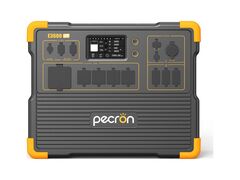
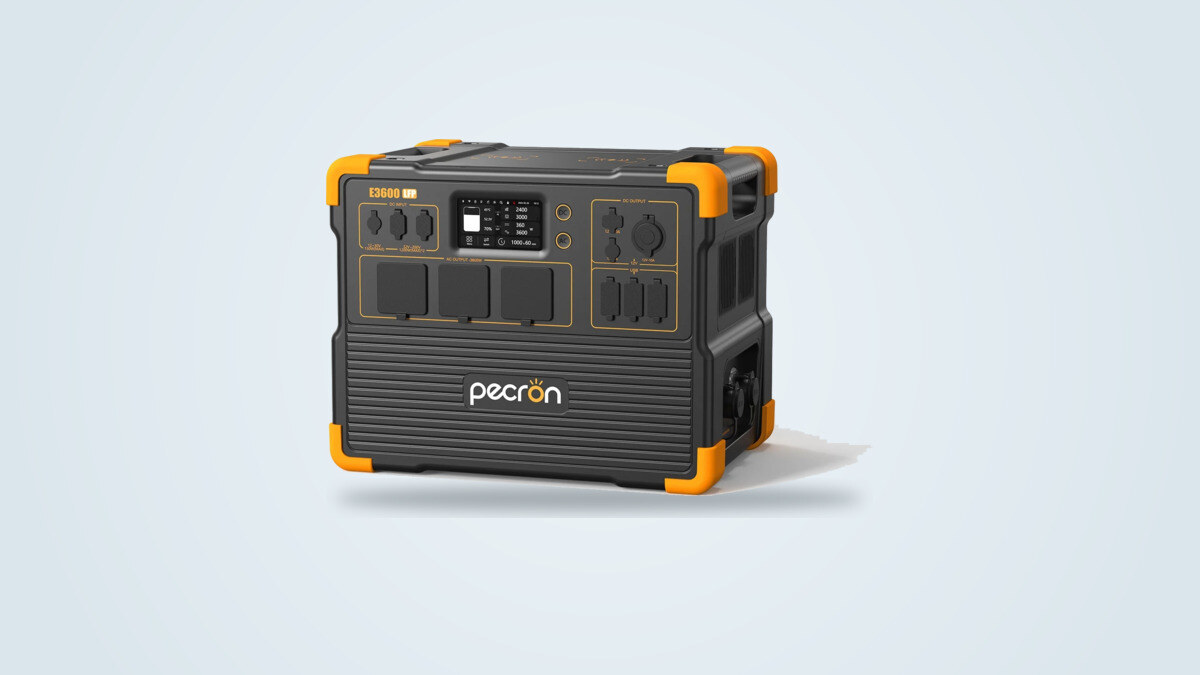
Pecron rates the E3600LFP at 3,072Wh, a base capacity that puts it near the top of the catalog's very-high-capacity bracket. As with any inverter-based station, the energy actually available at the output never matches the battery's chemical capacity: some of it feeds the conversion electronics, and that loss weighs proportionally more when the power drawn is low and the session runs long.
Under a high, continuous load (in the 3,000 to 3,300W range), efficiency comes in at around 89%, or roughly 2,700Wh actually available out of the claimed 3,072Wh, a solid result for this price bracket. The picture changes on a light, sustained load: continuous use at an average of about 90W for more than 25 hours delivered only around 2,300Wh, barely 75% of rated capacity. The gap comes down to the inverter's own power draw, which stays roughly fixed whatever is plugged in: on a small load, that fixed cost eats up a much bigger share of the total energy consumed.
In practice, the E3600LFP suits high-power, short-duration jobs (an induction cooktop, a power tool, a quick top-up) better than quietly holding very light loads for days on end, where its efficiency drops noticeably. One isolated report also describes a measured capacity well below the claimed figure on a single unit, with no answer from customer support judged satisfactory: no independent test has confirmed whether that case reflects an isolated fault or a wider issue.
Buying it on Amazon: a native option, with one detail to check
Unlike shoppers in the UK or the eurozone, US buyers can order the E3600LFP directly in dollars through Amazon, with no currency conversion or cross-border shipping to plan around. At $999 against a $2299 list price, it undercuts direct rivals of similar capacity by a wide margin, those typically run $1500 to $1900 in the US market. One thing worth checking before ordering: Pecron lists several bundle configurations of this same core unit on Amazon, some paired with extra batteries or a cart and priced well above the standalone unit, with combined capacities reaching into the 14 to 18kWh range. The figures in this review describe the standalone base unit alone, at its base 3,072Wh capacity and price.
One point worth a closer look for US and Canadian buyers specifically: the specification sheet behind this listing describes a 230V unit with three AC sockets and no RV-style outlet, the configuration sold in Europe. Pecron also sells a 120V version of the E3600LFP with five AC outlets, including an RV (TT30) plug, aimed at the North American market. Confirm which exact voltage and socket configuration a given listing ships before buying, since the two are not interchangeable.
The headline feature: expandable up to 15,360Wh
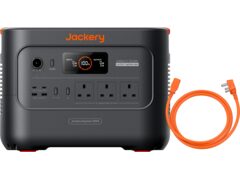
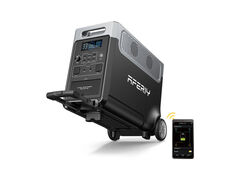
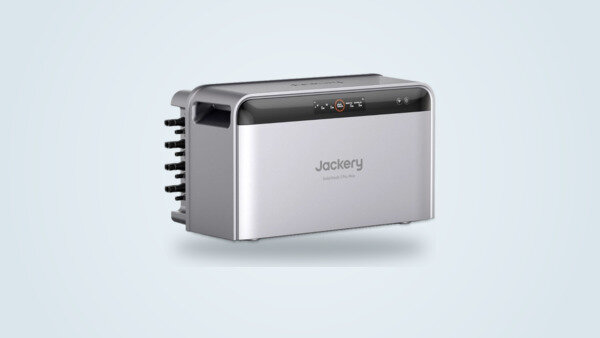
The E3600LFP's real selling point is not its starting capacity, unremarkable for this price bracket, but its ability to grow. Up to four EP3000-48V add-on batteries, sold separately, connect to the core unit without changing its inverter or control electronics, taking the total reserve to 15,360Wh (3,072 plus four times 3,072). That is, at the time of writing, the highest expansion ratio among this product's direct rivals: the Jackery Explorer 3000 v2 isn't expandable at all, and both the FOSSiBOT F3600 Pro and the AFERIY P310 cap out at 11,520Wh with the same number of add-on units.
This expandability changes what kind of purchase this is: a single unit covers an occasional outage or a portable job, while four add-on batteries turn it into a household reserve that can run for days without ever swapping the core unit. That's an appealing path for a household planning to grow its setup gradually rather than buying everything at once. One caveat worth keeping in mind: no reliable price for the EP3000-48V add-on batteries could be found at the time of writing, which makes it impossible to cost out a fully expanded setup.
AC recharging: the promise holds up
On paper, Pecron rates a full recharge at around 1.5 hours with the included 30A cable (up to 3,200W), or 2 hours with a standard 15A cable (1,800W). Those figures hold up: a 3,200W recharge wrapped up in a little over 1.5 hours, and an 1,800W recharge measured at around 2 hours 10 minutes, only a few minutes off the manufacturer's own numbers.
This is one of the areas where the spec sheet and real-world use line up most closely on this product. One point worth flagging: the minimum AC charging draw floors at around 400W even near the end of a charge, a level that could strain a small inverter or a light vehicle's power converter used to top up the unit on the road. For solar charging at the maximum combined 2,400W across both XT60 inputs, Pecron quotes a similar charge time, but no sufficiently detailed independent measurement could be found to confirm it.
3,600W continuous holds up, 7,000W peak needs a reality check
The spec sheet headlines 3,600W continuous and 7,000W peak. In the field, the continuous rating caused no issues: a fridge, a microwave, a portable air conditioner, a TV and laptop chargers all ran together without tripping any protection, though the combined loads tested topped out at around 2.9kW, short of the rated ceiling.
The 7,000W peak figure is a different story. A protection cutout tripped before reaching that threshold, at around 4,300W after about a minute of load in one case, and just under 5,800W in another. The two readings disagree with each other, which rules out settling on a single figure, but they agree on the broader point: the margin between the continuous rating and the real trip point is noticeably narrower than the 7,000W figure on the spec sheet suggests. For a typical home-backup load (fridge, lighting, electronics) that nuance changes nothing; for starting a high-inrush appliance (a compressor, a motor-driven tool), it would be unwise to bank on the full advertised figure.
2,400W of solar input: a genuine strength for this price bracket
The E3600LFP accepts up to 2,400W of combined solar input, split across two independent XT60 ports each run by its own MPPT controller (32 to 150V, 20A max per port). That's a level rarely matched at this price point: neither the Jackery Explorer 3000 v2, the FOSSiBOT F3600 Pro nor the AFERIY P310 publish an equivalent figure in their public specs. With two properly sized panel strings, a full solar recharge in a little over 1.5 hours of strong sun becomes theoretically possible, in line with the unit's own AC recharge speed.
Two precautions worth following to the letter, straight from the manufacturer's own documentation: never exceed 150V open-circuit voltage on a panel string, and never wire more than two 36V panels or more than four 18V panels in series on a single input. Going over that limit pushes the MPPT controller outside its rated voltage window, with no guarantee of effective protection.
14 outlets and Wi-Fi control, on a European-spec socket panel
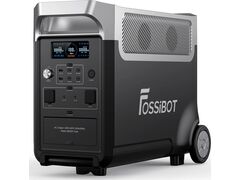
The official count is 14 outlets: three 230V sockets, four 18W USB-A ports, two USB-C ports (one at 100W), a 12V cigarette-lighter output, a 12V DC5525 output, a 12V/30A XT60 output, and two 15W wireless charging pads. For a station of this capacity, that's a decent but not outstanding line-up: the FOSSiBOT F3600 Pro, which scores higher on this front in our catalog, offers a port selection judged more complete for a comparable footprint.
As noted above, the exact unit this review describes runs on 230V with three AC sockets and no RV-style (TT30) outlet, the specification used in Europe. Pecron's separate 120V version for the North American market carries five AC outlets, including that RV plug, a materially different socket count worth confirming before ordering. Wi-Fi app control applies to both versions alike, with remote tracking of charge level and input/output power; the built-in LCD screen shows the same figures locally, with no need for an internet connection for everyday use.
Build quality: a young brand with a few documented rough edges
The E3600LFP's LiFePO4 battery system carries TÜV certification, and the cells are described as automotive-grade, UL-listed, according to the manufacturer's documentation. The chemistry is rated for over 3,500 cycles before dropping to 80% of its original capacity, in line with current LiFePO4 standards. The warranty is advertised as 5 years, but that breaks down into 2 years of full coverage followed by 3 years of support only, a less generous structure than a full 5-year warranty would be.
None of these reports describes a risk to people or property, and none has been corroborated by a second independent source. They do, however, sketch the picture of a brand still young on the market, one whose large-scale reliability track record is still being built, unlike more established players at the same price point.
Noise and heat: what can't be confirmed yet
Pecron publishes no noise rating for the E3600LFP, and no sufficiently documented independent measurement (calibrated meter, stated distance, stated load level) could be found at the time of writing. Clearly audible fan noise appears once charging or heavy output load kicks in, described as a whooshing sound with a buzz, though no usable figure could be found. As a precaution, this factor is left out of the sub-ratings breakdown below: a figure that hasn't been independently measured has no place in a rating, but that silence should not be read as a guarantee of quiet running.
The same applies to dust and water protection: no IP rating is published, which calls for caution before any permanent outdoor placement, despite a wide advertised operating range (-4 °F (-20 °C) to 113 °F (45 °C) on discharge, 32 °F (0 °C) to 113 °F (45 °C) on recharge). Fast charging at 3,200W brings a rise in internal temperature kept in check by the cooling fans, with no cutout or overheating, but again on a single unit and without a detailed measurement protocol.
Who it suits, and who it doesn't
With its 3,072Wh base capacity and 3,600W continuous output, the E3600LFP is aimed first at extended home backup: it runs a fridge, a freezer, a home router and lighting through an outage lasting several hours, and its UPS function switches the load onto the battery automatically the moment a mains outage is detected, protecting sensitive electronics from an abrupt restart. Paired with its generous solar input, it also suits serious off-grid use, a cabin, a workshop, a tiny house, where expandability up to 15,360Wh really pays off for riding out several sunless days.
In a large RV or on a job site without mains power, the continuous output covers most needs (an induction cooktop, power tools), with the same caveat around the unit's 79.4 lb (36 kg) weight, supplied without wheels as standard: this is a station you set down for the length of a stay or a job, not one you shift around often. At the other extreme, for a single light need, such as powering a CPAP machine overnight, the E3600LFP is considerably oversized: its base capacity alone covers a great many nights, and its weight only makes sense if the station is also doing double duty as wider home backup.
Versus the Jackery Explorer 3000 v2 and the FOSSiBOT F3600 Pro
On paper, the E3600LFP, the Jackery Explorer 3000 v2 and the FOSSiBOT F3600 Pro all target the same very-high-capacity bracket. Each has a different profile once the real figures are accounted for.
| Criterion | Pecron E3600LFP | Jackery Explorer 3000 v2 | FOSSiBOT F3600 Pro |
|---|---|---|---|
| Capacity | 3,072Wh | 3,072Wh | 3,840Wh |
| Expandable | Yes, up to 15,360Wh | No | Yes, up to 11,520Wh |
| Max solar input | 2,400W | Not disclosed | Not disclosed |
| Weight | 79.4 lb (36 kg) | 59.5 lb (27 kg) | ≈ 83.8 lb (38 kg) |
| Price observed | ≈ $999 | ≈ $1870 | ≈ $1580 |
| best-batteries.com rating | 4.0 | 4.2 | 4.3 |
The Jackery stands out for its noticeably lower weight (59.5 lb / 27 kg) and a better-established brand ecosystem, but it isn't expandable and publishes no solar-input figure at all. The FOSSiBOT offers a more generous base capacity (3,840Wh) and a port selection judged more complete, at a mid-range price. Against both, the E3600LFP wins on starting price relative to capacity and offers the widest expansion headroom of the three, at the cost of a less established brand, a peak power figure well above what it delivers in practice, and a socket configuration on this listing that buyers should double-check against their region.