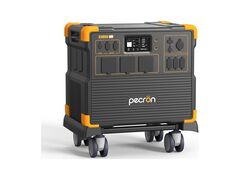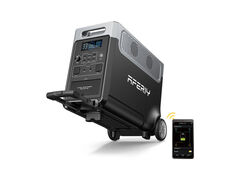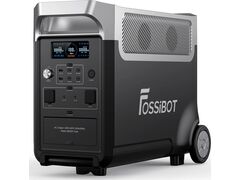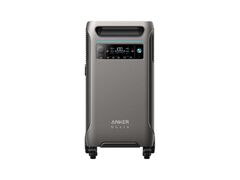
What the rated 3840Wh are really worth
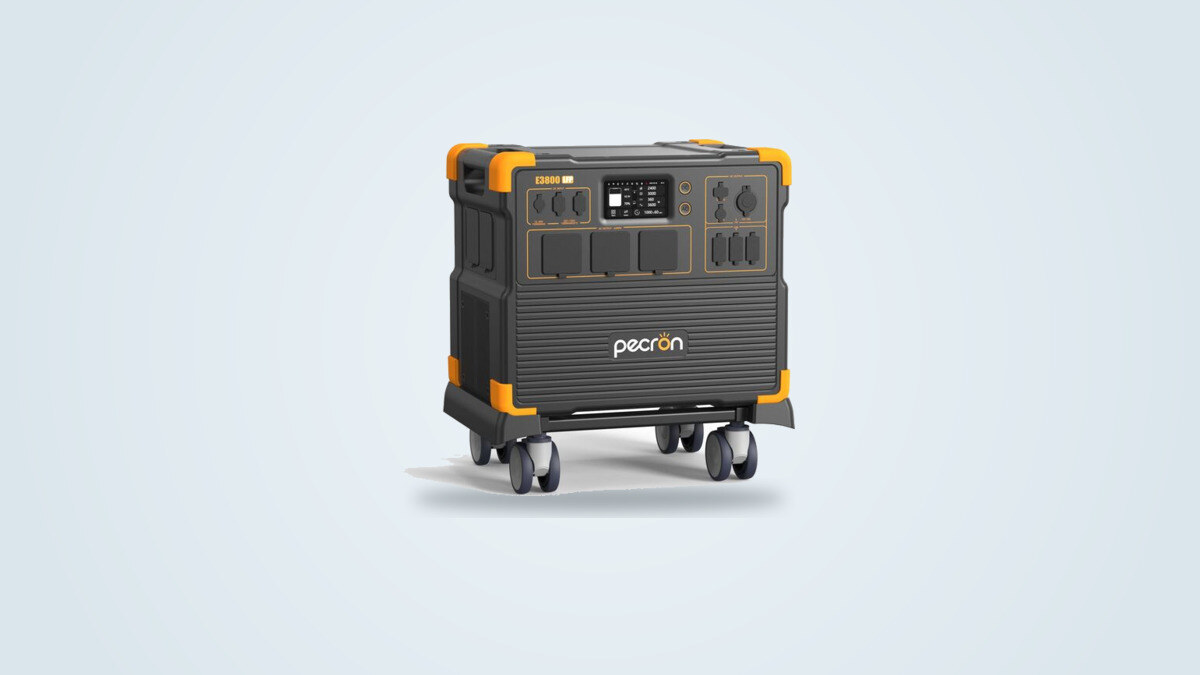
Pecron rates the E3800LFP at 3840Wh, a LiFePO4 battery at 51.2V (75Ah) rated for over 3500 cycles before dropping to 80% of its original capacity, a figure that's now standard for this chemistry. As with any device built around an inverter, the energy actually available at the output never matches the battery's raw chemical capacity: some of it powers the conversion electronics, a loss that weighs proportionally more when the power drawn is low and the use prolonged.
At the time of writing, this mechanism remains theoretical for the E3800LFP specifically: the product, launched in February 2026, is too new for an independent measurement of its real Wh output or its charge and discharge efficiency to have been found, whether in the US, European, Japanese or Chinese market. That's a different situation from other Pecron stations in the catalog, already on sale for several months by the time their own review was written, for which at least one figure, even an unprotocolled one, could be cross-checked. Here, the only data available is the maker's own: rated capacity and cycle count, with no independent confirmation to date.
As a purely theoretical, unmeasured reference point, 3840Wh works out, by simple arithmetic from the spec sheet, to enough to run a standard fridge for several consecutive days, or fully recharge a laptop several dozen times. That calculation assumes 100% efficiency, which is never physically the case: the real available figure will necessarily be lower, by a margin only an independent measurement could put a number on.
Record expandability, but a figure that shifts by market
The E3800LFP's most striking argument is its expandability: a dedicated port accepts up to six extra EP3800-48V battery packs, each rated by the maker at 3840Wh when sold on its own. Enough to turn an occasional-backup station into a household reserve capable of lasting several days without ever changing the central unit.
The figure quoted for that maximum varies, though, depending on which of the maker's listings you check. The general/European documentation rates a maximum of 22274Wh with the six modules, a total that implies an average contribution of around 3072Wh per added module, noticeably below the 3840Wh rated for that same module sold on its own. Listings aimed at the US market for the same product, by contrast, quote a single-unit maximum of around 26,880Wh with the same number of modules (that is, 3840Wh per module, with no shortfall), and up to 53,760Wh by pairing two units through the separately sold 240V Connect Box.
This roughly 21% gap between the two figures, for the same product and the same number of modules, has no known public explanation: it could reflect a simple mismatch between two regional marketing teams, or an actual technical limit specific to one of the product's electrical versions. Until that's clarified, it's safer to confirm the exact figure with the seller at the time of purchase rather than assume either number outright.
Recharging: the fastest in the Pecron lineup
On paper, recharging is the E3800LFP's most easily checkable strength, because the figure is repeated identically by the maker and by its listing: 100% in 84 minutes with the supplied 30A cable (up to 3200W), or around 2 hours 30 minutes with a standard 15A cable (1800W).
Relative to capacity, that speed puts the E3800LFP ahead of the whole Pecron lineup in the catalog: the smaller E3600LFP (3072Wh) needs around 1h30 with its own 30A cable, a proportionally slower charge rate. Against direct rivals of the same capacity in their own US listings, the gap is wider still: FOSSiBOT F3600 Pro rates 2 hours for the same full charge, and Aferiy P310's US listing rates 2 hours 30 minutes, both slower than the E3800LFP's 84 minutes. The Anker SOLIX F3800's US listing does not state a recharge time; its separate European listing rates 1h17.
No independent measurement was found confirming the E3800LFP's figure on a real unit, but it is repeated consistently across several distinct commercial sources without ever being contradicted, which limits the risk of a showroom figure with no bearing on reality.
4200W continuous: an output that beats its direct rivals
The E3800LFP's pure sine wave inverter delivers 4200W continuous, spread across its outlets. That's higher than the 3600W of the two direct rivals of the same capacity presented above, enough to run a fridge, a microwave and a space heater at the same time.
In practice, 4200W continuous is enough to stack several simultaneous loads without having to choose: a fridge (around 150W), a microwave (up to 1500W) and a space heater (up to 1500W) can all run together with a comfortable margin under the rated ceiling. That's a genuine advantage over less powerful stations, where such a combination would trip a protection cutoff.
No independent measurement of power delivery under load (behavior on difficult loads, real margin between continuous operation and the cutoff threshold) was found for this specific model. That's a gap worth keeping in mind, even though nothing in the available information points to a mismatch between the claim and reality, unlike other Pecron stations in the catalog where a rated peak figure turned out to be significantly overstated. For the E3800LFP, the maker only highlights the 4200W continuous figure: no numeric peak rating was found in its documentation, which limits this particular risk since there's no claim left to check.
3000W solar input: a genuine strength
The E3800LFP accepts up to 3000W of combined solar power, split across two independent XT60 ports each with its own MPPT controller (32 to 150V, 20A maximum per port). That's a rare figure at this price point: neither Aferiy P310 nor FOSSiBOT F3600 Pro quote an equivalent number in the public documentation checked for this review.
Two points flagged by the maker deserve to be followed to the letter: never exceed 150V open-circuit voltage on a panel string, and check voltage compatibility before connecting any third-party panel, since the maker's own documentation warns that a connection outside the accepted range can damage the unit. With two well-sized panel strings, a full solar recharge in a little over half a day of good sun becomes theoretically possible, a figure consistent with the same unit's mains recharge speed, though no independent measurement in the field has confirmed it.
As with any solar setup, the power actually received depends heavily on panel orientation, tilt and the weather on the day: the rated 3000W is a ceiling reached under optimal sun, not a guaranteed daily average. That's a limitation across the whole market, not something specific to the E3800LFP.
UPS function: a switchover rated at 8 to 20 milliseconds
The E3800LFP includes a UPS function that switches the load onto the battery within 8 to 20 milliseconds during a power outage, a delay the maker rates as short enough to stop a computer or router from rebooting. That's useful for protecting a sensitive IT or home-automation setup, on top of the station's broader role as an energy reserve.
This figure hasn't been independently verified for the E3800LFP, but it's consistent with what the maker quotes for the rest of its lineup, and with the usual standard for this kind of function on comparable stations. This UPS function doesn't replace a properly sized backup transfer panel for a fixed installation: it protects devices plugged directly into the station, not an upstream household circuit, unless a licensed electrician sets up a specific installation. For typical mobile backup use, that distinction doesn't matter.
A generous outlet count, but Bluetooth-only control
The US version of the E3800LFP outputs 120V across five AC-type outlets (four standard outlets plus one RV-style TT30-R socket), plus four 18W USB-A ports, two USB-C ports including one at 100W, a 12V car socket, a 12V/30A XT60 output and a DC5525 port. That's a generous line-up for a station of this capacity, with the RV-style outlet a genuine plus for anyone running recreational-vehicle equipment, and a 100W USB-C port that matches current expectations for charging a laptop directly.
Control is only available through a Bluetooth app: unlike several direct rivals of the same capacity, the E3800LFP offers no Wi-Fi connection, which limits monitoring and remote control to the unit's radio range, with no access from outside the home while away. For home backup use, where checking the charge level remotely during a long outage is sometimes exactly what you want, that's a real limitation compared with rivals offering both protocols. A built-in LCD screen shows charge level and input/output power locally, with no dependence on an internet connection for everyday use.
Build and warranty: a brand still building its reputation
Pecron rates the E3800LFP's cells as automotive-grade and UL-certified, a LiFePO4 chemistry rated for 3500 cycles at 80%, and a 5-year warranty split into 3 full years plus 2 years of support. That's a reasonable warranty structure, even if it remains less generous than a continuous 5-year full-cover warranty.
Chemically, the LiFePO4 (LFP) that Pecron uses across its whole E lineup remains the industry benchmark for high-capacity stations today: more full cycles than older NMC chemistries, a markedly lower risk of thermal runaway, and no cobalt. Those advantages belong to the chemistry itself, shared by nearly every rival named in this review, so they're not a distinctive selling point of the E3800LFP specifically. It's rated to run from -4 °F (-20 °C) to 113 °F (45 °C) on discharge and 32 °F (0 °C) to 113 °F (45 °C) on recharge, according to the maker, a wide range that covers most outdoor use even in the cold for discharge alone: below 32 °F (0 °C), only recharging needs to wait for a milder environment, standard behavior for this chemistry.
This caveat adds to something already known about another model in the lineup: the brand remains young in the US market, without the large-scale reliability track record of more established players at the same price point. No independent teardown was found for the E3800LFP, which rules out directly confirming the exact cells and power electronics used.
US version and European version: two electrically different products
Unlike a simple plug difference, the E3800LFP genuinely changes configuration between the version sold in the US and the one sold in Europe and the UK. The US version outputs 120V across five outlets (four standard outlets plus one RV-style TT30-R socket for recreational vehicles), at a rated continuous output of 4200W. The European and UK version outputs 230V, 50Hz, across three sockets in the local format, at the same rated continuous output of 4200W.
| Feature | US version | Europe / UK version |
|---|---|---|
| Output voltage | 120V | 230V, 50Hz |
| AC outlets | 4 standard outlets + 1 RV outlet (TT30-R) | 3 sockets, local format |
| Rated continuous output | 4200W | 4200W |
| 240V output | Only by pairing two units with the 240V Connect Box, sold separately | Native (European supply) |
| Rated maximum expansion | ≈ 26,880Wh (6 modules), 53,760Wh pairing two units | 22,274Wh (6 modules) |
This matters if you're interested in running large 240V household appliances (certain large appliances, well pumps, EV chargers): a single unit doesn't allow for it, you need to pair two complete units through the separately sold 240V Connect Box, an investment worth costing out in advance if that's the intended use. In Europe, this question doesn't come up at all, since the domestic supply is already natively 230V.
Buying the European or UK version to save money doesn't make sense for a US buyer either: plugging a 230V-rated unit into a 120V supply (or the reverse) won't work correctly and risks damage, on top of losing the warranty. Stick to the version sold for the US market.
Who it suits, and who it doesn't
With its base 3840Wh and 4200W continuous output, the E3800LFP is aimed first at serious home backup: it can cover a fridge, freezer, home router, lighting and microwave at once during a long outage, and its expandability means batteries can be added over time rather than over-buying up front. Paired with its generous solar input, it also suits serious off-grid use (cabin, workshop, an isolated vacation home), where gradual expansion makes sense to cover several sunless days.
In a large RV or as a semi-fixed setup in a converted van, the continuous output covers most needs (induction cooktop, coffee maker, power tools), with a reserve given the unit's 87.3 lb (39.6 kg): a station to install for the length of a stay rather than move around often, even if the included cart makes occasional handling easier. On a site with no power hookup or at an outdoor event, the total absence of combustion noise and fumes makes the difference where a gas generator is banned.
For a household simply looking to cover occasional outages of a few hours a year, a base capacity of 3840Wh and expandability built for several days are probably more than the real need calls for: a mid-capacity station with no expansion port would cover the same use at a lower cost. Expandability mostly makes sense for a household expecting a growing need and preferring to spread the investment over time rather than choosing an oversized fixed capacity from the start.
Conversely, for an isolated, light need (overnight power for a single small device, frequent nomadic use with daily moves), the E3800LFP is clearly oversized: its weight and bulk only make sense if the station also serves a broader home-backup role. Anyone who prioritizes a proven multi-year reliability record over a recent, not-yet-independently-verified spec sheet will also find more of a track record among more established brands in this segment.
Against Aferiy P310, FOSSiBOT F3600 Pro and Anker SOLIX F3800
On paper, these four stations target the same very-high-capacity segment at 3840Wh. Each has a different profile once rated features are weighed against each other in their own US listings.
| Criterion | Pecron E3800LFP | Aferiy P310 | FOSSiBOT F3600 Pro | Anker SOLIX F3800 |
|---|---|---|---|---|
| Continuous output | 4200W | 3600W | 3600W | 6000W |
| Expandable up to | 26,880Wh | 11,520Wh | 11,520Wh | 26,880Wh |
| Recharge | 100% in 84 min | 100% in 150 min | 100% in 120 min | not stated |
| Weight | 87.3 lb (39.6 kg) | 92.6 lb (42 kg) | 92.6 lb (42 kg) | 132.3 lb (60 kg) |
| Warranty | 5 years (3+2) | 7 years (5 conditional on registration) | 2 years | 5 years |
| Price | $1299 | $1299 | $1699.99 | $1999.99 |
| best-batteries.com rating | 4.0 | 4.2 | 4.3 | 4.1 |
At the same $1299 price as the Aferiy P310, the E3800LFP delivers 600W more continuous output and charges close to twice as fast (84 minutes against 150), while the Aferiy keeps the edge only on its rated 7-year warranty, of which just 2 years are automatic, the remaining 5 requiring online registration with the maker. The FOSSiBOT F3600 Pro, pricier at $1699.99 and heavier, doesn't stand out on any of the criteria above against the Pecron, though it does offer richer connectivity elsewhere. The Anker SOLIX F3800 matches the E3800LFP's US-market expansion ceiling and remains in a different league on power, but at $1999.99, roughly 1.5 times the price, and with a real efficiency of around 62% of the electricity consumed while charging, well below what its power figures might suggest.
In this comparison, the E3800LFP carries the most cautious rating of the group, not because its rated features are weaker (they are, if anything, favorable on power, weight and charge speed), but because none of the three rivals had to face such a complete absence of independent verification.