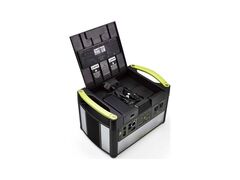
What the claimed 983Wh are really worth
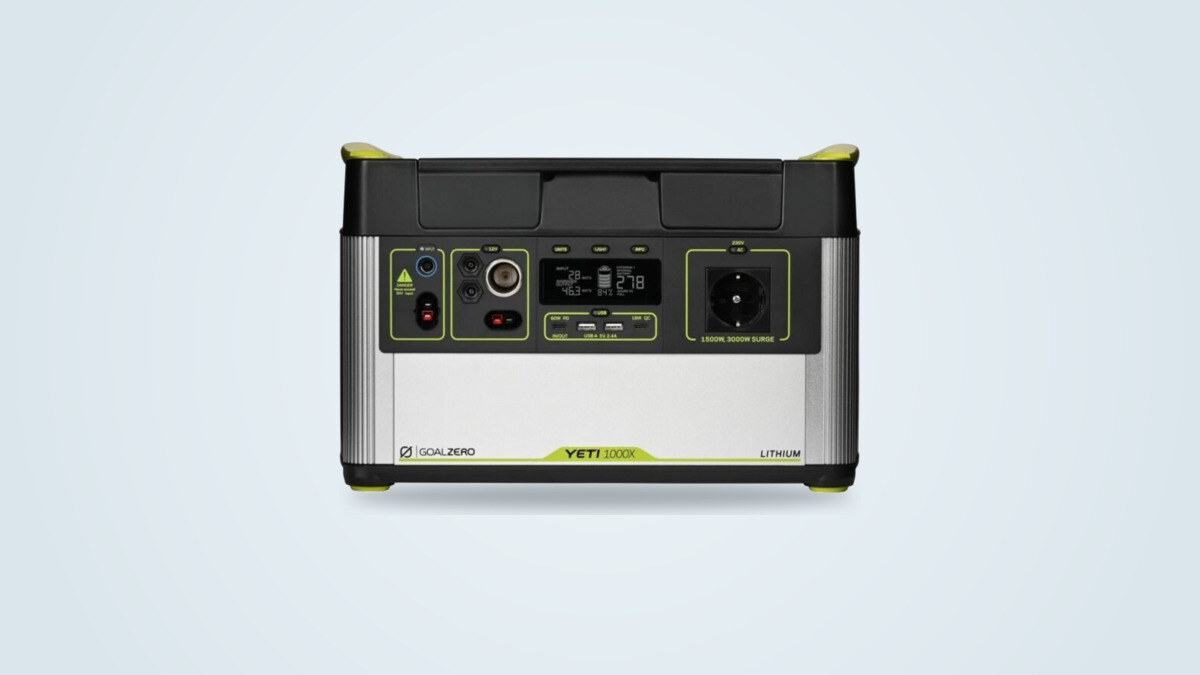
The Yeti 1000X's 983Wh is a nominal battery rating, measured at the lithium pack, not energy available as-is at the outlet. Between the two sits the inverter, which uses up some of the energy itself to convert the pack's DC current into AC, and that loss varies with the power drawn.
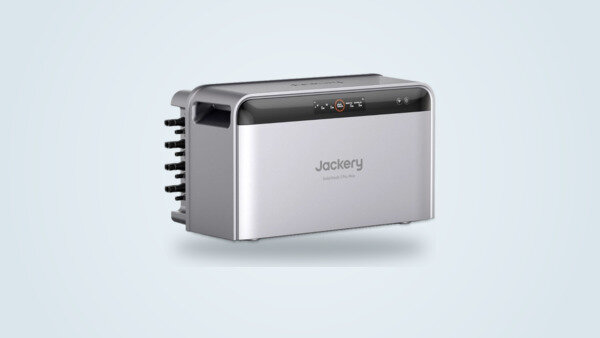
Discharged fully at low power through its USB port, the Yeti 1000X delivers 839.7Wh, an efficiency of 85.4% of the claimed 983Wh, a result slightly ahead of the same test on the Jackery Explorer 1000, a direct rival with almost identical capacity (1002Wh claimed). Under a far heavier load, close to 1370W (around 91% of its 1500W maximum continuous output), the reserve ran out in about half an hour, which works out to roughly 685Wh delivered, around 70% of the claimed capacity. The mechanism is the same as on most power stations: conversion losses rise with the square of the current drawn, so faster than the power itself.
One more figure is worth keeping in mind: idle draw, with the outlets powered on but nothing plugged in, sits between 7 and 8W, a gap of under 1W between two separate measurements. That is a low figure for this size of station, useful to know for anyone planning to leave the Yeti 1000X switched on permanently for home backup: over a full month, that standby draw alone adds up to between 5 and 6kWh.
NMC chemistry: the real cost of the Yeti 1000X
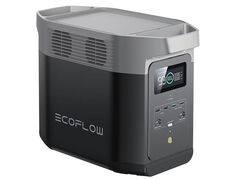
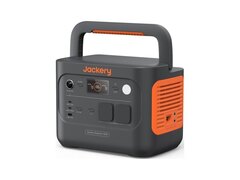
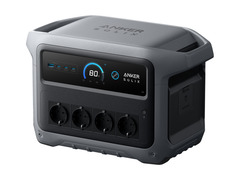
Like the rest of the Yeti X lineup, the Yeti 1000X uses NMC (nickel manganese cobalt) lithium-ion chemistry rather than LiFePO4 (LFP), now the norm on nearly every recent power station. The manufacturer rates it for only 500 charge cycles before it drops to 80% of its original capacity. Three direct rivals of comparable capacity claim, at the same 80% threshold, 3000 cycles each: the EcoFlow Delta 2, the Jackery Explorer 1000 v2 and the Anker SOLIX C1000, six times as many.
This technical choice reflects the age of the Yeti X lineup, launched in 2021, before LiFePO4 became standard at this price point. It still weighs directly on real running cost: a station recharged once a week hits its 500-cycle ceiling in a little under 10 years, where a 3000-cycle rival would last close to 58 years under the same routine. Goal Zero itself has since settled the question: the brand now sells an all-new sixth-generation Yeti lineup, including a LiFePO4 Yeti 1000 rated at 988Wh with over 4000 cycles and a 2000W inverter, which shares neither the casing nor the specs of the Yeti 1000X reviewed here despite the very similar name. This new series does not retroactively replace 1000X units already in circulation or still on shelves, but it confirms, from the manufacturer's own standpoint, that the 1000X's NMC chemistry is now a previous-generation technology.
1500W continuous: a promise kept, with no verified margin beyond it
On paper, the Yeti 1000X claims 1500W continuous and up to 3000W surge, with a pure sine wave inverter. A load close to 1370W, about 91% of the claimed continuous output, was held without a cutout or protection trip until the battery was fully drained. That is a solid result, even though no independent test has confirmed the full 1500W tier being held, nor the 3000W surge peak.
This unit ships with two 120V AC outlets. Running two AC-powered devices at once needs no extra hardware, though several direct rivals in this class ship with three or four outlets as standard. The version sold in Europe, by comparison, has only a single 230V outlet, making a power strip a near-requirement there.
Recharging: decent as standard, fast only as an option
The Yeti 1000X ships with a 120W wall charger, whose real input draw reaches 118W, and which took 8 hours and 32 minutes for a full charge from empty, a figure consistent with the manufacturer's own 9-hour estimate. Getting down to 4.3 hours requires an optional 230W supply; getting down to 2 hours requires an optional 600W supply through the High Power port, both sold separately and not included in the base price.
On solar, a built-in MPPT controller accepts up to 600W of input through Goal Zero's proprietary 0.3 in (8mm) connector, compatible with the brand's Boulder or Nomad panels. A 100W panel fully recharges the station in 12 to 24 hours depending on sunlight, and a 200W panel in 6 to 12 hours according to the manufacturer, with a 200W panel achieving a full charge in a little under 7 hours under favorable sunlight. The connector remains proprietary, less widespread than the MC4 standard used by most third-party panels: an adapter is needed to connect a solar panel from another brand.
No app, no Bluetooth: control is entirely local
Unlike the Yeti 1500X and the tiers above it (Yeti 3000X, 6000X, Pro), the Yeti 1000X has no Bluetooth, no WiFi and no mobile app: control happens entirely on the unit, through its built-in LCD screen and physical buttons. The Goal Zero Power app, which lets owners monitor and control the higher-tier models remotely, does not list this specific model among its compatible stations.
The LCD screen shows the essentials: charge percentage, input and output wattage, with no smartphone required. That is enough for a settled use case (home backup, a parked RV), but it leaves the owner without remote charge tracking, automatic alerts, or remote firmware updates, features now common across most direct rivals in this capacity range (EcoFlow, Jackery, Anker). For anyone who already owns a Yeti 1500X or a recent station from another brand, this return to purely local control can come as a surprise.
Build quality and safety recalls: what to know
The Yeti 1000X has a sturdy build, with two solid handles that make its 31.7 lb (14.37kg) easier to carry, in a format comparable to a small cooler. It has stayed on sale without interruption since launching in 2021, an unusual run for a segment where new generations typically arrive every 12 to 18 months.
Two accessories compatible with the Yeti 1000X have nonetheless been subject to an official fire-risk recall, both fixed free of charge by the manufacturer:
| Date | Accessory affected | Issue | Remedy |
|---|---|---|---|
| December 2020 | Yeti 25A Fast Charge power supply (model 98080) | Connection could loosen and overheat; three overheating incidents, no injuries | Free repair |
| June 2024 | Yeti Link expansion module and EC8 cables | Connection could melt; two cases of cable melting, minor property damage, no injuries | Free replacement kit |
In both cases, the affected part is an optional accessory, not the station itself: the Yeti 1000X does not appear in any recall as the primary product. Its warranty nonetheless remains capped at 2 years, short next to the 5 years offered by several recent LiFePO4 rivals.
Like most consumer lithium batteries, the Yeti 1000X is only rated for use between 32 °F (0 °C) and 104 °F (40 °C), both charging and discharging, with no internal battery-warming function: unheated outdoor winter use can push it into protection mode.
A real expansion ecosystem, but a costly one
The Yeti 1000X does not have a directly slot-in additional battery like some rivals, but it remains compatible with Goal Zero's expansion ecosystem: a Yeti Link module (around $400) lets owners connect one or more Yeti Tank batteries (from around $450 each), each adding 1200Wh of reserve, for a combined total capacity that can top 3400Wh. A Home Integration Kit (around $250) additionally lets the station tie into part of a home's electrical panel through a transfer switch.
This ecosystem turns the Yeti 1000X into a serious residential backup solution, but at a cost that far exceeds the station alone: the three accessories combined add up to more than $1,100, more than the station's own purchase price. For simple nomadic use or occasional backup, this expansion holds little interest; it targets extended home backup specifically.
Against the direct competition
How does the Yeti 1000X stack up against other stations in its capacity range (roughly 950 to 1100Wh)? Here is how it compares with three direct rivals.
| Criterion | Goal Zero Yeti 1000X | EcoFlow Delta 2 | Jackery Explorer 1000 v2 | Anker SOLIX C1000 |
|---|---|---|---|---|
| Capacity | 983 Wh | 1024 Wh | 1070 Wh | 1056 Wh |
| Chemistry | Li-ion NMC | LiFePO4 | LiFePO4 | LiFePO4 |
| Cycles at 80% | 500 | 3000 | 3000 | 3000 |
| Power | 1500 W (3000 W) | 1800 W (2700 W) | 1500 W (3000 W) | 1800 W (2400 W) |
| Remote control | None | App and Bluetooth | App and Bluetooth | App and Bluetooth |
| Warranty | 2 years | 5 years | 5 years | 5 years |
On paper, the Yeti 1000X offers slightly less capacity, far fewer cycles, no remote control and a shorter warranty than these three LiFePO4 rivals, generally at a higher price: a real drawback for anyone chasing the best capacity-per-dollar value. Its real edge lies elsewhere: Goal Zero is a pioneer of the category (founded in 2009), known for the sturdiness of its casings and its dedicated solar panel ecosystem (Nomad, Boulder), in a compact format that stays easy to carry with two hands.
Real-world availability in the US and overseas
Commercial availability of the Yeti 1000X shifts quickly and varies by market. In the US, the official list price stays at $999.95, though the unit is regularly out of stock directly from Goal Zero; past promotions have pushed the price well below that figure, just as other stretches have seen it climb past $1,300.
Overseas, the picture is patchier: availability through general retailers in the UK, France, Germany, Italy and Spain stays limited and irregular, with variable lead times, and several European retail listings still mix up the Yeti 1000X with its older predecessor, the Yeti 1000 Lithium (1045Wh, 40 lb), a different and heavier model that has been discontinued. Anyone buying from an overseas listing should check that the specs actually state 983Wh and about 31.7 lb (14.37kg) before ordering.
Who the Yeti 1000X suits, and who it does not
It suits anyone after a compact, sturdy station from a pioneering brand, who wants simple control with no dependence on an app or an online account, or who already uses Goal Zero's solar ecosystem (Boulder or Nomad panels) for home backup, RV or job-site use.
It does not suit anyone chasing the best capacity-per-dollar value on the market, who wants to control their station remotely from a smartphone, who plans very frequent use requiring hundreds of charge cycles a year, or who wants more than two outlets included as standard without an extra power strip.