EcoFlow Delta 3 Plus
(8 reviews)
The Delta 3 with the works: dual 1000 W solar input, 140 W USB-C and an advanced inverter, in a 1024 Wh station expandable to 5 kWh.
Buy at AmazonAs an Amazon Associate I earn from qualifying purchases.
Characteristics
- Capacity: 1024 Wh (LiFePO4, 4000 cycles)
- Output: 1800 W (X-Boost 2400 W)
- Solar: Dual MPPT up to 1000 W
- Recharge: 0 to 100% in 56 min (mains)
- Dual 1000 W solar, 140 W USB-C, NAS-ready UPS
Detailed overview: EcoFlow Delta 3 Plus 1024Wh power station
The EcoFlow Delta 3 Plus is the enriched version of the Delta 3: it keeps the 1024 Wh LiFePO4 battery (4000 cycles, about 10 years of regular use), the 1800 W output (up to 2400 W with X-Boost technology), the fast 0-100% recharge in 56 minutes from the mains and the expandability from 1 to 5 kWh, while adding three concrete upgrades that justify its higher positioning.
The first is the dual solar input, up to 1000 W split across two MPPT controllers: it halves solar recharge time versus the Delta 3, a decisive asset in a van, a second home or an off-grid setup. The second is the presence of 140 W USB-C ports (versus 100 W on the Delta 3), enough to charge a powerful laptop at full speed without going through the mains socket.
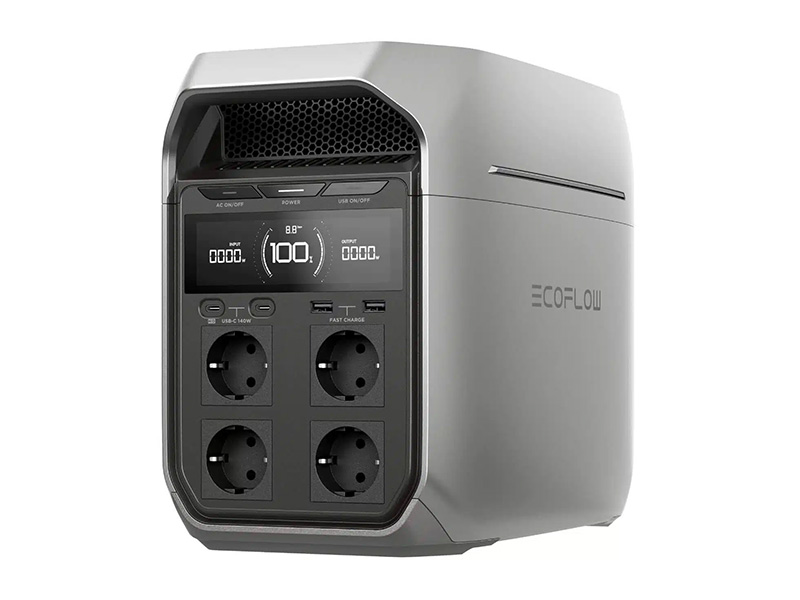
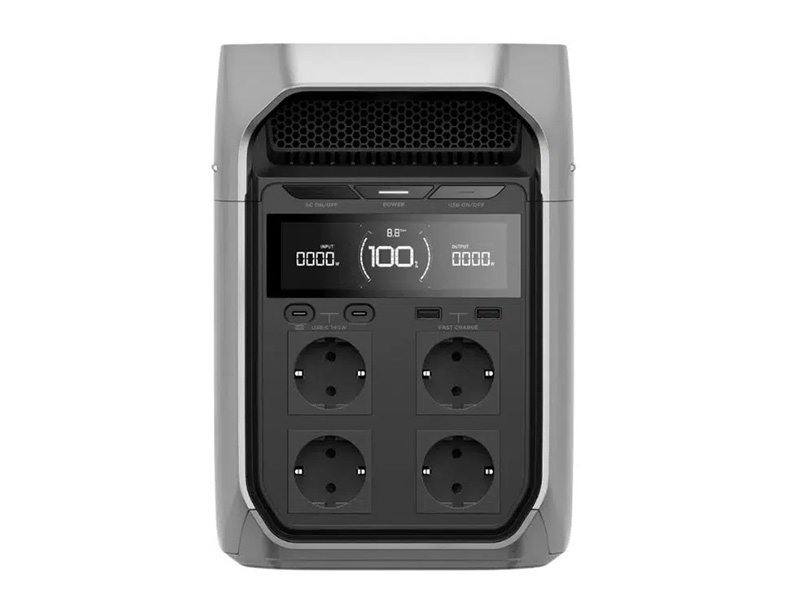
The third, more discreet but important for a connected office, is an advanced inverter (UPS) compatible with the NAS and HID protocols: during an outage, its switchover under 10 ms keeps not only essential devices but also a network storage server and its peripherals running, avoiding the abrupt shutdown that can corrupt data. It offers 4 AC outlets, 2 USB-C 140 W ports, 2 USB-A ports and a 12 V output, and is controlled from the EcoFlow app (Wi-Fi and Bluetooth).
Identical in weight and size to the Delta 3 at 27.6 lb (12.5 kg), the Delta 3 Plus is for anyone who often recharges via solar, uses powerful USB-C devices or wants to secure a NAS. For simpler use, the base Delta 3 remains an excellent choice at a lower cost.
Full specifications
Detailed characteristics (EAN: 4895251626354)
Battery and capacity
| Rated capacity?Total stored energy in watt-hours. The higher the figure, the longer the runtime. | 1024 Wh |
|---|---|
| Delivered energy, measured?Energy that actually leaves the battery and reaches the devices. Always below the stored energy, as conversion costs heat. Taken from our in-depth review. | 860 Wh |
| Max capacity (with extensions)?Total capacity reachable by adding extra batteries. | 5120 Wh |
| Expandable capacity?Whether capacity can be increased with add-on batteries. | Yes |
| Removable battery?The main battery can be removed or replaced by the user. | No |
| Battery chemistry?LiFePO4 (LFP) lasts far longer and is safer than NMC. | LFP (LiFePO4) |
| Charge cycles?Number of full charges before capacity drops to the stated threshold. | 4000 cycles (80 %) |
| Pack nominal voltage?Internal battery voltage; higher voltage helps deliver high power. | 51.2 V |
AC output
| Continuous AC power?Power the unit can sustain continuously on its 230 V outlets. | 1800 W |
|---|---|
| Surge power?Brief peak tolerated when starting motor or compressor devices. | 3600 W |
| Boost-mode power?Extended power via a proprietary mode (X-Boost, AmpUp…) by lowering voltage. | 2400 W |
| Inverter type?A pure sine wave is essential for sensitive electronics and motors. | Pure sine wave |
| AC voltage / frequency?Voltage and frequency of the AC output (230 V / 50 Hz in Europe). | 230 V / 50 Hz |
| Number of 230 V AC outlets?Number of mains outlets available on the unit. | 4 |
| RV / TT-30 outlet?Dedicated 30 A outlet for North-American style RVs. | No |
Recharging
| Max AC charging power?Maximum power drawn from a wall socket; higher means faster charging. | 1500 W |
|---|---|
| AC charge 0-100%?Stated time for a full charge on mains power. | 56 min |
| Max solar input?Maximum solar power accepted at the input (PV panels). | 1000 W |
| Accepted solar voltage?Panel voltage range compatible with the solar input. | 11 to 60 V |
| Max solar current?Maximum current accepted on the solar input. | 15 A |
| MPPT controllers?Number of independent MPPT solar inputs (yield optimisation). | 2 |
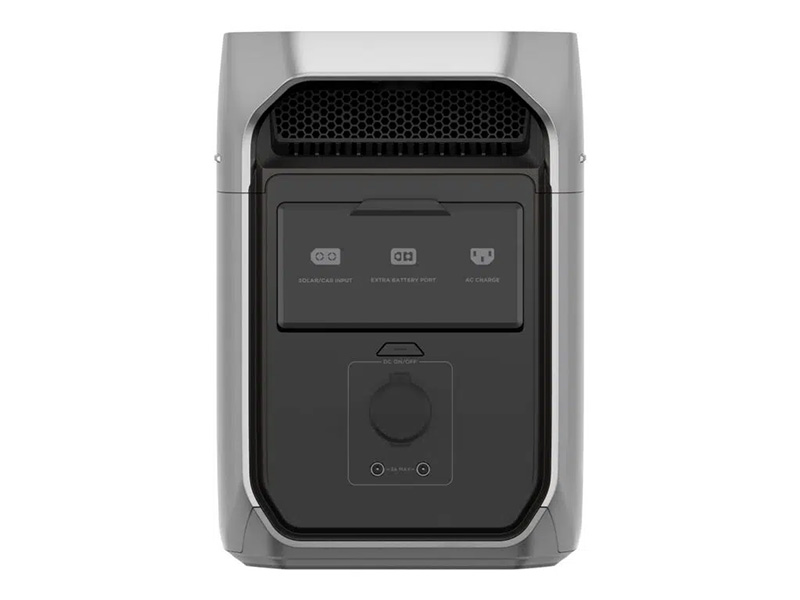
| Vehicle charging (12/24 V)?Can be charged from a vehicle's cigarette-lighter socket. | Yes |
| Pass-through charging?The unit can power devices while charging (pass-through). | Yes |
Ports and connectors
| USB-C ports?Number of USB-C ports and the fastest port's power (laptops, phones). | 2 × 140 W |
|---|---|
| USB-A ports?Number of USB-A ports and maximum power (small devices). | 2 × 36 W |
| 12 V output (car socket)?12 V cigarette-lighter output and its power (coolers, pumps…). | Yes (126 W) |
| Other DC outputs?Additional DC connectors (Anderson, DC5521, XT60…). | DC5521 |
Portability
| Weight?Net weight of the unit, battery included. | 27.6 lb (12.5 kg) |
|---|---|
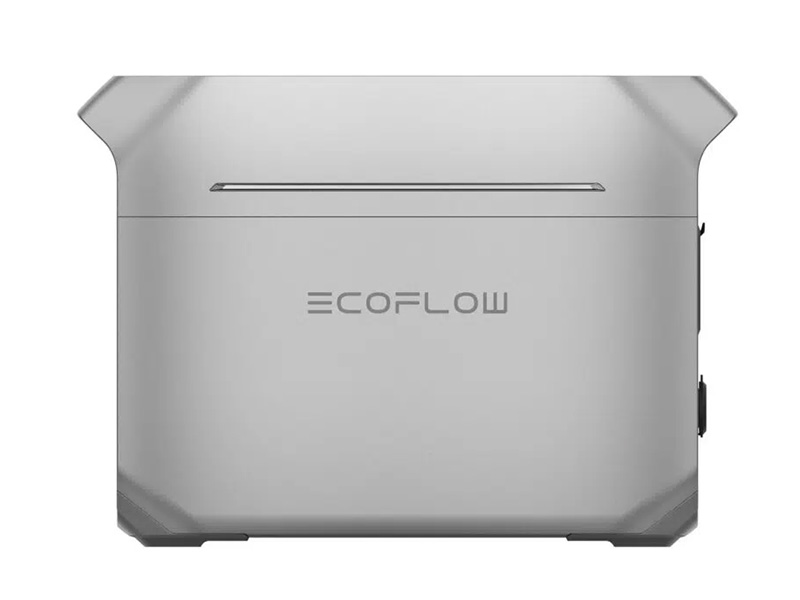
| Dimensions (L × W × H)?Overall size of the unit in millimetres. | 15.7 × 7.9 × 11.2 in (398 × 200 × 284 mm) |
| Form factor?Portable (hand-carried), transportable (heavy), or wheeled. | Portable |
| Wheels?Built-in wheels for moving the unit. | No |
| Telescopic handle?Retractable handle like a wheeled suitcase. | No |
Safety and environment
| Certifications?Standards and approvals obtained (CE, RoHS, UN38.3, UL…). | CE, RoHS, UN38.3 |
|---|---|
| Discharge temperature?Temperature range in which the unit can deliver power. | 14 to 113 °F (-10 to 45 °C) |
| Charge temperature?Temperature range in which the unit can be recharged. | 32 to 113 °F (0 to 45 °C) |
Backup / UPS
| UPS / EPS mode?Automatic switch to battery on a mains outage (backup). | Yes |
|---|---|
| Switchover time (rated)?Delay before switching to battery; under 20 ms suits a PC or router. | 10 ms |
Noise and thermal
| Noise level (rated)?Manufacturer-stated noise; a quiet room is around 30 dB. | 30 dB(A) |
|---|---|
| Quiet mode?Setting that limits fan noise, often by capping charge power. | No |
| Self-heating battery?Battery pre-heating to allow charging in cold weather. | No |
Display and connectivity
| Display?Type of screen showing power, runtime and alerts. | LCD |
|---|---|
| Bluetooth?Bluetooth link for nearby control. | Yes |
| Wi-Fi?Wi-Fi connection for remote control and monitoring. | Yes |
| Mobile app?iOS / Android app to control the unit. | Yes |
| Local control (no cloud)?Control possible over Bluetooth without an account or internet. | Yes |
| Solar connector?Connector type of the solar input (XT60, Anderson, MC4…). | XT60i |
Availability and warranty
| Market launch?Date the model first became available on the European market. Useful to place its generation: technology moves fast in this segment, and a device several years old may be at the end of its commercial life. | December 2024 |
|---|---|
| Warranty?Length of the manufacturer's warranty. | 5 years |
User manual / Instructions for use
⚡ How long will this power station run a device?
With 1 024 Wh, the EcoFlow Delta 3 Plus external battery runs a fridge (50 W) for ~17h or an LED TV (90 W) for ~9h40.
| Home | Runtime |
|---|---|
| Fan (45 W) | ~19h |
| Freezer (60 W) | ~15h |
| American fridge (150 W) | ~5h50 |
| Hair dryer (1800 W) | ~30 min |
| Outdoor & workshop | Runtime |
|---|---|
| CPAP machine (40 W) | ~22h |
| Water pump (60 W) | ~15h |
| Games console (200 W) | ~4h20 |
| Circular saw (1200 W) | ~45 min |
Rough estimate: real consumption varies, and very power-hungry appliances (heating elements) must stay below the output power.
What is this power station best for?
-
Home & Power cuts Ideal
The Delta 3 Plus is particularly at ease as home backup thanks to its advanced inverter: its UPS switchover under 10 ms protects the router, computer and lighting, and above all it supports the NAS and HID protocols, which shields a network storage server and its peripherals during an outage, where a classic station might cut a NAS and corrupt data. Its 1024 Wh cover these loads for several hours, expandable to 5 kWh with add-on batteries to last through a long outage. Its 1800 W (2400 W X-Boost) handle an occasionally demanding appliance, and its 0-80% recharge in 40 minutes tops it up fast when power returns. LiFePO4 cells (4000 cycles) and a 5-year warranty make it a reliable, scalable backup designed for the connected office.
-
Remote work Ideal
For a demanding mobile workstation, the Delta 3 Plus goes further than the base Delta 3: its two USB-C ports reach 140 W, enough to charge a powerful laptop at full speed while running screens, router and lighting on its 1800 W. Its UPS function (switchover under 10 ms) with NAS and HID support protects an entire connected workstation, down to the storage server, without ever interrupting a render or a video call. Its 1024 Wh ensure long hours of connectivity, expandable to 5 kWh, and its full recharge in 56 minutes brings it back online fast. Compact and quiet (30 dB), it suits a studio, a creative workshop or a shared workspace.
-
Motorhome & Van life Ideal
Expandable to 5 kWh and built for solar, the Delta 3 Plus accompanies a van or motorhome for several days: its 1024 Wh run fridge, lighting, ventilation, water pump and light cooking, and an add-on battery multiplies autonomy. Its dual solar input up to 1000 W (two MPPT controllers) recharges twice as fast as a single input, a real asset at a stopover on a sunny day, and its 56-minute mains recharge tops it up at a service area during a break. Its 1800 W handle an occasionally demanding appliance, and its quiet operation (30 dB) preserves the calm of nights. At 27.6 lb (12.5 kg), it adds no weight over the base Delta 3.
-
Off-grid & Solar Suitable
Its dual solar input up to 1000 W (two MPPT) makes the Delta 3 Plus an excellent solar storage core for an off-grid location: cabin, workshop, tiny house or second home. It recharges fast in the sun and runs a fridge, lighting, pump and tools on its 1800 W, while its expansion to 5 kWh increases autonomy as needed. Its LiFePO4 cells (4000 cycles) withstand years of daily cycling, and app control makes it easy to track production and consumption. For year-round permanent self-consumption, add panels and expansion batteries.
-
Job site & Tools Suitable
On an off-grid worksite, the Delta 3 Plus delivers versatile power and fast solar recharging: its 1800 W (3600 W surge) start and run a drill, sander, jigsaw or a small compressor, and its four outlets feed several stations. Its 1024 Wh cover a good part of a day, expandable to 5 kWh, and its 1000 W dual solar input recharges fast on site on a sunny day, without a generator's noise. At 27.6 lb (12.5 kg), it moves easily from one spot to another. For very demanding tools or a full intensive day, aim for a higher-capacity station or the expansion.
Our team's recommendations based on the model's capacity, output power and weight.
Comparison
Around $946.45 the EcoFlow Delta 3 Plus compares to power stations of about 1 kWh, targeted by searches like "1000W power station" or "expandable portable battery". Here is how it stands against three references: the EcoFlow Delta 3 (its base version), the Anker SOLIX C1000 and the Bluetti AC180.
| Criterion | EcoFlow Delta 3 Plus | EcoFlow Delta 3 | Anker SOLIX C1000 | Bluetti AC180 |
|---|---|---|---|---|
| Capacity | 1024 Wh | 1024 Wh | 1056 Wh | 1152 Wh |
| AC output | 1800W (X-Boost 2400W) | 1800W (X-Boost 2400W) | 1800W | 1800W |
| Solar input | 1000 W (dual MPPT) | 500 W | 600 W | 500 W |
| USB-C max | 140 W | 100 W | 100 W | 100 W |
| Observed price | ≈ $946.45 | ≈ $878.75 | ≈ $924.78 | ≈ $809.69 |
In short, the Delta 3 Plus stands out with its dual 1000 W solar input (the fastest of the group), its 140 W USB-C ports and its NAS/HID-compatible inverter, advantages that neither the base Delta 3 nor the Anker or Bluetti match. Versus the Delta 3, it charges about $67.70 more for these three features: worth it if you recharge via solar, use a powerful laptop or protect a NAS, superfluous for more basic use. It is the best 1 kWh Delta 3 for a connected office or a solar setup.
Related video
Video: EcoFlow Delta 3 Plus Review: 1,800W Power, 1kWh LFP Battery - Worth It? - Published on 28/02/2026
Our tester's review: Christophe Delpuech
We compared the Delta 3 Plus to the base Delta 3 over several weeks, and the premium justifies itself as soon as you use one of its three real new features. The dual solar input up to 1000 W is the most telling: with two panels, it recharges visibly faster than a single-input station, a real plus in a van or a second home. The 140 W USB-C ports charge our laptops at full speed, without going through the mains brick. And above all, the inverter's NAS and HID compatibility kept our storage server and its software UPS perfectly stable during our outage tests, where a classic station might have cut the NAS. Otherwise, you get everything that makes the Delta 3 strong: 1024 Wh, 1800 W (2400 W X-Boost), 56-minute recharge and expansion to 5 kWh. One useful point: it is no heavier than the Delta 3, 27.6 lb (12.5 kg) in both cases, so the premium costs nothing in bulk. The one real caveat: if you use neither fast solar, nor the 140 W, nor the NAS, the base Delta 3 is enough and costs less. But for a connected office or a solar setup, the Plus is the right choice.
In-depth review EcoFlow Delta 3 Plus: our full review 4.3/5 Read our full review → Capacity and efficiency 4.3 Delivered power 4.0 Recharging 4.7 Ports and control 4.7 Build and endurance 4.3 Noise not measuredFrequently asked questions: EcoFlow Delta 3 Plus 1024Wh power station
Both share 1024 Wh, 1800 W and one expansion port. The Delta 3 Plus adds a dual solar input of up to 1000 W across two regulators (against 500 W on a single one), USB-C ports at 140 W (against 100 W) and NAS and HID support, for around 100 pounds more.
Yes. Its dual solar input, up to 1000 W split across two MPPT controllers, recharges about twice as fast as a single 500 W input, a real asset in a van, a second home or off-grid.
Yes, but not to 5 kWh with just any battery. The Delta 3 Plus has a single expansion port: with a 1024 Wh Delta 3 add-on battery it reaches 2048 Wh. The advertised 5120 Wh requires a 4096 Wh Delta Pro 3 battery, which is far more expensive and far heavier.
Yes, it is one of its assets. Its advanced inverter switches over in under 10 ms and supports the NAS and HID protocols, keeping a network storage server and its peripherals running without an abrupt shutdown, avoiding data corruption.
Need help choosing?
Other products in the "Versatile power stations" category
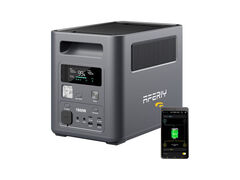
Aferiy P010
See price (3)
512Wh and 800W (1600W surge) in a 14.3 lb (6.5 kg)/14.3lb frame, UL/FCC/PSE certified for the US market, backed by up to a 7 year Aferiy warranty.
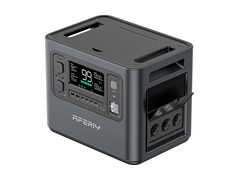
Aferiy P180
See price (7)
1024Wh expandable up to 5120Wh, 1800W (3600W peak) across four AC outlets, UL listed and under 30dB: the Aferiy P180 aims for quiet, flexible backup.
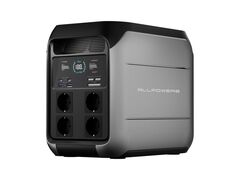
Aferiy P210
See price (7)
With 2048 Wh, 2400 W (up to 4800 W peak), a LiFePO4 battery and a 7-year warranty, the Aferiy P210 targets the best capacity-to-price ratio on the market.
Allpowers P1800
$439.00 (6)
A 1 kWh LiFePO4 power station with plenty of punch, fast wall-outlet recharging and quiet running: a smart pick for camper vans, camping and power outages.
Published on 02/09/2026, updated on 18/09/2026