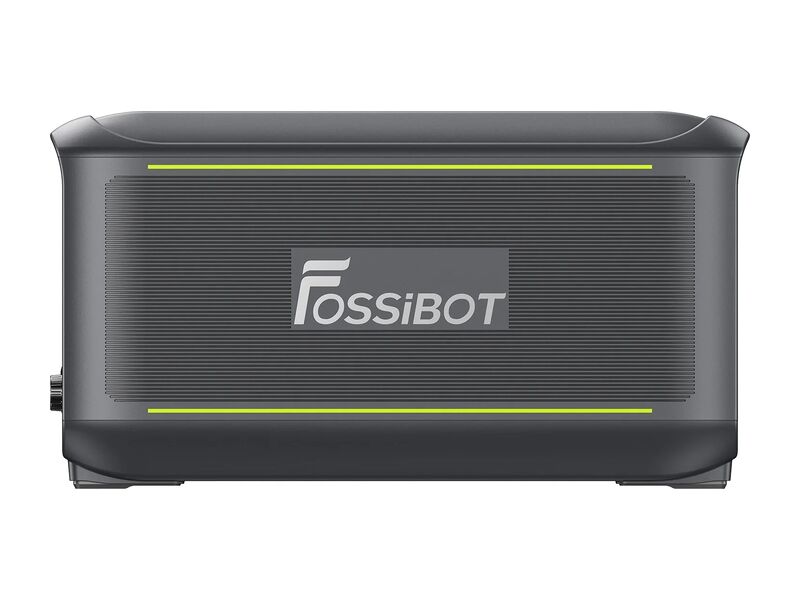
Fossibot F3000
(6 reviews)
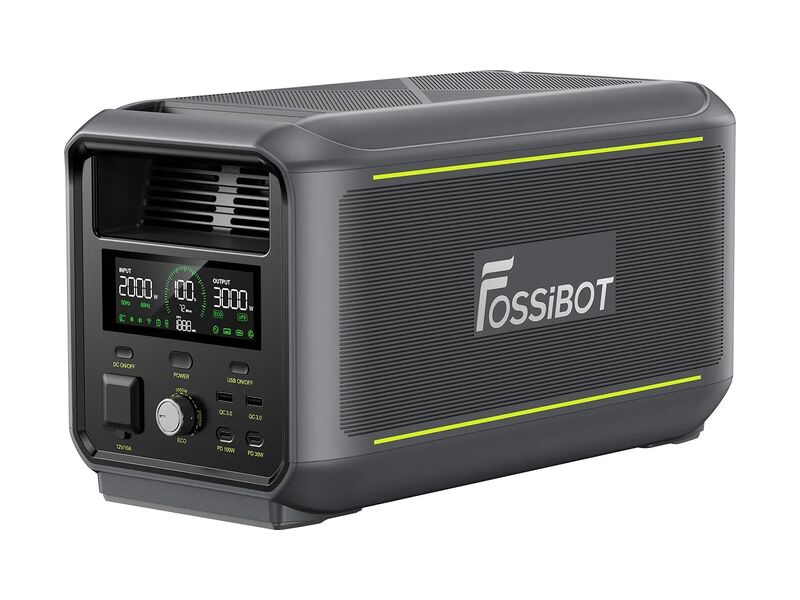
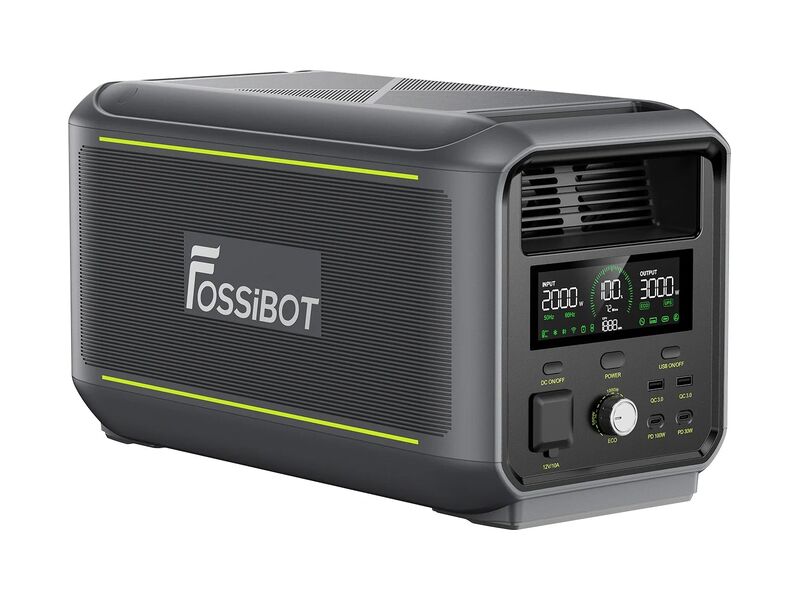
More powerful and lighter than the F2400, the Fossibot F3000 recharges in a little over an hour and doubles as a backup UPS when the grid drops out.
Characteristics
- Capacity: 2048Wh (LiFePO4 battery, 4000 cycles)
- Power: 3000W continuous, 6000W peak
- Outputs: 3 AC outlets (230V), 2 USB-C (100W max), 2 USB-A, 12V/10A
- Recharge: Full in about 1.2h (2000W AC)
- 3000W, 2000W recharge and UPS in 42.3 lb
Detailed overview: Fossibot F3000 - photo 2
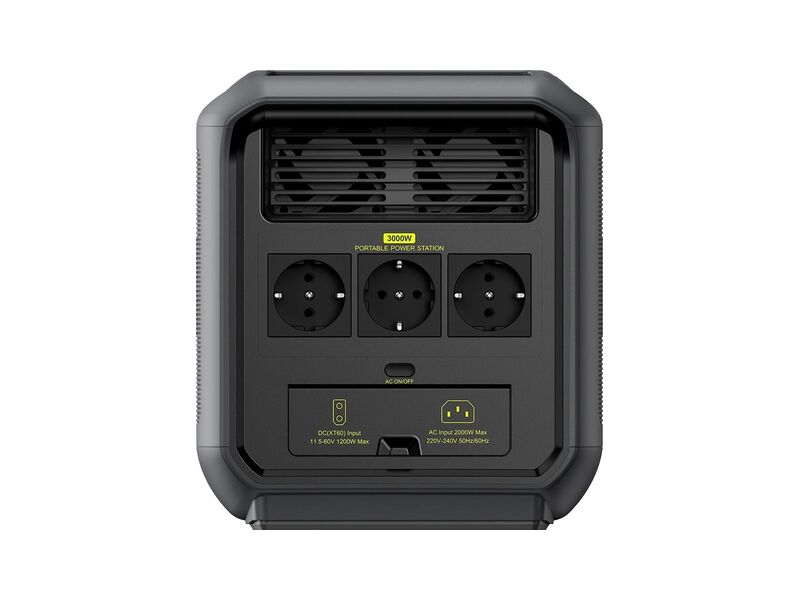
The Fossibot F3000 is the most ambitious 2 kWh power station in the brand's range. It pairs a 2048Wh LiFePO4 battery, rated for more than 4000 cycles, with a pure sine wave inverter delivering 3000W continuous, with surges up to 6000W to start a compressor or an angle grinder. Three 230V outlets share that output: a fridge, a kettle and a few small tools can run together, within the 3000W combined limit. The unit described here is the 230V European version.
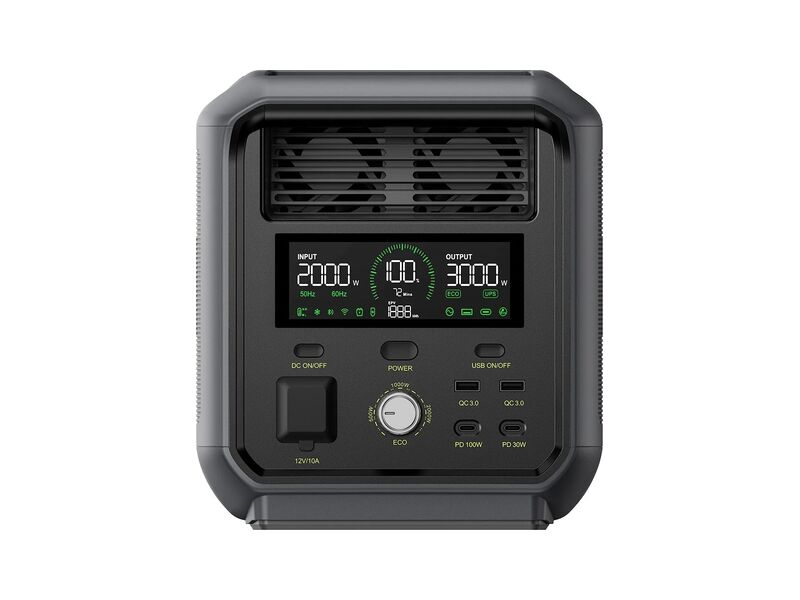
It is mostly on recharging that it improves on the F2400. From a wall outlet, the input rises to 2000W: about 52 minutes to reach 80% and 1.2 hours for a full charge. A dial on the front limits the input to 500, 1000 or 2000W, handy on a fragile installation or with a generator. The XT60 solar input accepts up to 1200W (12 to 60V, 25A maximum), against 500W on the F2400. An FAC580 alternator charger, sold separately, also lets you recharge while driving, the car socket being very slow.
During an outage, the UPS function switches to battery in under 10 ms, enough to keep a computer and a router running; in this mode, output is limited to 2000W and AC input to 300W. Smart ECO mode favors solar and battery power and only returns to the grid when the charge gets low. The Fossibot+ app (2.4 GHz Wi-Fi and Bluetooth) lets you monitor charging, set schedules and adjust the input power, with an offline mode that needs no account.
Connectivity includes three 230V outlets, two 18W USB-A ports, two USB-C ports (100W and 30W) and a 12V/10A car socket, with no dedicated RV outlet. The unit measures 18.1 x 8.7 x 9.9 in (461 x 220 x 252 mm) and weighs 42.3 lb (19.2 kg), runs from 14 °F to 104 °F (-10 °C to 40 °C), charges from 32 °F to 104 °F (0 °C to 40 °C) and is rated under 35 dB.
The limits: capacity cannot be expanded with a dedicated battery (only a do-it-yourself connection of an external 12, 24 or 48V battery, 15A maximum, is provided through the app), the warranty is 2 years with an announced 3-year extension, and, the product being very recent, independent measurements of delivered capacity and noise under load are still missing, the manual even tolerating fan noise up to 60 dB.
Full specifications
Detailed characteristics
Battery and capacity
| Rated capacity?Total stored energy in watt-hours. The higher the figure, the longer the runtime. | 2048 Wh |
|---|---|
| Expandable capacity?Whether capacity can be increased with add-on batteries. | No |
| Removable battery?The main battery can be removed or replaced by the user. | No |
| Battery chemistry?LiFePO4 (LFP) lasts far longer and is safer than NMC. | LFP (LiFePO4) |
| Charge cycles?Number of full charges before capacity drops to the stated threshold. | 4000 cycles (80 %) |
| Pack nominal voltage?Internal battery voltage; higher voltage helps deliver high power. | 51.2 V |
AC output
| Continuous AC power?Power the unit can sustain continuously on its 230 V outlets. | 3000 W |
|---|---|
| Surge power?Brief peak tolerated when starting motor or compressor devices. | 6000 W |
| Inverter type?A pure sine wave is essential for sensitive electronics and motors. | Pure sine wave |
| AC voltage / frequency?Voltage and frequency of the AC output (230 V / 50 Hz in Europe). | 230 V / 50 Hz |
| Number of 230 V AC outlets?Number of mains outlets available on the unit. | 3 |
| RV / TT-30 outlet?Dedicated 30 A outlet for North-American style RVs. | No |
Recharging
| Max AC charging power?Maximum power drawn from a wall socket; higher means faster charging. | 2000 W |
|---|---|
| AC charge 0-80%?Stated time to go from 0 to 80% on mains power. | 52 min |
| AC charge 0-100%?Stated time for a full charge on mains power. | 72 min |
| Max solar input?Maximum solar power accepted at the input (PV panels). | 1200 W |
| Accepted solar voltage?Panel voltage range compatible with the solar input. | 12 to 60 V |
| Max solar current?Maximum current accepted on the solar input. | 25 A |
| MPPT controllers?Number of independent MPPT solar inputs (yield optimisation). | 1 |
| Vehicle charging (12/24 V)?Can be charged from a vehicle's cigarette-lighter socket. | Yes |
| Pass-through charging?The unit can power devices while charging (pass-through). | Yes |
Ports and connectors
| USB-C ports?Number of USB-C ports and the fastest port's power (laptops, phones). | 2 × 100 W |
|---|---|
| USB-A ports?Number of USB-A ports and maximum power (small devices). | 2 × 18 W |
| 12 V output (car socket)?12 V cigarette-lighter output and its power (coolers, pumps…). | Yes (120 W) |
Portability
| Weight?Net weight of the unit, battery included. | 42.3 lb (19.2 kg) |
|---|---|
| Dimensions (L × W × H)?Overall size of the unit in millimetres. | 18.1 × 8.7 × 9.9 in (461 × 220 × 252 mm) |
| Form factor?Portable (hand-carried), transportable (heavy), or wheeled. | Portable |
| Wheels?Built-in wheels for moving the unit. | No |
| Telescopic handle?Retractable handle like a wheeled suitcase. | No |
Safety and environment
| Certifications?Standards and approvals obtained (CE, RoHS, UN38.3, UL…). | FCC, CE, PSE, RoHS, UN38.3 |
|---|---|
| Discharge temperature?Temperature range in which the unit can deliver power. | 14 to 104 °F (-10 to 40 °C) |
| Charge temperature?Temperature range in which the unit can be recharged. | 32 to 104 °F (0 to 40 °C) |
Backup / UPS
| UPS / EPS mode?Automatic switch to battery on a mains outage (backup). | Yes |
|---|---|
| Switchover time (rated)?Delay before switching to battery; under 20 ms suits a PC or router. | 10 ms |
Noise and thermal
| Noise level (rated)?Manufacturer-stated noise; a quiet room is around 30 dB. | 35 dB(A) |
|---|
Display and connectivity
| Display?Type of screen showing power, runtime and alerts. | LCD |
|---|---|
| Bluetooth?Bluetooth link for nearby control. | Yes |
| Wi-Fi?Wi-Fi connection for remote control and monitoring. | Yes |
| Mobile app?iOS / Android app to control the unit. | Yes |
| Local control (no cloud)?Control possible over Bluetooth without an account or internet. | Yes |
| Solar connector?Connector type of the solar input (XT60, Anderson, MC4…). | XT60 |
Availability and warranty
| Market launch?Date the model first became available on the European market. Useful to place its generation: technology moves fast in this segment, and a device several years old may be at the end of its commercial life. | September 2026 |
|---|---|
| Warranty?Length of the manufacturer's warranty. | 2 years |
User manual / Instructions for use (PDF)
⚡ How long will this power station run a device?
With 2 048 Wh, the Fossibot F3000 external battery runs a fridge (50 W) for ~35h or an LED TV (90 W) for ~19h.
| Home | Runtime |
|---|---|
| American fridge (150 W) | ~12h |
| Dehumidifier (300 W) | ~5h50 |
| Microwave (1000 W) | ~1h45 |
| Induction hob (1500 W) | ~1h10 |
| Outdoor & workshop | Runtime |
|---|---|
| Laptop (60 W) | ~29h |
| E-scooter (charging) (100 W) | ~17h |
| Games console (200 W) | ~8h40 |
| Pressure washer (1400 W) | ~1h15 |
Rough estimate: real consumption varies, and very power-hungry appliances (heating elements) must stay below the output power.
What is this power station best for?
-
Home & Power cuts Ideal
With 2048 Wh and 3000 W, the Fossibot F3000 covers most of a household during a power outage: fridge, freezer, router, lighting and chargers, plus a hungrier appliance such as a kettle or a microwave, within 3000 W combined across its three outlets. Its UPS function switches to battery in under 10 ms and keeps a computer, router or NAS running. In UPS mode, output is capped at 2000 W and AC input at 300 W, a point to know for recharging during a long outage. When power returns, the front dial lets you choose the charging power: at 2000 W it regains 80% in about 52 minutes. Connected to panels (1200 W maximum), it becomes a solar backup reserve. For an outage lasting several days, since its capacity cannot be expanded with a dedicated battery, solar will have to take over.
-
Motorhome & Van life Ideal
With 42.3 lb (19.2 kg), 3000 W and flexible recharging, the F3000 is a very good electrical base for an RV or a camper van. It runs a fridge, ventilation, lighting, a laptop, a coffee maker or an induction cooktop; the 12V/10A car socket and its USB-C ports (100 W and 30 W) serve small devices. At a campground with hookups, 2000 W AC charging restores 80% in about 52 minutes, and the 1200 W solar input makes use of roof panels, provided you respect the 12 to 60V range and the XT60 connector. On the road, the FAC580 alternator charger (sold separately) reaches up to 580 W, where the car socket alone stays very slow. It has no dedicated RV outlet, and its 2048 Wh means choosing your appliances carefully if you cook electrically for several days without recharging.
-
Job site & Tools Suitable
The F3000's 3000 W continuous and 6000 W surge start most portable tools: angle grinder, circular saw, hammer drill or a light compressor, without the noise or fumes of a generator. The three outlets power several workstations, and 2000 W recharging restores 80% in about 52 minutes during a break. Its 2048 Wh covers intermittent use rather than a full day of heavy tools running continuously. No ingress protection rating is published: it must be kept sheltered from rain and dust, and it runs from 14 °F to 104 °F (-10 °C to 40 °C).
-
Off-grid & Solar Suitable
With up to 1200 W of solar input (12 to 60V, 25A) through XT60, the F3000 claims a full charge in about 1.6 hours in ideal conditions, much faster than the F2400, which is limited to 500 W. Smart ECO mode favors solar and battery and only draws on the grid below a charge threshold, which suits a cabin, a workshop or a garden shed. The limit: the 2048 Wh capacity cannot be expanded with a dedicated battery, only a do-it-yourself connection of a 12, 24 or 48V battery is provided. It therefore suits seasonal use, as a complement or as a backup.
-
Remote work Suitable
For a home office, the F3000 acts as a backup UPS: during an outage it switches over in under 10 ms, enough to keep a computer, router and screen running without a restart. Its rated noise level is below 35 dB, although the manual accepts a louder fan under heavy load. The app lets you monitor consumption and schedule charging. In UPS mode, output is limited to 2000 W and AC input to 300 W, which is plenty for an office.
Our team's recommendations based on the model's capacity, output power and weight.
Comparison
At the price of a standard 2 kWh station, the Fossibot F3000 aims for the top of the category on power. How does it stack up against three alternatives it is often compared with, as in searches such as "F3000 vs DJI Power 2000", "F3000 vs Aferiy P280" or "F3000 vs Bluetti Elite 200 V2"?
| Criterion | Fossibot F3000 | DJI Power 2000 | Aferiy P280 | Bluetti Elite 200 V2 |
|---|---|---|---|---|
| Capacity | 2048Wh | 2048Wh | 2048Wh | 2074Wh |
| Continuous / peak power | 3000W / 6000W | 3000W / 3600W | 2800W / 5600W | 2600W |
| Max AC recharge | 2000W (full in about 1.2h) | 2200W (full in 75 min) | 1800W (full in 90 min) | 2300W (full in 90 min) |
| Max solar input | 1200W | 1200W | 1200W | 1000W |
| Weight | 42.3 lb (19.2 kg) | 48.5 lb (22 kg) | 47.6 lb (21.6 kg) | 53.4 lb (24.2 kg) |
| Lifespan (LiFePO4) | 4000 cycles | 4000 cycles | 4000 cycles | 6000 cycles |
| Observed price | ≈ $749 (converted from the EU price) | $760 | $799 | $899 |
The Fossibot F3000 is the lightest of the group (42.3 lb), the only one to combine 3000W continuous and 6000W peak, and, on a converted EU price, it is also the cheapest. The DJI Power 2000 recharges slightly faster from a wall outlet and remains expandable, the Aferiy P280 stands out for its longer warranty and lower rated noise level, and the Bluetti Elite 200 V2 for its 6000-cycle lifespan, at the cost of 11 lb (5 kg) more and a solar input limited to 1000W. For anyone who puts power and portability first, the F3000 is the most coherent choice on paper; those who want a long warranty or expandable capacity will look at the DJI or the Aferiy instead.
Related video
Video: New for 2026: 🔋 FOSSiBOT F3000 - 3000W Portable Power Station Review & Teardown. - Published on 04/10/2026
Our tester's review: Christophe Delpuech
On paper, the F3000 fixes the two weak points of the F2400: AC charging, up from 1100W to 2000W, and solar input, more than doubled. With 3000W continuous in 42.3 lb (19.2 kg), it is one of the strongest 2 kWh stations per pound. The input power dial is a genuine comfort: you can plug into a weak garage outlet or a small generator without digging through a menu. The sub-10 ms UPS looks credible, with one caveat worth knowing: output is capped at 2000W in that mode. The downsides: a very recent product, so few independent measurements of real delivered capacity or noise under full load (the manual tolerates fan noise up to 60 dB), no dedicated expansion battery, and an after-sales network that is thinner than the market leaders'. This is the 230V European version; check availability for the US before counting on it.
Frequently asked questions: Fossibot F3000 - photo 2
With 3000W continuous (6000W surge) and 2048Wh, it runs a fridge, kettle, microwave, induction cooktop or power tools, within 3000W combined across its three outlets. The brand estimates that a 1000W appliance runs for about 1.7 hours.
From a wall outlet at 2000W, allow about 52 minutes for 80% and 1.2 hours for 100%. On solar, the brand quotes about 1.6 hours with 1200W of panels in ideal conditions. Through the car socket, a full charge takes more than 17 hours.
Yes. Plugged between the wall outlet and your appliances, it switches to battery in under 10 ms when the power fails. In UPS mode, output is limited to 2000W and AC input to 300W, so the battery recharges slowly while appliances are running.
Yes, in series or in parallel, as long as the total stays within 12 to 60V, 25A and 1200W, through the XT60 connector. Note that the supplied solar cable is rated for 15A and is not suited to a parallel setup.
There is no dedicated Fossibot expansion battery: the F3000 is not compatible with one. The app only offers an external battery mode to connect your own 12, 24 or 48V battery yourself (15A maximum, cable not included).
At the time of writing, Fossibot lists the F3000 on its European stores but not on its US store. The model described here is the 230V European version, so check availability and the 120V variant with the brand before ordering.
Need help choosing?
Other products in the "High-capacity power stations" category
Aferiy P280
See price (5)
2048Wh expandable to 10.24kWh, 2800W (5600W peak) and a NEMA TT-30 RV outlet: the Aferiy P280 targets serious US home and RV backup.
Allpowers R2500 V2
$799.00 (6)
1920Wh, 2500W (5000W surge per the US listing), a 15ms UPS and 1000W of MPPT solar: the Allpowers R2500 V2 targets serious home and RV backup.
Allpowers R2500 V2
See price
1920 Wh, 2500 W continuous and a 15 ms UPS function: the Allpowers R2500 V2 keeps the home running and charges 80% in about an hour.
Anker Solix C2000 Gen 2
See price (14)
2048Wh, 2400W and a dedicated RV outlet: Anker's new-generation station, with 140W USB-C and expansion up to 4kWh for demanding home backup.
Published on 08/10/2026