What the claimed 3072Wh are really worth
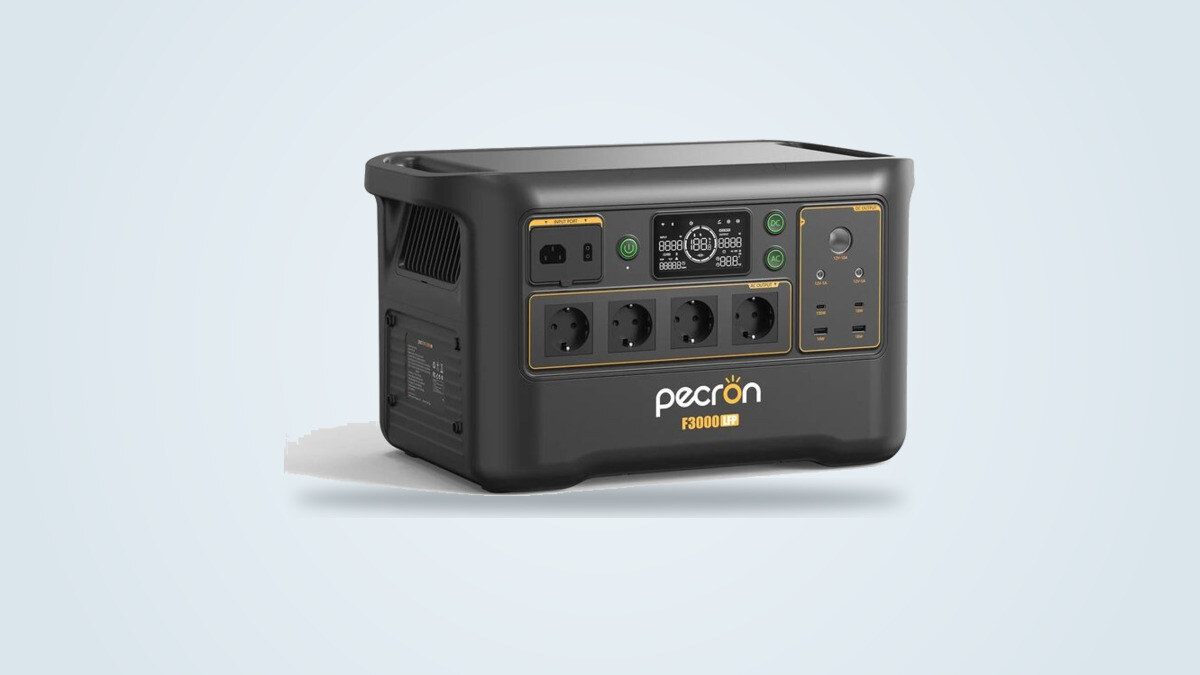
Pecron rates the F3000LFP at 3072Wh, a LiFePO4 battery at 51.2V that places it near the top of the high-end home backup segment. As with any device built around an inverter, the energy actually available at the output never equals the battery's chemical capacity: part of it powers the conversion electronics, and that share weighs proportionally more when the power drawn is high and sustained, since the inverter and cooling then run at full tilt to hold the requested load.
Under a continuous load close to the stated maximum (around 3600W), average delivery settles at 83% of rated capacity, roughly 2550Wh out of the 3072Wh on the spec sheet. That is a decent result for this power class, even if it stays behind the best stations in our catalog, some of which top 95% delivery at comparable power. No reliable figure was found for behavior under light, sustained load (a single fridge over several hours, for instance): on other stations from the same brand, that kind of use typically pulls efficiency down by several points, since the inverter draws a near-fixed amount of power regardless of the load applied. Without a figure specific to the F3000LFP on this exact point, it is best treated as unknown rather than as an established fact.
With the inverter switched on but no device plugged in, the station draws roughly 37W continuously. That is noticeably higher than on smaller-capacity Pecron stations in the same range, consistent with an inverter sized for 3600W rather than 2400W or less.
Expandable to 10752Wh: a real strength, a page that gets it wrong
The real selling point of the F3000LFP is not its starting capacity, average for its price bracket, but its ability to grow. Two additional EP3800-48V batteries (3840Wh each, about 66.8 lb / 30.3 kg, 17.4 x 12.3 x 8.8 in / 441 x 312 x 223mm) connect to the main unit through a dedicated XT120 port, without changing the inverter or the control electronics, taking total capacity to 10752Wh (3072 + 2 x 3840). That is one of the highest expansion ratios in its price bracket, comparable to its direct rivals.
This expandability changes the nature of the purchase: a single unit covers a one-off backup need or nomadic use, while one or two added batteries turn it into a household reserve able to last several days without ever swapping out the main unit. That is a sound path for a household planning to grow its setup over time rather than buying everything at once.
3600W continuous, 4500W peak: a promise kept
The spec sheet highlights 3600W of continuous power and a 4500W peak for 5 seconds. In practice, continuous power caused no issues: a fridge, a portable air conditioner, a space heater and electronics ran together with no protection trip, for combined loads approaching the stated 3600W ceiling.
The peak, meanwhile, holds and even exceeds its own promise in duration: a 4500W draw is reached and held for about ten seconds before protection kicks in, roughly twice as long as the 5 seconds stated on the spec sheet. The Anker Solix F3000, a rival of identical capacity, tops out at the same level of about 4500W held for about ten seconds, a sign that this peak level is genuinely reachable and not just a spec-sheet figure.
For a typical home backup use (fridge, lighting, electronics), this margin is more than enough. For starting a compressor or a tool with a heavy inrush current, the 4500W held for about ten seconds covers most real cases, without coming close to the 7000W sometimes wrongly advertised elsewhere.
Mains and solar charging combined: the promise holds, one figure to correct
Pecron states a full mains recharge in 2 hours with an input capped at 1800W, and a full charge takes just over two hours, in line with the manufacturer's claim. The spec sheet published on the manufacturer's European site also lists a mains input capable of reaching 2200W at 220 to 240V, without the stated charging time dropping below the usual 2 hours: the extra headroom does not appear to be used by the default charging curve.
When combining mains and solar, the manufacturer's structured spec sheet caps combined charging power at 2800W for a full charge in around 1h30, a figure worth using instead of the more optimistic estimate of roughly 3200W and 1h20 sometimes given elsewhere for this same model. The gap is likely explained by an internal limit in the charging circuit, unrelated to the arithmetic sum of the two inputs (1800W mains + 1600W solar = 3400W in theory).
Another point worth knowing for backup use: the manufacturer's manual mentions a maximum protected load of 1800W in UPS mode on the version sold at 120V, well below the station's 3600W rated output. For most home backup uses (fridge, home router, lighting), this limit is more than enough, but it is worth knowing before sizing a larger backup setup around this one function alone.
1600W solar input: a good level, a single MPPT controller
The F3000LFP accepts up to 1600W of solar panels through a single XT60 input (25 to 120V, 25A maximum), managed by a single built-in MPPT controller. That is a good level for this price bracket, enough to rebuild a good share of the reserve in half a day of strong sun, and wiring stays simple thanks to this single input rather than several strings to split up.
Against the Anker Solix F3000, a rival with an identical battery capacity (3072Wh), the difference shows up precisely here: the Anker accepts up to 2400W of combined solar, 50% more, a real advantage for anyone with several panels or aiming for the fastest possible solar recharge. The trade-off is a noticeably higher price, covered further below.
For everyday use with one or two modest folding panels, the F3000LFP's single 1600W input is not a practical limit. It becomes one for anyone planning a more ambitious fixed solar setup, where a second, separate input would allow splitting differently oriented panel strings without losing efficiency.
Noise: quiet at low load, a fan that's clearly audible past 1000W
Mains charging speed is set across five steps in the app (20, 40, 60, 80 and 100%), a setting that directly affects fan noise. Below roughly 700W (40% and under, on the version sold at 100V), the fan stays off and noise stays under 30dB. Past roughly 1000W (60% and above), the fan kicks in and the level reaches 43.5 dB at 7.9 in (20cm) from the unit, in an ambient environment of around 73 °F (23 °C). On that same version, the 80% and 100% steps both land at the same power of roughly 1418W, a limit that seems to owe more to the local electrical circuit than to a cap of the station itself.
Under heavy output power, the fan also stays audible without being unbearable, described as a moving-air sound with a slight mid-to-high pitch. Noise levels improve compared to older or larger-capacity Pecron stations, but the unit stays distinctly louder than the Anker Solix F3000, which runs noticeably quieter at comparable load. For nighttime use or a living space, the 40% charging step (silent) remains the most comfortable choice, at the cost of a longer charging time.
Ports and control: thirteen outputs, a lineup that changes with the market
The version sold in North America, at 100 to 120V, uses more numerous 120V outlets to split the total power, since a 120V outlet alone carries less current than a 230V one used elsewhere. For this version, the manufacturer states a mains output rated for 30A, consistent with delivering 3600W at 120V.
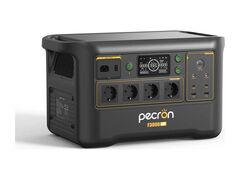
The European version, by contrast, offers four 230V mains sockets sharing the same 3600W, alongside two USB-A ports at 18W each, two USB-C ports including one at 100W, a 12V car socket (120W) and two 12V DC5525 outputs. The manufacturer claims thirteen outputs in total on its international spec sheet, counting every input and output port on the unit. All ports are grouped on the front panel on both versions, a practical choice that avoids needing rear access to plug or unplug a cable.
Control runs through an app over Wi-Fi or Bluetooth, with a real-time view of charge level and input/output power, backed up by an LCD screen showing the same information locally. One limit worth knowing in everyday use: the two USB-C ports can feel insufficient for anyone charging several modern devices at once, since only one of the two reaches 100W while the other caps at 18W.
Build, cycles and warranty
The F3000LFP's battery uses UL-certified automotive-grade LiFePO4 cells per the manufacturer's manual, rated for more than 3500 cycles before dropping to 80% of original capacity, a level in line with current standards for this chemistry. The stated warranty is 5 years, split into 2 years of full coverage followed by 3 years of support, a formula identical to other Pecron stations in the catalog and less generous than full coverage over the same period.
The station operates on discharge from 14 °F to 113 °F (-10 °C to 45 °C) and recharges between 32 °F and 113 °F (0 °C to 45 °C), a range that covers most outdoor uses without prolonged exposure to severe cold. No safety recall nor thermal runaway incident was found for this model at the time of writing, and no characteristic fault or recurring manufacturing defect stands out to date either.
No IP rating is published by the manufacturer, which calls for caution for any permanent outdoor installation, despite a wide operating temperature range. That is a trait shared with several Pecron stations in the catalog rather than a particularity of this specific model.
Against direct rivals
This class of 3000 to 3800Wh, 3600W stations looks similar on paper. Here is how the F3000LFP compares against three direct rivals in our catalog.
| Criterion | Pecron F3000LFP | FOSSiBOT F3600 Pro | AFERIY P310 | EcoFlow Delta 3 Max Plus |
|---|---|---|---|---|
| Capacity | 3072Wh | 3840Wh | 3840Wh | 2048Wh |
| Continuous power | 3600W | 3600W | 3600W | 3000W |
| Expandable | Yes, up to 10752Wh | Yes, up to 11520Wh | Yes, up to 11520Wh | Yes, up to 10000Wh |
| Max solar input | 1600W | Not disclosed | Not disclosed | Not disclosed |
| Weight | 63.3 lb (28.7 kg) | ≈ 83.8 lb (38 kg) | 92.6 lb (42 kg) | 48.7 lb (22.1 kg) |
| Warranty | 5 years | 5 years | 7 years | 5 years |
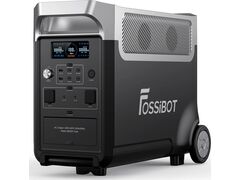
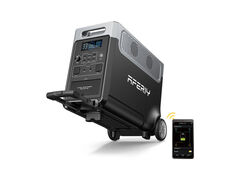
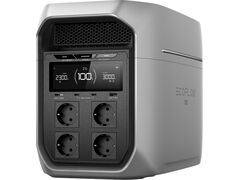
In this segment, the F3000LFP stands out clearly on price, while staying lighter than both the FOSSiBOT F3600 Pro and the AFERIY P310. Both of those keep the edge on base capacity and maximum expansion, and the AFERIY P310 remains unbeaten on warranty. The EcoFlow Delta 3 Max Plus, pricier and less powerful at equal capacity, only makes sense for the convenience of its own ecosystem.
Outside our catalog, the Anker Solix F3000 deserves a mention: identical capacity (3072Wh), the same 3600W continuous output, a 2400W solar input and a finish considered superior with noticeably quieter operation, but at a markedly higher price. Between the two, the choice comes down to priority: the best capacity-to-price ratio for the F3000LFP, comfort of use and quietness for the Anker.
Who it's for, who should look elsewhere
With its base 3072Wh, 3600W continuous output and expandability up to 10752Wh, the F3000LFP suits a growing home backup setup well: start with the unit alone to cover a typical outage (fridge, freezer, home router, lighting, even an induction hob), then add one or two EP3800-48V batteries if outages get longer or more frequent. The UPS function, switching in 8 to 20 milliseconds, also protects a computer or router from an unwanted restart.
In a large motorhome or van, the contained 63.3 lb (28.7 kg) weight and the 1600W solar input make it a solid base for extended off-grid use, and expandability allows for several weeks of autonomy without changing station. On a site with no mains connection, the 3600W continuous output covers most power tools, with the same weight caveat already mentioned for very frequent daily moves.
It suits less well anyone after silent operation at all times: the fan becomes clearly audible once the load passes the thousand-watt mark, a point where at least one direct rival does better. It also suits less well anyone planning an ambitious fixed solar setup with several differently oriented panel strings, since the single 1600W input and its single MPPT controller limit wiring flexibility against rivals with dual inputs.