Panasonic Eneloop AA: Our Full Review

Its charge retention promise holds up well, but the real cycle count falls far short of the 2100 recharges advertised: the Eneloop AA earns its reputation, as long as you do not take the marketing number at face value.

Our rating
4.0/5
Actual delivered capacity: 4.2 out of 5 (weighting 25%)Capacity4.2Long-term endurance: 4.0 out of 5 (weighting 25%)Endurance4.0Extreme-temperature performance: 3.8 out of 5 (weighting 20%)Temperature3.8Versatility across devices: 4.0 out of 5 (weighting 15%)Versatility4.0Build and safety: 3.8 out of 5 (weighting 15%)Build3.8

How is this rating calculated?

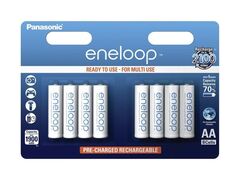
Panasonic Eneloop AA rechargeable batteries in an 8-pack

The essentials

The Eneloop AA earns its reputation from one precise promise: holding its charge for a very long time at rest. On that front, the manufacturer figure (70% of capacity retained after 10 years) holds up well over time, and real capacity reaches or even slightly beats the advertised minimum of 2000 mAh, with the expected variation depending on discharge current and cell generation. The gray area is the number of charge cycles: Panasonic advertises up to 2100 cycles, but real-world use falls well short of that, more in the range of a few hundred to around a thousand cycles depending on which end-of-life cutoff you use. A lesser-known point is worth calling out: the real longevity of genuinely authentic Eneloop cells can vary a lot depending on where they were manufactured, which explains part of the gap between user experiences without calling the product's authenticity into question. For everyday use in low-drain gadgets, with occasional long-term storage, the Eneloop AA remains a solid pick, as long as you treat the 2100-cycle number as a theoretical ceiling rather than a guarantee.

Strengths

  • Very low self-discharge: the multi-year charge retention claim holds up over time
  • Real capacity that reaches or beats the advertised minimum of 2000 mAh
  • Shipped pre-charged and ready to use right out of the pack
  • Universal format that works in almost any AA-powered device
  • Sold in an 8-pack, an economical option compared to repeatedly buying disposable batteries

Limitations

  • Real cycle count well below the 2100 advertised by the manufacturer
  • Real longevity that can vary noticeably from batch to batch depending on where the cells are made
  • 1.2V output instead of 1.5V, worth watching on the rare device that is very sensitive to voltage
  • No detailed manufacturer data on performance in extreme temperatures
  • Price on the US market varies from one retailer to another, worth comparing before you buy
Panasonic Eneloop AA 2000mAh: see the full details and price →

The benchmark rechargeable AA battery

Game controllers, remotes, wireless mice, camera flashes: the Eneloop AA is built for the everyday gadgets that chew through batteries. Its core promise is not raw capacity, but the ability to stay charged through long stretches in storage.

2000 mAh
Advertised minimum capacity
70 %
Capacity retained after 10 years
8
Batteries per pack

Real capacity that lives up to the promise

The real capacity of the Eneloop AA lands at or slightly above the advertised minimum of 2000 mAh, with the normal variation you would expect depending on discharge current and cell generation. That tracks with the product's reputation: unlike cheap rechargeable batteries, whose real capacity often disappoints next to the number printed on the package, the Eneloop AA generally delivers what it advertises.

Excellent charge retention, an overstated cycle count

Charge retention at rest is the Eneloop AA's best-proven strength: the manufacturer figure of 70% of capacity retained after 10 years of storage holds up over time, with older cells still showing a similar ballpark number. That is what separates a quality rechargeable battery from a cheap model that goes dead in a drawer within a few weeks.

The number of charge cycles is a different story. Panasonic advertises up to 2100 cycles, but real-world use falls well short of that, somewhere in a wide range from a few hundred to around a thousand cycles depending on which degradation threshold counts as end of life. A notable point that is rarely covered elsewhere: the longevity of genuinely authentic Eneloop cells can vary a lot depending on where they are manufactured, which explains part of the gap between user experiences without this being a case of counterfeiting. The 2100-cycle number should be read as a theoretical lab ceiling, not as an average you can expect in real use.

An NiMH chemistry with no detailed cold-weather data

Unlike primary lithium batteries, which often advertise a precise operating temperature range, Panasonic does not publish detailed data on how the Eneloop AA performs in extreme temperatures. NiMH chemistry holds up fine in moderate conditions, without being the benchmark on this front next to a lithium battery built specifically for deep cold.

A universal format, from camera flash to remote control

Real capacity close to the rated number translates into solid performance on both high, short-burst drain devices (camera flashes, motorized toys) and low, continuous drain devices (remote controls, clocks). Its 1.2V output, versus 1.5V for an alkaline battery, makes no real difference in the vast majority of uses, except for the rare device that is very sensitive to supply voltage.

Consistent manufacturing, no notable safety issues

Nothing points to a particular safety issue (leaks, overheating) with the Eneloop AA. Manufacturing consistency remains one of the brand's selling points, though there is no number that allows a precise comparison against competitors on this specific point.

Up against the Eneloop Pro AA and the Energizer Ultimate Lithium AA

How should you choose between the standard Eneloop AA and the two other AA batteries in our lineup?

Technical comparison: Eneloop AA versus the Eneloop Pro AA and the Energizer Ultimate Lithium AA (prices observed, for reference only)
CriterionEneloop AAEneloop Pro AAEnergizer Ultimate Lithium AA
TypeRechargeable NiMHRechargeable NiMHDisposable lithium
Advertised capacity2000 mAh2500 mAhNot disclosed (mAh)
Advertised cycles2100500Single use
Retention70% / 10 years85% / 1 year20 years (storage)
Price observed (pack)$23.99 (x8)$22.24 (x4)$25.49 (x12)

The standard Eneloop AA remains the most balanced choice for everyday use and long-term storage. The Eneloop Pro AA takes over for current-hungry devices, at the cost of a more limited real cycle count. The disposable Energizer Ultimate Lithium AA never recharges, but it delivers a genuine range boost on high-drain devices and better cold-weather performance, for backup or outdoor use.
The rating in detail

Our rating
4.0/5
Actual delivered capacity 4.2
Long-term endurance 4.0
Extreme-temperature performance 3.8
Versatility across devices 4.0
Build and safety 3.8
Panasonic Eneloop AA 2000mAh: see the full details and price →

The product and its alternatives

Panasonic Eneloop AA 2000mAh

Panasonic Eneloop AA 2000mAh

See price (60)

The benchmark AA rechargeable battery: up to 2100 charge cycles, ready to use out of the pack, and still holding 70% of its charge after 10 years in storage.

View product
Panasonic Eneloop Pro AA 2500mAh

Panasonic Eneloop Pro AA 2500mAh

See price (13)

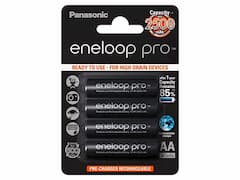
The high-capacity version of the Eneloop: 2500 mAh to last longer in power-hungry devices like camera flashes, game controllers or demanding toys.

View product
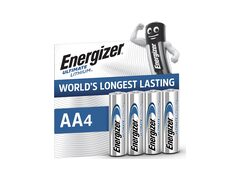
Energizer Ultimate Lithium AA (x12)

Energizer Ultimate Lithium AA (x12)

See price (75)

The longest-lasting AA battery in the world: Energizer Ultimate Lithium powers demanding devices through deep cold and heat, with 20 years of shelf life.

View product

Frequently asked questions

That is the theoretical ceiling Panasonic advertises, but real-world use falls well short of it, from a few hundred to around a thousand cycles. The product is still very durable, just not at the level of the marketing number.

Yes, it is the best-proven point on the spec sheet: older cells still show a similar ballpark number, which makes it this battery's strongest selling point.

The Pro AA offers a higher capacity (2500 mAh versus 2000 mAh), ideal for power-hungry devices, but it handles fewer charge cycles and holds its charge at rest a bit less well. The standard Eneloop AA remains the better pick for everyday use and long-term storage.

The longevity of genuinely authentic Eneloop cells can vary a lot depending on where they are manufactured. This does not call the product's authenticity into question, but it explains why two users can end up with different experiences.

In almost any AA-powered device. Its 1.2V output, versus 1.5V for an alkaline, only causes an issue on the rare device that is especially sensitive to supply voltage.