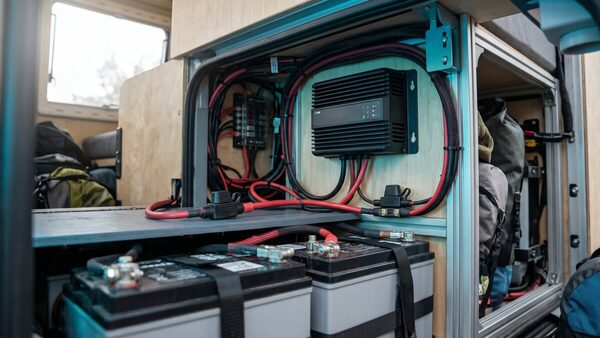

Why a simple voltmeter isn't enough on a house battery
On a LiFePO4 lithium battery, voltage stays remarkably flat between roughly 90% and 20% state of charge: a plain voltmeter or multimeter often shows nearly the same reading, within a few tenths of a volt, whether the battery still has half its real capacity left or only a quarter. On a lead-acid, AGM or gel battery, voltage moves more, but it stays misleading under load, during discharge, or right after a big current draw (compressor fridge, water pump, heater).
A shunt-based battery monitor sidesteps this problem: instead of guessing the state of charge from an ambiguous voltage, it measures the actual current flowing in and out of the battery, and displays a percentage and a remaining runtime in amp-hours, much like a fuel gauge.
How a shunt monitor actually works
The shunt is a precision resistor, rated at a known value (for example 500A/50mV), wired in series on the negative cable of the monitored battery, between the negative terminal and the rest of the system. Every amp that flows through this shunt causes a tiny voltage drop across it, which the monitor's electronics measure and convert into a precise current reading.
The device then integrates that current over time, a method called coulomb counting, to work out the energy that has actually entered or left the battery, and therefore its real state of charge. That's noticeably more reliable than a simple voltage reading, but it isn't foolproof: every small current-measurement error adds up cycle after cycle, and the estimate drifts gradually if the starting point wasn't accurate.
Physical display or Bluetooth app only: two philosophies
Consumer shunt monitors split into two clearly distinct families, and the right pick depends mostly on how you'll use it, not just on budget:
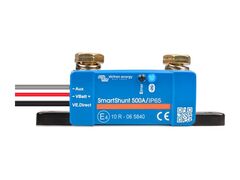
- No display, entirely Bluetooth (Victron SmartShunt): no panel to cut into, no display cable to run through the rig. All the data goes through an app on a phone or tablet. Discreet and quick to install, but fully dependent on having a phone nearby, less convenient for a quick glance first thing in the morning.
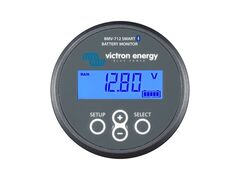
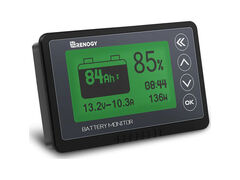
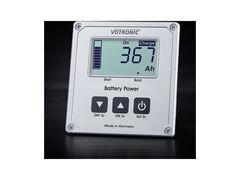
- Dedicated physical display (Victron BMV-712, Renogy RBM500, Votronic LCD Battery Computer): a dial that stays readable on the dashboard or electrical panel at all times, with no need to grab a phone. Bluetooth, when available, is there as a bonus for history and fine-tuning, not as the main way to read the data.
For marine use or anything exposed to real moisture, the monitor's housing matters too: the SmartShunt ships with an IP65 rating out of the box, a genuine advantage inside a damp battery compartment, while wired-display monitors are mostly designed for a sheltered mount on a dashboard.
Our comparison
| Model | Price | Shunt | Display | Bluetooth | Best for |
|---|---|---|---|---|---|
| Victron SmartShunt 500A | $98.25 | 500A/50mV | None (app only) | Built in | A discreet install, fully managed from a phone |
| Victron BMV-712 Smart | $158.95 | 500A/50mV | Dedicated backlit LCD | Built in | A direct dashboard readout, no phone needed |
| Renogy RBM500 | $87.33 | 500A, 10 to 120V | Wired LCD (20 ft cable) | No (optional BT-2 module) | A tight budget, a physical display is enough |
| Votronic LCD Battery Computer 100 S | $220.00 | 100A (up to 200A peak) | Dedicated backlit LCD | Optional | A small setup, with a 2nd (starter) voltage to watch |
The two Victron models share exactly the same 500A/50mV shunt and the same measurement accuracy: the SmartShunt costs about $60 less, purely because it skips the physical display. The Renogy RBM500 remains the most affordable pick once a wired readout is enough, with no native Bluetooth. The Votronic, with its more modest 100A shunt (plenty for most camper vans and RVs), adds a dedicated input to keep an eye on the starter (chassis) battery's voltage at the same time.
Which monitor to pick for your setup
A discreet install, managed from your phone: the Victron SmartShunt installs in a few minutes with no panel to cut into, and its IP65 housing suits a boat just as well as a van or RV. The only real trade-off is keeping a phone within range to check the data.
A real dial on the dashboard, with no phone dependency: the Victron BMV-712 Smart permanently shows voltage, current and charge percentage, with Bluetooth as a bonus for history and alarms. It's the most complete pick in this comparison, at the highest price.
A tight budget, where a wired display is plenty: the Renogy RBM500 covers the essentials (voltage, current, percentage, remaining runtime) at a much lower price than either Victron model, as long as you can live without native Bluetooth.
A small setup, with a starter (chassis) battery to watch at the same time: the Votronic LCD Battery Computer 100 S adds a dedicated second-voltage input, handy for keeping an eye on the engine battery without a separate device. For a bigger house bank (several hundred amp-hours), the 200 S version in the same lineup uses the same principle with a beefier shunt.
To recharge that monitored battery from the vehicle's alternator, our comparison of the best DC-DC dual-battery kits for vans and 4x4s pairs naturally with this choice of monitor.
Installing and calibrating a shunt monitor the right way
A few things worth checking, common to every model in this comparison:
- The shunt always wires into the negative side, between the battery's negative terminal and the rest of the system (fuse, bus bar, chassis ground). Everything that draws from or charges the battery has to pass through this single point for the reading to be complete; a cable that bypasses the shunt skews the measurement without any visible error.
- Enter the battery's real capacity (in amp-hours) in the monitor's menu right at install time: a wrong capacity setting throws off the displayed percentage directly, even if the shunt itself measures current perfectly.
- The first full charge cycle acts as the reference point. Until that first resync happens, the displayed percentage stays a rough estimate, especially if the battery wasn't fully charged at the moment of installation.
- A dedicated fuse on the monitor's positive supply cable (on models that include one, like the BMV-712) protects the electronics in case of a short circuit.
To dig deeper into what a charge percentage actually measures and why it's never perfectly exact, our guide on why your battery percentage is never exactly right covers the limits shared by every estimation method, shunts included.