What EcoFlow announced at IFA 2026
On September 4, 2026, at its booth at IFA Berlin, Europe’s biggest consumer electronics show, running September 4 to 8, EcoFlow unveiled two products aimed at radically different audiences. On one side, the RIVER Gen4 lineup, two very compact portable power stations built for outdoor use and occasional home backup. On the other, the PowerRock 4000, a rugged industrial power station designed for job sites and emergency response, far from the usual crowd for consumer power stations.
Both products share the same underlying theme, electrical reliability rather than raw capacity. The RIVER Gen4 leads with a near-instant UPS switchover, and the PowerRock 4000 packs in a safety feature usually reserved for fixed electrical wiring. That shift towards backup-grade reliability is what matters most to our readers, more than another capacity bump.
This shift is no accident of timing. The portable power station market has become far more crowded since 2023, and raw Wh capacity is no longer enough to set a lineup apart from the competition. Manufacturers are now looking elsewhere for their edge, in charge speed, noise, footprint or, as here, electrical reliability during an outage. For buyers, that is good news: backup features once reserved for professional-grade UPS units are gradually becoming a standard part of the spec sheet rather than a premium extra.
RIVER Gen4: two compact stations with a UPS function
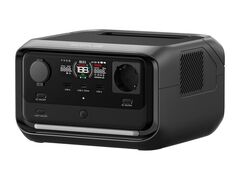
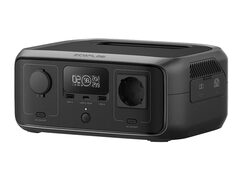
The RIVER Gen4 lineup consists of two models, the RIVER 260 Gen4 and the RIVER 520 Gen4, both built around LFP (lithium iron phosphate) cells, known for their longevity and thermal stability. The real selling point of this generation is not capacity, which stays modest, but electrical responsiveness.
| Model | Capacity | AC output | Weight | AC charge (0 to 80%) |
|---|---|---|---|---|
| RIVER 260 Gen4 | 256 Wh | 300 W (600 W with X-Boost) | about 6.6 lb (3 kg) | 42 minutes |
| RIVER 520 Gen4 | 512 Wh | 500 W (1,000 W with X-Boost) | about 10.1 lb (4.6 kg) | 50 minutes |
X-Boost is EcoFlow’s software feature that allows, by slightly distorting the waveform, powering appliances whose rated wattage exceeds the station’s normal AC output. It suits a vacuum cleaner or a coffee maker, but never a sensitive device such as an older computer or medical equipment.
The most interesting point remains the UPS function: during a power outage, the RIVER Gen4 switches to battery in under 10 milliseconds. That is fast enough for a computer, a router or a game console to keep running without even restarting, unlike a basic entry-level UPS that can take several tens of milliseconds to react. EcoFlow also claims roughly 30% lower idle power draw than the previous generation, a detail that is often overlooked despite determining the real-world runtime of a unit left permanently plugged in, as we explain in our deep dive on what a station’s Wh rating actually means in practice.
On connectivity, the RIVER 260 Gen4 offers five ports and the RIVER 520 Gen4 six, including a bidirectional 140 W USB-C port able to both charge the station and power a demanding laptop. EcoFlow also claims operating noise below 30 dB at a 200 W load, against 40 to 50 dB for most higher-power stations, and 99% charge retention after a year of storage under good conditions, a figure that matters most for occasional backup use, where the station can sit untouched for months.
EcoFlow is not alone on this front: Anker already offers an automatic switchover feature on its Solix lineup, and Bluetti has been advertising comparable switching times since last year. The real question is not who invented the UPS function on a small station, but who offers the best price-to-capacity ratio once US pricing lands. We track all three brands in our Anker Solix comparison and our EcoFlow vs Bluetti comparison.
PowerRock 4000: an IP65-rated industrial power station
The PowerRock 4000 is aimed at a completely different crowd. This industrial power station targets job sites, mobile workshops and emergency response, a segment where EcoFlow has so far had little presence against traditional gas-powered generators.
- 4 kW continuous, up to 7.2 kW peak for 100 seconds, enough to start a demanding power tool;
- 3 kWh of onboard capacity;
- all-metal housing, rated IP65 (fully dust-tight, water-jet resistant) with a reinforced roll cage that survives a 3.3 ft (1 m) drop;
- 83.8 lb (38 kg), with a full AC charge in 60 minutes (80% in 48 minutes), plus the ability to top up from a vehicle alternator;
- a 3-year warranty, well beyond the 1 to 2 years typical of entry-level gas generators.
Its most notable feature remains electrical safety: EcoFlow claims a built-in ground-fault circuit interrupter (GFCI), tripping at a 30 milliamp leakage threshold with a cutoff under 300 milliseconds, which the launch release describes as a first for this type of device. On a job site, where moisture and damaged cords multiply the risk of electric shock, this kind of protection is normally provided by the site’s fixed electrical wiring or a portable GFCI outlet, not by the power source itself. That is a genuine safety claim worth confirming once units actually ship, rather than taking the announcement sheet at face value.
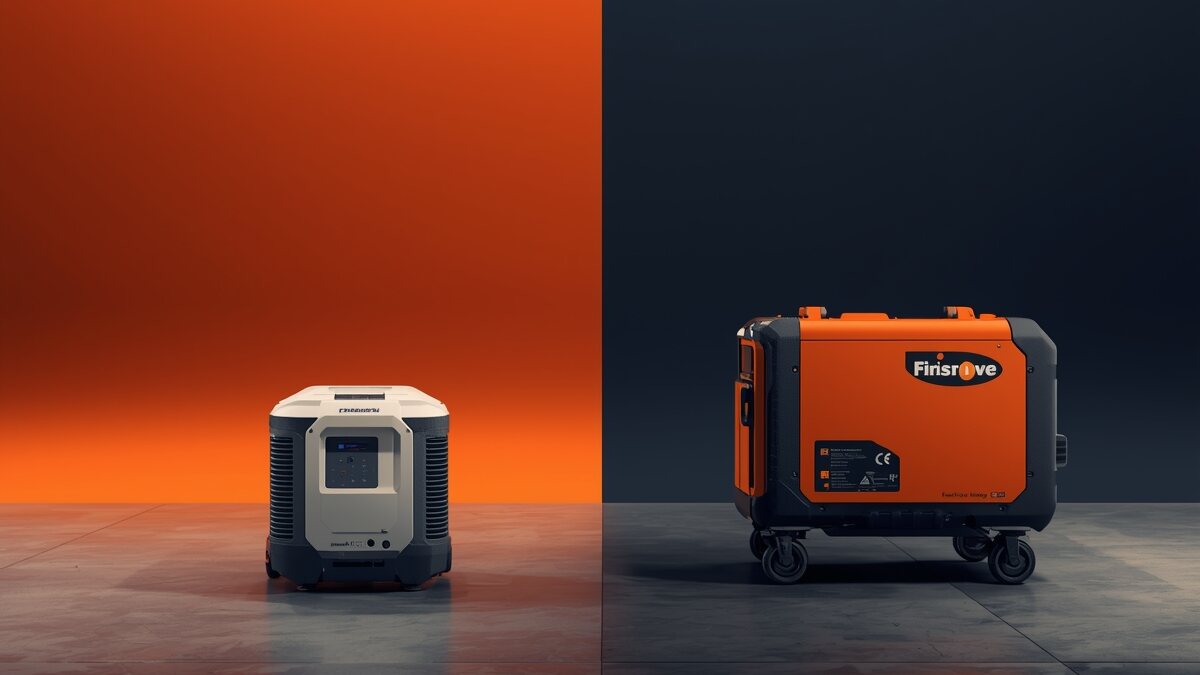
The PowerRock 4000 is not meant to replace an all-round power station like the ones we recommend in our best power stations comparison: it is a professional tool, positioned as a competitor to gas generators rather than to consumer power stations.
Against a similarly powered gas generator, the PowerRock 4000’s pitch comes down to three points: no fuel to store or exhaust fumes on an enclosed site, quiet operation compatible with night work or residential areas, and the flexibility to recharge from mains power, solar panels or a vehicle alternator depending on what is available on site. In exchange, its 3 kWh of capacity limits runtime compared with a gas generator, which can simply be refueled to keep running indefinitely: the PowerRock 4000 is therefore built for short, repeated jobs rather than continuous multi-day power on a single site.
Pricing, availability and what to remember
EcoFlow has not announced any US pricing or release date for either device at launch, a common practice at trade show reveals aimed primarily at the European market.
| Milestone | Date |
|---|---|
| Reveal at IFA Berlin | September 4, 2026 |
| European launch (RIVER Gen4 and PowerRock 4000) | September 4, 2026 |
| Professional distribution of the PowerRock 4000 in Europe (electricians, hardware stores, tool distributors) | from November 2026 |
| US pricing and release date | not announced |
This staggered timeline is not incidental. The RIVER Gen4, a consumer product, follows a standard online and retail launch. The PowerRock 4000, on the other hand, goes through a professional distribution network that only rolls out gradually from November in Europe, a pace closer to industrial tooling than to consumer electronics; a US rollout, if it happens, would likely follow a similar professional-channel approach.
Without an official US price, it is hard to place the RIVER Gen4 against the competition precisely. As a reference point, the previous generation, the EcoFlow River 3 Plus (288 Wh), currently sells for $258.99, and the simpler River 3 for $239.00. The Gen4’s UPS function and faster charging should logically translate into at least an equivalent price bracket, possibly a touch higher, if and when EcoFlow brings it to the US market.
We will update this article as soon as US availability and pricing are confirmed.