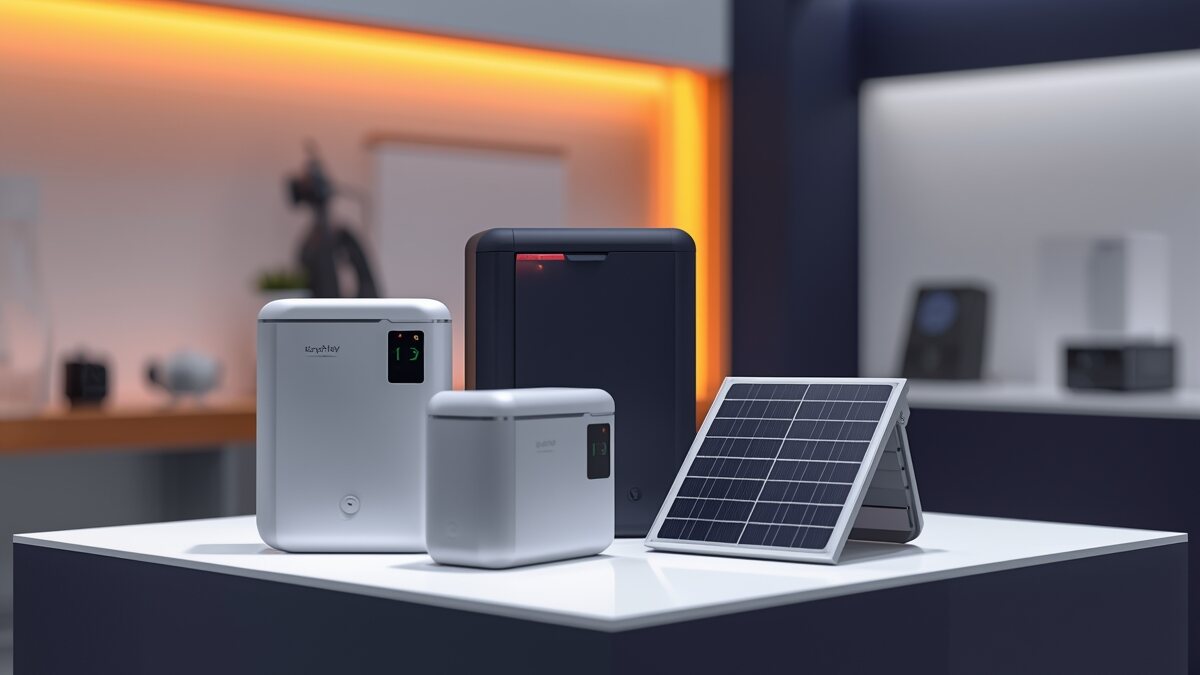
What Bluetti announced at IFA 2026
From September 4 to 8, 2026, at booth H2.2-176 of IFA Berlin, Bluetti delivered its biggest product announcement of the year under the tagline « From Balcony to Everywhere ». Five launches, aimed at very different use cases, illustrate that ambition: the Elite mini series, three ultra-compact power stations; the Balco 500, a home storage system tied to balcony solar; the Pioneer 5000, an electric generator designed to replace gas generators on job sites; and BlueBot, an AI energy management assistant built into the Balco lineup.
It is no coincidence that Bluetti is announcing products across such different segments at once. The brand, already well represented in our catalog with 75 product pages spanning power banks, power stations and solar gear, is aiming to cover the whole spectrum of portable and home energy, from a pocket-sized backup for a router to powering an entire job site.
Of the five hardware launches, only one is actually on sale today: the Elite 100 mini, available since September 2, 2026 in the US. The other four (Elite 30 mini, Elite 200 mini, Balco 500 and Pioneer 5000) follow a more staggered rollout, detailed at the end of this article.
Elite mini: three compact stations, up to 42% smaller
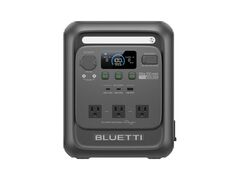
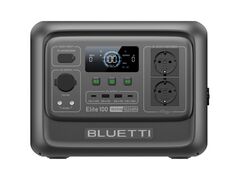
The Elite mini series brings together three portable power stations sharing the same goal: a capacity close to the existing Elite V2 models, in a noticeably smaller and lighter format. Bluetti claims a 15 to 42% reduction in volume and a 7 to 25% weight reduction, depending on the model, versus the equivalent Elite V2.
| Model | Capacity | Continuous output | Weight |
|---|---|---|---|
| Elite 30 mini | 288 Wh | 300 W | not disclosed |
| Elite 30 V2 (reference) | 288 Wh | 600 W | 9.5 lb (4.3 kg) |
| Elite 100 mini | 1,004.8 Wh | 700 W | 23.6 lb (10.7 kg) |
| Elite 100 V2 (reference) | 1,024 Wh | 1,800 W | 25.4 lb (11.5 kg) |
| Elite 200 mini | 2,009 Wh | 1,600 W | not disclosed |
| Elite 200 V2 (reference) | 2,074 Wh | 2,600 W | 53.4 lb (24.2 kg) |
The only full comparison available today is for the Elite 100 mini, already on sale: at a near-identical capacity (1,004.8 Wh versus 1,024 Wh), it weighs about 7% less than the Elite 100 V2, while continuous output and solar input are both less than half those of the V2. We already published our full review of the Elite 100 mini, including a measurement of its real-world Wh output and its UPS function.
The same logic likely applies to the other two models in the series: a real gain in compactness and weight, in exchange for a noticeably lower output and solar input compared with the matching V2. It is a deliberate trade-off, built for targeted backup use (a router, a home internet box, medical equipment) rather than powering heavy-draw appliances, as we detail in our best power stations 2026 comparison.
Only the Elite 100 mini is available today, since September 2, 2026 and only in the US, priced at $429 before tax. The Elite 30 mini and Elite 200 mini are slated for January 2027, with no pricing disclosed yet.
Balco 500: home solar storage moves upmarket
The Balco 500 is the higher-end version of the Balco 260, already in our catalog, and targets full home storage rather than a simple balcony top-up. Its LiFePO4 battery jumps to 5,024 Wh, up from 2,560 Wh on the Balco 260, and its solar input reaches 4,600 W through a high-voltage MPPT architecture (70 to 470 V), versus 2,400 W on the more compact model.
| Criterion | Balco 500 | Balco 260 |
|---|---|---|
| Capacity | 5,024 Wh | 2,560 Wh |
| Max solar input | 4,600 W | 2,400 W |
| Backup power (grid-tied and off-grid) | up to 4,360 W | 1,200 W (inverter) |
On the software side, the Balco 500 packs three smart systems new to this lineup: the Plug & Play Phase-Match Energy System, which automatically balances charging across the three phases of a typical European electrical setup (over 800 W in total); the EnergyFlex System, able to link up to 5 secondary Bluetti portable power stations to the main unit, with grid-tied output up to 800 W; and BlueBot, the AI assistant covered further below. Up to 3 Balco 500 units can also be linked together for a full 11 kW / 15 kWh whole-home backup setup.
Bluetti claims around 8,000 cycles before capacity drops to 70% and a 10-year warranty, both noticeably higher than what is typically advertised on a nomadic power station, in line with a fixed home use rather than portable use. The Balco 500 launched at IFA ahead of full market availability, with no confirmed rollout date per market.
Pioneer 5000: an electric generator built to replace gas units
The Pioneer 5000 targets an entirely different audience: this electric generator is aimed at construction sites, event production and emergency response, as a quiet alternative to gas and diesel generators. It claims 5 kW of continuous power, up to 18 kW of surge power for 0.1 second, enough to start demanding power tools or a professional compressor.
Its 5,120 Wh LiFePO4 battery expands up to 35 kWh, and recharges via AC (up to 5 kW input) or by combining AC and solar, up to 6.2 kW combined. A 5 to 80% charge takes about 60 minutes at that maximum input power. Bluetti claims an IP65-rated enclosure (fully dust-tight, resistant to water jets) and IK10 impact resistance, the top rating on that scale, with an operating range of -4 °F to 131 °F (-20 °C to 55 °C). At 164.2 lb (74.5 kg) and on a wheeled chassis, the Pioneer 5000 moves like a conventional generator, but without fuel to store or fumes on an enclosed site.
Against a gas or diesel generator of comparable power, the case rests on three points: a noticeably quieter operation (50 dB claimed, versus 70 to 90 dB for a gas or diesel unit of this output), no direct emissions on site, and the flexibility to recharge from AC or solar depending on what is available. The trade-off is that its 5,120 Wh base capacity limits runtime compared with a fuel generator that just needs a refill to keep going indefinitely, a compromise already noted for smaller stations in our power station versus generator piece.
The Pioneer 5000 is slated for January 2027, with no pricing disclosed yet, and targets a professional audience first (electrical contractors, equipment rental firms, event organizers, emergency response) rather than the brand's usual nomadic consumer base.
BlueBot: the AI assistant that runs a home's energy
BlueBot is Bluetti's new energy management assistant, available on the Balco lineup. Unlike the brand's regular app, which displays raw data (state of charge, instant power, history), BlueBot builds what Bluetti calls a household energy model: an approach the manufacturer sums up as « one home, one model », a single, personalized model per household rather than a generic dashboard.
In practice, the assistant learns a household's consumption patterns, cross-references them with solar generation, weather and variable electricity prices, then proposes charge and discharge plans that can be steered through natural-language interaction. Bluetti highlights an « AI Decision Ledger », which explains in plain language why the system made a given choice (prioritizing storage over grid injection at a given moment, for instance), a transparency feature rarely offered on this kind of tool.
It remains to be seen, once the product is actually in use in real households, whether these recommendations hold up over time: no independent usage data exists yet on BlueBot as of this article, only what Bluetti itself has disclosed.
Pricing, availability, and what to remember
| Product | Availability | Price |
|---|---|---|
| Elite 100 mini | available since September 2, 2026 (US only) | $429 before tax |
| Elite 30 mini | slated for January 2027 | not disclosed |
| Elite 200 mini | slated for January 2027 | not disclosed |
| Balco 500 | launched at IFA, per-market rollout date not confirmed | not disclosed |
| Pioneer 5000 | slated for January 2027 | not disclosed |
Of the five announcements, only the Elite 100 mini is actually available today, and it is already sold directly to US shoppers. The other four launches follow a rollout pushed back to January 2027 for the remaining three stations and the generator, or an as-yet unconfirmed date for the Balco 500. That staggered pattern is typical of trade-show announcements, already seen from EcoFlow and Jackery at IFA 2026: unveil early to make a splash, then ship later once production and distribution are ready.
These launches add to an already extensive Bluetti lineup in our power stations section and solar section. To compare Bluetti against the other major brands in the space, our comparisons of Bluetti versus EcoFlow, Bluetti versus Jackery and Bluetti versus Anker Solix remain up to date. We will update this article as soon as official pricing or dates are confirmed.