
Ugreen at IFA 2026: tackling the heat problem in MagSafe power banks
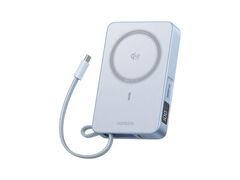
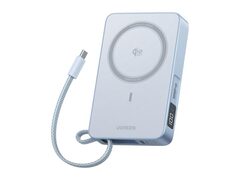
From September 4 to 8, 2026, at IFA Berlin, Ugreen unveiled its new MagFlow lineup, headlined by the MagFlow Pro: a Qi2 25W magnetic power bank claiming a world first, an active liquid cooling loop built directly into a consumer power bank.
Anyone who has used a MagSafe battery at full power knows the problem: the faster the wireless charge, the hotter the pack gets, and that heat ends up throttling the very charging speed printed on the box. Ugreen, already well established in our power banks section with its existing MagFlow range, is tackling this weakness head-on with an approach never seen before on this kind of product.
It is not the first time several manufacturers converge on the same challenge during the same trade show week either: we already covered Bluetti's and EcoFlow's announcements from this same edition, each with its own answer to a shared need: charge faster without compromising cell safety.
CryoPulse: how the MagFlow Pro's liquid cooling works
The system Ugreen calls CryoPulse combines three parts: a micro-pump circulating a coolant, a copper vapor-chamber sheet that captures heat right at the wireless charging coil, and a separate internal loop that carries that heat away from the surface touching the phone. A quirky, deliberate touch: a small side window lets you watch the coolant flow during charging, a design choice that makes an otherwise invisible mechanism visible.
On paper, Ugreen's claimed numbers are notable: 44% less heat build-up and a peak temperature kept 18 °F (10 °C) lower than a comparable magnetic power bank. A lower surface temperature should, in theory, let the pack sustain its maximum charging power for longer, whereas an overheating power bank has its controller automatically cut power to protect the cell, a phenomenon known as thermal throttling.
| Spec | MagFlow Pro |
|---|---|
| Capacity | 10,000 mAh |
| Wireless charging (Qi2) | 25W |
| Wired charging (built-in USB-C cable) | up to 45W combined |
| Weight | 8.1 oz (230 g) |
| Built-in display | charging wattage, battery level, cycle count |
| Claimed heat reduction | -44% build-up, -18 °F (-10 °C) peak |
These figures remain manufacturer claims for now: no in-depth independent testing has yet measured real-world Wh output or confirmed sustained power over time. We will update this article as soon as reliable hands-on data becomes available, as we always do for trade-show announcements.
Versus Anker's MagGo 2 Pro: liquid against fan
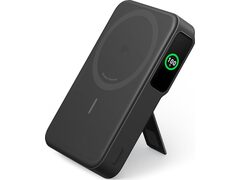
The timing is hard to ignore: a few stands away at the very same show, Anker showed its MagGo 2 Pro, another Qi2 25W MagSafe battery tackling the exact same overheating issue, but with a radically different fix: a real dual-channel active cooling fan paired with a graphene heat spreader, rather than a liquid loop.
Both approaches have their logic. Anker's fan is mechanically simpler and includes a Silent mode that switches the fan off at the cost of slower charging, handy overnight. Ugreen's liquid loop has no audible moving part, but adds mechanical complexity, sealing, long-term loop durability, to an everyday object that gets carried, dropped and knocked around. We cover the MagGo 2 Pro's full specs, its Silent mode and our take on it on its dedicated product page, rather than repeating them here.
Beyond the rivalry, this double launch confirms one thing: heat has become, in 2026, the main remaining technical bottleneck for genuinely fast MagSafe charging, more so than raw power itself. Both brands are turning to active cooling for the first time on this compact form factor, where the previous generation relied on passive heat sinks alone.
The rest of the MagFlow lineup: a desk stand and a foldable charger
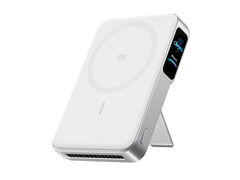
The MagFlow Pro is not the only product launched under the MagFlow name at IFA 2026. Ugreen rounds out the range with two accessories sharing the same Qi2 25W charging, though without the liquid cooling, which stays exclusive to the power bank:
- A cooled 3-in-1 desk charging stand, built to charge a phone, a watch and earbuds at the same time on a desk.
- A 2-in-1 foldable charger, more compact, for two devices at once (a phone and earbuds, for instance), with an adjustable tilt useful for desk or travel use.
The full lineup spans $49.99 to $149.99 depending on the product, with the MagFlow Pro sitting at the top of that range because of its unique cooling loop. For readers after a nomadic pick rather than a desk accessory, our best MagSafe power banks comparison remains the reference until the MagFlow Pro has been through a full independent test.
Pricing, availability and what to remember
| Market | Price | Note |
|---|---|---|
| United States | $100.05 | launch price before tax, full price listed at $149.99 |
| United Kingdom | £89.99 | launch price, full price listed at £109.99 |
| Eurozone | €119.99 | official price communicated by Ugreen |
The MagFlow Pro is already available directly from Ugreen's US store, at a launch price below the announced full price (tax calculated at checkout, as usual for the US market), a common practice for a product fresh off the show floor. UK and eurozone pricing has also been confirmed, though a wider retail rollout beyond Ugreen's own stores has not been announced yet.
This Ugreen-versus-Anker showdown adds another chapter to an already lively rivalry between the two brands in the power bank space, which we cover in our Anker vs Ugreen comparison. We will update this article as soon as independent testing shows whether liquid cooling truly outperforms Anker's fan.