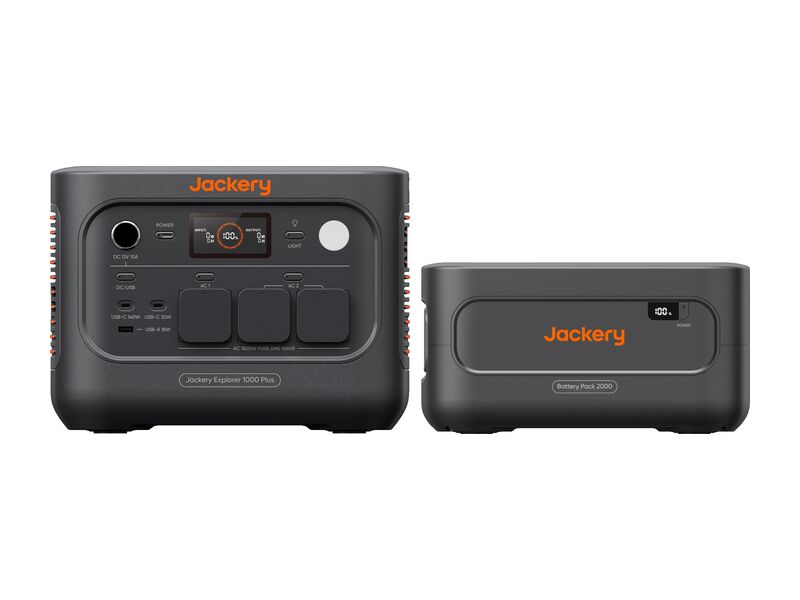
Jackery Explorer 1000 Plus v2
(1 reviews)
A 1 kWh power station that weighs 23.8 lb and can grow to 11 kWh: a kettle at the campsite or backup during an outage, with a UPS in under 10 ms.
Characteristics
- Capacity: 1024Wh LiFePO4, expandable to 11 kWh
- Power: 1800W continuous, 3600W peak
- Outputs: 3 AC outlets (230V), 2 USB-C (140W max), 1 USB-A, 12V/10A
- Recharge: Wall: full in 1.25h at best, solar up to 400W
- Expandable to 11 kWh in just 23.8 lb
Detailed overview: Jackery Explorer 1000 Plus v2 - photo 2
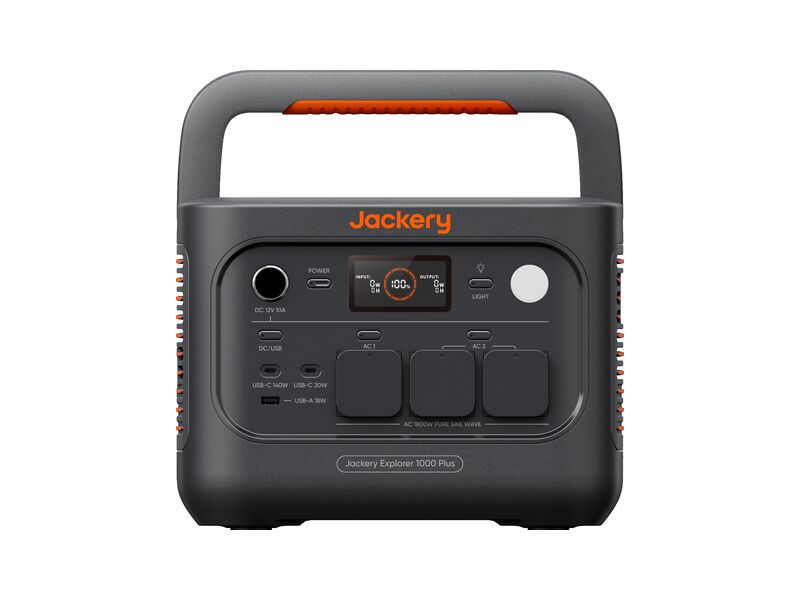
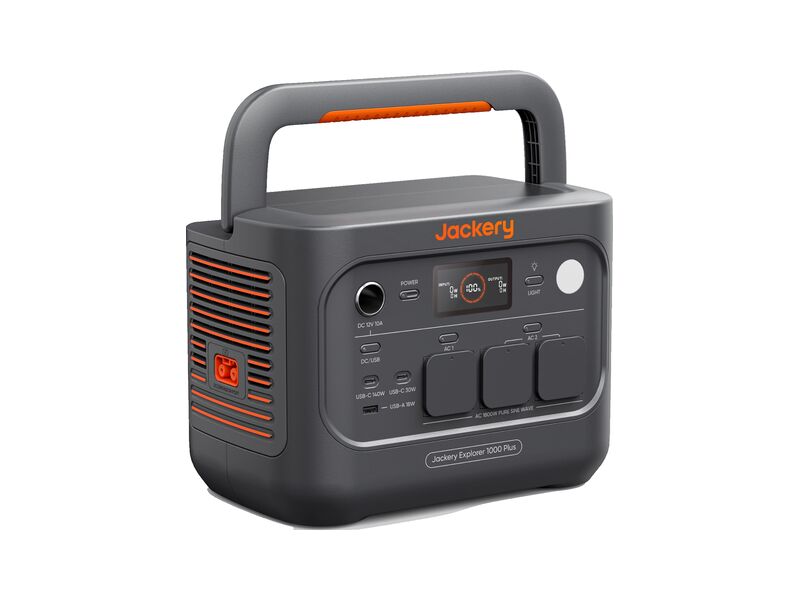
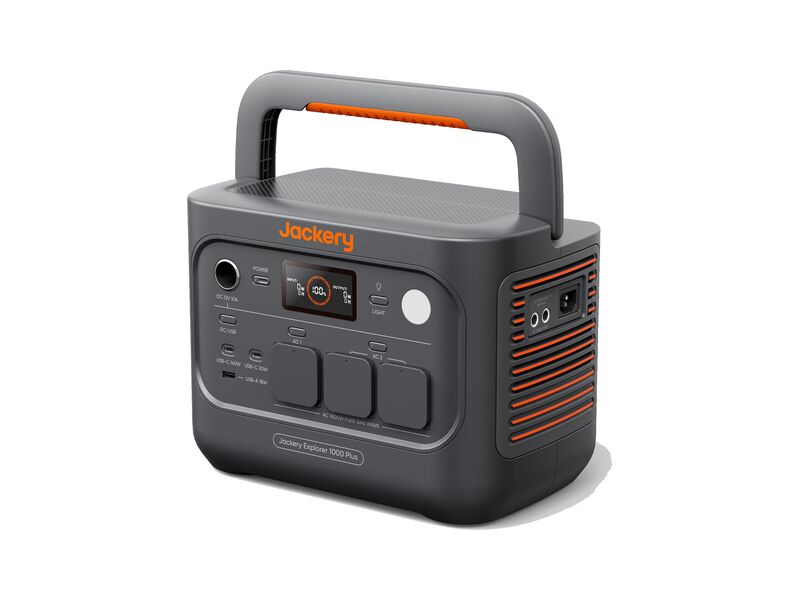
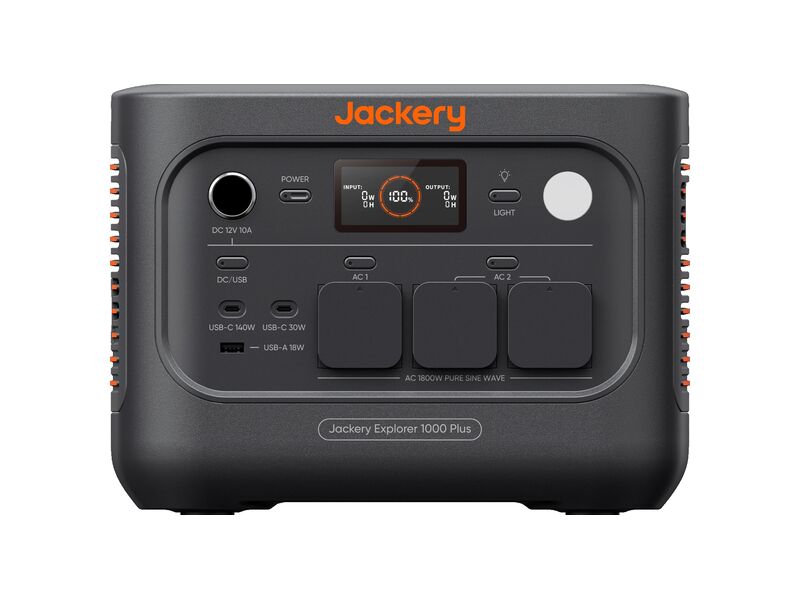
The Jackery Explorer 1000 Plus v2 is the brand's new one-kilowatt-hour portable power station, launched in Europe in mid-October 2026 as a 230 V, 50 Hz model. It succeeds the Explorer 1000 Plus with Jackery's CTB 2.0 structure, which makes it, according to the manufacturer, 44% smaller and 26% lighter: 23.8 lb (10.8 kg) for 12.3 x 7.9 x 9.2 in (313.5 x 201 x 233.5 mm), with a handle on the front to carry it one-handed.
Its 1024Wh LiFePO4 battery, built from ceramic-coated cells, is rated for 6000 cycles to 70% remaining capacity. The strength of this v2 is expansion: up to five Battery Pack 2000 Plus v2 batteries of 2048Wh connect to the expansion port and take the reserve to about 11 kWh. The manual recommends not stacking more than three batteries without an anti-tip fixing.
The pure sine wave inverter delivers 1800W continuous and 3600W peak, enough to run a kettle, a coffee maker, a small fridge or light tools. The three 230V outlets are split into two groups, AC 1 and AC 2, which you switch separately with the buttons or the app to set priorities when energy runs short. Two USB-C ports (140W and 30W), an 18W USB-A port and a 12V/10A socket complete the line-up.
For recharging, Jackery quotes a full charge from the wall in 1.25 hours at best, with an emergency mode that rises to about 1550W. The solar input accepts up to 400W through two DC8020 ports (16 to 60V), grid power and solar can be combined, and a vehicle's 12V socket serves as a top-up with a cable sold separately. A quiet charging mode keeps noise under 30 dB, at the cost of slower recharging. The station operates from 14 °F to 113 °F (-10 °C to 45 °C) for both charging and discharging.
During a power outage, the UPS function switches to battery in under 10 ms, enough to keep a router or a laptop running; the manual does however state that it does not provide the 0 ms transfer required by some servers or workstations. The Jackery app (Wi-Fi and Bluetooth) tracks the battery level, schedules charging times, offers an off-peak mode and an energy saving mode that cuts the outputs when consumption stays very low.
The limitations to know: the 400W solar input is lower than on several 1 kWh stations, the base capacity is more modest than the 1264Wh of the Explorer 1000 Plus, expansion batteries are sold separately, and the product, released only days ago, has not yet been independently measured. The warranty is 3 years, extended to 5 years with the 2-year extension. This is the European 230 V version: it is not sold in the US, where Jackery's 120 V sibling carries the HomePower 1000 Plus v2 name.
Full specifications
Detailed characteristics (EAN: 0810182245867)
Battery and capacity
| Rated capacity?Total stored energy in watt-hours. The higher the figure, the longer the runtime. | 1024 Wh |
|---|---|
| Max capacity (with extensions)?Total capacity reachable by adding extra batteries. | 11000 Wh |
| Expandable capacity?Whether capacity can be increased with add-on batteries. | Yes |
| Removable battery?The main battery can be removed or replaced by the user. | No |
| Battery chemistry?LiFePO4 (LFP) lasts far longer and is safer than NMC. | LFP (LiFePO4) |
| Charge cycles?Number of full charges before capacity drops to the stated threshold. | 6000 cycles (70 %) |
| Pack nominal voltage?Internal battery voltage; higher voltage helps deliver high power. | 51.2 V |
AC output
| Continuous AC power?Power the unit can sustain continuously on its 230 V outlets. | 1800 W |
|---|---|
| Surge power?Brief peak tolerated when starting motor or compressor devices. | 3600 W |
| Inverter type?A pure sine wave is essential for sensitive electronics and motors. | Pure sine wave |
| AC voltage / frequency?Voltage and frequency of the AC output (230 V / 50 Hz in Europe). | 230 V / 50 Hz |
| Number of 230 V AC outlets?Number of mains outlets available on the unit. | 3 |
| RV / TT-30 outlet?Dedicated 30 A outlet for North-American style RVs. | No |
Recharging
| Max AC charging power?Maximum power drawn from a wall socket; higher means faster charging. | 1550 W |
|---|---|
| AC charge 0-100%?Stated time for a full charge on mains power. | 75 min |
| Max solar input?Maximum solar power accepted at the input (PV panels). | 400 W |
| Accepted solar voltage?Panel voltage range compatible with the solar input. | 16 to 60 V |
| Max solar current?Maximum current accepted on the solar input. | 21 A |
| Vehicle charging (12/24 V)?Can be charged from a vehicle's cigarette-lighter socket. | Yes |
| Pass-through charging?The unit can power devices while charging (pass-through). | Yes |
Ports and connectors
| USB-C ports?Number of USB-C ports and the fastest port's power (laptops, phones). | 2 × 140 W |
|---|---|
| USB-A ports?Number of USB-A ports and maximum power (small devices). | 1 × 18 W |
| 12 V output (car socket)?12 V cigarette-lighter output and its power (coolers, pumps…). | Yes (120 W) |
| Other DC outputs?Additional DC connectors (Anderson, DC5521, XT60…). | Allume-cigare |
Portability
| Weight?Net weight of the unit, battery included. | 23.8 lb (10.8 kg) |
|---|---|
| Dimensions (L × W × H)?Overall size of the unit in millimetres. | 12.3 × 7.9 × 9.2 in (313.5 × 201 × 233.5 mm) |
| Form factor?Portable (hand-carried), transportable (heavy), or wheeled. | Portable |
| Wheels?Built-in wheels for moving the unit. | No |
| Telescopic handle?Retractable handle like a wheeled suitcase. | No |
Safety and environment
| Discharge temperature?Temperature range in which the unit can deliver power. | 14 to 113 °F (-10 to 45 °C) |
|---|---|
| Charge temperature?Temperature range in which the unit can be recharged. | 14 to 113 °F (-10 to 45 °C) |
Backup / UPS
| UPS / EPS mode?Automatic switch to battery on a mains outage (backup). | Yes |
|---|---|
| Switchover time (rated)?Delay before switching to battery; under 20 ms suits a PC or router. | 10 ms |
Noise and thermal
| Noise level (rated)?Manufacturer-stated noise; a quiet room is around 30 dB. | 30 dB(A) |
|---|---|
| Quiet mode?Setting that limits fan noise, often by capping charge power. | Yes |
Display and connectivity
| Display?Type of screen showing power, runtime and alerts. | LCD |
|---|---|
| Bluetooth?Bluetooth link for nearby control. | Yes |
| Wi-Fi?Wi-Fi connection for remote control and monitoring. | Yes |
| Mobile app?iOS / Android app to control the unit. | Yes |
| Solar connector?Connector type of the solar input (XT60, Anderson, MC4…). | DC8020 |
Availability and warranty
| Market launch?Date the model first became available on the European market. Useful to place its generation: technology moves fast in this segment, and a device several years old may be at the end of its commercial life. | October 2026 |
|---|---|
| Warranty?Length of the manufacturer's warranty. | 5 years |
⚡ How long will this power station run a device?
With 1 024 Wh, the Jackery Explorer 1000 Plus v2 external battery runs a fridge (50 W) for ~17h or an LED TV (90 W) for ~9h40.
| Home | Runtime |
|---|---|
| Freezer (60 W) | ~15h |
| Portable AC (1000 W) | ~50 min |
| Air fryer (1500 W) | ~35 min |
| Hair dryer (1800 W) | ~30 min |
| Outdoor & workshop | Runtime |
|---|---|
| Wi-Fi router (15 W) | ~58h |
| Laptop (60 W) | ~15h |
| E-bike (charging) (150 W) | ~5h50 |
| Sander (300 W) | ~2h55 |
Rough estimate: real consumption varies, and very power-hungry appliances (heating elements) must stay below the output power.
What is this power station best for?
-
Camping & Tent Ideal
At 23.8 lb (10.8 kg) with a handle on the front, the Explorer 1000 Plus v2 can be carried to the campsite in one hand and is one of the lightest in its class. Its 1800 W runs a kettle or a coffee maker, and its 1024 Wh is enough for a weekend of electric cooler, lighting and phone charging: Jackery quotes roughly 1 hour for an 850 W kettle and up to 19 hours for a 40 to 140 W cooler. The AC outlets are controlled by group from the buttons or the app, which avoids wasting energy on a forgotten appliance, and the quiet charging mode keeps noise under 30 dB. Two 200 W SolarSaga panels recharge it in about 3.8 hours according to Jackery, and capacity can be raised to 11 kWh for longer stays. One limit remains: without expansion, 1024 Wh will not cover several days of electric cooking.
-
Remote work Ideal
For a mobile workstation, the Explorer 1000 Plus v2 has headroom: its 1800 W powers a computer, monitor, printer and router without effort, and its 140 W USB-C port charges a demanding laptop directly, while the 30 W port looks after a phone or tablet. Its UPS function switches to battery in under 10 ms during a power outage, which is enough for a router or a laptop, but not for equipment that needs a 0 ms transfer: the manual names servers and workstations. In quiet charging mode, noise stays under 30 dB, pleasant next to a desk. At 23.8 lb (10.8 kg), it moves easily from the office to the backyard or the van. The energy saving mode, on by default, switches the outputs off after 12 hours of very low consumption: set it in the app for a router kept on backup for a long time.
-
Home & Power cuts Suitable
During a power outage, the Explorer 1000 Plus v2 takes over in under 10 ms according to Jackery and keeps the router, lighting and a small fridge running for many hours, its 1024 Wh being the main ceiling. The outlets can be prioritized from the app to reserve energy for essential appliances. Its real strength for the home is expansion: up to five Battery Pack 2000 Plus v2 batteries of 2048 Wh take the reserve to about 11 kWh. On its own, it suits short outages; for an outage lasting several days you will need at least one expansion battery or solar panels, whose input is capped at 400 W here.
-
Motorhome & Van life Suitable
In a van or RV, the Explorer 1000 Plus v2 slips into a locker or under a seat (12.3 x 7.9 x 9.2 in, 23.8 lb) and powers lighting, ventilation, device charging and light electric cooking with its 1800 W. It can recharge from the vehicle's 12 V socket with a cable sold separately, but at about 12 V/8 A that is a slow top-up. Solar, up to 400 W, remains the real autonomy solution. To keep a compressor fridge running for several days you will want to add an expansion battery; for a very power-hungry stay, a larger station will be more comfortable.
-
Job site & Tools Suitable
On a job site or in a workshop without grid power, its 1800 W (3600 W surge) starts a drill, a screwdriver, a jigsaw or a small grinder, and the pure sine wave protects the tools' electronics. With 1024 Wh, Jackery estimates about 2 hours of running for a 400 to 800 W angle grinder: that is the limit of this version on its own, which suits short jobs or charging tool batteries rather than a day of heavy tools. The 23.8 lb (10.8 kg) makes it easy to move around, and an expansion battery extends the runtime.
-
Health & CPAP Suitable
For a CPAP machine, which commonly draws around twenty watts without a heated humidifier, the 1024 Wh offers in theory more than 40 hours, so several nights, and noise stays low in quiet charging. The UPS switchover announced at under 10 ms limits the risk of a break during sleep, but the manual rules out equipment that needs 0 ms. Remember to set the energy saving mode duration (12 hours by default) to avoid an automatic shutdown, and check compatibility with your provider for any medical device.
Our team's recommendations based on the model's capacity, output power and weight.
Comparison
At 1 kWh, how does the Explorer 1000 Plus v2 compare with three stations it is often set against, as in searches such as "Jackery 1000 Plus v2 vs EcoFlow Delta 3 Plus" or "Jackery 1000 Plus v2 vs Anker Solix C1000"? Here is its position against the EcoFlow Delta 3 Plus, the Anker Solix C1000 and the Bluetti Elite 100 V2.
| Criterion | Jackery Explorer 1000 Plus v2 | EcoFlow Delta 3 Plus | Anker Solix C1000 | Bluetti Elite 100 V2 |
|---|---|---|---|---|
| Capacity | 1024Wh | 1024Wh | 1024Wh | 1024Wh |
| Continuous / peak power | 1800W / 3600W | 1800W / 3600W | 2000W / 3000W | 1800W / 3600W |
| Maximum capacity with expansion | 11 kWh | 5.12 kWh | Not expandable | Not expandable |
| Battery life (LiFePO4) | 6000 cycles to 70% | 4000 cycles to 80% | 4000 cycles to 80% | 4000 cycles to 80% |
| Max solar input | 400W | 1000W | 600W | 1000W |
| Weight | 23.8 lb (10.8 kg) | 27.6 lb (12.5 kg) | 24.9 lb (11.3 kg) | 25.4 lb (11.5 kg) |
| Observed price | Not sold in the US | ≈ $550 | ≈ $500 | ≈ $489 |
The Explorer 1000 Plus v2 is the lightest of the group (23.8 lb), the only one rated for 6000 cycles and the one whose capacity climbs highest (11 kWh, against 5.12 kWh for the Delta 3 Plus). It gives ground on solar input (400W, against 600 to 1000W). On price there is nothing to compare in the US: it is a 230 V European model with no US listing, while the three rivals sell for roughly $489 to $550. The Anker Solix C1000 offers 200W more output. For anyone who wants to start at 1 kWh and then grow with batteries, the Jackery is the most scalable.
Related video
Video: JACKERY Explorer 2000 Plus V2 VS Explorer 1000 Plus V2 - Which One is Best for You? - Published on 14/10/2026
Our tester's review: Christophe Delpuech
We have not had the Explorer 1000 Plus v2 in hand and no independent test has been published so far: this review is based on the manufacturer's spec sheet and manual. On paper, it is a well-judged evolution: 23.8 lb for 1024Wh, a handle to carry it one-handed, AC outlets whose priority you set from the app or the buttons, and a capacity that can grow to 11 kWh with expansion batteries. The announced sub-10 ms UPS switchover and the 6000 cycles to 70% are good arguments for backup use. The reservations are clear: a product released only days ago, so no track record on reliability, real recharge times or noise at fast charging; a solar input limited to 400W when several rivals accept 1000W; a manual that advises against the UPS for equipment needing 0 ms; and launch prices that may move. A serious candidate for camping and short outages, to be confirmed by independent measurements. It is a 230 V European model, not sold in the US.
Frequently asked questions: Jackery Explorer 1000 Plus v2 - photo 2
Yes, with up to five Battery Pack 2000 Plus v2 batteries of 2048Wh, which takes the whole system to about 11 kWh. Switch off all appliances before connecting the expansion cable, and do not stack more than three batteries without an anti-tip fixing, according to the manual.
Yes: plugged into the wall, it switches to battery in under 10 ms during an outage, which is enough for a router or a laptop. The manual states that it does not provide the 0 ms transfer required by some servers or workstations.
It has two DC8020 inputs (16 to 60V) for 400W in total. Jackery recommends its SolarSaga 100 Air and 200W panels, with the same model on both inputs, and quotes about 3.8 hours to charge with two 200W panels. Jackery accepts no responsibility with third-party panels.
Its 1800W covers a kettle, a coffee maker, a small fridge or light tools. Jackery quotes about 1 hour for an 850W kettle, 8 hours for a 100W projector and up to 19 hours for a 40 to 140W electric cooler, on its 1024Wh battery alone.
According to Jackery, it is 44% smaller and 26% lighter thanks to the CTB 2.0 structure. It does go from 1264Wh and 2000W down to 1024Wh and 1800W, while quoting 6000 cycles and expansion up to 11 kWh.
Not at the moment. It is a 230 V, 50 Hz European model, and Jackery's US store does not list it under this name. The US store sells a 120 V sibling called HomePower 1000 Plus v2 with the same 1800W rating and 11 kWh expansion ceiling. The price shown here is converted from the European price, not a US offer.
Need help choosing?
Other products in the "Versatile power stations" category
Aferiy P010
See price (3)
512Wh and 800W (1600W surge) in a 14.3 lb (6.5 kg)/14.3lb frame, UL/FCC/PSE certified for the US market, backed by up to a 7 year Aferiy warranty.
Aferiy P180
See price (7)
1024Wh expandable up to 5120Wh, 1800W (3600W peak) across four AC outlets, UL listed and under 30dB: the Aferiy P180 aims for quiet, flexible backup.
Aferiy P210
See price (7)
With 2048 Wh, 2400 W (up to 4800 W peak), a LiFePO4 battery and a 7-year warranty, the Aferiy P210 targets the best capacity-to-price ratio on the market.
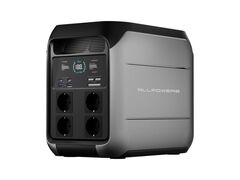
Allpowers P1800
$439.00 (6)
A 1 kWh LiFePO4 power station with plenty of punch, fast wall-outlet recharging and quiet running: a smart pick for camper vans, camping and power outages.
Published on 20/10/2026